Bettors on Polymarket are now pricing a 61% chance that the Digital Asset Market Clarity Act will be signed into law in 2026, following a bipartisan agreement that resolves a central dispute in the bill.
The shift marks a 15% increase in a single day, with trading volume on the platform surpassing 600,000 since the January 2026 launch, as sentiment turned sharply after news of the deal.
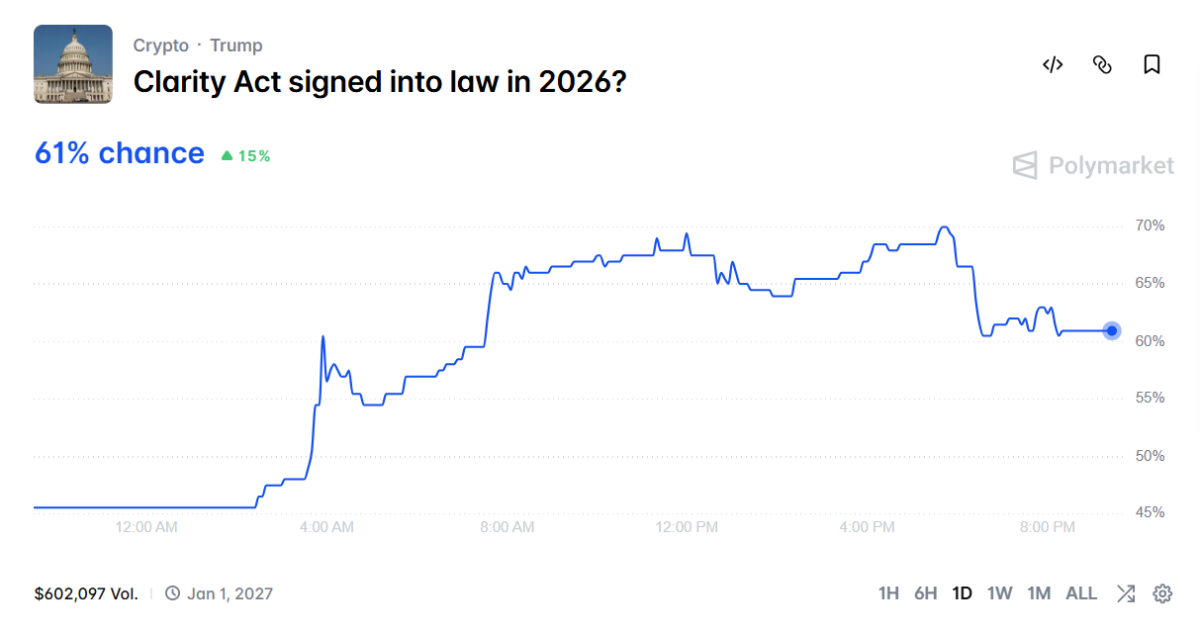
The change in odds reflects renewed expectations that the legislation, commonly referred to as the CLARITY Act, can advance in the U.S. Senate after months of stalled negotiations.
Stablecoin compromise breaks core deadlock
The breakthrough centers on a compromise between Thom Tillis and Angela Alsobrooks over how stablecoin rewards should be treated under the law. Banks had pushed for a full ban on yield-bearing stablecoins, arguing such products could pull deposits away from traditional institutions. Crypto firms, including Coinbase, opposed a blanket restriction.
The agreed language introduces limits on rewards that resemble interest paid on bank deposits, while allowing incentives tied to platform activity such as payments and transactions.
Market reaction mirrors policy momentum
Prediction markets often react quickly to political developments, and the move on Polymarket suggests traders see the compromise as removing the biggest barrier to progress.
The stablecoin provision had previously derailed a planned committee markup earlier this year. With that issue addressed, attention has shifted to scheduling the next step in the legislative process. Public comments from lawmakers and industry participants following the agreement indicate that negotiations have narrowed, even as some provisions remain under discussion.
Why the yield issue mattered
The debate over stablecoin rewards has been a focal point because of its potential impact on both banks and crypto firms.
For exchanges like Coinbase, revenue tied to stablecoin-related activity represents a meaningful share of earnings. At the same time, banking groups have argued that offering yield-like incentives could alter deposit flows. A review cited by policymakers found limited evidence that such products significantly affect bank deposits, though the issue has remained politically sensitive.
Faryar Shirzad, Chief Policy Officer of Coinbase, commented on the development in an X post, stating, “The final rewards text in the CLARITY Act is now public. We’ve been clear throughout this process: much of this debate was based on imagined risks, not real evidence, nor was it based on a real understanding of how crypto actually works.”
He added, “In the end, the banks were able to get more restrictions on rewards, but we protected what matters – the ability for Americans to earn rewards, based on real usage of crypto platforms and networks. We also ensured the US can be at the forefront of the financial system – which in this competitive geopolitical era is paramount.”
What comes next for the CLARITY Act
The compromise clears a major procedural hurdle, but the bill still faces additional steps before a final vote. Lawmakers are expected to move toward a Senate Banking Committee markup, with timing dependent on finalizing remaining provisions. These include questions around ethics rules and legal protections tied to decentralized technologies.
Even with those outstanding issues, the shift in Polymarket odds suggests expectations have moved decisively toward passage, at least compared with earlier in the year.
Also Read: Trump’s WLFI Under Fire: $550M Raised, Investors Trapped as 5.9B Tokens Sold