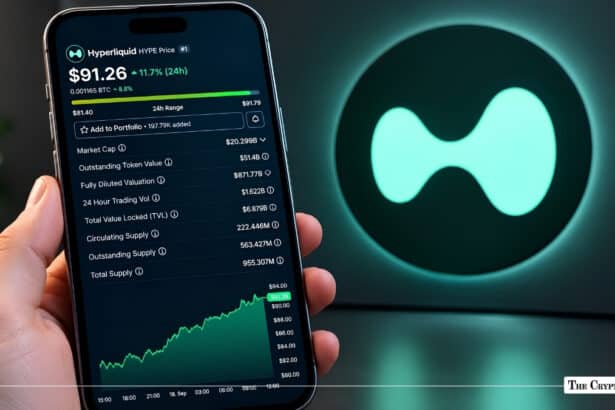
Hyperliquid, the high-speed decentralized perpetuals exchange that has dominated on-chain derivatives trading, flipped the switch on its long-awaited outcome contracts Saturday.
With the mainnet deployment of HIP-4, the platform now offers binary event markets that settle at 0 or 1, directly challenging established players like Polymarket in one of crypto’s fastest-growing sectors.
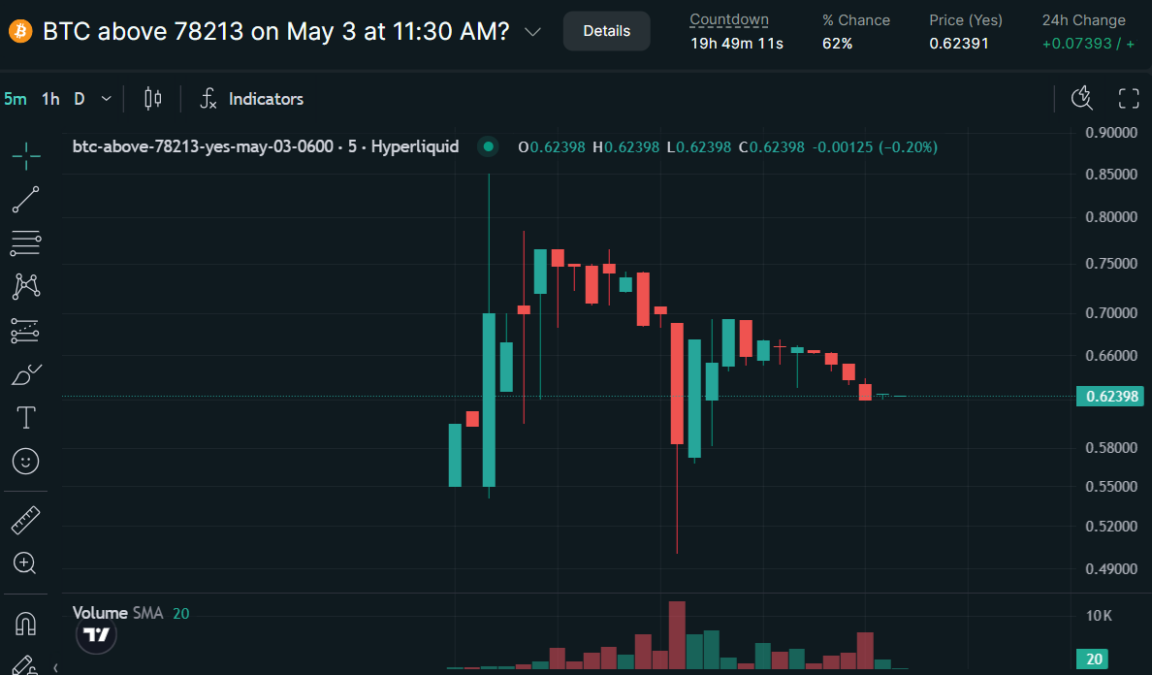
As the first outcome, Hyperliquid had listed the Bitcoin market—“BTC above 78213 on May 3 at 8:00 AM?” Early data showed modest but real activity, roughly $59,500 in 24-hour volume and $84,600 in open interest, with the “Yes” side trading around 63% probability.
Originally launched as a decentralized perpetual (perp DEX) platform, Hyperliquid quickly became a hub for decentralized trading, especially after the introduction of HIP-3 markets.
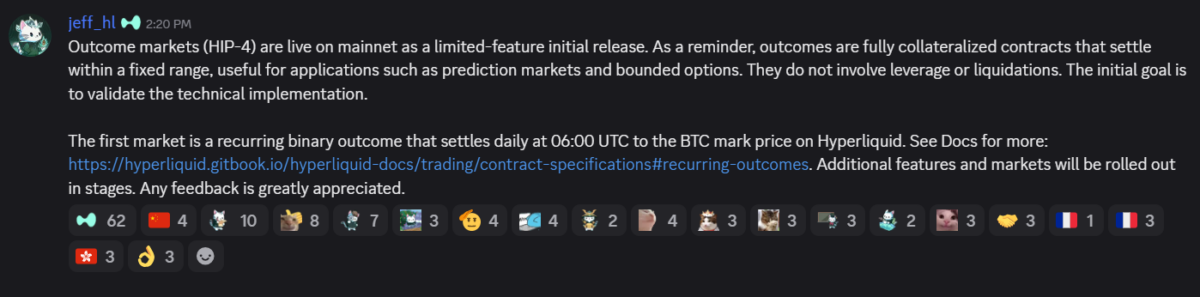
Jeff Yan, founder of Hyperliquid, announced the launch on project’s Discord channel, noting, “additional features and markets will be rolled out in stages.”
From testnet to trading floor
Hyperliquid first teased outcome trading in February when it dropped HIP-4 on testnet. The feature introduces fully collateralized, expiry-dated contracts that function like simplified binary options.
Traders buy “Yes” or “No” shares that pay out in the platform’s native stablecoin, USDH. Unlike perpetual futures, there is no leverage and no liquidation risk—the contracts simply resolve based on oracle prices at a set time.
The rollout follows a two-phase plan, with the unveiling of curated canonical markets first, followed by permissionless deployment for builders. Early markets appear focused on short-term crypto price thresholds, including Bitcoin and the platform’s own HYPE token. This integration lets users hold outcome positions alongside perps and spot trades in a single margin account, a structural advantage over standalone prediction platforms.
Hyperliquid’s move arrives weeks after Binance integrated prediction markets into its wallet through Predict.fun, signaling big centralized players are eyeing the same turf.
Polymarket Vs Hyperliquid: Is there even a comparison?
Hyperliquid enters the prediction market space with distinct structural advantages that could help it carve out meaningful share. By embedding binary outcome contracts directly into its existing perpetuals and spot trading platform, users benefit from a single margin account, unified liquidity, and seamless switching between perps and events.
The perp DEX’s zero-fee model on position opening and deep existing liquidity give it a technical edge that standalone platforms like Polymarket cannot match. This composability, combined with its already massive user base in derivatives, positions Hyperliquid to attract high-frequency traders and bots who value speed and capital efficiency.
However, significant challenges remain. Early volume for binary markets on Hyperliquid is expected to remain modest and dwarfed in comparison with Polymarket’s established liquidity and politically driven markets.
In addition, potential user-experience hurdles and question whether oracle-based short-term crypto price binaries can draw the same depth and engagement as Polymarket’s broader, more diverse event offerings.
For Hyperliquid to truly compete, it will need to rapidly expand market variety, grow open interest, and prove it can convert its derivatives dominance into sustained prediction market activity in the coming weeks.
A recent report from TRM Labs revealed that monthly prediction market volume exploded to $20 billion in 2026 so far. In this domain, Polymarket remains the clear leader but the field is now getting crowded.
Unlike Polymarket’s share-based system with fees on winners, Hyperliquid is experimenting with zero fees on opening positions—costs only apply on close or settlement. That structure could attract high-frequency traders and bots already active across both platforms.
Technical edge and token impact
Hyperliquid built its reputation on raw performance while offering features such as sub-millisecond execution, deep liquidity in perpetuals, and a unified engine that now powers outcomes too. This addition gives it an edge in composability that pure prediction platforms lack.
HYPE, the platform’s token, reacted positively in early trading, rising around 3% near $41—as per CoinMarketCap data. The token benefits from fee buybacks and broader activity across the ecosystem, giving holders indirect exposure to prediction market growth—something neither Polymarket nor Kalshi currently offers.
For now, activity on this newly launched feature remains small compared with Hyperliquid’s massive perpetuals business, which routinely posts billions in open interest. But the launch marks a strategic pivot.
By embedding prediction markets inside its core trading venue, Hyperliquid is betting that users want one account, one margin pool, and seamless switching between directional bets and event contracts.
Traders on X were quick to test the waters, with some posting screenshots of small positions and others joking about farming HIP-4 volume for fee-tier benefits on the perps side. Skeptics pointed to user-experience hurdles and questioned whether oracle-driven short-term markets will draw enough liquidity to compete with Polymarket’s deep, politically flavored books.
The next few weeks will reveal whether Hyperliquid can convert its derivatives dominance into meaningful prediction market share. If early BTC binary contracts gain traction, expect more assets, longer timeframes, and permissionless market creation.
Also read: Paradigm Researcher Proposes Quantum Bitcoin Escape Hatch