Key Highlights
- The CLARITY Act’s developer safe harbor lives in Section 604, which folds in the Blockchain Regulatory Certainty Act (BRCA).
- The entire bargain now hinges on 18 U.S.C. § 1960, the federal criminal statute for unlicensed money transmission.
- Senate Judiciary Chairman Chuck Grassley and Senator Dick Durbin have already objected to the provision, and a narrowed compromise could leave developers with thinner protection than the industry wants.
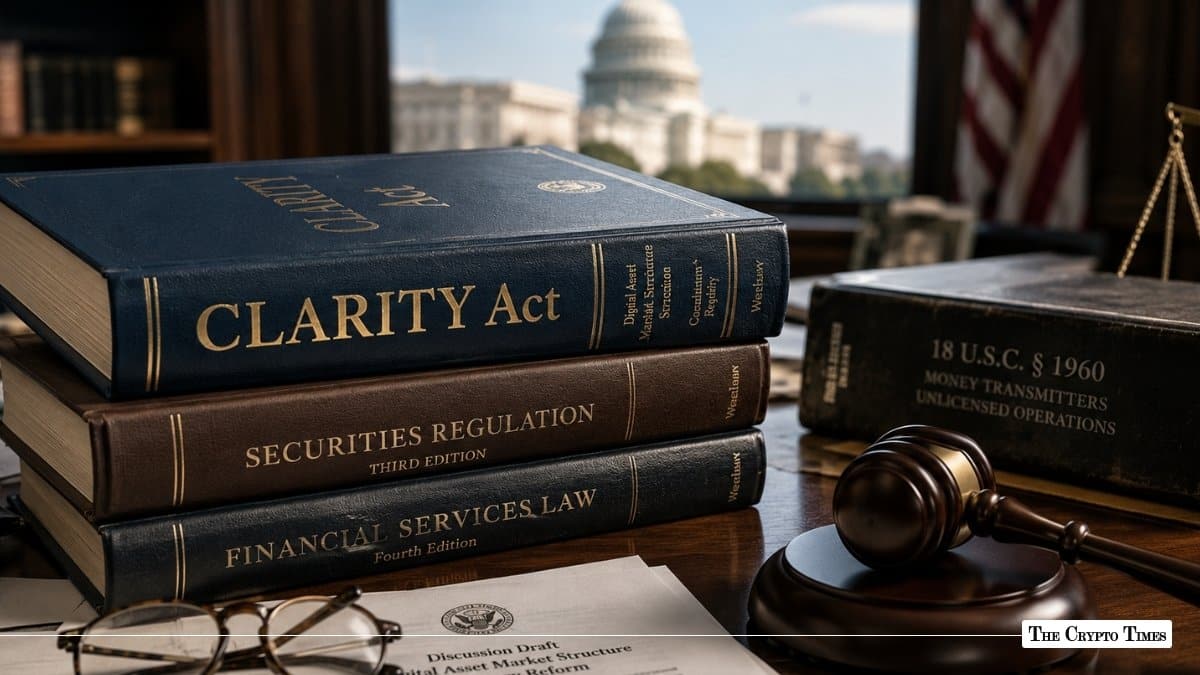
For years, building open-source crypto in the United States has meant working with one eye on the courtroom. Publish a wallet, run a node, or maintain a DeFi protocol, and you could in theory be accused of operating an unlicensed money-transmitting business — a federal crime. The Digital Asset Market Clarity Act of 2025 (H.R. 3633), better known as the CLARITY Act, was supposed to end that anxiety.
On May 14, 2026, the Senate Banking Committee advanced the bill in a 15-9 bipartisan vote, sending the first comprehensive Senate crypto market-structure bill to the floor. Two Democrats — Senators Angela Alsobrooks of Maryland and Ruben Gallego of Arizona — crossed over to join Republicans, and Committee Chairman Tim Scott called the markup a historic step after nearly a year of negotiations.
Lost in the celebratory headlines, though, is a more complicated truth: the most important protection in the bill for developers is also its most contested, and the fight over it is far from settled.
Where the Protection Actually Lives
The draft most observers point to as the developer “win” is the Blockchain Regulatory Certainty Act, which the CLARITY Act incorporates in Section 604. The BRCA is not a new idea — it is a long-standing effort championed by Rep. Tom Emmer, with a Senate companion introduced in January by Senators Cynthia Lummis and Ron Wyden. After years stalled on its own, it finally found a vehicle inside the larger market-structure package.
The core principle is simple: if you build software and never touch anyone’s money, you should not be regulated like a bank. Section 604 creates a federal safe harbor from money-services-business registration under 31 U.S.C. § 5330 and from criminal money-transmission prosecution under 18 U.S.C. § 1960 — but only for “non-controlling” developers.
The Senate Banking draft defines a non-controlling developer or provider as one who, in the regular course of operations, lacks the legal right or unilateral ability to control, initiate, or carry out transactions involving user assets without another party’s approval. Under that language, such a party would not be treated as a money transmitter solely because they create software, provide self-custody tools, or support blockchain infrastructure.
Elsewhere in the bill, Section 601 carves DeFi software development out of Securities and Exchange Commission (SEC) registration requirements (with parallel provisions in the Senate Agriculture Committee’s companion text addressing Commodity Futures Trading Commission (CFTC) aspects), as long as the participant is not performing traditional intermediary functions like holding customer assets or running a centralized exchange. Together, these provisions form the legal cover DeFi builders have been seeking for years.
But here is the first reality check the early drafts circulating online tend to skip: the shield is not blanket. The protection applies most directly to developers who build neutral tools without managing user funds. Front-end operators and DAOs that collect fees may still face registration obligations, and states retain full authority over anti-money-laundering, anti-fraud, and anti-manipulation enforcement. The safe harbor is real, but it is narrow by design.
The Statute That Could Decide Everything
The fault line runs through one provision: 18 U.S.C. § 1960, the federal criminal statute covering unlicensed money-transmitting businesses. And it is a criminal statute, not merely a regulatory classification — which is exactly what makes any safe harbor around it politically radioactive.
White House digital-assets adviser Patrick Witt described Section 1960 in early May as the “final hurdle” for the CLARITY Act, predicting the issue would be resolved “very soon.” Witt argued the developer protections are essential to bringing builders back onshore, noting that only about 19% of crypto developers are currently based in the United States.
That figure captures the industry’s whole pitch: certainty keeps talent at home. But law-enforcement-focused lawmakers see the same language and worry about a loophole. They want assurance that a developer safe harbor will not block prosecutors from pursuing people who use “I just wrote code” as cover for moving illicit funds.
The independent analysis bears out their concern about scope. According to a section-by-section reading from blockchain-intelligence firm TRM Labs, Section 604 preserves the criminal carve-out under 18 U.S.C. § 1960(b)(1)(C) — leaving intact the prosecutorial basis used in cases against operators who knowingly facilitate the transfer of criminal proceeds. In other words, the bill as written already tries to thread the needle: protect the neutral builder, keep the bad actor exposed.
The backdrop makes the stakes concrete. In August 2025, the Justice Department secured a conviction against Tornado Cash co-founder Roman Storm on a charge of conspiracy to operate an unlicensed money-transmitting business. For developers, that case is the nightmare scenario the BRCA is meant to address — and for prosecutors, it is precisely the kind of action they do not want a new safe harbor to foreclose.
Grassley and Durbin Enter the Picture
This is where the exclusive story sits — and where the optimistic drafts go quiet. The CLARITY Act’s developer protections have already drawn formal pushback from the one committee with jurisdiction over the criminal code.
Senate Judiciary Chairman Chuck Grassley and Senator Dick Durbin sent a joint letter in January to Senate Banking leaders objecting to the BRCA’s inclusion in the market-structure package, arguing that the provision modifies Title 18 of the U.S. Code — including Section 1960. The two senators opposed placing crypto developer protections inside a market-structure bill at all, citing criminal-enforcement concerns.
That objection is not trivia. Because Grassley chairs Judiciary, his review carries real weight over any language touching the criminal code. If Judiciary lawmakers press for narrower wording, DeFi developers could end up with materially less protection than the industry has been promised. If a compromise holds, the bill could preserve a safe harbor for non-controlling developers while still excluding those who knowingly facilitate money laundering.
Reporting indicates negotiators have been working toward language that would deny the safe harbor to developers who knowingly assist illicit finance — a claim that should be attributed to the negotiation reporting rather than treated as confirmed bill text until Grassley’s office or Judiciary says so directly. The exact wording, in other words, is still live.
Why “Era of Fear Is Over” Is Premature
It is tempting to write that the CLARITY Act ends a decade of legal limbo for builders. The more accurate framing is that it offers the strongest developer safe harbor ever drafted — conditioned on a definition of “non-controlling” that is still being negotiated, and bounded by a criminal carve-out that deliberately keeps the door open for prosecutions.
There is also a long road left. Committee passage is not law. The bill must still be merged with the Senate Agriculture Committee’s CFTC-related provisions, survive a 60-vote floor threshold, and then be reconciled with the House-passed version in conference before reaching the president’s desk. Republicans hold 53 Senate seats, so passage will require sustained Democratic crossover — and several Democrats have reserved judgment over law-enforcement and ethics provisions.
For developers reading this in the hope of a green light, the honest answer is: not yet, and not unconditionally. The protections that emerge will be only as strong as the final Section 1960 language — and that language is being written under pressure from the very committee that polices the federal criminal code.
The CLARITY Act may still become the most builder-friendly crypto law the United States has passed. But whether it actually shields the open-source developer, or merely appears to, now comes down to a single statute and a single chairman’s review.
Also Read: Crypto Rules Diverge: U.S. Seeks Clarity, Europe Chooses Uniform Control