Key Highlights
- The Linux Foundation has officially launched the x402 Foundation under an open governance model.
- Coinbase has contributed the x402 protocol as the foundation’s core payment standard.
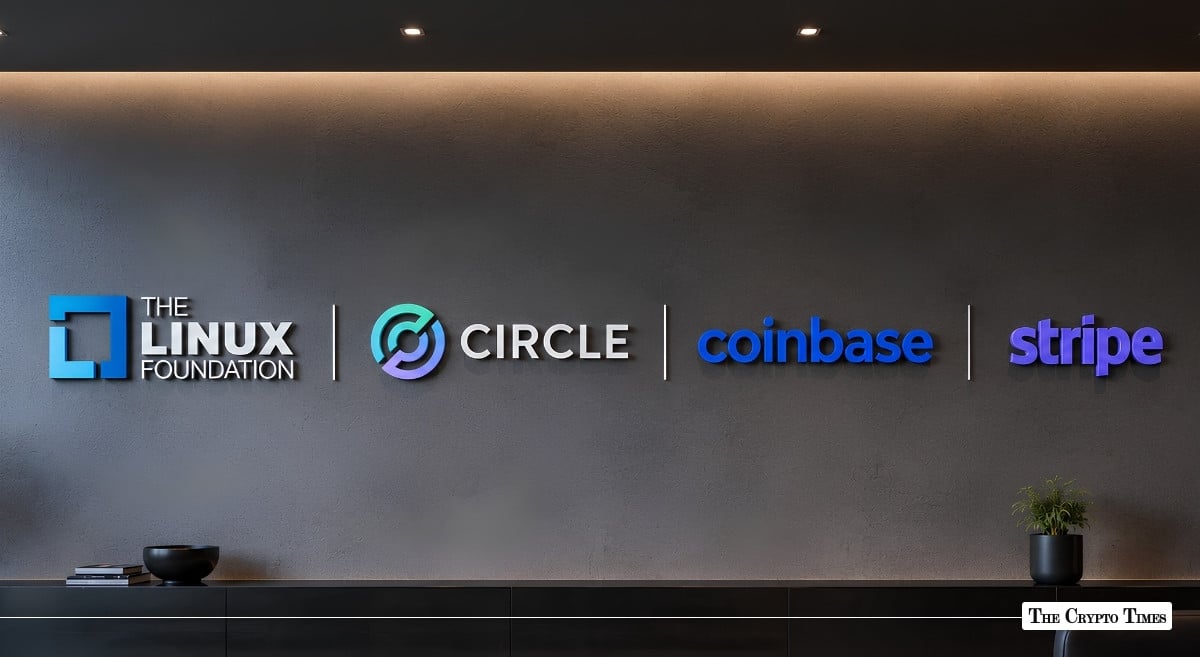
- Circle, Stripe, Amazon Web Services, Google, Mastercard, Visa, Ripple, Shopify, and the Solana Foundation are among the premier members.
The Linux Foundation, a global open-source organization, has officially launched the x402 Foundation, a new open-governance initiative designed to establish a universal payment standard for AI agents, APIs, and internet applications.
According to the official announcement, the launch follows Coinbase’s contribution of the x402 protocol, which embeds payment functionality directly into HTTP. The move allows software agents and applications to exchange value as seamlessly as they exchange data.
The foundation brings together 40 organizations spanning payments, cloud infrastructure, stablecoins, blockchain, and financial services to develop the protocol under vendor-neutral governance. Premier members include Circle, Coinbase, Stripe, Amazon Web Services (AWS), Google, Mastercard, Visa, Ripple, Shopify, Solana Foundation, MoonPay, Adyen, and Stellar Development Foundation, among others.
A payment layer for the AI economy
The x402 protocol aims to address one of the key challenges facing AI-powered applications: enabling autonomous software to pay for digital services without relying on traditional payment workflows. Rather than building proprietary payment systems, the foundation seeks to establish an open internet standard that supports multiple payment methods, including credit cards and regulated stablecoins.
Linux Foundation Executive Director Jim Zemlin said AI systems are increasingly becoming participants in the global economy but still lack native payment infrastructure. He said, “AI agents and automated systems are becoming active participants in the global economy, yet they have lacked a native, secure way to transact.”
He added that the operational launch of the x402 Foundation represents a significant step toward creating an open, community-governed standard for payments over HTTP.
According to the Linux Foundation, the protocol is intended to keep the internet’s payment infrastructure open, interoperable, and free from vendor lock-in as AI adoption accelerates.
Circle sees USDC at the center of agentic commerce
Among the foundation’s most prominent members is Circle, which said the protocol aligns closely with its long-term vision for programmable internet payments.
Gagan Mac, Vice President of Circle’s Arc Platform, said x402 allows payments to become a native part of internet communication. “At Circle, we’re building the open financial stack for the agentic economy,” he said. He added that AI agents can already communicate through HTTP, while x402 enables them to pay for services within the same request-response cycle.
Circle also announced that it has joined the foundation as a premier member and will help advance USDC as one of the settlement assets powering the protocol.
Coinbase hands protocol to community governance
The x402 protocol originated inside Coinbase, which developed the standard before transferring stewardship to the Linux Foundation.
Lincoln Murr, Coinbase’s Head of AI Product, said moving the protocol into neutral governance was essential for industry-wide adoption. He said, “x402 was started at Coinbase to solve a real problem – AI agents had no native, interoperable way to pay for the things they needed to do.”
He added that transferring the protocol to the Linux Foundation is how open technologies earn lasting trust across an industry.
Stripe, Visa, Mastercard, and AWS join the initiative
Several of the world’s largest payment and technology companies also highlighted the importance of open payment infrastructure for AI. Stripe said it sees AI becoming an active participant in online commerce.
Meanwhile, Visa described interoperability as essential for the future of agentic commerce. “Commerce will not run on a single agent, protocol, or payment method.”
Mastercard said trusted standards will be necessary as AI systems increasingly conduct transactions independently. “As people and businesses increasingly use AI agents to get work done, internet-native payments will need the same secure, trusted, and interoperable foundation that powers digital commerce today.”
Meanwhile, AWS argued that agentic commerce requires open standards that allow businesses to maintain control while enabling secure machine-to-machine payments.
Builds on earlier stablecoin expansion
The x402 initiative adds another layer to Circle’s broader strategy of expanding USDC beyond crypto trading into global payment infrastructure.
Earlier this month, Circle Mint France expanded support for automated USDC and EURC payouts across more than 180 countries, enabling businesses to manage compliant cross-border payments through a single API.
Circle has likewise expanded partnerships with major financial institutions, including JCB, which recently signed a memorandum of understanding to explore stablecoin-powered cross-border treasury operations and merchant payments using Circle’s infrastructure.
Open standards become the next focus
The launch of the x402 Foundation reflects how competition is shifting beyond individual stablecoins and payment products toward the underlying standards that could power AI-driven commerce.
With backing from global payment networks, cloud providers, stablecoin issuers, and blockchain ecosystems, the Linux Foundation hopes x402 will become the common payment language for autonomous internet services.
As AI agents increasingly interact with APIs, software platforms, and financial services, the companies behind x402 believe open, programmable payment infrastructure will become as fundamental to the internet as HTTP itself.
Also Read: UK, US Unveil Joint Stablecoin Framework for Cross-Border Payments