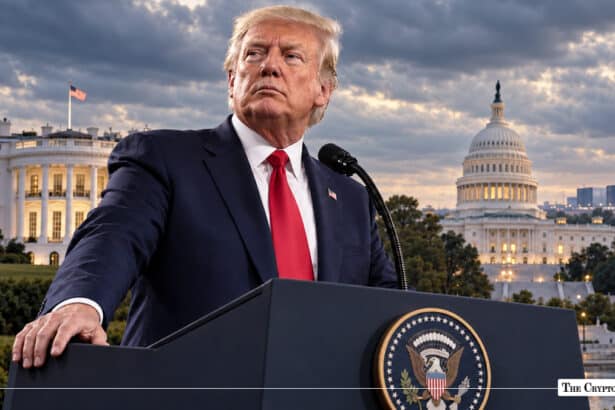
The U.S. President Donald Trump earned more than $635 million from his $TRUMP memecoin last year, according to his annual financial disclosure—a sum that dwarfs the Bitcoin he holds and underscores that his crypto fortune flows from his brand, not from betting on the market.
The memecoin that outearned his portfolio
The figure, disclosed Tuesday in a filing released by the U.S. Office of Government Ethics, was the single largest crypto line item in the president’s 2025 income. The roughly $635 million came almost entirely from royalties tied to a licensing agreement, rather than from Trump buying and selling the token himself. The $TRUMP coin launched on the Solana network days before he retook office in January 2025, and its structure funnels a share of activity back to Trump-linked entities as licensing revenue.
That distinction matters. A memecoin typically carries no underlying business, cash flow, or utility; its value rests on attention and speculation. What made $TRUMP extraordinarily lucrative for the president was not any appreciation he captured as a holder but the licensing arrangement that paid him regardless of where the token traded—turning his name itself into the revenue-generating asset. For most of the year, that single arrangement out-earned every conventional investment in his disclosure.
The Bitcoin, by comparison
Against that backdrop, Trump’s actual crypto holdings look modest. The filing lists his Bitcoin position at more than $50 million, the top band in the disclosure’s reporting structure. Because federal ethics filings report values in ranges rather than exact amounts, the precise size is not specified, but the memecoin’s $635 million haul is more than ten times the floor of that Bitcoin holding.
Bitcoin is held through DT Marks DeFi LLC, a Trump Organization-affiliated entity that holds the family’s stake in World Liberty Financial, alongside a large Ether position, smaller amounts of USDC and other tokens, and cold-wallet holdings tied to World Liberty spanning assets like LINK, AAVE, ENA, MOVE, and ONDO. The direct Bitcoin position is itself notable, since for most of his ascent as a crypto figure, Trump’s wealth came from ventures bearing his name rather than from holding major assets. But the comparison is stark: the coin he licensed made him far more than the coins he owns.
A fortune built on the brand
The pattern extends across the disclosure. Beyond the memecoin, the filing reports more than $500 million from token sales connected to World Liberty Financial, the family’s decentralized-finance and stablecoin venture, plus roughly $65.6 million from selling equity in the company’s holding entity. Together, the document details crypto income exceeding $1 billion for the year, though tallies range from about $1.2 billion to $1.4 billion depending on which items are counted—figures that build on a Reuters analysis estimating the Trump family earned around $2.3 billion across four crypto ventures since his second term began.
Almost none of it came from holding crypto as an investment. The memecoin royalties, the World Liberty token sales, and the equity each monetize the Trump name and network rather than a bet on prices, which is why his crypto income climbed even as Bitcoin fell roughly 50% from its late-2025 peak and much of the industry slid into a downturn. The 927-page disclosure, against former President Barack Obama’s final eight-page filing and former President Joe Biden’s 11, is itself a measure of how much that machinery has grown.
The scrutiny the scale invites
The numbers land in the middle of an unresolved political fight. Trump’s crypto ventures have drawn sustained conflict-of-interest concerns, and those concerns are one of the two central obstacles stalling the CLARITY Act in the Senate. Democrats, including Ruben Gallego and Cory Booker, have made ethics provisions—barring the president and his family from crypto businesses—a condition of their support, and Senator Elizabeth Warren has urged the SEC to investigate World Liberty Financial over potential securities and conflict issues.
The Trump side has rejected that framing; the memecoin’s promotional materials described it as a collectible rather than an investment, and World Liberty Financial has pushed back against conflict allegations as it pursues a national trust-bank charter. White House spokespeople did not immediately respond to requests for comment on the disclosure. What the filing establishes beyond dispute is the shape of the fortune: a president whose largest crypto payday came not from the assets the industry trades, but from selling his own name back to it.