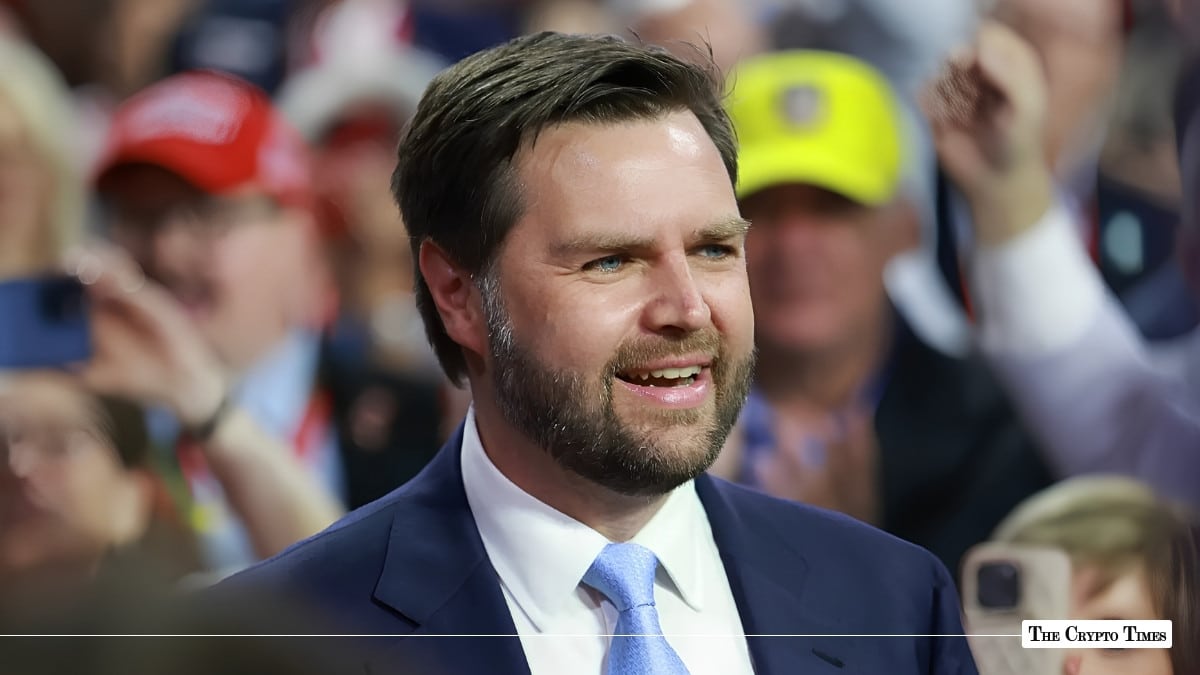
Bitcoin has a foothold at the very top of the US government. According to his latest annual financial disclosure, filed on an OGE Form 278e, Vice President JD Vance holds between $250,001 and $500,000 in Bitcoin. The holding represents a modest but symbolically potent position that gives the nation’s second-ranking official direct skin in the game as his administration executes one of the most aggressively pro-crypto agendas in U.S. financial history.
The holding, listed under “Other Assets and Income,” generated no reportable income during the period. As is standard for senior officials, the disclosure reports value in broad brackets, meaning it does not reveal exactly how much Bitcoin Vance owns, when he bought it, or its precise current value.
A telling detail sits just a few lines above the Bitcoin entry: Vance holds the SPDR Gold Trust (GLD) in the very same $250,000 to $500,000 range. In other words, the vice president owns roughly as much “digital gold” as he does the physical kind; a neat encapsulation of Bitcoin’s arrival as a mainstream store-of-value asset alongside the oldest one there is.
A steady Bitcoin bet
Vance’s crypto conviction is not new; and the paper trail shows it has grown. As a Senate candidate in 2022, he disclosed Bitcoin worth $100,001 to $250,000. By his 2024 vice-presidential nominee filing, that range had climbed to $250,001 to $500,000, where it has now held for a second consecutive disclosure. In other words, his Bitcoin bracket has roughly doubled since he first entered federal politics.
He has never been shy about it. Speaking at the Bitcoin 2025 Conference in Las Vegas, Vance told the crowd he was one of the only candidates actually holding Bitcoin when he ran for Senate, and said he still owns a fair amount today. His exposure runs deeper than the coins themselves: through the Rise of the Rest Seed Fund, Vance is also invested in The Bitcoin Company, a startup focused on Bitcoin adoption.
The Trump contrast
Vance’s stake looks tiny beside the man at the top of the ticket. The same disclosure cycle showed President Donald Trump reporting more than $1 billion in crypto-related income for 2025, with public tallies ranging from roughly $1.2 billion to $1.4 billion. As The Crypto Times reported, the single largest line item was around $635 million in royalties from his $TRUMP memecoin — more than 10x the $50 million-plus in Bitcoin he holds — alongside over $500 million from World Liberty Financial token sales.
The two filings illustrate very different models of crypto exposure inside the executive branch. Trump’s is an active, nine-figure machine built on monetizing his own name, his branded coin out-earned the crypto he actually holds. Vance’s is a passive, custodial Bitcoin position on a regulated US exchange, representing a small slice of his net worth.
Vance’s broader financial picture
Bitcoin is far from Vance’s largest asset. His bestselling memoir Hillbilly Elegy remained his biggest private income source, generating between $1 million and $5 million in royalties. He also reported sizable positions, $1 million to $5 million each, in major ETFs including the Invesco QQQ Trust and the SPDR S&P 500 ETF held through Charles Schwab, along with venture-capital interests via Narya Capital, real estate in Washington, Ohio, and Kentucky, and liabilities including a mortgage and a Schwab line of credit. Independent reviews of the filing put his total assets somewhere between roughly $6 million and $22 million or more.
Why it matters for crypto
The optics are what make this more than a routine paperwork story. Vance holds Bitcoin directly while the administration he helps lead has established a Strategic Bitcoin Reserve, pushed the market-structure CLARITY Act toward passage, and reshaped the SEC and CFTC in a crypto-friendly direction. To supporters, that alignment is a feature: a vice president with personal conviction in Bitcoin, putting his own money where the policy is. To ethics watchdogs, it raises the familiar question of senior officials holding assets that stand to benefit from their own administration’s decisions, though Vance’s position is modest, long-held, fully disclosed, and custodial rather than tied to any crypto venture he controls.
Either way, the symbolism is hard to miss. A decade ago, the idea of a sitting US vice president disclosing a six-figure Bitcoin position would have been unthinkable. Today it is a line item in a routine federal form; a quiet marker of just how thoroughly digital assets have moved from the fringe into the corridors of American power.
Also Read: Circle (CRCL) Drops 16% After Major Coalition Unveils Open USD Rival