The blockchain landscape is filled with chains declaring themselves the fastest, and networks are routinely judged by their transactions-per-second (TPS) rates and cumulative transaction volumes. Analytics dashboards turn these numbers into public rankings that shape perceptions of scale and activity.
On one such platform, Token Terminal, Internet Computer (ICP) currently leads several of the longest-term tables, recording 449.5 billion transactions over three years—nearly half of the 919.9 billion tallied across all tracked layer-1 networks—and holding a 48.9% share. Its 365-day total stands at 144.0 billion, ahead of Solana’s 101.2 billion.
Sustained Lead in Multi-Year Metrics
Token Terminal calculates the Internet Computer figures by converting pre-aggregated average transactions-per-second statistics into daily totals. The daily average rate is multiplied by 86,400—the number of seconds in a day. This produces the large cumulative sums that appear on the project’s explorer page.
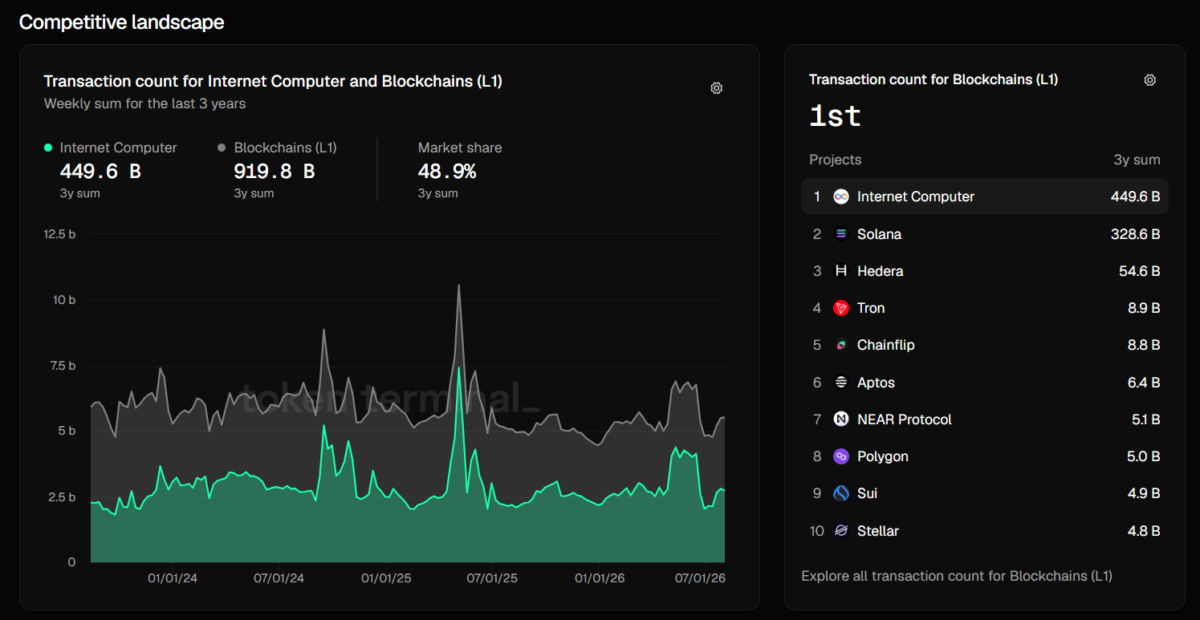
The same source reports a latest weekly-average transactions-per-second reading of 4.6K for Internet Computer against 9.1K for the broader layer-1 group, corresponding to a 50.6% share. Ranking tables for the last year and the last month consistently show the network at or near the top of the ordered list.
These numbers have accumulated since the mainnet launch in May 2021. Independent trackers such as Chainspect record a lifetime total exceeding 298 billion transactions for Internet Computer as of 1 PM UTC – 11 August 2026, compared with 121 billion for Solana.
Real-time one-hour snapshots on the same platform have shown Internet Computer processing volumes in the range of several billion transactions during peak windows, though the exact ranking against Solana fluctuates with short-term load.
This surprising growth for Internet Computer coincides with expansion of the underlying infrastructure. The network operates through multiple independent subnets, each running its own consensus, which allows capacity to increase by adding subnets rather than enlarging a single chain. Official documentation describes this arrangement as enabling concurrent execution of smart-contract units across the system.
Network Design Supporting High Message Throughput
To better understand how Internet Computer is ranking first in this segment, we must first clear how the blockchain itself actually works.
Internet Computer runs computation in units called canisters—packages of code and state hosted across parallel subnets. All activity occurs as messages: external users send ingress messages, while canisters exchange inter-canister messages with one another.
It uses two main types of counts: First, Update calls that change state and go through subnet consensus, typically finishing in one to two seconds. Second, Query calls that read data without changing it and return results faster from a single node.
On the network, inter-canister calls run asynchronously, letting a canister keep working while waiting for replies. It also generates messages when canisters serve web content, run timers, or make outbound HTTP requests.
Token Terminal’s transactions-per-second figure for the project tracks the average rate of these message executions from the network’s own monitoring data.
Read: Modular vs. Monolithic Chains: The Evolution of Blockchain Architecture
Distinguishing Canister Messages from Conventional Transactions
Now back to the point, the high rankings on Token Terminal arise from a definition of activity that differs from the counting methods used for most other blockchains. On conventional networks a transaction is ordinarily a discrete user-initiated action—token transfer, contract invocation, or similar—recorded in a block after consensus. Token Terminal’s general definition of transaction count is the number of confirmed transactions added to the blockchain.
For Internet Computer, the platform instead converts pre-aggregated average transactions-per-second statistics into daily totals. Those statistics track messages processed by canisters.
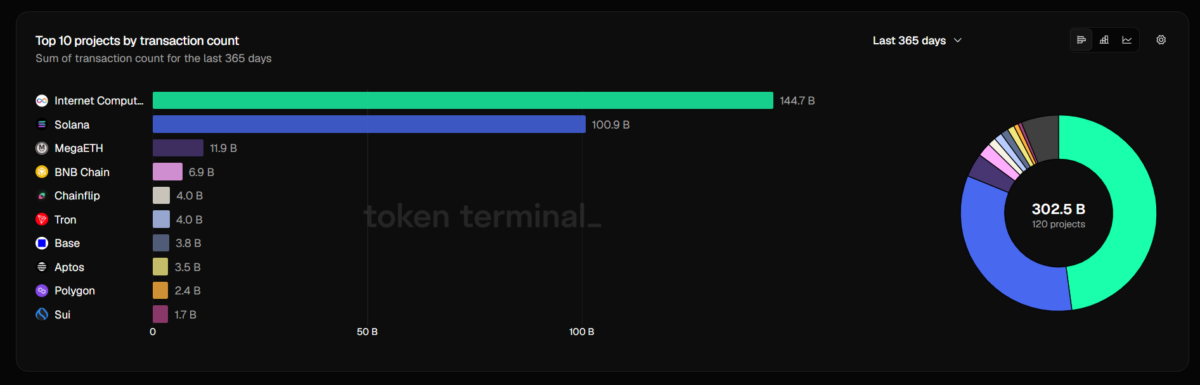
An individual user action that touches a multi-canister application can therefore generate multiple counted messages: an ingress update, several inter-canister calls, queries for data, and responses. Many of those messages perform computation or state changes that, on other chains, would occur off-chain or would not be recorded as separate on-chain events.
Official documentation confirms that every interaction with a canister occurs through messages and that inter-canister calls themselves constitute messages. Update calls go through full consensus; query calls do not. The resulting volume therefore includes a broader class of computational events than the value-transfer or smart-contract invocations typically tallied on Ethereum or Solana.
Analyses published by the project itself have noted that individual replicated calls on its blockchain can execute substantially more instructions than average transactions on Ethereum.
This methodological difference explains why cumulative figures for Internet Computer exceed those of networks that process higher volumes of conventional financial transactions.
The Token Terminal dashboard still lists the network first by the metric it applies, but the underlying events are canister messages rather than the narrower class of transactions used elsewhere.
Real-Time Daily Activity and Enterprise Versus Public Network Models
When measured by real-time throughput rather than multi-year aggregates, rankings shift. Chainspect data (as of 1 PM UTC – 11 August 2026) show Solana leading at 1,635 transactions per second over a one-hour window, with Internet Computer at 1,309.
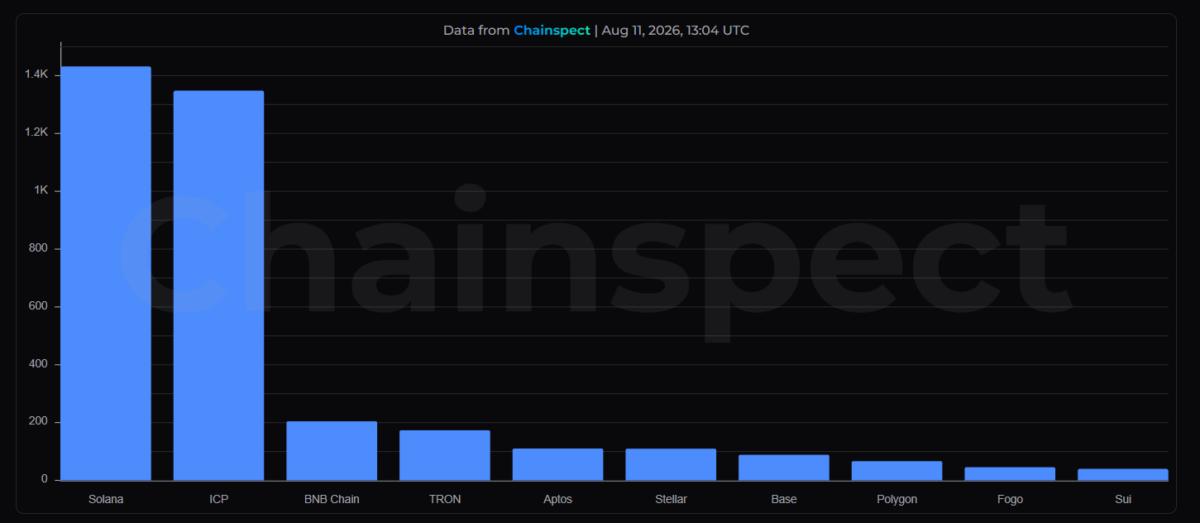
Transaction volume in the same window reached 4.24 billion for Solana and 3.39 billion for Internet Computer. Ethereum layer-1 registers far lower rates, typically in the mid-twenties of transactions per second.
Daily and weekly snapshots on the same tracker have alternated leadership between Solana and Internet Computer depending on load. Solana’s figures include both user transactions and, in some presentations, consensus votes; many comparative views exclude the votes to focus on non-vote activity. Internet Computer’s counts continue to reflect the broader message set described above.
A further distinction appears between public permissionless networks and enterprise-oriented designs. Public networks such as Ethereum, Solana and Internet Computer allow any participant to submit transactions or deploy code under the rules of the protocol. Enterprise systems, by contrast, typically operate as permissioned ledgers in which membership, visibility and governance are controlled by a defined set of organizations.
Hedera occupies an intermediate position: it is a public network whose nodes are operated by a governing council of large corporations, combining open access with institutional oversight. Transaction fees on Hedera are fixed at low absolute levels, and the network has historically recorded high lifetime volumes under its own consensus mechanism.
Public networks emphasize open participation and composability; enterprise deployments prioritize compliance, privacy controls and predictable cost. The Token Terminal and Chainspect rankings primarily capture public-network activity.
Read: Hedera’s Biggest DeFi Lender Bonzo Lend Hacked for $9M
Comparable Approaches on Hedera, Chainflip and NEAR Protocol
Several other networks produce elevated activity counts through architectural choices that expand the set of counted events or raise throughput capacity. Hedera’s hashgraph consensus supports high sustained rates with finality measured in seconds; its three-year Token Terminal sum places it third among layer-1 projects. The governing-council model allows enterprises to participate directly while the ledger remains publicly accessible.
Chainflip, another leading name in transactions count, operates an application-specific state chain optimized for cross-chain swaps. Its design batches events and limits the surface available for general smart-contract deployment, concentrating throughput on the core swapping function. Token Terminal records Chainflip among the higher-volume projects over both yearly and monthly windows.
NEAR Protocol, another enterprise-oriented blockchain, relies on sharding. Each shard processes a portion of state; dynamic resharding adjusts the number of shards according to load. Its recent benchmarks have demonstrated high theoretical capacity under test conditions, and the network appears in Token Terminal’s mid-tier rankings for transaction count. Official updates report average daily transaction volumes in the hundreds of thousands during 2026.
In each case the measured activity reflects the specific design of the protocol—message-oriented execution on Internet Computer, council-governed high-frequency consensus on Hedera, swap-focused batching on Chainflip, and sharded parallel processing on NEAR—rather than a uniform definition of a transaction. Token Terminal’s rankings capture these differences through the metrics it applies to each project.