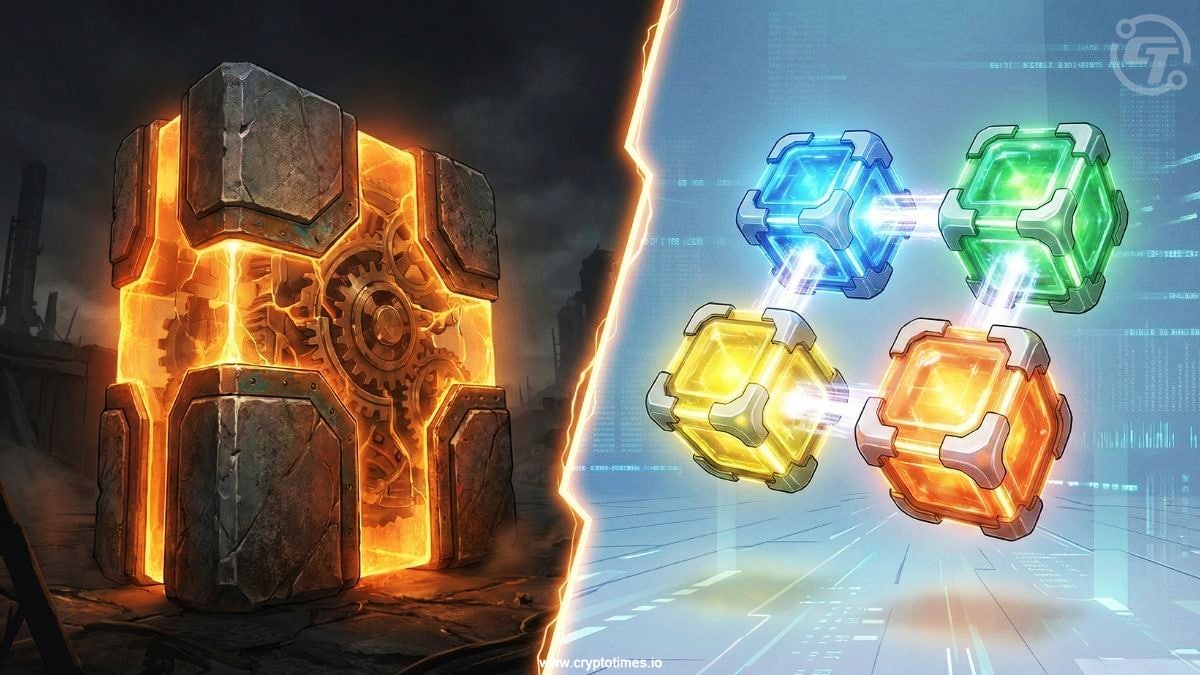
Imagine you are trying to build a car.
You have two options. Option A is to have one master craftsman build every single part of the car himself. He forges the steel, stitches the leather seats, assembles the engine, and paints the chassis. He does it all in one garage.
Option B is to build a factory assembly line. One specialized team builds the engine. Another team handles the tires. A third team does nothing but paint. Finally, they snap all the parts together.
In the world of cryptocurrency, Option A is a Monolithic Blockchain (like Bitcoin, Ethereum, or Solana). Option B is a Modular Blockchain (those emerging app-specific chains).
For the last decade, the crypto industry has been dominated by the “Master Craftsman” model. But as we try to scale from thousands of users to hundreds of millions, the industry is shifting toward the “Assembly Line.” This shift is called The Modular Thesis, and it is the most important technical evolution happening in crypto today.
This guide will explain exactly how these two architectures work, why the industry is splitting apart, and which model might win in the future.
The Core Problem of Blockchain Trilemma
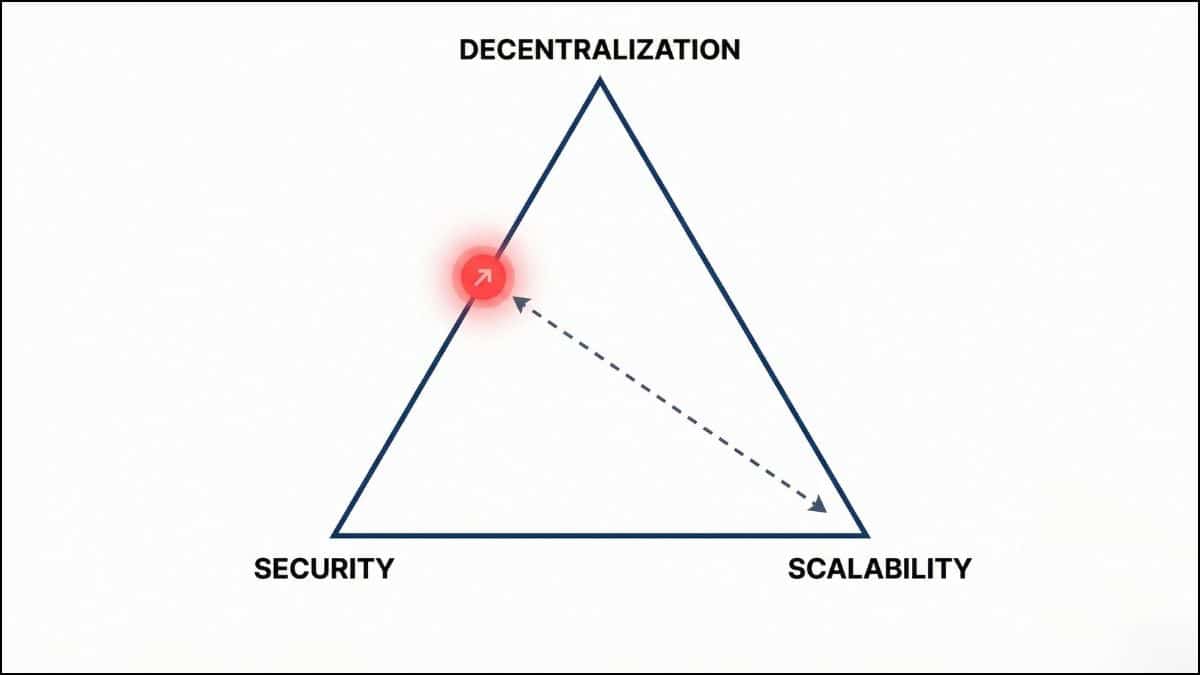
To understand why we need “Modular” chains, we first have to understand the problem they are trying to solve. It’s called the Blockchain Trilemma.
Proposed by Ethereum co-founder Vitalik Buterin, the trilemma states that a blockchain can only optimize for two of three critical features at the same time:
- Decentralization: No single entity controls the network; many people run nodes.
- Security: The network is unhackable and immutable.
- Scalability: The network can process thousands of transactions per second (TPS) cheaply.
Many legacy blockchain networks, including Bitcoin, Ethereum, and Solana, are stuck in this triangle.
- Bitcoin and Ethereum chose Decentralization and Security. The trade-off? They are congestive and slow (Scalability suffers).
- Solana chose Scalability and Security. The trade-off? It requires massive, expensive computers to run, meaning fewer people can participate (Decentralization suffers).
For years, developers thought the only way to scale was to just make the computers faster (bigger blocks, faster chips). This is Monolithic scaling.
But recently, a new school of thought appeared: What if we stop trying to do everything on one chain?
What is a Monolithic Blockchain?
In the context of cryptocurrency, a Monolithic Blockchain is a network where a single software layer handles every aspect of the blockchain’s operation.
For the first decade of crypto history (roughly 2009–2020), this was the standard. Bitcoin, the original blockchain, is monolithic. Solana, the current speed leader, is monolithic. Ethereum is also a monolithic network but it has started seeing a series of developments towards becoming a modular blockchain.
Also Read: Who is Satoshi Nakamoto, the Anonymous Creator of Bitcoin?
The term “Monolithic” comes from the Greek word monolithos, meaning “made of one stone.” To understand the technical aspects of monolithic blockchain, you must recognize that a blockchain isn’t just a ledger; it is a machine performing four distinct heavy-lifting jobs simultaneously:
- Execution: Processing the transaction logic (e.g., “Move 5 BTC from Alice to Bob”).
- Settlement: Resolving disputes and finalizing the state (e.g., “The transaction is valid and irreversible”).
- Consensus: Getting hundreds of nodes to agree on the order of transactions (e.g., “Alice paid Bob before she paid Charlie”).
- Data Availability: Storing the transaction history so anyone can download and verify it.
In a monolithic system, every single node (computer) on the network must perform all four of these jobs for every single transaction. There is no outsourcing. If you run a Bitcoin node, you are verifying the entire history of the chain yourself.
Pros of Monolithic Blockchain
- Simplicity: For developers, it is easy to build on. You deploy your app, and it just works.
- Synchronous Composability: This is a fancy term meaning “apps can talk to each other instantly.” A trader can borrow money from a lending app and swap it on a decentralized exchange (DEX) in one single, split-second click.
- User Experience: Users don’t need to “bridge” funds. It’s one wallet, one fee, one chain.
Cons of Monolithic Blockchain
- The “Traffic Jam”: Because one lane handles everything, if a popular NFT mint happens, the whole network slows down for everyone (even people just trying to send tokens).
- Hardware Limits: To process 100,000 transactions per second on one chain, you need supercomputers. This pushes out regular users, leading to centralization.
What is a Modular Blockchain?
If Monolithic blockchains are the “Swiss Army Knife,” Modular blockchains are a set of specialized Lego blocks. A Modular Blockchain is a system that splits the core tasks of a blockchain into separate layers, rather than trying to perform all of them on a single network.
This approach is based on a simple economic principle: Specialization leads to efficiency.
In the web2 world, Amazon doesn’t build its own computers, write its own banking software, and deliver every package personally. It uses AWS for servers, Stripe for payments, and FedEx for delivery. The Modular Blockchain thesis applies this same logic to crypto infrastructure. It “unbundles” the stack.
While Monolithic chains scale vertically (bigger computers), Modular chains scale Horizontally. This means you can keep adding more chains on top of the base layer without slowing down the network.
In this system, the “Blockchain” is no longer one single thing. It is a stack of protocols working together:
- The Execution Layer (The Top): This is where the user lives. It handles the smart contracts and signatures. Rollups (like Arbitrum or Base) are the most common form of modular execution. They process thousands of transactions off-chain, compress them into a tiny bundle, and send only the summary to the main chain.
- The Consensus & Settlement Layers (The Middle): This is usually a major L1 like Ethereum. It provides the security budget. It checks the “summary” sent by the Rollup and gives the final stamp of approval. It doesn’t need to process every coffee purchase; it just verifies the math.
- The Data Availability Layer (The Bottom): This is the archives department which ensures that the raw data behind those transactions is stored and accessible.
Pros of Modular Blockchain
- Scalability: Modular chains can scale to millions of TPS without requiring supercomputer-level hardware.
- Innovation: Specialized teams innovate and upgrade each layer independently, making progress much faster.
- Sovereignty: Developers gain full sovereignty to choose their own VM, gas token, sequencer, and governance rules.
- Cost: Transactions on modular rollups are typically 50–100× cheaper than on Ethereum L1 or most L2s.
Cons of Modular Blockchain
- Composability: Apps on different rollups cannot interact atomically in a single transaction like on monolithic chains.
- Bridging: Users must bridge assets between chains, which is slow, costly, and has been hacked for billions.
- Liquidity: Liquidity and users get fragmented across dozens of rollups instead of being unified in one place.
- Complexity: Building and using modular stacks is significantly more complex for both developers and end users.
Why Developers Choose Modular
The biggest advantage of this architecture is Sovereignty and Flexibility. In a Monolithic system, developers are renters—they must obey the rules, fees, and programming languages of the main chain. In a Modular system, developers can build their own custom chains (“App-Chains”).
For example, a game developer might want a chain that is incredibly fast and essentially free, even if it is slightly less secure. They can spin up a modular execution layer optimized for gaming, settle it on a cheaper layer, and use a specialized data layer. They can mix and match components to build the exact product they need, rather than forcing their product to fit into a general-purpose blockchain.
Comparison between Monolithic and Modular Blockchain

Which architecture is better? There is no perfect answer, only trade-offs.
| Feature | Monolithic (e.g., Bitcoin, Solana) | Modular (e.g., Ethereum + Rollups) |
| Philosophy | Integrated: Do it all in one place for maximum performance. | Specialized: Do one thing perfectly and outsource the rest. |
| Scalability | Vertical: Requires more powerful hardware (bigger servers) to scale. | Horizontal: Scales by adding more chains (Rollups) that run in parallel. |
| Cost | Low fees, but can spike during congestion. | Extremely low fees on L2 (Execution), higher security cost on L1. |
| Flexibility | Rigid: Developers must follow the rules of the main chain. | Flexible: Developers can swap out layers (e.g., use Ethereum for settlement but Celestia for data). |
| Security | Single Point: The chain is only as secure as its own validators. | Shared Security: New chains inherit the massive security of the parent layer (Ethereum). |
| User Experience | Seamless: One click, one chain. | Fragmented: Users often have to “bridge” assets between different layers. |
Also Read: Ethereum vs. Solana: Which Blockchain Wins DeFi Race?
The “Billboard” vs. “Library” Cost Factor
Why is the Modular approach cheaper?
Think of Ethereum Mainnet as a Times Square Billboard. It is prime real estate. Posting data there is incredibly expensive because every node in the world has to watch it.
Modular chains like Arbitrum, Optimism and other layer 2 solutions are like a Suburban Public Library. It is cheap to store data there. Modular apps save money by executing the math on a fast layer (Rollup) and storing the heavy data records in the cheap library, only using the expensive Billboard (Ethereum) for the final “receipt.”
The Current Landscape
Who are the key players driving this technology right now?
1. The Monolithic Champion: Solana (SOL)
Solana is the king of the monolithic approach. It aggressively optimizes its software to squeeze every ounce of performance out of a single chain.
- Why it works: It offers the best User Experience (UX). It feels like a modern web app—fast and cheap.
- The Risk: If the main network goes down (which has happened often), the entire ecosystem halts. There are no other layers to fall back on.
2. The Modular Pioneer: Ethereum (ETH) and its Layer 2 Networks
Ethereum started as a monolithic chain but realized it couldn’t scale without fees becoming too high. It pivoted to a “Rollup-Centric Roadmap.”
- How it works: Ethereum Mainnet is becoming a “Settlement Layer” for dozens of Layer 2s (Arbitrum, Base, Optimism). It doesn’t want to process your coffee purchase; it wants to process the proof of 10,000 coffee purchases bundled together.
3. The Pure Specialist: Celestia (TIA)
Celestia claimed to be the first truly modular blockchain designed only for Data Availability. It has no smart contracts. You cannot build a DeFi app directly on Celestia.
- Why it matters: It allows other developers to deploy their own high-speed blockchains easily, using Celestia as their hard drive. It essentially allows you to “rent” a blockchain foundation.



Conclusion
The war between Modular and Monolithic is often framed as “Winner Take All,” but the reality is likely different. The lines are already blurring.
- Monolithic chains are becoming modular: Solana is developing “Network Extensions” that look a lot like Layer 2s to handle extra load.
- Modular chains are becoming integrated: Ethereum is implementing “Based Rollups” to make the fragmented layers feel more like one single smooth experience.
- Monolithic wins in the short term for Consumer Apps (Games, Social Media) where simple, fast UX is everything.
- Modular wins in the long term for Global Infrastructure, serving as the backbone for thousands of specialized chains powering finance, identity, and logistics.
For the investor and the developer, the “Evolution of Architecture” isn’t about choosing one coin over another. It’s about recognizing that blockchain technology is finally maturing from a clunky experiment into a sophisticated, multi-layered machine capable of running the world’s economy.