Gensyn’s $AI token made one of the most volatile debuts of 2026 following its April 29, 2026, Token Generation Event (TGE), major exchange listings triggered a sharp pump-and-dump move.
The token surged over 250% in early trading before experiencing a sharp correction of up to 46% from its all-time high of $0.1035. Currently, the Gensyn token price is trading around $0.048 – $0.055 USD.
It has a market capitalization of approximately $63 – $73 million and a fully diluted valuation (FDV) of $482 – $552 million. Its 24-hour trading volume has ranged between $70 – $95 million, with a circulating supply of 1.304 billion out of a total/max supply of 10 billion. This dramatic price action has placed Gensyn firmly in the spotlight as one of the most discussed AI + DePIN projects of the year.
What Is Gensyn AI Coin / Project?
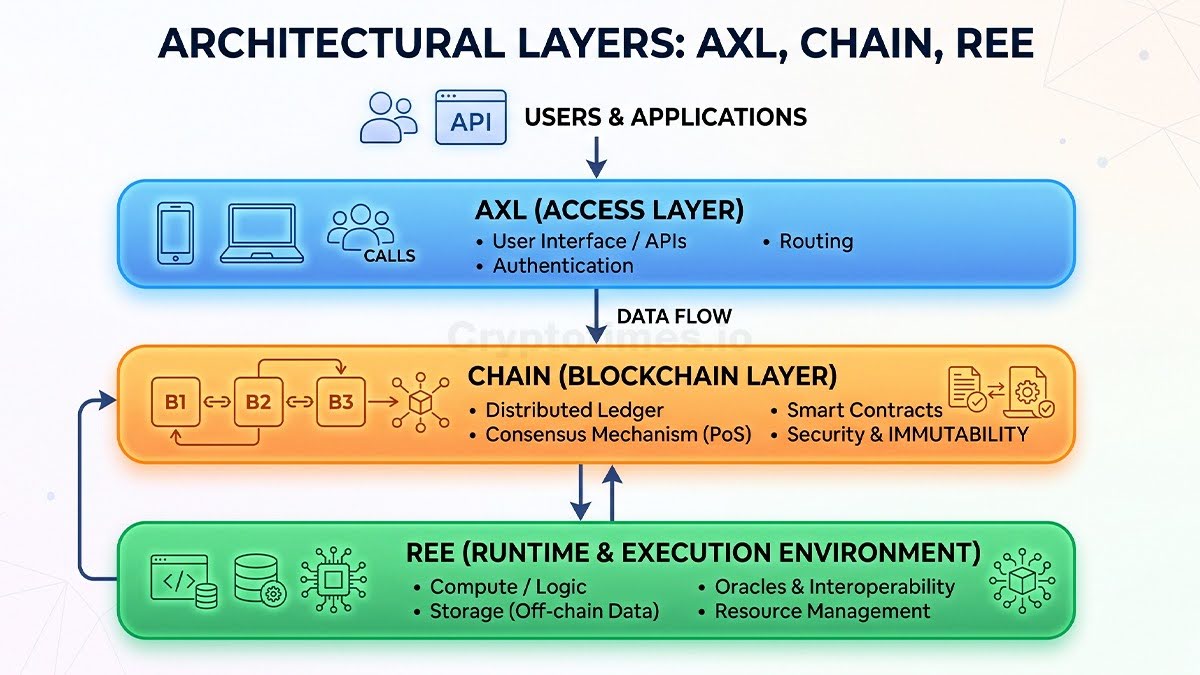
Gensyn is a decentralized compute network designed for machine learning and artificial intelligence. It aims to build a global, permissionless “supercluster” by aggregating idle compute power from gaming PCs, data centers, and eventually mobile devices — offering a cheaper, open alternative to centralized cloud providers like AWS, Google Cloud, or Azure. The project’s core innovation lies in its three-layer architecture:
- AXL — Peer-to-peer networking layer for sharing ML models, gradients, and data.
- CHAIN — On-chain identity, reputation, and coordination system.
- REE (Reproducible Execution Environment) — Cryptographic proofs that verify computations were performed correctly without trusting any single party.
In simple terms, Gensyn turns anyone with spare GPU/CPU power into a node that can earn rewards by training, verifying, or contributing to AI models. The network focuses on verifiable, trustless machine intelligence. The $AI coin (often referred to as Gensyn AI Coin) is the native utility and incentive token that powers the entire ecosystem. It is used for:
- Paying for compute resources
- Staking to participate in tasks
- Rewarding high-performing models and nodes
- Governance and fee mechanisms
Delphi — Gensyn’s flagship application — launched on mainnet on April 22, 2026. It is a decentralized, AI-settled information and prediction market platform targeting the $250 billion creator economy. Anyone can create markets on any topic, with outcomes settled by verifiable AI oracles. Creators earn fees (1.5% of volume), and the protocol uses a portion of fees to buy back and burn $AI tokens.
The “Verification” Edge: REE Technology
What distinguishes the Gensyn $AI token from other decentralized physical infrastructure (DePIN) projects like Render or Akash is its focus on Verifiable Computing.
Because AI training is computationally expensive, some nodes might try to “cheat” by claiming they performed work when they actually didn’t. Gensyn solves this through its Reproducible Execution Environment (REE). This three-layer architecture uses cryptographic proofs to verify that computations were performed accurately without needing to trust the individual node.
Delphi Gives Gensyn Its First Live Application
Gensyn’s token launch came shortly after the mainnet launch of Delphi, an AI-settled information market platform. Gensyn describes Delphi as a decentralized information market where users can create markets, trade outcomes and monetize their views.
The platform is important because it gives Gensyn a live consumer-facing use case rather than leaving the project only as infrastructure. Reports around the Delphi launch said the platform uses AI models for settlement and includes fee mechanics tied to the $AI token economy. MEXC’s coverage said Delphi launched on mainnet on April 22, with 70% of protocol revenue burned and 29% routed to the Community Treasury. It also said market creators earn 1.5% of volume.
That makes Delphi central to Gensyn’s investment story. If Delphi gains users and volume, the market may treat $AI as more than a speculative listing token. But if activity slows after the launch cycle, traders may focus more on supply, FDV and unlock risk.
Tokenomics and Sale Details
- Total Supply: 10 billion $AI (fixed, no inflation)
- Circulating Supply: 1.304 billion (13%)
- Public Sale (December 2025): 300 million tokens (3%) sold via English auction, raising funds at ~$0.0473 average price.
- Major Allocations: Community Treasury (40.4%), Investors (29.6%), Team (25%), Community Sale (3%).
Backers include top-tier funds such as a16z crypto, CoinFund, Galaxy Digital, Eden Block, and Maven 11. The project has raised approximately $66–100 million across rounds. No active gensyn airdrop or gensyn mining is currently live, though compute contributors and Delphi participants will earn $AI rewards going forward.
Why Gensyn Is Trending
The primary trigger was the Token Generation Event (TGE) and rapid listings on Binance Alpha, KuCoin, Bitget, Coinbase, and others on April 29. Heavy pre-launch hype, leveraged perpetuals, and low initial floating supply created massive volatility. Gensyn benefits from the dominant 2026 narrative: AI infrastructure + DePIN. With Delphi now live and generating real usage, it stands out from purely speculative AI tokens. It competes directly with Bittensor (TAO), Render (RNDR), and Nosana.
Related News: Gensyn AI Token Pumps 250%, Dumps 45% After Binance & Coinbase Listings
How Gensyn Compares with Other AI-DePIN Tokens
Gensyn sits in the same broad market category as Bittensor, Render, and Akash, but its focus is different.
Bittensor is built around decentralized machine intelligence and subnet-based incentive systems. Render has historically focused on decentralized GPU rendering, though it has expanded deeper into AI compute. Akash operates as a decentralized cloud marketplace.
| Project | Primary Focus | Key Technology |
|---|---|---|
| Gensyn ($AI) | Verifiable AI Model Training | REE Verification Layer |
| Bittensor (TAO) | Decentralized Machine Intelligence | Proof-of-Intelligence |
| Render (RNDR) | GPU Graphical Rendering | OctaneRender |
| Akash | Decentralized Cloud | Reverse Auction |
Future Expectations and Gensyn Token Price Prediction
Short-term outlook remains highly speculative due to volatility and low circulating supply. Medium-to-long-term prospects depend on:
- Adoption of Delphi and future applications
- Growth of the decentralized compute network
- Ability to deliver meaningfully cheaper AI training (Gensyn claims up to 90%+ cost reduction in some cases)
Analyst estimates (aggregated from various sources):
- 2026: Base $0.08–$0.18 | Bullish $0.25–$0.45
- 2027–2028: $0.20–$0.80+ if network effects kick in
- 2030 Bull Case: $1.50–$3+ in a strong AI bull market
Success hinges on attracting real AI workloads, scaling node participation, and competing with established players.
Risks to Consider
Gensyn is still early-stage and high-risk. Key challenges include slow DePIN adoption curves, intense competition, future token unlocks, and regulatory uncertainty around AI and crypto. Extreme price swings are likely to continue in the near term.
How to Buy Gensyn Token: Available on major exchanges including Coinbase, Binance (futures/Alpha), KuCoin, Bitget, and Uniswap. Always verify the official contract address before trading.
Bottom Line: Gensyn’s $AI launch delivered exactly what traders expect from a high-hype AI token debut: a sharp rally, heavy volume and an equally sharp correction.
The project has more substance than a basic AI ticker. It is backed by a decentralized compute thesis, a verification-focused technical stack, and a live application in Delphi. But the token is still in its earliest trading phase, and the market has already shown that launch-day demand can disappear quickly.
DYOR and only invest what you can afford to lose. Monitor official channels for updates on compute incentives, network growth, and roadmap progress.
Disclaimer:
Some elements of this content may have been enhanced with the help of our artificial intelligence (AI) assistants for purposes such as basic refinement, review, image generation, and translation to deliver high-quality news in a shorter time frame. However, all AI-assisted content is reviewed and approved by our team to ensure accuracy, fairness, and editorial integrity.