Key Highlights
- Bittensor (TAO) mirrors Bitcoin’s 21 million supply and fair-launch model to power the world’s first decentralized intelligence marketplace.
- Over 100 specialized subnets let miners and validators compete to produce real AI commodities—from text generation to protein folding—earning TAO rewards.
- After the December 2025 halving cut daily emissions to ~3,600 TAO, the network enters a new era of programmed scarcity, positioning TAO as a potential index for decentralized AI growth
Imagine a world where the most powerful artificial intelligence isn’t locked behind the firewalls of a handful of tech giants. Instead, anyone with a GPU, a good model, or a sharp validator’s eye can plug into a global, permissionless marketplace and get paid in real time for contributing intelligence. That world isn’t science fiction—it’s live on Bittensor (TAO).
Bittensor isn’t just another AI crypto project. It is an open-source protocol that turns machine intelligence into a tradable commodity, using blockchain incentives to coordinate thousands of participants worldwide.
Launched with a pure fair launch in 2021 and no pre-mine, it has grown into one of the most ambitious experiments in decentralized AI. As of April 2026, TAO trades at approximately $317.45, with a market cap of $3.43 billion and a fully diluted valuation of $6.66 billion.
This guide cuts through the hype. You’ll get the complete picture: how Bittensor actually works under the hood, its token economics, the subnet ecosystem powering real use cases, current market realities, risks, and what 2026 holds. Whether you’re a crypto investor eyeing AI exposure, a developer curious about running a miner, or simply someone who wants to understand the next evolution of intelligence markets, read on.
What Is Bittensor? The Peer-to-Peer Intelligence Market
Bittensor is a decentralized blockchain protocol that creates an open marketplace for machine intelligence.
The foundational idea, laid out in the original whitepaper by Yuma Rao, is to treat intelligence like a commodity. Think of it as “Bitcoin for AI”—but instead of mining hashes, participants mine useful intelligence.
Traditional AI development is centralized, expensive, and siloed. A few companies control the data, compute, and models. Bittensor flips this script. It connects miners (who run AI models and produce outputs) with validators (who score the quality of those outputs) inside specialized subnets. The entire system runs on the Subtensor blockchain layer and uses the native TAO token to incentivize high-quality contributions.
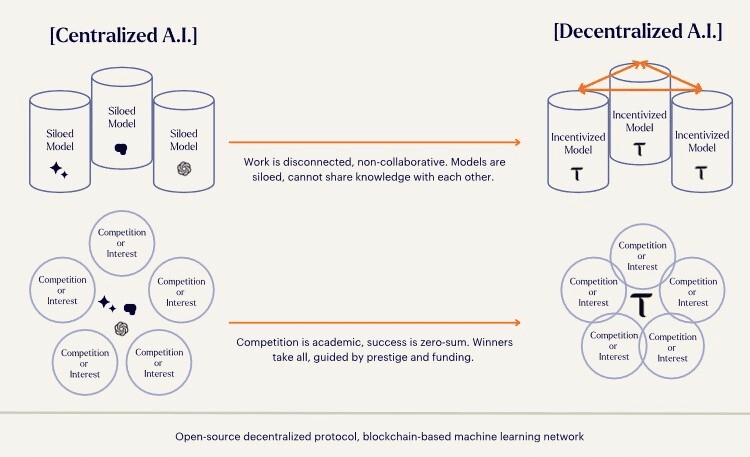
The whitepaper’s central thesis is elegant: intelligence can be measured by other intelligence. Peers rank each other’s neural network outputs through a peer-to-peer mechanism that resists collusion and rewards genuine value. New TAO is minted and distributed based on these rankings, creating a self-reinforcing flywheel of improving intelligence.
History and Fair-Launch Philosophy
Bittensor launched in January 2021 with a true fair launch—no venture capital allocation, no pre-mine, no ICO. Every single TAO has been earned through network participation. This Bitcoin-inspired approach set it apart from most 2021-era projects and built deep community trust.
By 2024–2025, the project matured rapidly: subnet registrations exploded, the dTAO governance upgrade improved decentralization, and institutional interest grew (Grayscale filed for a Bittensor Trust). The first halving in December 2025 was pivotal, slashing daily emissions from ~7,200 to ~3,600 TAO. Today the network hosts dozens of active subnets, processes real AI workloads, and continues to attract developers and capital.
Architecture: Subnets, Miners, Validators, and Yuma Consensus
Bittensor’s architecture has a few key pieces:
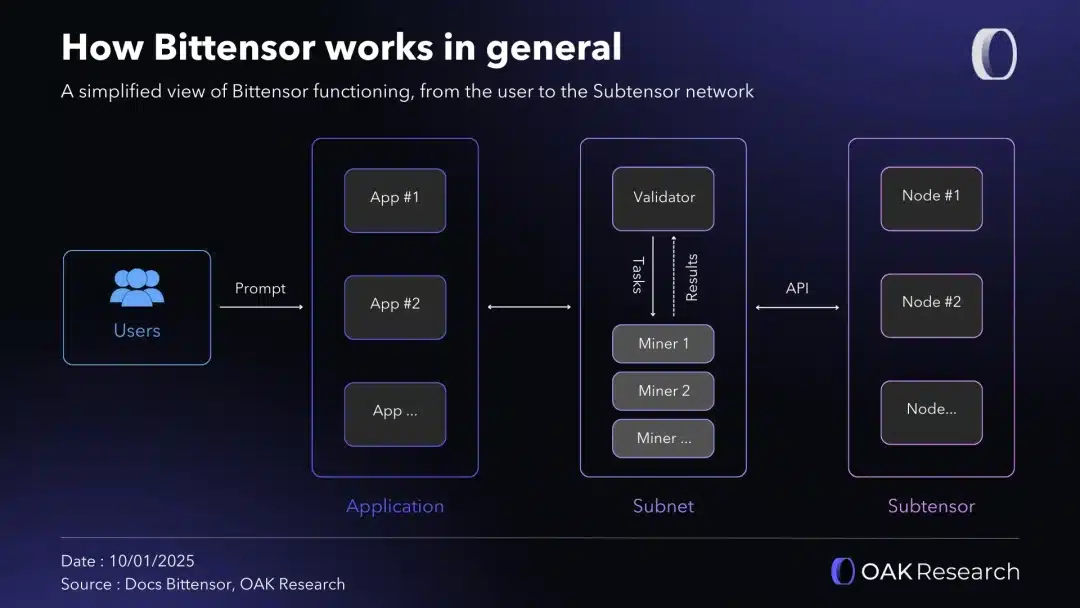
- Subnets – Independent, specialized marketplaces. Each subnet focuses on a specific digital commodity (e.g., text generation, image synthesis, financial forecasting, protein folding). Subnet creators define the incentive rules, but the broader network governs registration and emissions.
- Miners – Run AI models and respond to tasks. They compete to produce the highest-quality outputs.
- Validators – Propose tasks, score miner outputs, and submit rankings to the blockchain. Their accuracy directly affects their own rewards.
- Yuma Consensus (Proof-of-Intelligence) – The innovative mechanism that replaces traditional Proof-of-Work or Proof-of-Stake. It measures “intelligence” through peer rankings and a consensus-weighted incentive function. Rewards flow only to participants who achieve a majority consensus, making collusion extremely difficult.
- Staking & Delegation – TAO holders can stake directly or delegate to validators, earning a share of their rewards (typically ~82% passed through).
How the decentralized AI marketplace functions
Within a subnet, validators periodically submit a weight vector ranking miners based on observed performance. Yuma Consensus aggregates these rankings on-chain into two emissions vectors, one for miner incentives and one for validator dividends, weighting trusted validators more heavily and clipping out-of-consensus evaluations. Clipping uses stake-weighted benchmarks (default κ=0.5) to cap overly generous weights, while bonds with EMA smoothing reward validators who stay near consensus over time.
The marketplace operates at three layers:
- Off-chain work: miners deliver outputs (e.g., inference responses, training progress, predictions), validators test and score them.
- On-chain signal aggregation: validators’ scores become weights stored/used on-chain; Yuma Consensus resolves them into rewards.
- Capital allocation: TAO holders and stakers influence validator power (and, under Dynamic TAO, subnet economics) via staking/unstaking flows into subnets’ pools.
Training vs Inference
Bittensor is not limited to one AI workflow. Subnets can produce many kinds of digital commodities, so “training” and “inference” are subnet-defined.
- In an inference-style subnet, miners run models and return responses to validator queries, scored on latency, quality, and robustness.
- In a training-style subnet, miners may contribute training steps, checkpoints, gradients, or verified improvements. Exact verification rules are per-subnet and should be checked against each subnet’s repository.
Dynamic TAO and Flow-Based Emissions
The emissions system is explicitly documented as a two-stage process:
- Injection: each block, TAO (and alpha) are injected into each subnet’s liquidity pool in quantities determined by the cross-subnet distribution formula.
- Distribution: at the end of each tempo (~360 blocks, ~72 minutes), accumulated rewards are distributed within each subnet via Yuma Consensus.
The key 2025–2026 update is that cross-subnet injection is now flow-based (“Taoflow”): an EMA of net TAO flows from staking and unstaking drives each subnet’s share, and negative-flow subnets can be clipped to zero emissions. This replaces the earlier price-based model and is designed to reduce price inertia and mitigate TAO treasury gaming.
TAO Tokenomics
TAO is the lifeblood of the network. It serves as:
- Reward token for miners and validators
- Staking asset for network security and delegation
- Governance token for protocol upgrades
- Payment rail for accessing AI services on subnets
Key Tokenomics Table
| Metric | Value (April 2026) | Notes |
|---|---|---|
| Current Price | $317.45 USD | -1.80% 24h |
| Market Cap | $3.43 billion | Rank #28 |
| Fully Diluted Valuation | $6.66 billion | – |
| Circulating Supply | 10.81 million TAO | ~51.5% of max |
| Total / Max Supply | 21 million TAO | Bitcoin-like cap |
| 24h Trading Volume | $308.42 million | High liquidity |
| All-Time High | $767.68 (Apr 2024) | -58.65% from ATH |
| Block Time | 12 seconds | – |
| Current block emission | 0.5 TAO/ block | – |
| Daily Emissions (post-halving) | ~3,600 TAO | Next halving ~2029 at 15.75M supply |
Unlike inflationary tokens, TAO issuance halves at predefined supply thresholds (the first at 10.5M TAO in December 2025). All emissions flow into subnet pools, providing liquidity and incentives. No team or investor allocations exist—100% of supply is earned on-chain.
Real-World Use Cases and the Subnet Ecosystem
Subnets are where the work happens. As of April 2026, the network features active subnets across diverse domains. Top performers by emissions include:
Top Subnets by Emissions (Recent Snapshot)
| Rank | Subnet Name | SN # | Emission % | Primary Use Case |
|---|---|---|---|---|
| 1 | Chutes | 64 | High | Advanced inference |
| 2 | τemplar | 3 | 7.19% | Text & knowledge tasks |
| 3 | Targon | 4 | 6.24% | High-performance compute |
| 4 | Affine | 120 | – | Mathematical modeling |
| 5 | lium.io | 51 | 4.73% | Enterprise AI solutions |
Live use cases include decentralized LLMs, cost-competitive image generation, deepfake detection, financial prediction models, and scientific computing. Developers can run local subtensors, register miners, and start earning TAO immediately, and enterprises are exploring private subnets for secure, auditable AI.
Market Performance, Adoption & 2026 Outlook
TAO has shown resilience. Despite broader market volatility, it broke out against BTC in early 2026 and maintains strong community sentiment (81% bullish on CoinMarketCap). Institutional products like the Grayscale Bittensor Trust signal growing mainstream acceptance.
2026 Roadmap Highlights (based on community and official updates):
- Potential subnet cap expansion from 128 toward 256
- Further Yuma Consensus upgrades for efficiency
- Enhanced privacy features and quantum-resistant staking research
- Deeper enterprise adoption via improved UX and dTAO governance
Analysts frame TAO as a “picks-and-shovels” play for the decentralized AI boom — an index-like exposure to the entire AI-crypto narrative.
Risks and Challenges
No guide would be complete without balance. Bittensor faces real hurdles:
- Technical complexity – Running miners or validators requires expertise and hardware.
- Competition – Centralized AI giants and other decentralized projects (Render, Akash, Fetch.ai) vie for mindshare.
- Regulatory uncertainty – AI and crypto regulations are evolving globally.
- Volatility – Crypto assets, including TAO, can swing dramatically.
- Adoption curve – While subnets are live, mainstream developer and enterprise onboarding is still early.
Always do your own research. This is not financial advice.
Comparison with comparable decentralized AI/data projects
The decentralized AI space changed materially in 2024–2026 due to the attempted token consolidation under the Artificial Superintelligence Alliance (ASI) between SingularityNET, Fetch.ai, and Ocean Protocol. A two-phase merger began in July 2024 with conversion tooling and a planned transition to the ASI ticker, but in October 2025, the Ocean Protocol Foundation stated it had withdrawn from the alliance. Project, token, and alliance boundaries, therefore, differ from 2024 assumptions.
With that caveat, the comparison below focuses on mechanism design and market structure:
| Dimension | Bittensor (TAO) | SingularityNET | Ocean Protocol | Fetch.ai / ASI ecosystem |
|---|---|---|---|---|
| Core product model | Many subnets as off-chain competitions; on-chain settlement and emissions via Yuma Consensus. | Decentralised AI platform + marketplace for AI services; uses middleware (Daemon) for auth, metering, payment channels. | “Tokenized AI & Data” stack; privacy-preserving compute-to-data; tokenized access via datatokens and data NFTs. | Agent-focused network; FET used for staking/governance, agent registration, and micro-payments; positioned as part of broader ASI ecosystem. |
| How “quality” is priced | Validators score miners; stake-weighted clipping + bonds/EMA shape rewards; emissions are the pricing signal. | Market discovery via published services + usage; on-chain records + off-chain service operation; pricing via token payments/channels. | Compute-to-data lets algorithms run where data lives; privacy + access control provide value; datatokens gate access. | Agents transact and use services; token utility describes payments, staking, and network ops; quality depends on agent/service ecosystems. |
| Tokenomics approach (high-level) | TAO capped at 21M; supply-based halving; per-block emissions injected across subnets (now flow-based), then distributed within subnets (18/41/41). | AGIX described as a utility + governance token for the ecosystem; token specifics may be changed due to ASI integration. | OCEAN supports Ocean stack; compute-to-data/docs emphasise privacy-preserving data monetisation; alliance membership/token status changed in 2025 communications. | Fetch docs describe FET as a utility token and medium of exchange; staking supports PoS consensus and outputs governance; ASI posts detail planned merger and supply changes. |
| Decentralization “centre of gravity” | Economic Decentralization occurs through staking flows into subnets + on-chain Yuma; chain consensus uses Substrate runtime configuration (Aura/GRANDPA referenced in code). | Decentralization is primarily marketplace/service-based (services run by providers; chain pays/records), plus governance via token. | Decentralization centres on data tokens, nodes, and privacy-preserving compute; sensitive-data use cases are explicitly targeted. | Decentralization centres on PoS chain security + agent ecosystem, token utilities for staking and governance. |
| Maturity signals (as of 2026) | Mainnet emissions + many active subnets; detailed protocol docs updated through 2026. | Active developer portal, marketplace tooling, and token utility docs; significant 2024–2025 governance/token transitions. | Active dev docs and continuing product updates (e.g., Ocean Nodes tooling); alliance relationship evolved materially in 2025. | Active network documentation and ongoing ecosystem integrations; token merger plan and related upgrades described in 2024–2025 docs. |
How to Get Started with Bittensor
- Buy TAO on major exchanges (Binance, Coinbase, etc.).
- Stake via official wallets or delegation platforms.
- Run a miner/validator using the Bittensor SDK (docs.learnbittensor.org).
- Explore subnets at taostats.io or tao.app.
Conclusion: The Future of Intelligence Is Decentralized
Bittensor isn’t promising to replace OpenAI tomorrow. It is building the open infrastructure where the next generation of intelligence can emerge collaboratively, meritocratically, and without single points of failure. In a world racing toward AGI, a decentralized, incentivized marketplace for machine intelligence may prove as foundational as Bitcoin was for digital money.
The first halving is behind us. Subnets are scaling. Real workloads are running. The flywheel is turning. Whether you’re bullish, skeptical, or just curious, Bittensor (TAO) has moved from experiment to one of the most watched projects at the intersection of AI and crypto.
Also Read: Bittensor (TAO) Price Analysis: Why the DeAI Pioneer Surged 62% in April 2026
Disclaimer:
Some elements of this content may have been enhanced with the help of our artificial intelligence (AI) assistants for purposes such as basic refinement, review, image generation, and translation to deliver high-quality news in a shorter time frame. However, all AI-assisted content is reviewed and approved by our team to ensure accuracy, fairness, and editorial integrity.