Every few weeks, crypto X — popularly called Crypto Twitter — lights up with the same kind of headline: “Tether just froze tens or hundreds of millions in USDT.” On May 4, 2026, Tether blacklisted $38.4 million on Tron after on-chain investigator ZachXBT traced funds tied to the collapsed DSJ Exchange and BG Wealth Sharing Ponzi scheme. Just days earlier, in late April 2026, Tether had locked up $344 million across two Tron wallets in coordination with OFAC and the U.S. Treasury — the largest single freeze action in stablecoin history, later confirmed by Treasury Secretary Scott Bessent as part of Operation Economic Fury, a campaign targeting Iran’s financial lifelines.
To casual observers, it looks like magic — money simply stops moving on a “decentralized” blockchain. But there’s nothing magical about it. The freezing of USDT is a deliberate, technical, and legally coordinated process that sits at the intersection of smart contracts, law enforcement, and global compliance.
This guide breaks down exactly how Tether freezes USDT, why it does so, the real-world cases behind the headlines, and what it means for everyday holders of the world’s largest stablecoin.
What Does It Mean to “Freeze” USDT?
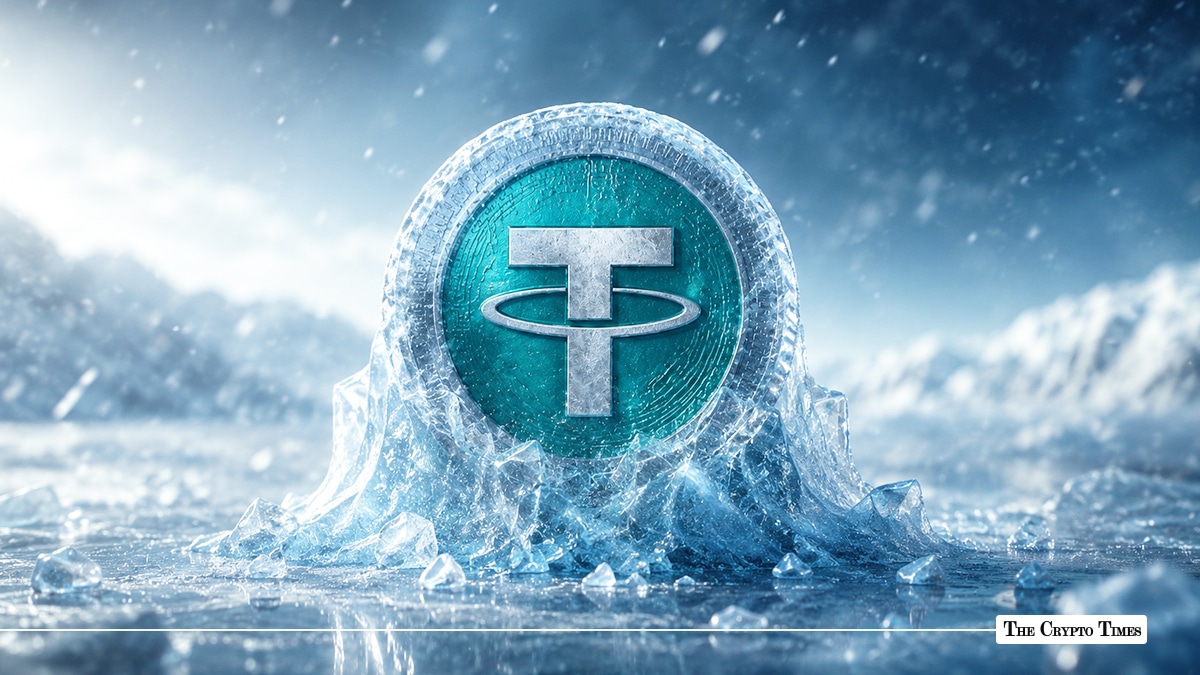
When people say USDT has been “frozen,” they mean Tether has added a specific wallet address to an on-chain blacklist, rendering the tokens inside that wallet permanently immobile until Tether reverses the action. The funds remain visible on the blockchain — anyone can still see the balance — but the wallet’s owner cannot send, swap, or interact with those tokens in any way.
A frozen USDT wallet is not destroyed. It is functionally paralyzed. The wallet itself stays active and can still hold other assets like TRX or ETH, but every USDT transfer attempt will simply fail at the smart contract level.
There are typically two reasons Tether takes this action: suspected illegal activity such as theft, hacks, or money laundering, or a direct request from law enforcement, usually backed by a seizure warrant or court order.
The Smart Contract Mechanism: How Tether Technically Freezes USDT
The freezing capability is not bolted on after the fact. It is hard-coded into the USDT smart contract itself on every blockchain where Tether issues the token, including Tron (TRC-20), Ethereum (ERC-20), Solana, and others.
At the heart of the system are three administrative functions written directly into the USDT contract code:
The Three Core Functions
-
01addBlackList(address)
When Tether’s privileged wallet calls this function with a target address, that address is instantly flagged. From that moment on, any attempt to transfer USDT out of the address is automatically rejected by the contract.
-
02removeBlackList(address)
The reverse function. If a freeze is lifted, Tether removes the address from the blacklist, restoring full functionality.
-
03destroyBlackFunds(address)
The most aggressive option. This function permanently burns the entire USDT balance held by a blacklisted address, reducing it to zero. The owner never regains access to those funds.
// Recorded on-chain when a freeze occurs
event AddedBlackList(address _user);
event RemovedBlackList(address _user);
event DestroyedBlackFunds(address _blackListedUser, uint _balance);
Every one of these actions is publicly recorded on-chain. When you see “AddedBlackList” or “RemovedBlackList” events in a Tron or Ethereum explorer, you are watching the freeze mechanism in motion.
What’s important to understand is that Tether does not need access to the user’s private keys to do any of this. As the issuer, Tether retains administrative control over its own token contract. That control is what makes USDT a centralized stablecoin in the truest sense, even though the underlying blockchains it runs on are decentralized.
“
The blockchain is decentralized, but the asset on top of it is not. Even if you hold the keys, you don’t fully own the token unless the issuer agrees you do.
— On the centralization of stablecoins
Why Tether Freezes USDT: The Five Main Triggers
ether does not freeze wallets randomly or unilaterally for ordinary disputes. Freezes generally fall into five well-defined categories.
1. Hacks and exploits
When a DeFi protocol or centralized exchange is drained, attackers often try to convert stolen assets into USDT for liquidity. If Tether and law enforcement can flag the receiving wallets quickly enough, the stolen funds can be locked before they reach a fiat off-ramp.
2. Ponzi schemes and “pig butchering” scams
“Pig butchering” is a category of long-con romance and investment fraud where scammers build emotional trust with victims over weeks or months before funneling them into fake crypto investment platforms. These operations almost always settle in USDT because of its liquidity and stability. Tether has frozen hundreds of millions tied to these networks, including a landmark $225 million freeze in November 2023 connected to a Southeast Asian human-trafficking-fueled syndicate.
3. Sanctions evasion
Tether complies with the U.S. Treasury’s Office of Foreign Assets Control (OFAC) Specially Designated Nationals (SDN) list. Wallets linked to sanctioned individuals, entities, or jurisdictions can be blacklisted on demand. This is why Venezuela’s PDVSA-related USDT activity drew direct intervention.
4. Terrorist financing and money laundering
Investigations into groups like Hamas have led Tether to freeze wallets either reactively or, in some documented cases, proactively before formal seizure orders were issued.
5. Court orders and seizure warrants
When U.S. agencies such as the DEA, FBI, IRS-Criminal Investigations, Secret Service, or Homeland Security Investigations obtain a warrant, Tether will freeze the targeted wallet — and in many cases, burn the existing USDT and reissue an equivalent amount to a government-controlled wallet for forfeiture.
How the Freeze Process Actually Works, Step by Step
Despite varying triggers, the workflow is remarkably consistent.
The Five-Step Workflow
-
01Detection and Tracing
Investigators (Tether’s internal compliance team, independent on-chain sleuths like ZachXBT, or law enforcement using firms like Chainalysis, TRM Labs, and PeckShield) trace illicit fund flows across the blockchain. Public ledgers make this possible — every transaction leaves a permanent trail.
-
02Legal Request or Coordination
Law enforcement sends Tether a formal request, typically backed by a seizure warrant, court order, or sanctions notification. Tether requires appropriate legal process before acting on most requests, but can also freeze proactively when it identifies clear illicit activity on its own.
-
03Blacklist Execution
Tether’s compliance team calls the addBlackList function on the relevant blockchain. Recent BlockSec analysis showed the average time between a seizure order and on-chain blacklisting is roughly 2.1 days, demonstrating how operationally fast this has become.
-
04Optional Burn-and-Reissue
If law enforcement obtains a forfeiture order, Tether can burn the frozen USDT and mint an equivalent amount into a government-controlled wallet. This transfers value to authorities without anyone ever needing the criminal’s private keys.
-
05Restitution (When Applicable)
In some cases, Tether reissues clean tokens to victims. This was demonstrated in the Drift Protocol incident in April 2026, where Tether committed ~$148 million toward making affected users whole.
Case Study: The $38M DSJ/BG Wealth Sharing Ponzi Freeze (May 2026)
The most recent freeze offers a textbook illustration of how the entire system works in practice. On May 4, 2026, Tether blacklisted $38.4 million in USDT across 19 Tron addresses connected to the collapsed DSJ Exchange (DSJEX) and BG Wealth Sharing investment scheme — a fraud network that had grown into a suspected $150 million-plus Ponzi operation since 2025.
The case began with on-chain investigator ZachXBT. After the scheme imploded between April 27 and May 3, he conducted timing analysis across Solana and Tron deposits to Binance, matching them with Tron withdrawals to identify the perpetrator wallets. He then coordinated with Tether, Binance’s security team, OKX, and U.S. law enforcement. The result: more than $41.5 million frozen in total — $38.4 million by Tether, plus another $3.1 million held at various exchanges and services.
The single largest blacklisted address held about $9.4 million, with several others holding between $1 million and $2 million each. Notably, ZachXBT estimated that illicit actors managed to launder over $92 million across chains between April 27 and May 3, using token swaps, cross-chain bridges, USDD wrapping, and consolidation across hundreds of addresses before the freeze landed. ZachXBT also said roughly $63 million of those flows ended up at custody platform Cobo. U.S. law enforcement also seized one BG Wealth Sharing domain on April 23.
The DSJ/BG operation had been advertising daily returns of 1.3% to 2.6%, referral commissions, and rank-based bonuses — promoted as a hedge fund using AI-generated trading signals pushed via Hong Kong messaging app BonChat by a fictitious CEO named “Stephen Beard.” Regulators across the world, including in Canada, the U.K., New Zealand, Tonga, Utah, and Washington had already issued warnings before the collapse, but, as is common with Ponzi schemes, recruitment continued until withdrawals were disabled.
This case shows two things clearly: how fast scam operators can move funds once a scheme collapses, and how the combination of independent investigators, exchanges, and Tether’s freeze function can still arrest a meaningful portion of the proceeds.
More Notable USDT Freezes in Recent History
The scale and frequency of Tether freezes have grown dramatically. As of 2026, Tether has frozen more than $4.4 billion in USDT linked to illicit activity, working with over 340 law enforcement agencies in 65 countries and supporting more than 2,300 cases globally.
-
$344MApril 2026 · Tron Largest single freeze on record. Two wallets, coordinated with OFAC under “Operation Economic Fury” targeting Iran’s financial network.
-
$225MNovember 2023 · Tron Tied to Southeast Asian “pig butchering” rings linked to a human-trafficking-fueled syndicate.
-
$182MJanuary 2026 · Tron Spread across five Tron wallets connected to fraud and laundering operations.
-
$61MFebruary 2026 · Multi-chain Coordinated with the U.S. Attorney’s Office for the Western District of North Carolina.
-
$45MOctober 2025 · Ethereum Action across 15 Ethereum addresses linked to laundering networks.
-
$23MMarch 2025 · Multi-chain Tied to the sanctioned Russian crypto exchange Garantex.
Tether vs. Circle: Why USDT Freezes Make Headlines More Often
USDT is not the only stablecoin with freeze capability. Circle’s USDC has an almost identical blacklist function in its smart contract. The difference lies in philosophy and speed.
Tether takes a more proactive stance, often flagging wallets within hours of identifying credible links to criminal networks, even ahead of formal court orders. Circle has historically operated under a stricter judicial model, freezing only when explicitly compelled by law. CEO Paolo Ardoino has framed Tether’s faster posture as a competitive advantage, while CEO Jeremy Allaire has publicly defended the slower, court-driven approach as a safeguard against arbitrary seizure — citing the “moral quandary” of a private company unilaterally freezing user funds.
The contrast became sharply visible after the April 2026 Drift Protocol exploit, when North Korean-linked attackers drained roughly $285 million in USDC and Circle was widely criticized for slow response. A class action lawsuit followed, and Drift announced it would migrate to USDT.
What Freezes Mean for Everyday USDT Holders
For most users, the practical risk of being caught up in a freeze is essentially zero. Freezes target wallets with documented connections to illicit activity, not random retail holders.
That said, the existence of the freeze function carries an important philosophical lesson. USDT, like all centrally issued stablecoins, is not censorship-resistant in the way Bitcoin is. The token’s transferability ultimately depends on Tether’s permission. For users who prioritize absolute self-custody, this is a meaningful trade-off.
There is also a hard truth for victims: a freeze does not automatically equal recovery. Blacklisting only stops the funds from moving while law enforcement and Tether continue their review. Victims still typically have to navigate civil forfeiture or court proceedings to get reimbursed, which is why prevention always beats remediation.
If you ever want to verify whether a wallet has been blacklisted, you can check directly on the blockchain explorer. On Etherscan, navigate to the USDT contract (0xdAC17F958D2ee523a2206206994597C13D831ec7), open the “Read Contract” tab, and use the isBlackListed function with the wallet address. A “True” result means the address is frozen. The same check works on Tronscan for TRC-20 USDT.
The Bigger Picture: Stablecoins as a Compliance Battleground
Tether’s freezing capability has rewritten the relationship between crypto and law enforcement. A decade ago, the prevailing narrative was that crypto existed outside the reach of regulators. Today, stablecoins represent at least 84% of fraudulent on-chain transaction volume according to Chainalysis, and they have simultaneously become the most powerful enforcement lever governments have ever had against crypto crime.
For the industry, this dual reality is both a strength and a vulnerability — it builds trust with regulators while reminding users that the “decentralized” label often comes with caveats. As stablecoin regulation hardens globally under frameworks like the U.S. GENIUS Act and the EU’s MiCA, expect freezes to become more frequent, more transparent, and more deeply embedded in everyday crypto operations.
Final Thoughts
The freezing of USDT is not a glitch in the crypto matrix — it is a feature, deliberately engineered into Tether’s smart contracts and increasingly central to how the digital asset industry handles crime. From the $344 million OFAC-coordinated freeze in April 2026 to the $38 million DSJ Ponzi freeze just days later, the pattern is clear: for criminals, USDT is a growing threat, not a safe harbor.
For law enforcement, it is a uniquely powerful tool. For ordinary users, it is a reminder that the type of stablecoin you hold quietly determines how much control you ultimately have over your funds. As Tether CEO Paolo Ardoino has repeatedly emphasized, USDT is not designed to be a safe haven for illicit money — and with over $4.4 billion frozen and growing, the numbers suggest the message is being backed by action.
Frequently Asked Questions
1. How can Tether freeze USDT, and who actually has the authority to do it?
Tether freezes USDT by calling the addBlackList function built into its own smart contract on each blockchain it operates on (Tron, Ethereum, Solana, and others). Once an address is added, the contract automatically rejects any outgoing USDT transfer from that wallet.
Only the contract owner can call this function — and the owner is not a single person but a multisignature wallet controlled by Tether’s administrators, requiring multiple internal approvals before any action is taken. No exchange, government, lawyer, or third-party service can technically execute the freeze itself; they can only request that Tether do it.
This is why all roads — whether from the FBI, OFAC, OKX, Binance, or independent investigators like ZachXBT — ultimately lead back to Tether’s compliance team pressing the button.
2. How much USDT has Tether frozen, and where can I see the data?
As of 2026, Tether has frozen more than $4.4 billion in USDT linked to illicit activity, supporting over 2,300 cases across 65 countries. Of that total, roughly $2.1 billion is tied specifically to U.S. law enforcement requests, and approximately $3.5 billion has been frozen since 2023 alone, when Tether adopted a more proactive blacklisting policy.
Independent on-chain analysis from AMLBot found over 7,268 addresses blacklisted between 2023 and 2025. You can verify any specific freeze directly on-chain by searching for AddedBlackList or DestroyedBlackFunds events on Tronscan or Etherscan under the official USDT contract addresses.
3. Why is my USDT frozen if I never did anything illegal?
This does happen, and it is one of the most painful realities of using a centralized stablecoin. The most common cause is transactional contamination — your wallet may have received USDT, even indirectly, from an address Tether has flagged as linked to a hack, scam, sanctioned entity, or mixer. Tether’s compliance system can flag wallets that are several “hops” away from a tainted source.
False positives also occur with shared exchange deposit wallets, peer-to-peer trades where the seller’s funds were stolen, or small “dusting” transfers from criminal addresses meant to deliberately taint clean wallets.
If you believe your freeze was a mistake, you can submit a formal request to Tether’s compliance team through their official channels, providing transaction history and proof of fund origin. Be prepared for a slow review process.
4. Can I unfreeze my USDT? Are there legitimate services that help?
The honest answer is: only Tether itself can lift a freeze, and only through a legal or compliance review process. There is no technical “hack,” no insider shortcut, and no service that can bypass the smart contract. Anyone advertising guaranteed unfreezing through “technical means” is a scammer.
The legitimate routes are limited to two: (1) filing a formal compliance complaint with Tether directly, ideally through a lawyer experienced in crypto asset recovery, and (2) if a U.S. agency triggered the freeze, engaging an attorney to negotiate with the relevant law enforcement body and contest any seizure or forfeiture proceeding.
Specialized law firms in jurisdictions like Bulgaria, the U.S., and Hong Kong handle these cases, typically charging either a flat fee or a success-based percentage (commonly 15–20%). Always verify a firm’s track record before paying anything upfront. Never pay anyone in cash or untraceable crypto, and never share your seed phrase under any circumstance.
5. Why can Tether freeze stolen USDT while Ethereum and Bitcoin remain “decentralized”?
The difference is foundational. Bitcoin and Ethereum are base-layer blockchains — their native assets (BTC and ETH) are not issued by any company, have no administrative owner, and exist as protocol-level money. There is no central authority with the power to freeze, mint, or destroy them. Even Vitalik Buterin cannot freeze your ETH.
USDT, by contrast, is a token issued on top of those blockchains by a company — Tether Limited. Although USDT travels on decentralized rails like Tron and Ethereum, the token itself is essentially a digital IOU representing a dollar held in Tether’s reserves. Because Tether issued the token, Tether retains administrative control over its smart contract.
In short: the blockchain is decentralized, but the asset on top of it is not. This is why “not your keys, not your coins” is only half the story when it comes to stablecoins — even if you hold the keys, you don’t fully own the token unless the issuer agrees you do.