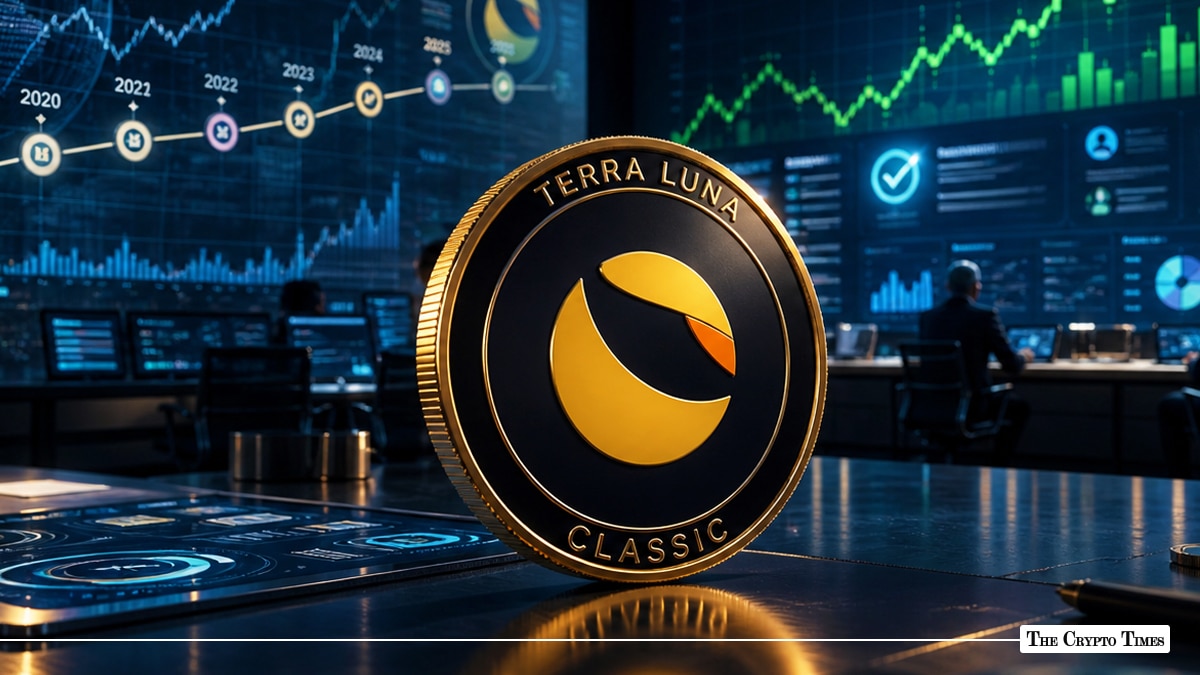
The story of Terra Luna Classic ($LUNC) is among the most dramatic in the history of decentralized finance. Once a top-ten cryptocurrency that powered a multi-billion-dollar algorithmic stablecoin ecosystem, it became the center of a “black swan” event in 2022 that wiped out $60 billion in market value almost overnight.
However, by 2026, $LUNC is no longer just a relic of a failed experiment. It has evolved into a community-led blockchain characterized by deflationary mechanics, decentralized governance, and a “phoenix from the ashes” market narrative that continues to defy skeptical expectations.
The origin: What is Terra Luna Classic?
Terra Luna Classic is the original version of the Terra blockchain. Before the 2022 collapse, it functioned as a dual-token system: UST (an algorithmic stablecoin) and LUNA (the utility and governance token).
When the peg failed in May 2022, the “minting” mechanism entered hyperinflation, flooding the market with trillions of new tokens. While the original developers moved on to a new chain (Terra 2.0), the remaining community rebranded the tokens as LUNC (Luna Classic) and USTC (TerraClassicUSD) and took control of the network’s future.
The 2026 landscape: Why LUNC is trending again
As of May 2026, Terra Luna Classic has regained attention as a high-volatility retail favorite. The project has recently seen increased interest due to two major catalysts:
Catalyst 1 — The 150% monthly surge
In the last 30 days, $LUNC has outperformed a significant portion of the altcoin market. This rally has been fuelled by technical breakouts and renewed speculative interest.
Market Data: See the full price breakdown — Terra Luna Classic surges 150% in a month amid massive social media volume
Catalyst 2 — The Binance burn effect
Binance remains the largest “guardian” of the LUNC ecosystem. Through its monthly burning mechanism, where the exchange destroys its own trading fee revenue generated from LUNC pairs, millions of tokens are permanently removed from circulation.
Burn Tracking: Monitor daily reductions via LUNC Dash or the official Binance announcement portal.
The Do Kwon factor: Separating fact from fiction
No discussion of Terra is complete without its founder, Do Kwon. However, 2026 has also seen the spread of misinformation.
A viral rumor recently suggested that Do Kwon had been pardoned after allegedly investing in a high-profile political crypto project (Trump’s WLFI). Fact-Check: It has been confirmed that Terra founder Do Kwon was NOT pardoned; he remains under intense legal scrutiny, and the LUNC chain remains fully community-governed.
Core mechanics: How LUNC works today
Terra Luna Classic operates as a Proof-of-Stake (PoS) blockchain built on the Cosmos SDK. Its survival depends on three strategic pillars:
Pillar 1 — The burn tax
The community has implemented an on-chain “burn tax” on every transaction. This ensures that even without exchange support, the total supply of 6.7 trillion tokens slowly decreases over time.
Pillar 2 — Staking and network security
Validators play a crucial role in securing the network. By staking LUNC, users earn rewards and participate in governance votes. This process is similar to other DePIN or AI projects; for instance, you can see how Gensyn ($AI) uses staking to secure its decentralized compute network.
Pillar 3 — Community governance
All major protocol decisions, from tax rates to network upgrades, are voted on by LUNC stakers via decentralized governance proposals on Terra Station.
LUNC at a glance — May 2026
| Metric | Details |
|---|---|
| Blockchain | Terra Classic (original Terra chain, Cosmos SDK) |
| Consensus | Proof-of-Stake (Tendermint) |
| Token | LUNC (Luna Classic) |
| Stablecoin | USTC (TerraClassicUSD) |
| Total Supply | ~6.7 trillion LUNC |
| Burn Mechanic | On-chain transaction burn tax + Binance monthly burns |
| Governance | Decentralized — L1 Joint Task Force + community validators |
Future outlook: Can LUNC re-peg?
The “Holy Grail” for the community is the re-pegging of USTC to $1. If successful, this would restore the utility of the network. While several “Signal Proposals” have been discussed in early 2026, the path to a sustainable re-peg remains a technical challenge.
For investors looking at high-conviction plays, it is vital to watch how broader US legislation, such as the CLARITY Act, will define the future of stablecoins like USTC.
Key milestones to watch
- USTC Re-peg Initiative — Long-term community-driven goal to restore the legacy stablecoin’s $1 peg.
- CLARITY Act — US stablecoin legislation that could directly affect USTC’s regulatory status.
- Binance Monthly Burns — Continued deflationary pressure; track at luncmetrics.com.
- L1 Joint Task Force Proposals — Active governance votes shaping the protocol’s technical future.


Frequently asked questions
What is the difference between LUNA and LUNC?
LUNA (Terra 2.0) is the token for the new blockchain created after the crash. LUNC (Luna Classic) is the token for the original blockchain maintained by the community.
Why is Binance burning LUNC?
Binance supports the community by burning a portion of trading fees to help reduce the massive 7 trillion token supply.
Is Do Kwon still involved?
No. Do Kwon has no role in LUNC governance. The project is managed by decentralized groups like the L1 Joint Task Force.
How do I protect my LUNC from scams?
As LUNC surges, “Pig-Butchering” and recovery scams often increase. Follow our guide on how to stay safe from crypto scams to protect your wallet.
Disclaimer:
Some elements of this content may have been enhanced with the help of our artificial intelligence (AI) assistants for purposes such as basic refinement, review, image generation, and translation to deliver high-quality news in a shorter time frame. However, all AI-assisted content is reviewed and approved by our team to ensure accuracy, fairness, and editorial integrity.