In the last chapter, we briefly introduced Proof-of-Work and Proof-of-Stake. While both achieve the same goal, reaching network consensus & they do so using fundamentally different resources and economic incentives.
Understanding the difference between Mining and Staking is crucial because it defines the security, speed, and environmental impact of a blockchain.
Proof-of-Work: The Miner
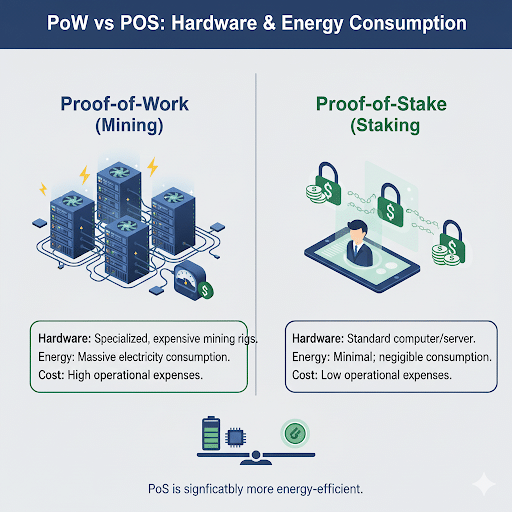
Proof-of-Work is the method used by Bitcoin. It requires real-world physical resources, specifically energy and specialized hardware (miners).
The Mechanism: Solving the Puzzle
In a PoW system, computers called Miners compete to be the first to find a solution to a difficult mathematical problem. This is a game of trial and error, requiring massive amounts of guessing power.
The first miner to find the right answer proves they did the “work.” They then get to propose the next valid block and are rewarded with new coins and transaction fees.
The Incentive and Security
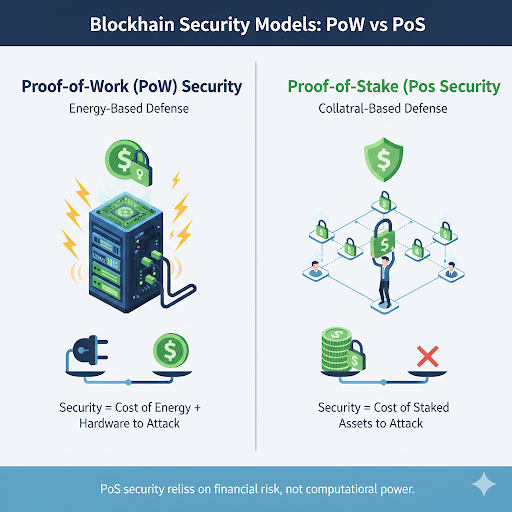
The incentive is the reward (new coins). The security comes from the huge financial cost of operating the mining equipment and paying for the electricity.
To successfully attack the network and cheat, you would need to control 51% percent of the entire network’s computing power. Since this would require billions of dollars in hardware and electricity, it becomes economically unfeasible. The cost of the attack far outweighs the potential gain.
Proof-of-Stake: The Validator
Proof-of-Stake is the method used by Ethereum (since 2022) and many newer cryptocurrencies. It is seen as the natural evolution of consensus mechanisms because it replaces raw energy with financial assets.
The Mechanism: Locking Up Assets
In a PoS system, participants are called Validators. Instead of buying expensive hardware, validators lock up (or stake) a specific amount of the network’s native currency.
The network then chooses a validator at random to create the next block. The selection is weighted: the more coins you stake, the higher your chance of being selected.
The Incentive and Security
The incentive for validators is also the reward (fees for validating transactions).
The security of PoS comes from the financial risk. If a validator tries to approve a fraudulent transaction, the network can immediately take away or “slash” their entire staked amount. This is a powerful financial deterrent against cheating.
Key Differences between Proof-of-work & Proof-of-stake
| Feature | Proof-of-Work (PoW / Mining) | Proof-of-Stake (PoS / Staking) |
| Resource Used | Energy (Electricity) and Computing Power | Digital Assets (Coins) and Financial Capital |
| Participant | Miner | Validator |
| Security Mechanism | High hardware/energy cost to attack (Economic cost of 51 percent attack). | Financial penalty (Slashing) for misbehavior. |
| Energy Impact | High energy consumption. | Low energy consumption (significantly greener). |
| Example | Bitcoin | Ethereum, Solana, Cardano |
Analogy: Winning the Right to Decide
Imagine a club needs to decide who gets to sign the club’s ledger next:
- PoW Club: Everyone races to solve a complex riddle using their calculators. The person with the biggest, fastest, and most power-hungry calculator wins. This favors those who can afford massive resources.
- PoS Club: Everyone who stakes their own money into a pot gets a ticket in a lottery. The network randomly draws a ticket. If the chosen person tries to cheat, they lose all the money they put into the pot. This favors those willing to commit their assets.
In short, PoW validates security through cost-of-production, while PoS validates security through cost-of-loss. This shift has been the focus of much of the blockchain world’s development in recent years.
Disclaimer:
Some elements of this content may have been enhanced with the help of our artificial intelligence (AI) assistants for purposes such as basic refinement, review, image generation, and translation to deliver high-quality news in a shorter time frame. However, all AI-assisted content is reviewed and approved by our team to ensure accuracy, fairness, and editorial integrity.