If blockchain technology is so superior and secure, why can a centralized payment company process thousands of transactions per second, while major blockchains often handle fewer than twenty?
The answer lies in the concept of Scalability, and the fundamental trade-off known as the Blockchain Trilemma.
This is the greatest challenge the industry faces: increasing speed without sacrificing the core promises of the technology.
What is Scalability?
Scalability, in technology, is the ability of a system to handle a growing amount of work.
When dealing with transactions, scalability means the ability to handle millions of transactions per second as the number of users increases globally.
Centralized companies, like credit card networks, achieve high scalability because they use massive, fast central servers and sacrifice decentralization.
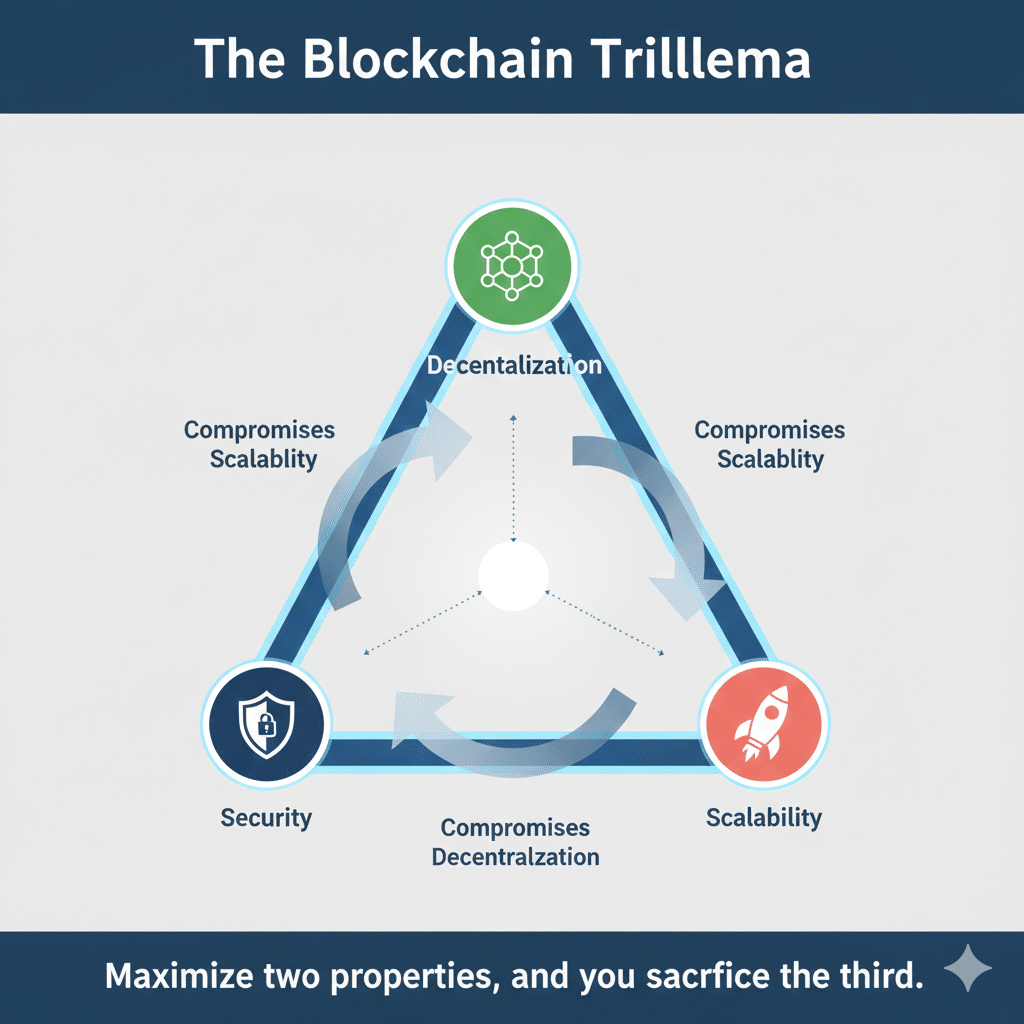
The Blockchain Trilemma Explained
The reason public blockchains are slow is because they try to achieve three things simultaneously, which is mathematically difficult to do:
- Decentralization: The network must be run by thousands of independent nodes worldwide.
- Security: The network must be cryptographically secure and immune to attacks.
- Scalability: The network must be able to process transactions quickly and cheaply.
The Trilemma states that any decentralized system can only perfectly achieve two of these three features at any given time.
The Bitcoin Trade-Off
Bitcoin, as the original blockchain, famously chose to maximize Security and Decentralization above all else.
- Security: It uses the highly robust, but energy-intensive, Proof-of-Work consensus.
- Decentralization: It is designed to be run on ordinary computers, keeping the barrier to entry low for node operators.
The compromise is Scalability. Because every single node must download, verify, and store every single transaction, the transaction size must be kept small. This deliberate limitation makes Bitcoin secure and decentralized but results in slow transaction speeds.
The Ethereum Trade-Off (The Shift to PoS)
Early Ethereum also prioritized Security and Decentralization but quickly ran into scalability problems that led to high transaction fees.
While Ethereum has now shifted to Proof-of-Stake(PoS) to improve energy efficiency, the core architectural limitations—requiring every node to process every transaction, still persist on the main layer.
Why Decentralization Slows Things Down
Imagine trying to pass a new law in a small town versus a massive country.
- Centralized System (Small Town): The mayor (central authority) just signs the paper. It’s fast, but risky.
- Decentralized System (Massive Country): The law must be debated by thousands of representatives, passed by two different houses of government, and approved by a wide consensus before it takes effect. This process is slow, but it guarantees that the decision is verified and fair.
On a blockchain, every transaction is a “law” that must be verified by thousands of nodes. The time it takes for every node to receive, process, and agree on the new transaction is what creates the bottleneck and limits transaction speed.
Solutions: The Path to Scale
Solving the trilemma involves designing new architectures that push the work away from the main chain, often called Layer 1.
The most common solutions focus on Layer 2 protocols. These are secondary networks built on top of the main chain that handle transactions off-chain, then submit the final, summarized result back to the main chain for security.
Examples include rollups and sidechains, which aim to increase scalability and speed without forcing the main chain to sacrifice its core promises of security and decentralization. The pursuit of true scalability remains the most active area of development in the entire blockchain space.
Disclaimer:
Some elements of this content may have been enhanced with the help of our artificial intelligence (AI) assistants for purposes such as basic refinement, review, image generation, and translation to deliver high-quality news in a shorter time frame. However, all AI-assisted content is reviewed and approved by our team to ensure accuracy, fairness, and editorial integrity.