Welcome to the start of our journey! The world of blockchain can seem complicated, but at its core, it’s built on some very simple, powerful ideas. Our goal in this first chapter is to cut through the jargon and explain exactly what a blockchain is and why it matters to you.
Think of blockchain not as a mysterious new type of money, but as a revolutionary way to record information.
The Simple Definition
A blockchain is simply a special type of database.
We call it a blockchain because it stores data in groups, or blocks, that are linked together in a chronological chain. Once a block of information is added to the chain, it cannot be changed or deleted.
The real magic, however, isn’t just in how the data is stored, but where it is stored: everywhere.
The Shared Ledger Example
To understand this concept, let’s look at how things work today using traditional systems, like a bank.
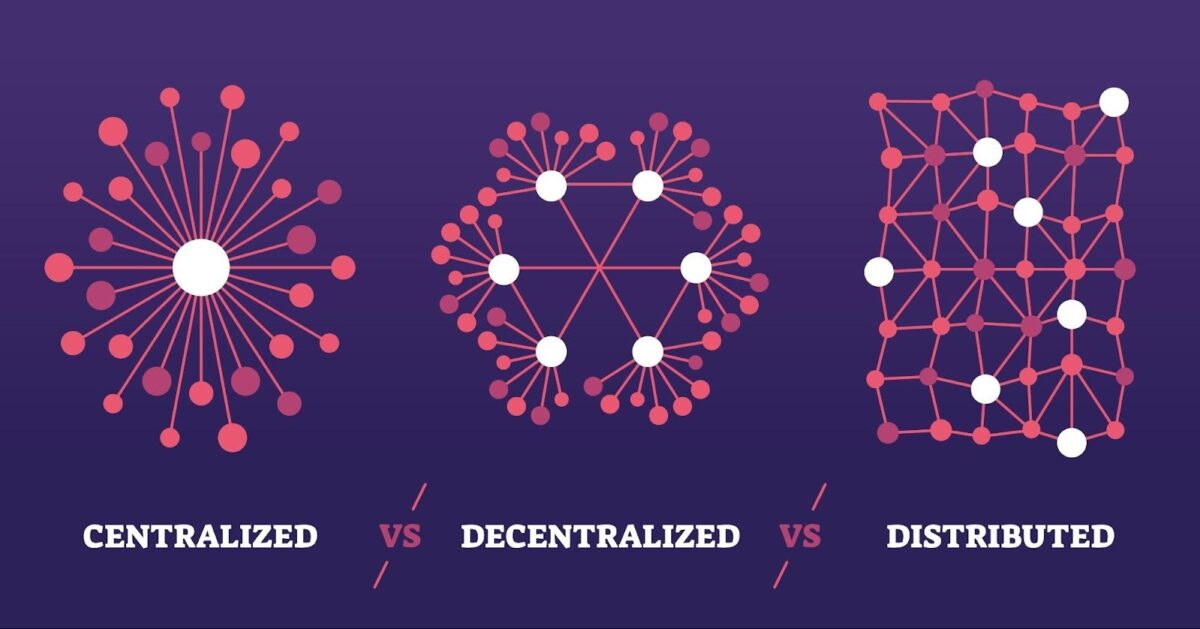
When you send money to a friend, only two people have the main record of that transaction: you and your bank. The bank is the single, centralized authority that confirms the transaction happened.
Now, imagine a small company with 10 employees. Instead of keeping a spreadsheet of expenses on one boss’s computer, they decide to use a shared, collaborative digital ledger, like a shared Google Sheet or document.
- Everyone in the company gets a copy of this ledger.
- When someone buys something, they announce it to the group.
- Everyone verifies the purchase, and then everyone updates their own copy of the ledger.
That shared, constantly updated, and verified record—where no single person holds the “master copy”—is the core idea of a decentralized, distributed ledger. That is what a blockchain is.
Why Do We Need This?
The main reason we use blockchain technology is to build trust without relying on a middleman.
In the traditional world, we rely on institutions like banks, governments, or tech companies (like Google or Amazon) to be that trusted middleman. If you trust the bank, you trust their ledger.
Blockchain technology removes the need for this central trust. Because millions of people (or computers called “nodes”) all hold a copy of the ledger, you don’t have to trust any single company. You just have to trust the math and the collective network.
This shift creates three powerful features that were previously impossible to coexist in a single system:
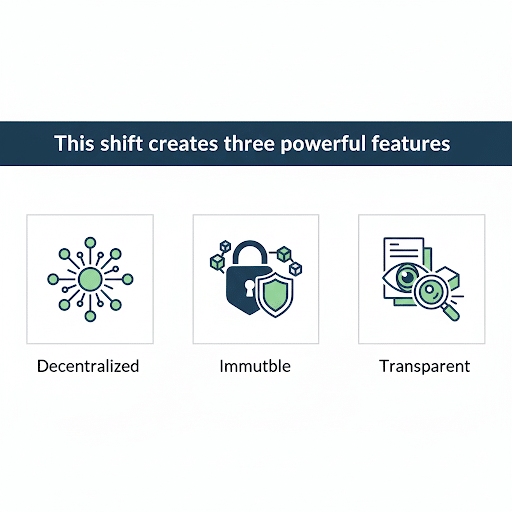
- Decentralization: No single person or group can control the data. If one server goes down, the other copies keep working.
- Immutability: Once a record is written, it is permanent. This is crucial for security and prevents fraud.
- Transparency: While personal names may be private, the ledger itself is often public. Anyone can see the records on the chain.
The Block and the Chain: An Analogy
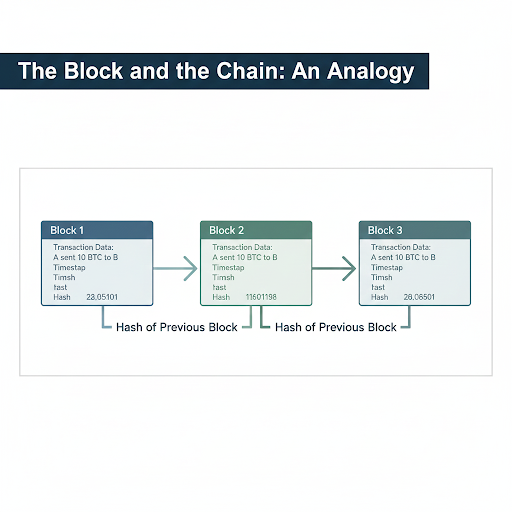
How does the data stay secure and unchangeable? By using a special linking method.
Imagine the ledger isn’t a long scroll, but a series of pages in a giant binder.
- Each page is a block. It holds a collection of recent transactions (like 1,000 recent sales).
- When a page is full, it gets a unique digital fingerprint (we will call this a hash in Chapter 1.4).
- The next page (the new block) must have the fingerprint of the previous page stamped at the top.
This is the chain part. Since every block is cryptographically linked to the one that came immediately before it, changing one single transaction on an old block would instantly change its fingerprint. This would then break the link to every subsequent block, making the tampering immediately obvious to the entire network.
Why You Should Care (Beyond Bitcoin)
While Bitcoin was the first major application of blockchain technology (it uses blockchain as its transaction ledger), the technology is far bigger than just currency.
Companies and developers are using the blockchain to create new systems for:
- Supply Chains: Proving where your coffee beans or medicines really came from.
- Voting: Creating transparent, tamper-proof election records.
- Digital Identity: Giving you ownership over your personal data instead of a social media company.
- Digital Ownership: Creating unique digital items NFTs that prove you own a piece of art or music.
In summary, the blockchain gives us a way to prove that something happened, that something exists, or that something is true, without ever needing a boss or a third party to vouch for it. It is the new architecture for trust in the digital age.
Disclaimer:
Some elements of this content may have been enhanced with the help of our artificial intelligence (AI) assistants for purposes such as basic refinement, review, image generation, and translation to deliver high-quality news in a shorter time frame. However, all AI-assisted content is reviewed and approved by our team to ensure accuracy, fairness, and editorial integrity.