Up until now, we have mostly discussed the characteristics of Public blockchains, like Bitcoin and Ethereum. These are open, permissionless systems that anyone can join.
However, blockchain technology is versatile, and not every organization wants a completely open system. This leads us to the crucial difference between public and private blockchains.
This choice between openness and control determines where and how blockchain technology can be applied.
1. Public Blockchains (Permissionless)
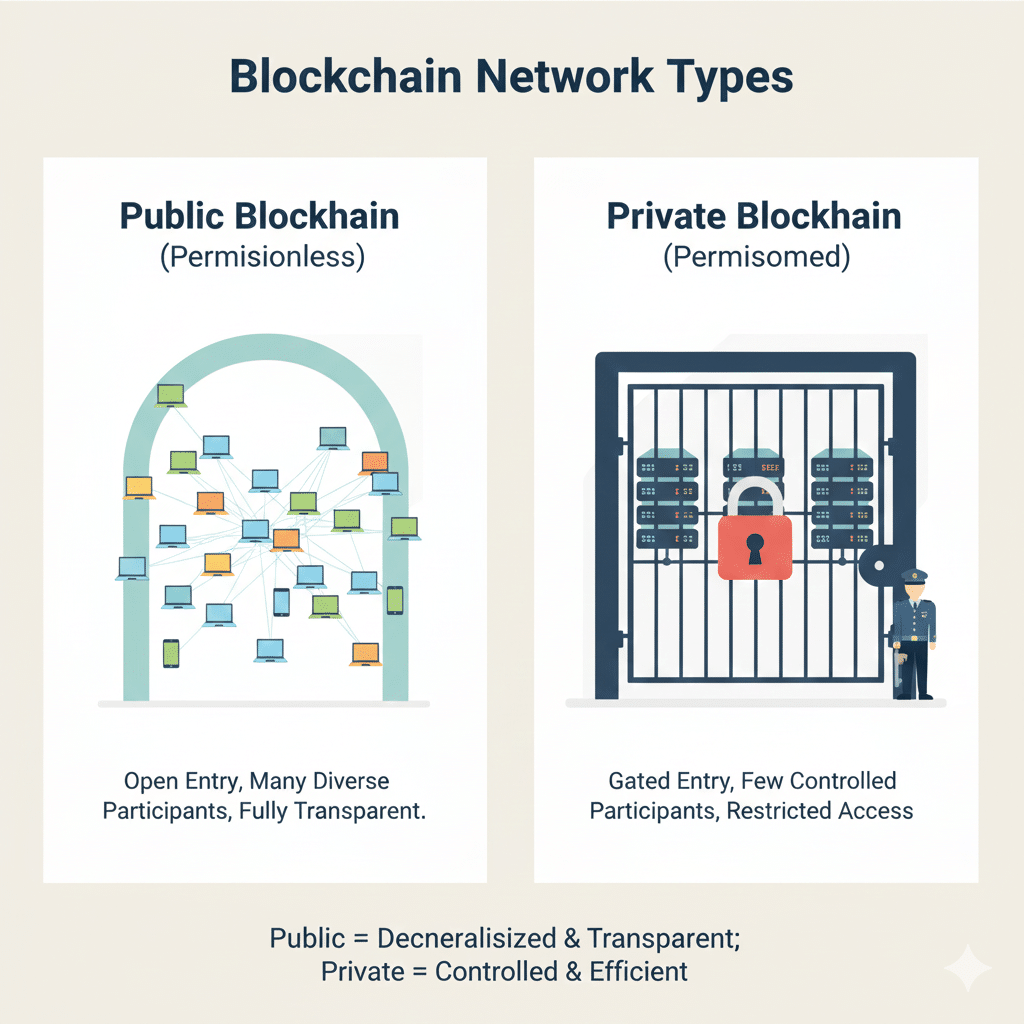
A public blockchain is exactly what it sounds like: a decentralized ledger that is open to the public.
Anyone can join the network, download the entire ledger, and participate in running a node. There is no central gatekeeper controlling access.
Key Features:
- Transparency: All transactions are viewable by everyone. While addresses are public, the owners’ identities remain pseudonymous.
- Trustless: You do not need to trust any company or person; you only trust the code and the consensus mechanism.
- High Censorship Resistance: Since millions of nodes worldwide run the ledger, no government or single entity can shut it down or alter its history.
Best Fit: Cryptocurrencies, globally distributed applications, and any system where absolute transparency and neutrality are required.
2. Private Blockchains (Permissioned)
A private blockchain, also known as a Permissioned Ledger, operates inside a single organization, much like a private intranet.
While it still uses blocks, chains, and cryptography, the entire system is centrally managed by that organization.
Key Features:
- Access Control: Only approved, known participants (employees or partners) are allowed to join the network and view the ledger.
- High Efficiency: Since there are fewer nodes, and the identity of every validator is known, transaction speed is much faster than public chains.
- Auditability and Privacy: The data is not visible to the outside world, satisfying strict regulatory requirements for privacy.
Best Fit: Corporate supply chain tracking, inter-bank settlement systems, and internal corporate record-keeping where speed and strict identity control are needed.
3. Consortium Blockchains (Hybrid)
The third type, the Consortium Blockchain, is a hybrid approach that sits between the public and private models.
It is a private blockchain, but instead of being controlled by a single company, it is governed by a group of organizations—a consortium.
For example, a group of 10 banks might set up a consortium chain where all 10 share the governance and validation rights, but no single bank controls 51 percent of the network.
Key Features: It offers more security and decentralization than a single-company private chain, but maintains the high speed and controlled access that public chains lack.
Finding the Right Fit: The Key Trade-off
The choice between these models always comes down to a trade-off between Decentralization/Trustlessness and Efficiency/Control.
| Feature | Public (Bitcoin) | Private (Corporate) | Consortium (Group of Banks) |
| Who can join? | Anyone (Open) | Only approved members | Group of approved organizations |
| Speed | Slow (due to high consensus work) | Very Fast | Fast |
| Trust Model | Trustless (Trust the Code) | Trusted (Trust the controlling organization) | Trust among member organizations |
| Use Case | Global currency, Open NFTs | Internal audits, Data sharing | Supply chains, Financial settlements |
Public chains prioritize trust and security above all else, requiring slow and expensive consensus. Private chains prioritize speed and control. Understanding these differences helps explain why blockchain is being adopted across many different industries, not just in finance.
Real-World Application: Which one to choose?
Do you need to issue a global currency?
Use a Public blockchain.
Does your company need to track internal assets across five departments?
Use a Private blockchain.
Does a group of $20$ hospitals need to share patient records securely without one hospital owning the data?
Use a Consortium blockchain.The evolution of blockchain is moving toward Interoperability, where these different types of chains can eventually “talk” to one another, allowing data to move from a private corporate environment to a public marketplace safely.
Disclaimer:
Some elements of this content may have been enhanced with the help of our artificial intelligence (AI) assistants for purposes such as basic refinement, review, image generation, and translation to deliver high-quality news in a shorter time frame. However, all AI-assisted content is reviewed and approved by our team to ensure accuracy, fairness, and editorial integrity.