We know that a blockchain is a shared, distributed ledger. But what happens when thousands of computers (nodes) around the world disagree on which block should be added next?
This is where the Consensus Mechanism comes in. Consensus simply means general agreement.
A consensus mechanism is a set of rules and incentives that ensures all participants in the network agree on the true and valid state of the blockchain. It prevents cheating and maintains a single, unified history.
The Need for Agreement
Imagine a busy village with 100 people sharing a single community ledger.
If five people try to add a record at the exact same time, and two of those records conflict (e.g., Alice spending the same $10 in two places), the village needs a clear rule to decide which record is valid and gets written into the history book.
Without this rule, the ledger would instantly split into multiple, competing versions, and the system would fail.
The consensus mechanism is that rule. It makes cheating incredibly expensive or impossible, ensuring the network is secure.
The Two Most Common Mechanisms
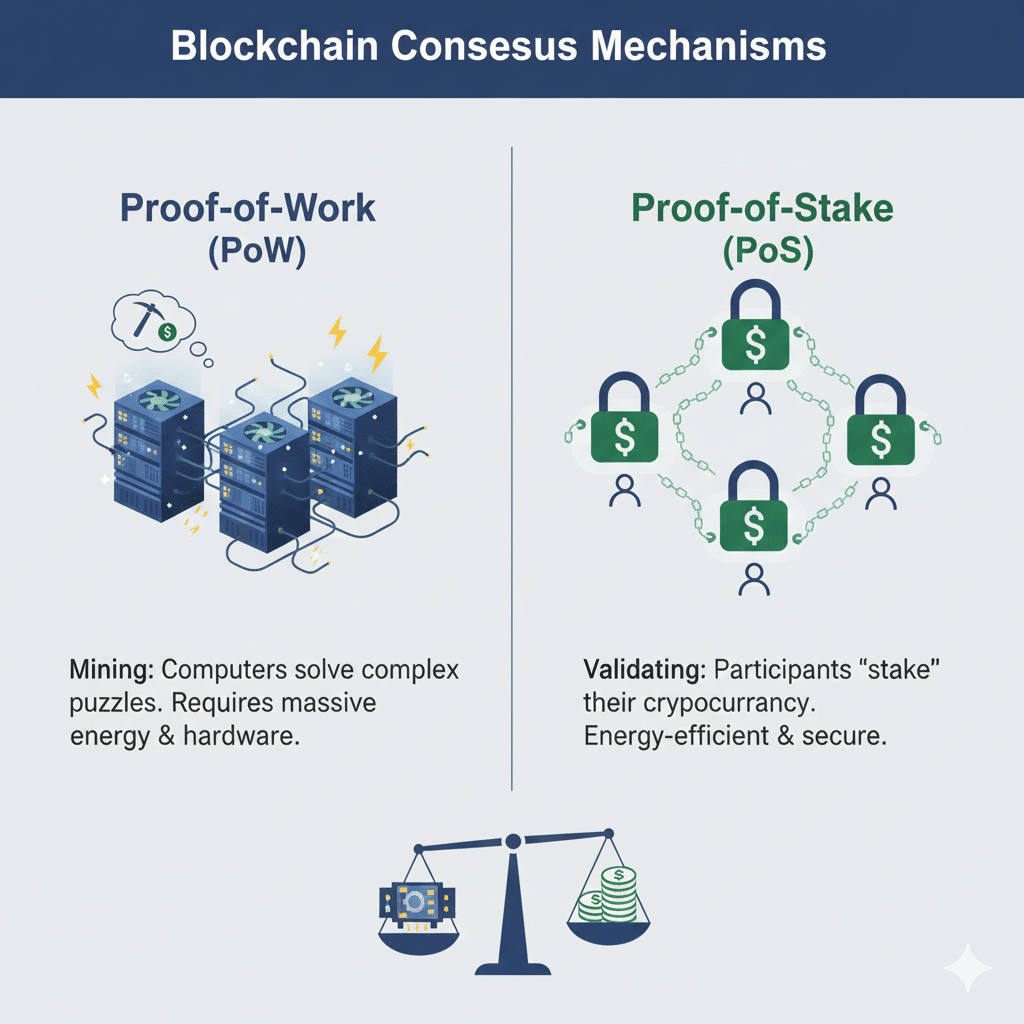
While there are many types of consensus mechanisms, two currently dominate the blockchain world: Proof-of-Work (PoW) and Proof-of-Stake (PoS).
1. Proof-of-Work
Proof-of-Work is the original mechanism, used by Bitcoin. It requires nodes (called miners) to expend massive amounts of computer processing power to solve a difficult math problem.
Solving this problem is like a cryptographic lottery. The first miner to find the solution wins the right to create the next block and add it to the chain. They are rewarded with new coins for their work.
The “work” is easily verifiable by the rest of the network but extremely hard to produce. This high cost of energy and computing power makes it economically impossible for a single entity to control 51 percent of the network and cheat.
2. Proof-of-Stake
Proof-of-Stake is a newer, more energy-efficient mechanism used by Ethereum and many other modern blockchains. It replaces computational work with financial commitment.
In PoS, users who want to participate in verifying transactions (called validators) must lock up (or “stake”) a certain amount of the blockchain’s native currency.
The network then randomly chooses a validator to create the next block, based on how much they have staked and for how long. The more you stake, the higher your chance of being chosen.
Instead of burning electricity, validators put their own financial capital at risk. If they try to validate a false transaction or cheat, they lose their staked money (this is called “slashing”). This financial penalty is the incentive to behave honestly.
Why Consensus Matters
The consensus mechanism is what allows a global, trustless network to operate as a single, harmonious entity.
It turns the decentralized nature of the ledger into a strength, not a liability. It ensures that even though thousands of copies of the ledger exist, all copies remain synchronized and identical.
This process of “how everyone agrees” is the final piece of the puzzle that establishes the blockchain as a permanent, reliable, and secure system for record-keeping.
Disclaimer:
Some elements of this content may have been enhanced with the help of our artificial intelligence (AI) assistants for purposes such as basic refinement, review, image generation, and translation to deliver high-quality news in a shorter time frame. However, all AI-assisted content is reviewed and approved by our team to ensure accuracy, fairness, and editorial integrity.