For most of 2025 and the first quarter of 2026, U.S. crypto regulatory developments shared a common feature: they were almost all prospective. Bills were drafted. Compromises were negotiated. Treasury and the White House signaled support. Industry CEOs called for movement. But the actual machinery of federal regulation, the markups, the executive orders, the commissioner appointments, the criminal charges, moved in starts and stops, frequently delayed and rarely landing within any reasonable window.
May 2026 broke that pattern. Across roughly four weeks, the United States produced more discrete, concrete, executable crypto regulatory developments than any single month since at least 2015 — and arguably the most consequential month for U.S. crypto policy since the very early ETF approval discussions. The Senate Banking Committee delivered the first bipartisan markup of comprehensive crypto market structure legislation in U.S. history. The President signed an executive order that put the Federal Reserve squarely on a 120-day clock to evaluate a structural question crypto firms have been litigating for years. The House Agriculture Committee — through a rare bipartisan letter — demanded the executive branch repopulate the regulator that would administer the resulting rules. The world’s largest spot Bitcoin custodian’s CEO published an eight-point public commitment positioning his company at the center of the resulting regime. Singapore brought criminal charges against the executive of a defunct Terra-era crypto lender, signaling that the post-2022 accountability cycle is now operational. And a new Federal Reserve Chair took the reins of the central bank in the middle of all of it.
Each of these developments would individually represent a meaningful month in any prior year. Compressed into May 2026, they collectively represent a regulatory inflection point. This is the deep-dive into what happened, why, and what it means for crypto’s next six months.
The CLARITY Act Markup: A Bill That Almost Didn’t Survive May 14
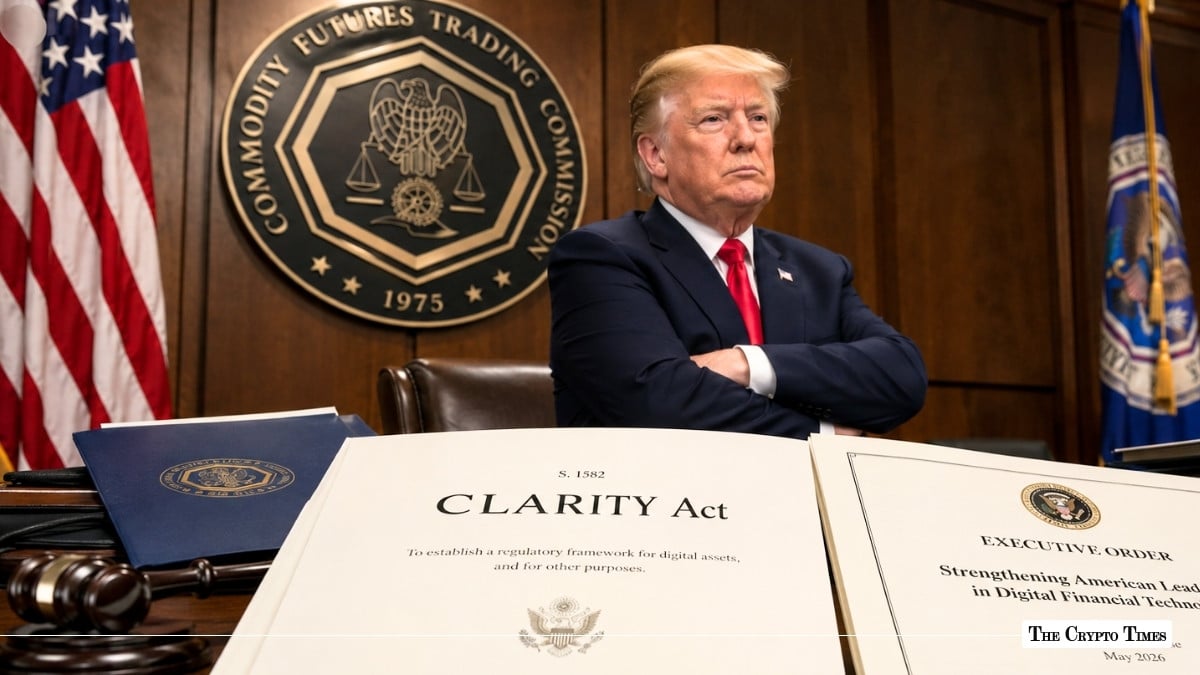
The Digital Asset Market CLARITY Act, which would, if signed into law, establish the first federal jurisdictional framework dividing digital asset oversight between the CFTC (digital commodities, spot markets) and the SEC (digital securities), entered the morning of May 14 with no certainty of bipartisan passage.
The bill survived only because a small bipartisan group struck a last-minute deal in the committee’s “ante room” after the markup had been gaveled into session.
The negotiations had ended Wednesday evening, May 13, without a deal, despite what sources described as “significant progress” on ethics guardrails for government officials. Talks then stalled when discussion shifted to proposed changes to the Blockchain Regulatory Certainty Act, the provision designed to shield non-custodial software developers from prosecution under money-transmitter laws. Republicans were unwilling to accept the changes Democrats sought.
The standoff continued into Thursday morning. The committee’s five pro-crypto Democrats, Senators Mark Warner (D-VA), Catherine Cortez Masto (D-NV), Raphael Warnock (D-GA), Alsobrooks, and Gallego, reportedly gathered in Warner’s office to discuss strategy before heading to the Dirksen Senate Office Building for the 10:30 a.m. hearing.
The turning point came after Chairman Tim Scott (R-SC) had already called the hearing to order, and largely unnoticed by the packed room of reporters watching an amendment dispute unfold on the dais. In the chamber off the hearing room known as the “ante room,” a small bipartisan group, including Senators Thom Tillis (R-NC), Cynthia Lummis (R-WY), Alsobrooks, and Gallego, gathered to strike the last-minute deal aimed at salvaging Democratic support.
The compromise centered on strategic revisions to five proposed Lummis amendments. Per Crypto in America, the key changes included a controversial removal of language from Section 301 that referenced the Blockchain Regulatory Certainty Act in Section 604, edits authorizing banks and credit unions to engage in digital asset activities, a small tweak relating to tokenization, a ban on insider trading involving ancillary assets, and language preserving state consumer protection laws.
All of the revised amendments were added back into the voting lineup at Scott’s direction and passed with bipartisan support — several reportedly clearing with 18 or 19 votes each. That bipartisan amendment support was the mechanism that ultimately secured the committee votes of Gallego and Alsobrooks.
The bill ultimately cleared the committee in a 15-9 vote.
The DeFi Cost of the Deal
The compromise was not cost-free. The removal of the Blockchain Regulatory Certainty Act reference from Section 301 has, “raised concerns among some DeFi advocates who say the change could strip out critical protections for software developers as the bill moves forward.”
This connects directly to a fight The Crypto Times has tracked since early May: the unresolved question of whether non-custodial developers should be shielded from money-transmitter liability under Section 1960 of Title 18. The ante-room deal kept the bill alive — but appears to have done so partly by trimming the very developer protections the DeFi industry had lobbied hardest to preserve.
How that language is restored, modified, or left out as the bill moves to the floor will be one of the most closely watched questions of the next phase.
Lummis Thanks the Coalition
Three days after the markup, on May 17, Senator Cynthia Lummis, the Wyoming Republican who chairs the Senate Banking Subcommittee on Digital Assets, used X to publicly thank the cross-aisle coalition that had made the markup possible. The post drew more than 150,000 views.
Her exact words: “Thank you to my colleagues, Treasury, the White House, and members of the industry for your tireless efforts and partnership. Now let’s get the Clarity Act to the President’s desk!”
The phrasing was deliberate. Lummis thanked not just her own party but “colleagues” broadly, Treasury, and the White House — an acknowledgment that the bill survived committee only because a cross-aisle group was willing to negotiate in real time. The closing line reframed the markup win not as a finish line but as a pivot point toward the far harder Senate floor fight ahead.
From here, the bill will be merged with text from the Senate Agriculture Committee before heading to the full Senate floor, where it will need 60 votes to overcome a filibuster. Roughly seven Democratic votes on the floor will determine whether the White House hits its July 4 signing target — and even in the best case, enforceable rules are unlikely to exist before 2027.
The Trump Fintech Executive Order: A Federal Reserve on the Clock
Five days after the CLARITY Act markup, on May 19, President Donald Trump signed an executive order titled “Integrating Financial Technology Innovation into Regulatory Frameworks” — what may turn out to be the most consequential federal-level fintech directive of his second term.
The order does three things. First, it directs six federal financial regulators — the Consumer Financial Protection Bureau, the Securities and Exchange Commission, the National Credit Union Administration, the Commodity Futures Trading Commission, the Federal Deposit Insurance Corporation, and the Office of the Comptroller of the Currency — to overhaul fintech rules on a 90-day clock and take action within 180 days.
Second, it requests the Federal Reserve Board to conduct a comprehensive evaluation, within 120 days, of granting direct access to Reserve Bank payment accounts and payment services to uninsured depository institutions and non-bank firms — including those engaged in digital assets and real-time payment networks.
Third, it defines “fintech firm” broadly enough to sweep nearly the entire crypto industry — exchanges, custodians, stablecoin issuers, on-chain payment processors, derivatives venues, infrastructure providers — into a single regulatory category subject to the streamlining mandate. The Section 2(a) definition explicitly includes “digital asset-related services” and “blockchain-based services” alongside payment processing, lending, deposit-taking, derivatives, investment management, brokerage, and custodial activities.
Why the Reserve Bank Payment-Access Question Matters
The most consequential provision is Section 4, which requests the Fed evaluate granting direct access to Reserve Bank payment accounts and payment services to uninsured depository institutions and non-bank financial companies, explicitly including those engaged in digital assets and other novel financial activities.
The order asks the Fed to deliver findings, options, and recommendations to the President within 120 days. Specifically, the evaluation is requested to assess: the Fed’s legal authority to extend such direct access; options for expanding access subject to risk management requirements; legal impediments that currently preclude direct access; and whether each of the 12 individual Federal Reserve Banks has independent legal authority to grant or deny access.
The substance of what the order calls “Reserve Bank payment accounts and payment services” is, in industry shorthand, master account access — the foundational piece of U.S. payment infrastructure that allows an institution to hold reserves at the Fed, send and receive payments through Fedwire and FedNow, and operate as a fully participating financial entity rather than as a customer of a correspondent bank.
For years, crypto-native firms, including state-chartered special-purpose depository institutions like Wyoming’s Custodia Bank, have argued that being denied this access constitutes a structural barrier that forces them to rely on intermediary banks, increasing cost, friction, and counterparty risk. The Custodia Bank litigation against the Federal Reserve, which has been ongoing since 2022, has centered on this exact question.
It is worth noting what the order does not do. It does not direct the Fed to grant such access. It does not name any specific firm. And it does not use the term “master account” — it refers throughout to the broader category of “Reserve Bank payment accounts and payment services.” That framing leaves the Fed substantial interpretive room, and any meaningful policy change will depend on what the FRB concludes in its 120-day review.
The Leadership Transition That Will Decide the Answer
The timing of the order is critical. The Fed-related sections explicitly use the word “requested” rather than “directed,” reflecting the central bank’s independence. The 120-day Federal Reserve evaluation requested in the order will be conducted by a Board operating under new leadership for the first time in eight years.
Kevin Warsh was confirmed by the Senate on May 13, 2026 by a 54-45 vote as the 17th Chair of the Federal Reserve, succeeding Jerome Powell whose term as chair concluded on May 15. Powell was named chair pro tempore on May 15 to serve until Warsh was sworn in, per aFederal Reserve Board press release. In a break from tradition, Powell will remain on the Board of Governors after stepping down — the first time a former Fed chair has done so in nearly 80 years — with a governor term that runs until January 2028.
Whether the Fed engages with the order, on what timeline, and with what substantive conclusions will be decisions made under Chair Warsh, a Trump appointee who served on the Fed Board from 2006 to 2011 and led the central bank’s response to the 2008 financial crisis, and not by the White House directly.
What the order accomplishes regardless of the Fed’s response is the placement of direct payment-access for crypto-native firms squarely on the federal regulatory agenda, with a presidential deadline attached. That alone is a meaningful procedural shift from a status quo in which the question has been litigated case by case for years.
The CFTC Vacancy Problem
One day after the CLARITY Act markup, on May 15, the U.S. House Committee on Agriculture sent a formal bipartisan letter to President Trump urging him to nominate a full, bipartisan slate of CFTC Commissioners.
The letter, signed by Committee Chairman Glenn “GT” Thompson (R-PA) and Ranking Member Angie Craig (D-MN), wrote that “the public, the markets, and the agency itself will be best served by a full five-member commission.” The Committee framed the request as a means to deliver “better regulations, more durable rules, and more sensitivity to the divergent views of key derivatives market stakeholders.”
The CFTC is, by statute, designed to operate as a five-member commission — traditionally composed of two Democrats, two Republicans, and a chair from the President’s party. Today, it has just one confirmed commissioner: Chairman Michael S. Selig, sworn in as the agency’s 16th Chairman in December 2025 after being confirmed by the Senate on December 18, 2025.
His predecessor, Acting Chairman Caroline Pham, departed shortly afterward to join crypto payments firm MoonPay — leaving Selig as the sole sitting commissioner of a five-seat agency, with four vacancies.
The Committee’s letter is explicit about what is driving the urgency: the CFTC is about to get significantly bigger responsibilities. “Congress and your Administration are also working together to add to the Commission’s work through the adoption of legislation that significantly expands the CFTC’s mandate to bring spot digital commodity transactions under federal oversight,” the letter states, noting that this “would require a significant rulemaking process.”
That legislation is the CLARITY Act, which would grant the CFTC primary jurisdiction over spot digital commodity markets — a substantial expansion of the agency’s authority that would require it to write an entirely new body of rules covering exchanges, custodians, brokers, and dealers in the digital asset space.
The letter’s timing is pointed. It is dated May 15, 2026 — one day after the Senate Banking Committee’s CLARITY Act markup. The bipartisan nature of the letter is itself notable. In a Washington environment where crypto regulation has frequently split along party lines, a jointly signed appeal from both the Republican chairman and the senior Democrat of a major House committee carries unusual weight — and signals that the under-staffing of the CFTC is a concern shared across the aisle.
Coinbase’s “Jobs Not Done” Eight-Point Framework
The institutional and corporate response to May’s regulatory momentum is best captured by a single post.
On May 25, Coinbase CEO Brian Armstrong posted an eight-point framework on X, describing what he characterized as the “jobs not done” of cryptocurrency. The post drew more than 189,000 views.
The eight points: tokenization of real-world assets, 24/7 global trading, next-gen payments (including agentic), AI-powered risk and compliance and advice, innovation-friendly regulation, expanded access through self-custodial wallets, low-cost capital formation, and “sound money” as a refuge from inflation.
He closed: “Jobs not done until we get these working for all. Will require lots of tech innovation and policy work to get there.”
The framework is, in one important sense, a piece of policy advocacy as much as it is a vision statement. The phrasing under Point 5 — “Move from one-size-fits-all to risk-based rules that encourage innovation and competition instead of stifling it” — is the language of the long-running argument between the cryptocurrency industry and the SEC. It is also, almost verbatim, the language of the May 19 Trump executive order.
The post arrived four days after Armstrong’s separate disclosure that Coinbase had cut its compliance restriction-resolution times by 90% by rebuilding workflows around AI, and at the end of a month in which Coinbase had publicly backed the CLARITY Act after reversing position twice earlier in the year. Read together, the May 25 post is best understood as Armstrong’s public commitment that Coinbase intends to spend the next decade building toward each of the items the CLARITY Act and the Trump executive order are now setting up.
The Hodlnaut Charge: Post-Terra Accountability Goes Operational
The regulatory and policy momentum of May 2026 was not confined to the United States. On May 26, Singapore’s Commercial Affairs Department charged Zhu Juntao, age 36, the former Chief Executive Officer of the now-defunct cryptocurrency platform Hodlnaut, with fraud by false representation.
Per the SPF statement, the alleged conduct centers on what Hodlnaut told its users during the most consequential weeks of the Terra/LUNA collapse. “Following a sudden price crash of TerraUSD (‘UST’) in early May 2022, Zhu allegedly instigated Hodlnaut’s employees to make misleading statements on the company’s official Telegram group chat and in official emails sent directly to some of its users between May and July 2022. These statements allegedly asserted that Hodlnaut did not have direct exposure to UST and/or did not suffer losses arising from the crash of UST.”
The gap between what Hodlnaut was telling users and what was actually on its books appears to have been substantial. Hodlnaut later disclosed a $193 million financial shortfall in court documents filed in Singapore in August 2022. The platform held approximately $13.1 million of user assets stranded on the collapsed FTX exchange, and had over 30,000 users worldwide before becoming defunct in August 2022.
The criminal charge is a separate track from the regulatory regime — it is a Penal Code matter pursued by the police, not a licensing matter pursued by the Monetary Authority of Singapore. But the signal is consistent: Singapore is willing to pursue individual senior executives, in court, for alleged conduct that affected retail crypto users during a market crisis, even when years have passed since the underlying events.
That signal travels. The Hodlnaut charge fits into a longer pattern of post-Terra accountability proceedings that have continued to play out years after the May 2022 collapse itself. Coinbase faces ongoing litigation over its 2022 suspension of Wrapped LUNA trading. CZ’s 2026 memoir,covered in detail by The Crypto Times, disclosed that Binance Labs’s $3 million 2018 investment in Terra had grown to roughly $1.6 billion on paper at the April 2021 peak — with Binance never selling during the run-up — even as the exchange faced subsequent UST-related litigation across multiple jurisdictions. TerraForm Labs co-founder Do Kwon’s own criminal proceedings continue to wind their way through the U.S. court system.
What distinguishes the Hodlnaut charge is its specificity. The allegation is not about strategy, accounting, or systemic risk management — it is about a precise, narrow claim: that Hodlnaut’s CEO directed employees to tell users something he allegedly knew to be false, through identifiable communication channels (the company’s official Telegram group, official emails), within a specific window (May to July 2022), on a specific topic (UST exposure and UST-related losses).
That specificity matters legally. Fraud by false representation under Singapore law requires demonstrating that a representation was made, that it was false, that the person making it knew or had reason to know it was false, and that it was intended to or did induce action by the recipient. The SPF’s framing is calibrated to each element of that offense.
The outcome of Zhu’s prosecution will be watched closely by other Asian crypto jurisdictions — including Hong Kong, South Korea, and Japan — that have built post-Terra and post-FTX consumer-protection regimes of their own.
How May 2026 Reshapes H2 2026
The cumulative effect of May 2026’s regulatory developments has materially reshaped the H2 2026 outlook for U.S. and global crypto policy in several specific ways.
First, the CLARITY Act now has a credible path to the President’s desk. The Senate Banking Committee passage was the single hardest procedural hurdle the bill faced. The bill must still merge with Senate Agriculture text, clear the Senate floor with 60 votes (requiring roughly seven additional Democratic crossovers from the committee floor), and pass through House-Senate conference if amended. The July 4 White House target remains ambitious but no longer implausible. Realistically, enforceable rules from the CLARITY Act are still unlikely to exist before 2027.
Second, the Federal Reserve is now on a public clock. Whatever the Fed concludes in its 120-day evaluation, the public pressure created by the May 19 executive order makes simply ignoring the question untenable. Chair Warsh’s first major institutional decision will almost certainly involve how the Fed responds. Custodia Bank’s seven-year litigation against the central bank has, in effect, just been escalated to the executive branch.
Third, the CFTC vacancy problem is now the rate-limiting constraint on CLARITY Act implementation. Even if CLARITY passes, an agency operating with a single confirmed commissioner cannot reasonably write the rules required to administer it. The bipartisan House Agriculture letter is the executive-branch pressure point that determines whether CFTC rulemaking can begin in 2026 or slips into 2027.
Fourth, the institutional crypto industry has formally chosen sides. Coinbase’s eight-point framework, Strategy’s ongoing accumulation, SpaceX’s S-1 disclosure of 18,712 BTC, and Block’s mass Lightning Network rollout earlier in 2026 collectively represent industry consolidation around a single thesis: crypto as financial infrastructure embedded in traditional finance, not as a parallel rebel system.
Fifth, criminal accountability for the 2022 collapse cycle has finally moved from regulatory action to courtroom charges. Singapore’s Hodlnaut charge is unlikely to be the last. The infrastructure of post-Terra accountability — civil litigation, regulatory penalties, criminal charges — is increasingly mature, increasingly cross-jurisdictional, and increasingly willing to pursue individual senior executives.
What Comes Next
The remaining weeks of Q2 2026 and Q3 2026 will determine whether May’s regulatory momentum produces lasting structural change or stalls at the Senate floor and the Fed’s deliberation table.
The key milestones to watch:
- Senate floor vote on the CLARITY Act, with the White House targeting July 4 passage. Whether the bipartisan coalition that survived the markup ante-room holds on the floor depends on how the unresolved Section 1960 / Blockchain Regulatory Certainty Act developer-protection question is resolved.
- The Federal Reserve’s 120-day response to the May 19 EO, with September 16, 2026 as the de facto deadline. Whether Chair Warsh concludes that existing law permits direct payment-account access for crypto firms will determine the trajectory of state-chartered crypto banks for years to come.
- CFTC commissioner nominations, which will determine whether the agency that would administer the CLARITY Act actually has the institutional capacity to write the rules. The House Agriculture Committee’s letter is now public pressure; whether the administration responds depends on White House priorities through the summer.
- The 90-day fintech regulator review, which lands on August 17, 2026. Whether the CFPB, SEC, NCUA, CFTC, FDIC, and OCC actually identify and streamline meaningful rules — or whether the review produces only modest cosmetic changes — will indicate the depth of the administration’s commitment to the EO’s stated framework.
- Subsequent post-Terra criminal charges, with the Hodlnaut prosecution serving as a template. Other regional crypto-lender failures — Celsius, BlockFi, Vauld, Zipmex — may face analogous proceedings.
Lummis’s framing on May 17 — “Now let’s get the Clarity Act to the President’s desk!” — was both a victory lap and a pivot. The harder fight, she implicitly conceded, was just beginning.
For the first time in years, U.S. crypto policy is now operating on a defined federal timeline. Whether that timeline produces lasting structural change or another year of unfulfilled expectations will be determined by the political and institutional decisions of the next four months.
What May 2026 established is that the machinery, finally, exists to make those decisions matter.