
Key takeaways
- Hodlnaut CEO Zhu Juntao was charged with six counts of fraud by false representation in Singapore on May 26, 2026, each carrying up to 20 years’ imprisonment.
- The Singapore-based crypto lender suspended withdrawals on August 8, 2022, with a reported $190 million hole tied to the May 2022 collapse of TerraUSD.
- Police allege Zhu instructed employees to send misleading statements to users in May–July 2022, asserting that Hodlnaut had no direct UST exposure or losses as a firm.
- Hodlnaut had 30,000+ users and over $500M in assets at its peak. The Singapore High Court wound up the company on November 10, 2023.
- Zhu has pleaded not guilty. A pre-trial conference is scheduled for June 2026.
For three years, Hodlnaut sold one of the most attractive promises in crypto: park your Bitcoin, earn interest, and let “vetted institutions” do the rest. The Singapore startup wrapped its pitch in the language of caution, risk management, tiered rates, and a Monetary Authority of Singapore licence application. Tens of thousands of people believed it.
Then, on the morning of August 8, 2022, a day before Singapore’s National Day, the withdrawal button stopped working.
On May 26, 2026, the moment 30,000 affected users had waited four years for arrived. Hodlnaut’s co-founder and former CEO, Zhu Juntao, was charged in Singapore with six counts of fraud by false representation, facing up to 20 years per count. This is the full story of how the company got there, and what its leadership allegedly told users while the platform was already falling apart.
What Was Hodlnaut?
Hodlnaut was a Singapore-based crypto lending platform. In plain terms, it ran something that looked and felt like a high-interest savings account, but for digital tokens.
Users deposited cryptocurrencies, Bitcoin (BTC), Ethereum (ETH), and stablecoins like USDC, USDT, and DAI, into a “Hodlnaut Interest Account.” In return, the company promised eye-catching annual yields, advertised over time at rates ranging from around 6% to nearly 13% APY, depending on the asset and tier.
How did Hodlnaut generate those returns? According to its own marketing, by lending users’ deposits to “vetted institutions,” typically crypto trading firms, hedge funds, and market makers who would pay Hodlnaut interest to borrow the assets. Hodlnaut kept a margin and passed the rest on to depositors.
The name itself was a wink to the community: a mashup of “HODL,” crypto slang for holding tokens through volatility, and “astronaut.”
What readers should know: A crypto lending platform is not a bank. Deposits aren’t insured. When users hand over their tokens, they typically transfer legal title to the platform, which then re-lends those tokens elsewhere. If the borrowers default, or if the platform’s own bets go wrong, depositors can lose everything. This is called counterparty risk, and it sits at the heart of the Hodlnaut story.
Who Is Zhu Juntao?

Zhu Juntao co-founded Hodlnaut in April 2019 alongside Simon Eric Lee. Zhu took the CEO seat, while Lee served as CTO. Both publicly described themselves as “Bitcoin maximalists,” people who view Bitcoin as the singular, superior cryptocurrency.
The duo were not industry veterans with decades of finance experience. They came through Antler, a global early-stage venture firm running startup cohorts in Singapore, joining Antler’s second Singapore cohort and graduating at its Demo Day in July 2019. Hodlnaut’s pre-seed funding was a modest $100,000 from Antler.
From there, Zhu became the public face of Hodlnaut. He gave press interviews, signed off on press releases announcing new interest tiers, and maintained an active presence on X, a habit that would later become central to the criminal case against him.
In 2026, the Singapore Police Force named Zhu, by then 36, as the only person charged so far in connection with Hodlnaut’s collapse. His co-founder, Simon Lee, was not named in the police announcement, though both men had previously been involved in broader regulatory and court proceedings.
The Early Growth Phase: 2019 to 2020
Hodlnaut launched in April 2019 into a young but rapidly maturing crypto-lending market. The pitch was simple: existing platforms like BlockFi and Celsius were primarily US-focused; Hodlnaut would build something tailored to Asia, headquartered in Singapore, a jurisdiction already positioning itself as one of the world’s most credible fintech hubs.
Through 2019 and 2020, the team focused on the basics:
- Onboarding users with know-your-customer (KYC) checks
- Supporting a small set of core assets: BTC, ETH, and major stablecoins
- Building a clean, mobile-friendly product that didn’t feel like the wild west of DeFi
By early 2021, the company’s pitch appeared to be working. In a February 2021 announcement, accounting firm Crowe Singapore validated that Hodlnaut held roughly $106 million in crypto assets, a credibility milestone the team featured heavily in marketing. By mid-2021, this figure had climbed to over $500 million in assets under management, according to a profile published by Antler.
How Hodlnaut Attracted Users With High-Yield Crypto Accounts
Three things made Hodlnaut especially attractive to retail crypto holders:
1. Headline-grabbing interest rates
At various points, Hodlnaut advertised up to 7.5% APY on BTC and as high as 12.7% APY on stablecoins like USDC and USDT, yields that dwarfed anything available from traditional banks.
2. Apparent regulatory legitimacy
Hodlnaut publicly promoted that it had received in-principle approval (IPA) for a Major Payment Institution licence from the Monetary Authority of Singapore (MAS) for its Token Swap feature, and that it was a certified Fintech by the Singapore Fintech Association. To many users, an “in-principle approval” sounded like a stamp of regulatory blessing, even though it was conditional, narrow in scope, and not a full licence.
3. The language of risk management
Press releases regularly quoted Zhu emphasizing “risk aversion policies” and adjustments made “in light of the current market conditions.” The platform offered no lock-in periods, no minimum deposits, and weekly interest payouts, features that made it appear flexible and conservative at the same time.
Behind the scenes, the company also kept up a steady drumbeat of small product launches, wrapped Bitcoin support, a Token Swap feature, mobile apps, and a VIP fixed-term loan product for whales depositing over 100 BTC, all of which reinforced the impression of a growing, professionally-run platform.
The Crypto Lending Boom — and Why Investors Trusted Platforms Like Hodlnaut
To understand why so many people sent real money to Hodlnaut, you need to remember what 2020 and 2021 felt like in crypto.
Bitcoin rose from under $5,000 in March 2020 to over $60,000 by late 2021. Stablecoins exploded as a category, with platforms worldwide offering double-digit yields on what looked, on the surface, like dollars on the blockchain. Centralized players like Celsius, BlockFi, Voyager Digital, Nexo, and Hodlnaut competed for deposits. Decentralized finance (DeFi) protocols offered even higher rates directly on-chain.
Quick glossary
- DeFi (Decentralized Finance): Financial services — lending, borrowing, trading — run by smart contracts on public blockchains, without a traditional company in the middle.
- Stablecoin: A crypto token designed to hold a stable value, usually pegged to the US dollar.
- Yield account: A product that pays interest on deposited crypto.
In that environment, a 7% yield on Bitcoin looked almost boring. Users assumed, reasonably, given the marketing, that platforms generated those returns by lending to professional trading firms hungry for capital, with appropriate risk controls.
What very few retail depositors understood was how aggressively some of those platforms were chasing yield themselves.
The Hidden Risks Behind Yield Products
Every high yield comes from somewhere. In crypto lending, the “somewhere” was usually one of three places:
- Lending to hedge funds and trading firms — collecting interest, sometimes against collateral, sometimes not.
- Earning yield in DeFi protocols — depositing user funds into smart contracts that paid attractive rates.
- Proprietary trading — the platform itself taking market positions with user funds.
Each of these strategies carried serious risks. A hedge fund could blow up (as Three Arrows Capital famously did in 2022). A DeFi protocol could be hacked, exploited, or fail outright. Proprietary trading meant the platform’s solvency was directly tied to its own market bets.
The crucial point: depositors generally had no clear, audited view of where their money was actually being deployed.
In Hodlnaut’s case, the picture that later emerged through court proceedings, regulator statements, and creditor allegations appeared far more concentrated than anyone outside the company appears to have realized.
Hodlnaut’s Exposure to Terra, UST, and the Anchor Protocol
To understand what allegedly happened inside Hodlnaut, you need to understand Terra.
Terra was a blockchain ecosystem built around an algorithmic stablecoin called TerraUSD (UST). Unlike “fiat-backed” stablecoins such as USDC, UST was not backed by actual dollars sitting in a bank. Instead, it tried to hold its $1 peg through a mint-and-burn mechanism involving a sister token called LUNA.
The magnet that drew billions into UST was the Anchor Protocol, a DeFi savings product on Terra that paid roughly 20% annualized yield on UST deposits. Many crypto-native investors knew that yield was unsustainable, subsidized by Terra’s own reserves, but the rate persisted long enough to attract enormous flows.
On April 6, 2022, just a month before the collapse, Hodlnaut publicly announced support for both UST and LUNA on its platform, with Zhu publicly praising the Luna Foundation Guard. The press release framed it as a celebration of Hodlnaut’s third anniversary.
According to court filings and subsequent reporting, the firm’s exposure to the Terra ecosystem was far larger than that public launch suggested. Reports indicate Hodlnaut moved a substantial share of user funds, by some accounts, nearly all of its productive assets, into UST positions, with much of that ultimately flowing through Anchor Protocol. The reported financial shortfall after the collapse was approximately $190 million, against a $193 million gap disclosed in court documents.
Key terms in this section
- Algorithmic stablecoin: A stablecoin that tries to hold its peg through code and trading incentives rather than dollar reserves.
- Anchor Protocol: A Terra-based DeFi savings product that paid up to ~20% yield on UST deposits.
- Terra/LUNA collapse: The catastrophic depegging of UST and crash of LUNA in May 2022, wiping out tens of billions of dollars in market value.
Warning Signs Before the Collapse
In hindsight, the signs were there — for those who knew where to look:
- Yields too good to last: A 12%+ APY on stablecoins required Hodlnaut to earn meaningfully more somewhere. Anchor’s ~20% on UST was one of the very few sources that could mathematically support those numbers.
- A late, public embrace of UST and LUNA: Adding UST in April 2022, weeks before the crash, suggested deep engagement with the Terra ecosystem rather than cautious distance.
- An IPA, not a full licence: Hodlnaut’s regulatory status with MAS was preliminary, conditional, and narrow in scope.
- Limited transparency on lending counterparties: Like most centralized lenders of the era, Hodlnaut never disclosed in detail where user funds actually sat.
None of these, individually, screamed “fraud.” Together, they pointed to a platform whose risk profile was very different from the conservative image it projected.
What Users Were Told vs What Later Came Out
This is the heart of the criminal case against Zhu Juntao.
In early May 2022, TerraUSD lost its dollar peg and LUNA collapsed toward zero, wiping out an estimated tens of billions of dollars across the crypto industry. Hodlnaut’s reported $190 million loss made it one of the most severely affected centralized lenders.
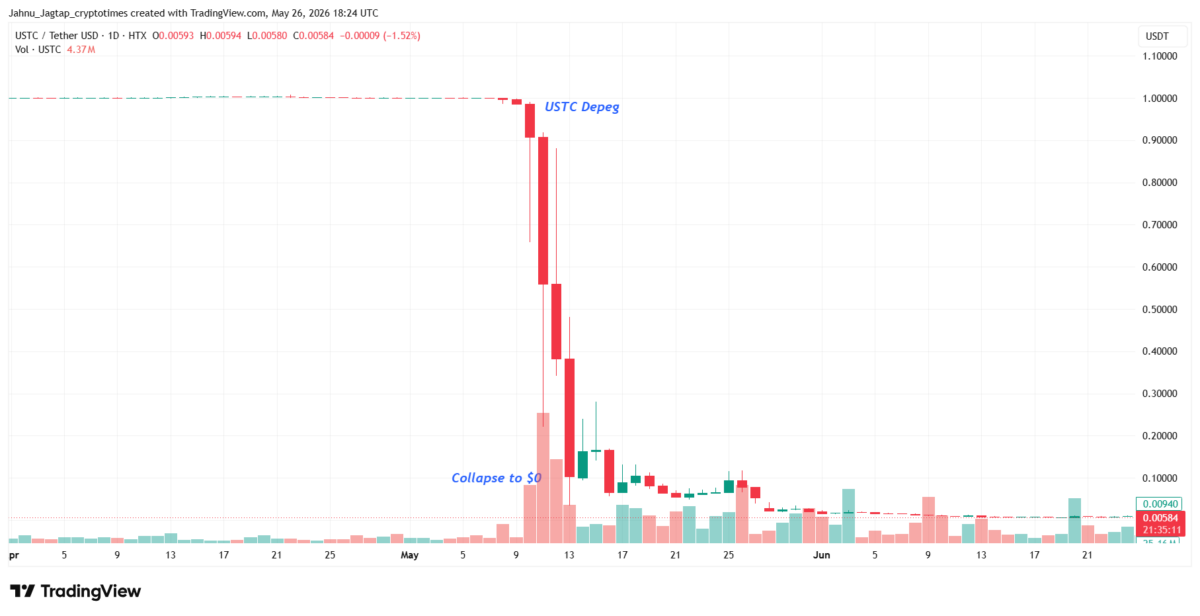
According to the Singapore Police Force’s May 26, 2026 statement, what users were told during May, June, and July 2022 was the opposite of what was happening:
- Police allege that Zhu instructed Hodlnaut employees to make misleading statements on the company’s official Telegram group and in emails to users between May and July 2022, asserting that Hodlnaut did not have direct exposure to UST or had not suffered losses from the UST crash.
- According to media reports, Zhu also posted on his personal X account in June 2022 that Hodlnaut “as a firm did not take any losses on UST” and that users who held UST on the platform did. (Exact phrasing of these statements is described in the charge sheets and contemporaneous press coverage.)
- A separate email, allegedly directed by Zhu and sent by an employee to a group of recipients in 2022, reiterated that Hodlnaut had not taken losses as a firm.
Police allege these statements helped slow panic withdrawals while the platform was already in deep financial trouble.
For now, these remain allegations being tested in court. Zhu has pleaded not guilty and disputes all charges. A pre-trial conference is scheduled for June 2026.
The Collapse and Legal Fallout
The public-facing reassurances ended abruptly on August 8, 2022, when Hodlnaut suspended all withdrawals, swaps, and deposits, citing “recent market conditions.”
Days later, the company applied to the Singapore High Court to be placed under interim judicial management, a court-supervised process that gives a struggling company protection from creditors while professionals (in this case, partners from EY) try to restructure or wind it down.
The picture that emerged in court was grim:
- Hodlnaut had a reported $193 million financial shortfall, largely tied to the Terra/UST collapse.
- The company also disclosed that it held assets worth $13.1 million on the FTX exchange, which itself collapsed in November 2022, deepening the hole.
- According to reporting on the interim judicial managers’ findings, Hodlnaut’s founders and several employees allegedly deleted more than 1,000 files and were uncooperative during the early phase of court proceedings.
In November 2022, the Singapore Police Force’s Commercial Affairs Department (CAD) confirmed it had opened a formal investigation into Hodlnaut and its directors for suspected cheating and fraud after receiving multiple police reports from users.
The civil and insolvency side moved faster than the criminal side. In [2023] SGHC 323, dated 10 November 2023, Justice Aedit Abdullah of the General Division of the High Court of Singapore granted a winding-up order against Hodlnaut.
The judgment is notable beyond the Hodlnaut story itself: it tackled the legal question of whether cryptocurrency obligations should count as “debts” for insolvency purposes under Singapore’s Insolvency, Restructuring and Dissolution Act.
The court held that Hodlnaut’s obligations to return cryptocurrency to creditors did count as debts in determining cash flow insolvency, and that imposing a withdrawal halt did not extinguish those obligations. Net liabilities were assessed at roughly $92 million as of July 2023. The directors’ alternative proposal, a non-binding restructuring offer from a firm called OPNX, was rejected as having a very low likelihood of success, with the judgment also noting that major creditors did not support it.
EY’s interim judicial managers were appointed as liquidators.
Three years later, on May 26, 2026, the criminal phase arrived. Zhu was charged with:
- Three counts under Section 424A(1)(a) read with Section 424A(3) of Singapore’s Penal Code 1871 (fraud by false representation).
- Three counts under the same provision read with Section 109 (abetment) — relating to allegedly instigating employees to make misleading statements.
Each charge carries a maximum penalty of up to 20 years’ imprisonment, a fine, or both.
From Terra to Hodlnaut: Test of Disclosure, Insolvency, and Enforcement
The Hodlnaut case sits inside a much larger story. The May 2022 Terra collapse triggered a chain reaction involving Three Arrows Capital, Celsius Network, Voyager Digital, BlockFi, and FTX, wiping out a generation of centralized crypto lenders and exposing billions of dollars in user losses.
What makes Hodlnaut distinct, and worth watching closely:
- Singapore’s role: Singapore authorities are pursuing criminal charges against a high-profile homegrown crypto founder, sending a clear signal to both industry and investors that the jurisdiction will not let fraud allegations against crypto firms quietly fade.
- A landmark insolvency precedent: The 2023 judgment is one of the clearest Singapore court rulings to date, treating cryptocurrency obligations as debts for insolvency purposes, a decision likely to influence how future crypto failures are wound up across the region.
- Test of corporate disclosure standards: The case isn’t about whether Hodlnaut took losses — losses are not, by themselves, a crime. It’s about what executives said publicly while those losses were happening. The outcome could shape how aggressively regulators and prosecutors elsewhere treat misleading statements by crypto platform leaders.
Lessons for Crypto Investors
Whatever the eventual verdict in Zhu’s case, the Hodlnaut story already offers several hard-won lessons:
- Headline yield is a warning, not a feature: Anything significantly above what professional money markets pay must be funded by risk, somewhere, by someone. If a platform can’t (or won’t) explain exactly how, treat that as a red flag, not reassurance.
- “In-principle approval” is not a full licence: Provisional regulatory status, narrowly scoped, is not the same as the level of oversight applied to banks or fully licensed payments firms.
- Counterparty risk is real, even at “boring” platforms: A crypto lending account is not a savings account. Deposits are not insured. Legal title typically transfers to the platform. If the platform fails, depositors become unsecured creditors at the back of a long line.
- Concentration risk hides easily: Hodlnaut’s reported exposure to a single ecosystem (Terra) was, by all accounts, enormous. Most users had no way to see it.
- Public statements during a crisis deserve scrutiny: When a platform tells users everything is fine while pausing internally, the gap between the two messages is exactly where regulators and prosecutors look first.
What the Case Reveals About Trust in Crypto Lending
Hodlnaut began the way many crypto startups do, with a small founding team, a clean product, a credible jurisdiction, and a simple promise: deposit your tokens, earn interest, sleep easy.
For three years, that promise worked. By early 2022, Hodlnaut had over 30,000 users and hundreds of millions of dollars in deposits. Then, in the space of a few weeks in May 2022, a single bet on a collapsing algorithmic stablecoin unravelled the entire structure, and, according to Singapore’s prosecutors, what executives said next allegedly turned a financial disaster into a criminal case.
The trial ahead will determine Zhu Juntao’s individual responsibility. But for everyone else — investors, regulators, and founders of legitimate crypto firms. The case is already a kind of verdict. Trust in crypto lending was built largely on words: marketing copy, founder tweets, regulatory-sounding accreditations. The Hodlnaut story shows how quickly those words can outrun the reality behind them, and how long it can take for the courts to catch up.
Timeline Table (2019 – Early 2022 and Key Later Dates)
| Date | Event |
|---|---|
| April 2019 | Hodlnaut founded in Singapore by Zhu Juntao and Simon Eric Lee. |
| July 2019 | Co-founders graduate from Antler’s second Singapore cohort; receive ~$100,000 pre-seed funding. |
| 2020 | Platform builds out core BTC, ETH and stablecoin interest accounts; KYC onboarding scales. |
| Feb 2021 | Crowe Singapore validates ~$106M in crypto assets held by Hodlnaut. |
| Mid-2021 | Reported AUM crosses ~$500M (per Antler profile). |
| Aug 2021 | Hodlnaut introduces tiered interest rates; advertises up to 12.7% APY on stablecoins. |
| Late 2021 | Hodlnaut announces in-principle approval from MAS for a Major Payment Institution licence (Token Swap feature). |
| Jan 2022 | Interest rates revised; tiers updated “in light of market conditions.” |
| 6 April 2022 | Hodlnaut launches support for TerraUSD (UST) and LUNA on the platform. |
| Early May 2022 | TerraUSD depegs; LUNA collapses to near-zero. |
| May–July 2022 | Alleged misleading statements made on Hodlnaut’s Telegram, in emails, and on Zhu’s personal Twitter/X account. |
| 8 Aug 2022 | Hodlnaut freezes all withdrawals, swaps and deposits. Applies for judicial management. |
| Nov 2022 | Singapore Police’s CAD opens formal fraud investigation into Hodlnaut and its directors. |
| 2023 | OPNX restructuring offer rejected; directors’ conduct flagged by the court. |
| 10 Nov 2023 | Singapore High Court orders Hodlnaut wound up — [2023] SGHC 323. EY appointed as liquidators. |
| 26 May 2026 | Zhu Juntao charged with six counts of fraud by false representation; pleads not guilty; pre-trial conference set for June 2026. |
Key Facts Table
| Item | Detail |
|---|---|
| Company | Hodlnaut Pte Ltd |
| Founded | April 2019, Singapore |
| Co-founders | Zhu Juntao (CEO); Simon Eric Lee (CTO) |
| Backer | Antler (pre-seed, ~$100,000) |
| Users at peak | ~30,000+ worldwide |
| AUM (Feb 2021) | ~$106 million (Crowe Singapore validation) |
| AUM (mid-2021) | ~$500 million (per Antler) |
| Headline yields | Up to ~7.5% APY on BTC; up to ~12.7% APY on USDC/USDT |
| Reported losses (May 2022) | ~$190 million linked to Terra/UST |
| Court-disclosed shortfall | ~$193 million |
| FTX exposure (Nov 2022) | ~$13.1 million |
| Net liabilities (July 2023) | ~$92 million |
| Winding-up order | [2023] SGHC 323 (10 Nov 2023) |
| Liquidators | EY (former interim judicial managers) |
| Charges against Zhu (May 2026) | 6 counts — 3 under Penal Code §424A(1)(a) + §424A(3); 3 under §424A(1)(a) + §424A(3) + §109 |
| Maximum penalty | Up to 20 years’ imprisonment + fine, per charge |
| Plea | Not guilty |
Also Read: Inside Bitcoin’s 7-Year Quantum Shield: BIP-360 and BIP-361 Plan to Save a $1.5 Trillion Network
FAQs
1. What is Hodlnaut, and what did it do?
Hodlnaut was a Singapore-based crypto lending platform, founded in 2019, that let users deposit cryptocurrencies like BTC, ETH, and stablecoins to earn interest. It generated returns by lending those deposits to other institutions and, allegedly, deploying them into yield-generating products like Anchor Protocol on Terra.
2. Who is Zhu Juntao?
Zhu Juntao is the co-founder and former CEO of Hodlnaut. He co-founded the company in April 2019 alongside Simon Eric Lee. On May 26, 2026, he was charged with six counts of fraud by false representation in Singapore.
3. Why did Hodlnaut collapse?
Hodlnaut suspended withdrawals on August 8, 2022. Court filings indicate the company suffered a ~$190 million loss tied to the collapse of TerraUSD (UST) in May 2022, leaving it unable to meet its obligations to depositors.
4. How much did Hodlnaut lose in the Terra collapse?
Reports and court filings indicate a loss of approximately $190 million linked to UST exposure, against a court-disclosed shortfall of about $193 million.
5. What charges does Zhu Juntao face?
Six charges in total: three under Section 424A(1)(a) read with Section 424A(3) of Singapore’s Penal Code 1871, and three under the same provision read with Section 109 (abetment). Each carries a maximum of 20 years’ imprisonment, a fine, or both. Zhu has pleaded not guilty.
6. What happened to Hodlnaut as a company?
Hodlnaut was placed under interim judicial management in 2022 and formally wound up by the Singapore High Court on November 10, 2023, in [2023] SGHC 323. EY partners, who had served as interim judicial managers, were appointed as liquidators.
7. Can Hodlnaut users still recover their funds?
Recovery is being handled through the liquidation process led by EY. As of the 2023 judgment, net liabilities were assessed at roughly S$92 million, and creditors are unlikely to recover anywhere near the full value of their deposits.
8. How is this case different from FTX or Celsius?
FTX and Celsius are US-led cases involving exchanges and lenders with very different business mixes. Hodlnaut is significant because it tests Singapore’s willingness to bring criminal fraud charges against a homegrown crypto founder, and because the Singapore High Court has already issued a landmark ruling treating cryptocurrency obligations as debts for insolvency purposes.
Disclaimer:
Some elements of this content may have been enhanced with the help of our artificial intelligence (AI) assistants for purposes such as basic refinement, review, image generation, and translation to deliver high-quality news in a shorter time frame. However, all AI-assisted content is reviewed and approved by our team to ensure accuracy, fairness, and editorial integrity.