The dominant popular narrative around Bitcoin Pizza Day reduces Laszlo Hanyecz to a single line: “the guy who paid 10,000 BTC for pizza.” Sixteen years on, this framing remains the most consistently misleading thing said about the most important transaction in the network’s history.
Hanyecz was, by mid-2010, one of the most consequential developers in Bitcoin’s small community. He had built and deployed the first macOS port of Bitcoin Core, translating the original Windows/Linux codebase onto an Apple environment so Mac users could connect to the network natively. PerNathaniel Popper’s account in Digital Gold, Hanyecz was one of “the first five developers who helped Satoshi” iterate on the protocol.
His more transformative contribution was technical, not user-facing. In early 2010, every Bitcoin block was mined on a standard CPU: Satoshi’s “one CPU, one vote” architecture, designed for an egalitarian distribution of network rewards. Hanyecz recognized a fundamental inefficiency in this setup. CPUs compute sequentially. The SHA-256 hashing algorithm at the heart of Bitcoin mining doesn’t need sequential logic — it needs millions of identical brute-force calculations done in parallel. Graphics Processing Units (GPUs) — built to render video game graphics with thousands of small parallel cores — were structurally far better suited to this kind of math.
Hanyecz wrote the code that turned graphics cards into Bitcoin mining engines. Per the documented record, the breakthrough yielded a roughly tenfold increase in his hashpower over standard CPU rigs. He was, within weeks of deployment, mining at speeds the rest of the network simply could not match. According to Digital Gold, he was “winning up to blocks of 50 bitcoins per day and multiple blocks per hour” using his experimental methods. On-chain analysis later compiled by the OXT blockchain explorer shows his wallet balance climbing rapidly — peaking at 20,962 BTC in May 2010 and reaching 43,854 BTC by June 2010.
For context: at that moment in 2010, no one in the world had ever held that much Bitcoin outside of Satoshi Nakamoto. Hanyecz was, briefly, the closest thing the network had to a mining oligarch; by accident, by virtue of one technical insight.
The Ideological Clash With Satoshi
Hanyecz did not keep the breakthrough secret. He shared his GPU mining code with Satoshi Nakamoto, expecting the network’s creator to be pleased.
Nakamoto was not pleased.
In documented correspondence between the two — recovered from the early Bitcointalk archives and Hanyecz’s own later interviews — Satoshi warned that GPU-class mining would inevitably concentrate hashpower among participants with specialized hardware, ending the egalitarian model on which the network’s security depended. The exchange culminated in Nakamoto’s now-famous line: “It’s inevitable that GPU compute clusters will eventually hog all the generated coins, but I don’t want to hasten that day.”
Hanyecz, by his own later account, felt genuine remorse. “I felt guilty,” he told an interviewer years afterward. “As if I had spoiled someone else’s project.”
He stopped publicly promoting the standalone GPU code. But there was a problem: he had already integrated his mining innovation as a patch into the open-source Bitcoin Core repository to test it. Other technically literate users discovered the patch, extracted the logic, and built standalone GPU miners for Windows, Mac, and Linux. Within months, the era of CPU-only mining was effectively over. The trajectory toward FPGA mining, ASIC mining, and eventually the gigawatt-scale industrial Bitcoin mining operations that secure the network in 2026 began here, with Hanyecz’s GPU patch.
This is the context that makes the pizza transaction comprehensible. By May 2010, Hanyecz’s wallet was overflowing with Bitcoin that had no liquid market and traded, when it traded at all, for fractions of a penny. He himself described it to interviewers as “Monopoly money”: a curious digital token that accumulated automatically as a byproduct of his coding hobby. The asset had no exchange infrastructure (Mt. Gox would not launch until July 2010), no merchant acceptance, no documented commercial use, and no real-world price discovery beyond informal forum trades.
What it had not yet proven was that it could buy anything.
The Four-Day Negotiation
On May 18, 2010, Hanyecz posted to the Bitcointalk forum under his username “laszlo”: “I’ll pay 10,000 bitcoins for a couple of pizzas… Like maybe 2 large ones so I have some left over for the next day. I like having left over pizza to nibble on later.”
He listed his preferred toppings — onions, peppers, sausage, mushrooms, tomatoes, pepperoni — and explicitly banned “weird fish topping[s].” He clarified that the counterparty could either make the pizzas themselves or order them from a delivery service. He wasn’t fussy about how the food got there. He just wanted to test whether the cryptographic abstraction in his wallet could be converted into something he could eat.
The post sat for four days. Forum members debated whether 10,000 BTC was a serious offer or a joke. One user, “ender_x,” commented that the sum was “quite a bit,” pricing the offer at roughly $41 in informal exchange terms. International members expressed interest but couldn’t resolve the logistics of ordering pizza delivery across borders. On May 21, Hanyecz himself returned to the thread, publicly asking the forum whether his bid was too low.
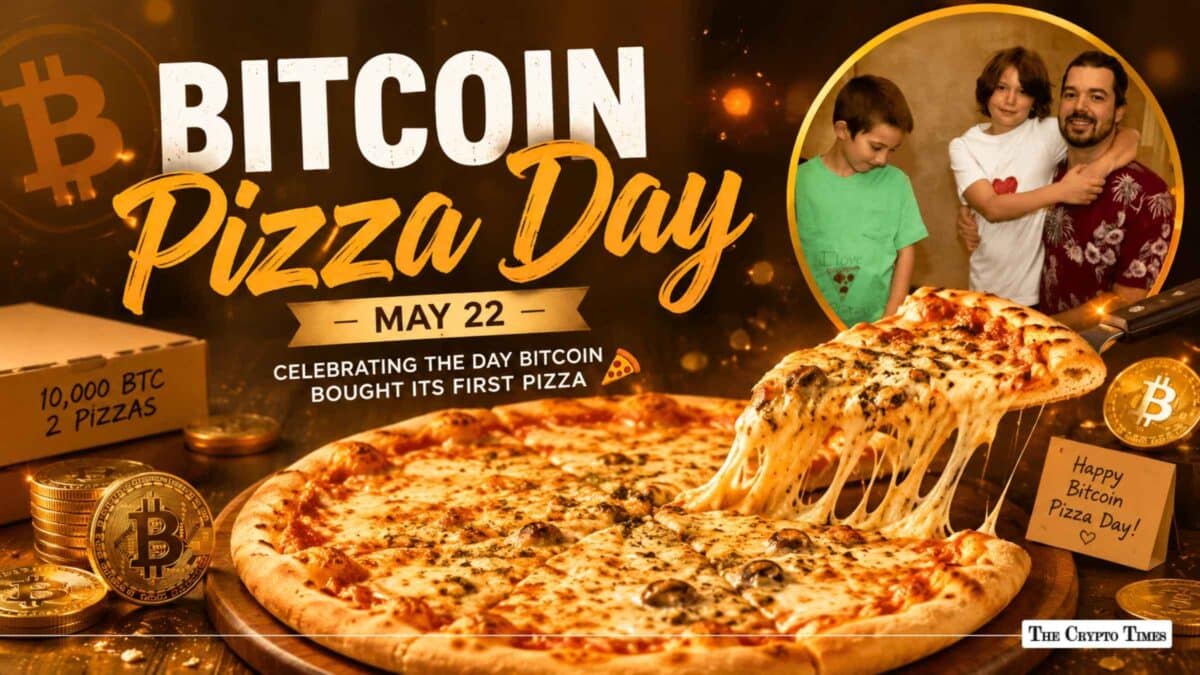
The market cleared on May 22, 2010. A 19-year-old California student named Jeremy Sturdivant, posting under the alias “jercos,” accepted the terms via Internet Relay Chat. Using his own debit card and roughly $25 of personal fiat, Sturdivant placed an order at a Jacksonville, Florida Papa John’s franchise and had two large supreme pizzas delivered to Hanyecz’s home.
When the delivery arrived, Hanyecz sent 10,001 BTC to Sturdivant’s wallet over IRC — 10,000 BTC for the pizzas, plus a 1 BTC transaction fee paid to the network’s miners. At 7:17 PM, he posted an update to the Bitcointalk thread: “I just wanted to report that I traded 10,000 bitcoins for pizza.” He included a photograph of the pizzas.
The first documented commercial Bitcoin transaction was complete. Implied exchange rate: approximately $0.0041 per BTC.
The $400 Liquidation
The mythology that Sturdivant became a long-term “HODLer” who slowly turned $25 worth of pizza into a billion-dollar fortune is, simply, untrue. Sturdivant did not hold the 10,000 BTC. Operating under the same liquidity constraints as everyone else in 2010 — no exchanges, no on-ramps, no obvious path to convert the asset into anything useful — he liquidated the entire position within months, for approximately $400 in fiat, and used the proceeds to fund a road trip across the United States with his girlfriend.
He has expressed no regret. “Even after fees, I could convert the 10,000 BTC back at the original price, and I didn’t see Bitcoin completely collapsing, although I never imagined its future success,” he told an interviewer in a later retrospective. “It seemed fair to both parties and, frankly, who doesn’t love pizza?”
Hanyecz, too, kept moving. He left the pizza offer standing on Bitcointalk through August 4, 2010, by which point, by his own later estimate, he had spent roughly 100,000 BTC across multiple pizza purchases over the summer, continuously generating fresh coins through his GPU rig. The wallet that peaked at 43,854 BTC in June 2010 had nearly emptied by the end of the year. He officially withdrew the offer only when his mining setup could no longer generate Bitcoin fast enough to keep up with his pizza habit.
He has been just as direct as Sturdivant about not regretting any of it. When CBS’s Anderson Cooper asked him on 60 Minutes in 2019 whether the lost fortune kept him awake at night, Hanyecz said: “I think thinking like that is… not really good for me.”
What Hanyecz did, in the summer of 2010, was prove, through repeated, real-world transactions, that a permissionless cryptographic ledger could be used to buy physical things. That proof did not exist before May 22, 2010. After it, it did.
Sixteen Years Later: The Frictionless Side of the Same Idea
The most important way to understand Bitcoin Pizza Day in 2026 is to look at what just happened in March.
On March 30, 2026, Block, Inc., Jack Dorsey’s payments company, auto-enabled native Bitcoin Lightning Network payments by default across roughly 4 million eligible Square merchants in the United States. The rollout flipped Bitcoin acceptance from an opt-in feature into an opt-out default. The terms of service notice sent to merchants in March confirmed the change. Sellers retained the right to disable the feature, but the architectural posture had reversed: Bitcoin payment acceptance was now the baseline state of a Square terminal.
The mechanics matter:
- Lightning Network, not base-layer Bitcoin. Transactions route through Layer 2 payment channels, settling in seconds with negligible fees rather than waiting for on-chain block confirmations.
- USD settlement by default. Customers pay in Bitcoin; merchants receive U.S. dollars instantly, with Block handling the conversion in the background. Merchants are not exposed to BTC price volatility unless they actively choose to be.
- Optional native Bitcoin holding. Merchants can toggle off the auto-conversion and accept BTC directly to their balance sheet — or set percentage splits (e.g., settle 80% in USD, retain 20% in BTC as treasury).
- Zero processing fees through end of 2026. A flat 1% fee applies from 2027; significantly below the 2-3% standard interchange rate on credit card networks.
- Existing hardware. No new equipment. Square terminals already in millions of small businesses simply gained the capability via software update.
Per Miles Suter, Block’s Bitcoin Product Lead, inBlock’s official announcement: “Block has long been a champion of bitcoin, focused on making it more accessible and usable in our everyday lives. Rolling out a native bitcoin experience to millions of sellers brings us one step closer to that goal. When a coffee shop or retail store can accept bitcoin through Square, small businesses get paid faster, and get to keep more of their revenue.”
That is the architectural distance traveled in sixteen years. The 2010 transaction required: a forum post, a four-day wait, an international community of skeptics, an IRC channel, a 19-year-old willing to put $25 of his own fiat on the line, a Papa John’s franchise that had never heard of Bitcoin, and a 1 BTC network fee paid to miners. The 2026 equivalent requires: scanning a QR code at any of four million U.S. point-of-sale terminals.
The Same Customer, 16 Years Apart
There is one detail in this story that closes the loop with unusual elegance.
On February 25, 2018, nearly eight years to the week after the original pizza order, Laszlo Hanyecz became one of the first documented individuals to purchase pizza using the Lightning Network. He ordered two pizzas (Papa John’s again, naturally) and paid the equivalent of 0.00649 BTC over Lightning to a forum member who acted as the fiat intermediary. The Lightning transaction settled in under a second.
Hanyecz himself drew the through-line. From the most expensive pizza order in history to the cheapest, from a four-day forum negotiation to a one-second Layer 2 settlement, the same person, the same restaurant, the same use case — but separated by an entire generation of engineering work that turned the foundational concept Hanyecz proved in 2010 into something operationally viable at global scale.
What the Pizza Actually Bought
The story is repeated every May 22 in two forms. The first form is the mainstream-media framing: a man squandered a billion-dollar fortune on dinner. By that measure, the 10,000 BTC Hanyecz spent on May 22, 2010 would today be worth approximately $770 million at current Bitcoin prices — substantially below the $1.1B+ peak valuation reached on the 15th anniversary in May 2025, when Bitcoin crossed $111,000.
The second form, the more accurate one, is that the transaction was the foundational proof of concept for everything that followed. Without it, Bitcoin would have remained an interesting cryptographic curiosity — a working ledger with no demonstrated commercial utility. With it, the network suddenly had a use case that anyone could understand: digital money you could spend on physical things. That single fact was the catalyst for the next sixteen years of engineering, capital formation, regulatory engagement, and institutional adoption.
Look at what exists today that did not exist on May 22, 2010:
- Spot Bitcoin ETFs holding hundreds of billions of dollars in assets under management, integrating Bitcoin directly into U.S. retirement portfolios.
- Strategy (formerly MicroStrategy), the largest corporate Bitcoin treasury, holding 843,738 BTC under Michael Saylor’s accumulation thesis.
- SpaceX, which disclosed 18,712 BTC on its balance sheet in its May 20 S-1 IPO filing — a position acquired in 2021 and untouched since end-2024.
- The Lightning Network, processing payments in milliseconds at fractions of a cent.
- The Digital Asset Market Clarity Act, which cleared the Senate Banking Committee 15-9 on May 14, and is on track for potential July 4 passage.
- A regulatory environment in which the U.S. President has issued executive orders directing federal financial regulators to integrate cryptocurrency into traditional financial frameworks.
None of this would have happened without first establishing that the underlying asset could buy a pizza.
A Quantitative Retrospective: 16 Years of Valuations
To fully grasp the macroeconomic implications and the sheer scale of wealth generation initiated by the May 22, 2010 transaction, it is essential to trace the exact valuation of the Bitcoin network on each subsequent anniversary. The following table reconstructs the closing spot price of Bitcoin on every May 22 from 2010 through 2026, alongside the corresponding fiat valuation of the original 10,000 BTC transaction.
Historical Price Index (May 22, 2010 – May 22, 2026)
| Year | BTC Spot Price (USD) | Value of the 10,000 BTC Pizza Purchase (USD) |
|---|---|---|
| 2010 | ~$0.0041 | $41 |
| 2011 | $6.12 | $61,200 |
| 2012 | $5.10 | $51,000 |
| 2013 | $123.89 | $1,238,900 |
| 2014 | $524.58 | $5,245,800 |
| 2015 | $240.97 | $2,409,700 |
| 2016 | $439.32 | $4,393,200 |
| 2017 | $2,173.40 | $21,734,000 |
| 2018 | $8,041.78 | $80,417,800 |
| 2019 | $7,680.07 | $76,800,700 |
| 2020 | $9,182.58 | $91,825,800 |
| 2021 | $37,536.63 | $375,366,300 |
| 2022 | $30,323.72 | $303,237,200 |
| 2023 | $26,851.28 | $268,512,800 |
| 2024 | $69,122.34 | $691,223,400 |
| 2025 | $111,970.17 | $1,119,701,700 |
| 2026 | ~$77,000.00* | ~$770,000,000 |
*(Data strictly sourced and cross-referenced from historical market aggregators, previous reporting by The Crypto Times, and current 2026 spot market indicators). The 2026 figure represents the projected stabilization range as of the May 22 reporting period, reflecting recent market consolidation.
Hanyecz Was Not Wrong
The most important thing to internalize about Laszlo Hanyecz is that he was not naive about the value of what he was spending. He was a technical insider who understood — better than almost anyone else alive in May 2010 — that Bitcoin’s design implied a fixed supply, a halving emission schedule, and a deflationary trajectory. He had personally mined a meaningful fraction of all Bitcoin in circulation. He knew exactly what he was burning.
He did it anyway because he understood what no one else seemed to: that an asset which cannot be spent has no value at all. A ledger that records balances but never moves is a museum exhibit. A currency only becomes a currency when someone, somewhere, finally trades it for something tangible — and another someone, somewhere, accepts the trade.
On May 22, 2010, two people did exactly that. The asset became a currency. Everything since has been scaling.
Sixteen years later, four million merchants on Square’s network can accept that same asset in under a second, at zero fees, with no specialized hardware, settling in dollars by default. The argument Hanyecz was making with 10,000 BTC and two pizzas — that Bitcoin’s value would ultimately be determined by its ability to function as money in the real world — is no longer an argument. It is the architecture.
He didn’t lose a fortune. He started one. Happy Bitcoin Pizza Day.
Also Read: Binance Marks Bitcoin Pizza Day With New WOTD Campaign