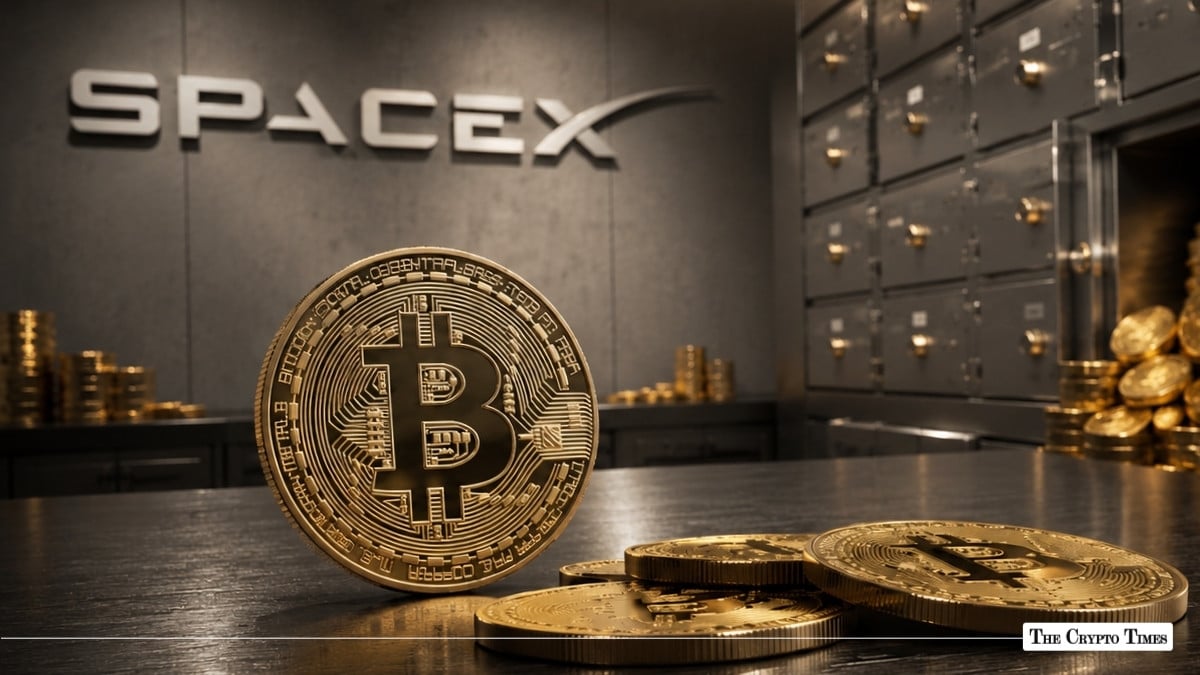
SpaceX has held Bitcoin for longer than almost any other private company of comparable scale, and the precise size of that position was, until Wednesday, one of the more interesting open questions in the corporate crypto landscape.
The answer, per the company’s Form S-1 registration statement filed with the Securities and Exchange Commission (SEC) on May 20, 2026: 18,712 Bitcoin (BTC) as of March 31, 2026, acquired at a total cost basis of approximately $661 million, implying an average purchase price of roughly $35,320 per coin.
That position is more than double the ~8,285 BTC that on-chain analytics firms, including Arkham Intelligence and the data aggregator Bitcoin Treasuries, had attributed to SpaceX based on tracked addresses. The gap reflects what the filing describes as a third-party custody arrangement: “The Company has ownership of and control over its digital assets, which consist of bitcoin, and utilizes, and expects to continue to utilize third-party custodians to hold its bitcoin.” On-chain trackers can only observe addresses they can identify; custodied holdings sitting on the books of a regulated custodian do not show up.
At current Bitcoin prices, the position is worth approximately $1.45 billion. The filing itself recognized the holding at a fair value of $1.29 billion as of the reporting date.
Untouched Since 2021
The single most striking feature of the disclosure is what the position has not done in nearly two years.
Per the S-1 and corroborating data from Bitcoin Treasuries, SpaceX:
- Began acquiring Bitcoin in early 2021, around the same time as Tesla’s much-publicized $1.5 billion purchase that year. The company at one point held as much as 25,724 BTC in February 2021.
- Reduced its position to zero by the end of 2022, mirroring Tesla’s well-documented sell-down during the 2022 bear market.
- Re-built the position over the following years to its current 18,712 BTC level.
- Has not made any new acquisitions since at least the end of 2024, with the Bitcoin balance disclosed in the filing identical to the company’s year-end 2024 holding.
In effect, what the S-1 confirms is a static treasury position: a substantial but ring-fenced Bitcoin allocation that the company has neither added to during multiple subsequent rally cycles nor trimmed during interim drawdowns.
A $112M Unrealized Loss After a $955M Gain
The filing also discloses the year-over-year mark-to-market swing on the holding. SpaceX recorded an unrealized loss of $112 million on its Bitcoin position in the most recent fiscal year, a sharp reversal from an unrealized gain of $955 million in 2024 when Bitcoin’s price ran higher.
The accounting treatment is consistent with how corporate Bitcoin holders are required to mark their digital-asset positions under updated FASB rules: the asset is held at fair value with changes flowing through earnings. For a company moving toward an IPO, the practical implication is that Bitcoin price volatility will introduce direct volatility into reported earnings—a consideration the filing flags briefly under risk factors but does not develop in detail.
How SpaceX’s Bitcoin Position Ranks
Per the disclosed figure of 18,712 BTC, SpaceX ranks approximately 11th globally among corporate Bitcoin holders. The position is larger than:
- Tesla, which held 11,509 BTC ($386M acquisition cost) as of its Q1 2026 disclosure after selling roughly 75% of its position in mid-2022.
- Coinbase corporate balance sheet holdings.
- Block Inc. (SQ).
- Hut 8 mining company.
It remains in stark contrast to MicroStrategy, which has acquired Bitcoin on a near-weekly cadence, and now holds 843,738 BTC, roughly 45 times SpaceX’s position. This highlights how distinct the two companies’ Bitcoin strategies are. MicroStrategy has positioned Bitcoin accumulation as its core capital allocation thesis; SpaceX’s position appears to function as a one-time strategic allocation made during a specific 2021–2024 window and left alone since.
Market and Industry Reaction
The disclosure landed with a structural irony the crypto community immediately seized on: the company tracked by on-chain analytics firms as holding ~8,285 BTC actually held more than double that—and the tracking community had been quietly modeling SpaceX’s stack for years.
Arkham Intelligence showed approximately 8,280 BTC attributed to the company immediately before the disclosure. The S-1’s confirmation implies that roughly 10,400 BTC of SpaceX’s holdings sit in custody arrangements that on-chain trackers cannot fully see; a meaningful data point for any analyst attempting to estimate other private companies’ undisclosed Bitcoin positions. The Bitcoin Treasuries database will require a substantial revision following the disclosure.
Broader X commentary on the filing has split along three lines:
- Bitcoin maximalists framing the disclosure as further validation of the corporate-treasury thesis, particularly given the IPO context. With SpaceX targeting a reported $1.75 trillion to $2 trillion valuation, public-market investors buying SPCX shares will indirectly gain Bitcoin exposure.
- Treasury-strategy analysts noting the contrast with MicroStrategy’s accumulation cadence. Where Saylor’s MicroStrategy continues to add nearly every Monday, SpaceX operates on a “hold but don’t add” profile.
- Critics pointing to the apparent tension between the holding and Elon Musk’s recent federal court testimony that “most” cryptocurrencies are “scams.”
The Musk Statement That Hangs Over the Filing
The disclosure arrives three weeks after Elon Musk made his sharpest public comments on cryptocurrency in years.
During testimony at the Federal Courthouse in Oakland on April 30, 2026, in connection with his ongoing lawsuit against OpenAI, Musk was asked about OpenAI’s 2018 plans to raise capital through an Initial Coin Offering (ICO). Per courtroom reporting, Musk responded: “Some of them have merit, but most of them are scams.”
The tension between the statement and the S-1 disclosure is more rhetorical than substantive. Musk has long drawn a clear line: Bitcoin and Dogecoin in the “merit” category, with the broader memecoin and ICO universe in the “scams” category. The SpaceX filing reinforces that distinction: Bitcoin is on the balance sheet, but the company has explicitly not chased the broader digital-asset market.
Other Key Details From the Filing
Beyond the Bitcoin disclosure, the S-1 contains substantial material. Key items:
- Valuation and offering size: SpaceX is reportedly targeting a valuation of $1.75 trillion to $2 trillion and seeking to raise approximately $75 billion. This would make it the largest IPO in capital markets history, exceeding Saudi Aramco’s record $29.4 billion 2019 listing. Goldman Sachs, Morgan Stanley, BofA Securities, Citigroup, and J.P. Morgan are leading the syndicate, with a planned Nasdaq debut targeted for June 12, 2026 (Ticker: SPCX).
- Q1 2026 financials: Consolidated revenue of $4.69 billion for the three months ended March 31, 2026, with a loss from operations of $(1.94) billion and Adjusted EBITDA of $1.13 billion. The newly acquired AI segment (xAI, Grok, X) remains in heavy investment mode with $7.7 billion in Q1 capital expenditures.
- The xAI merger: SpaceX’s results have been retrospectively recast to include the February 2, 2026 acquisition of xAI, which itself acquired X in March 2025.
- The Anthropic compute deal: In May 2026, SpaceX signed Cloud Services Agreements with Anthropic PBC providing access to compute capacity across the COLOSSUS AI data centers. Anthropic will pay $1.25 billion per month through May 2029.
- The Cursor option: In April 2026, SpaceX entered an agreement granting it the right to acquire AI coding startup Cursor at an implied $60 billion equity value. If SpaceX terminates, Cursor is entitled to a $1.5 billion termination fee plus an $8.5 billion deferred services fee.
- Orbital AI compute roadmap: SpaceX disclosed plans to begin deploying orbital AI compute satellites as early as 2028—solar-powered data centers in Sun-synchronous orbit designed to deliver AI compute at lower costs than terrestrial equivalents.
What the Filing Does Not Disclose
The S-1 is notable for what it does not say about Bitcoin. It contains no discussion of future acquisition plans, strategic rationale, custodian identity, or hedging approaches.
For investors evaluating SPCX, this means Bitcoin will sit on the balance sheet as a roughly $1.45B asset whose forward trajectory is a function of price action and future board-level decisions—without a published company thesis on the holding’s ultimate purpose.
The next question is whether SpaceX will use any portion of its IPO proceeds to add to the Bitcoin position. Nothing in the filing suggests it will, but nothing rules it out either. For now, the disclosure has done what it was meant to do: it has placed an exact number on a holding the crypto market had been triangulating for years.
Also Read: Trump-Linked Truth Social Withdraws Bitcoin ETF Plans Amid Fierce Fee Wars