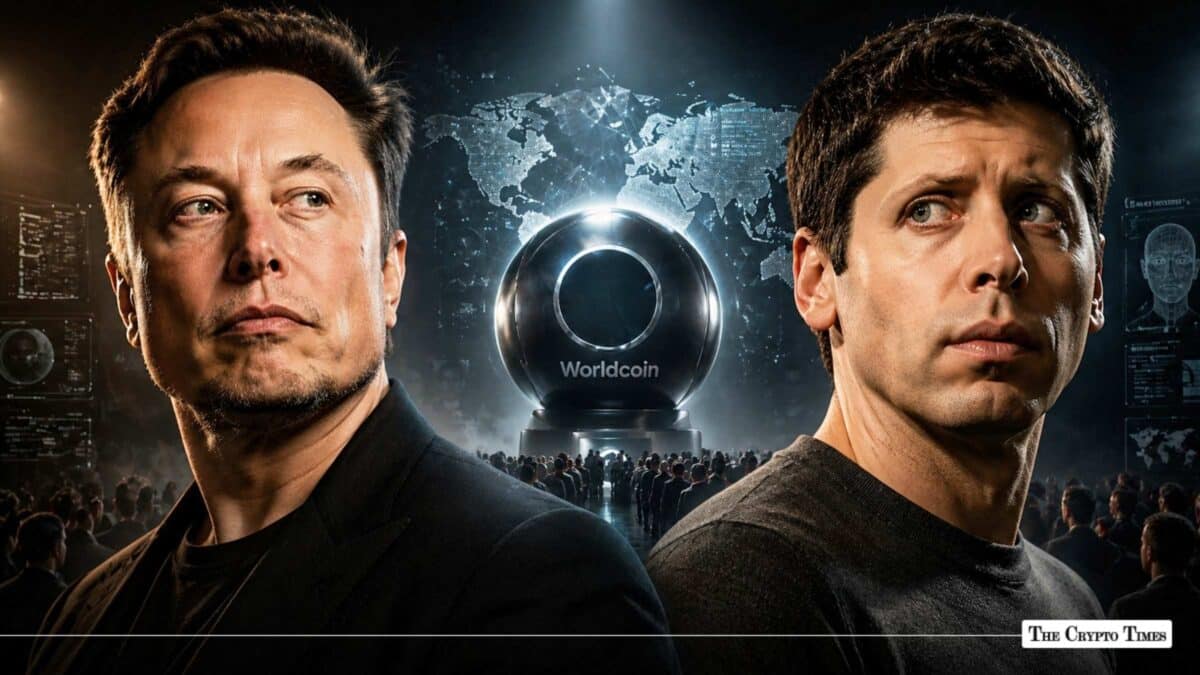
The first thing to understand about the moment Elon Musk decided, on a Monday morning in late April, that the most useful word in the English language was ‘Scam,’ is that he was not in the courtroom. He was on his phone.
Across the bay from Oakland, in Federal Building 1301, a nine-person jury had just been seated to decide whether Musk’s old friend, OpenAI Co-Founder Sam Altman, had stolen a charity. Musk did not bother showing up. He posted instead. “Scam Altman and Greg Stockman stole a charity. Full stop,” he wrote on X, the social network he owns, mangling the surname of OpenAI’s president, Greg Brockman, into a more punchable rhyme. By lunchtime, the post had been amplified by tens of thousands of followers. By evening, “Scam Altman” was trending in three countries.
It was a phrase Musk did not invent. The crypto industry had been calling Altman “Scam Altman” for the better part of two years. It started, of all places, with eyeballs.
This is the story of how those two narratives — one a billionaires’ courtroom drama over the future of artificial intelligence, the other an on-chain investigation into a token launched on the bodies of the world’s poor — collided this week into a single, expanding indictment of one man. It is the story of an iris-scanning silver Orb in a village in Indonesia, of a 120-page complaint filed in San Francisco, of a 15,000-word New Yorker investigation, and of a pseudonymous on-chain detective named ZachXBT who has spent years insisting that one of these things is not like the other but in fact looks an awful lot like it.
It is, in other words, the messy, public, partly petty, partly civilizational fight over what Sam Altman actually is.
A friendship, and then not
To understand why Musk is so personally furious, it helps to remember that he and Altman were once close enough to text each other in lowercase. In December 2015, the two men, along with Brockman, the AI researcher Ilya Sutskever, and a small crew of true believers, founded OpenAI as a nonprofit research lab in San Francisco. The pitch was almost religious in its earnestness: artificial general intelligence, or AGI, was coming, and someone needed to build it openly, safely, and for humanity rather than for shareholders. Musk co-chaired the board. He pledged $1 billion. He ultimately donated about $44 million between 2015 and 2020, court filings show.
Then, in 2018, the relationship cratered. By OpenAI’s account, Musk had wanted to absorb the lab into Tesla and run it himself; when the rest of the founders refused, he walked. By Musk’s account, he was the one being lied to. Either way, he resigned from the board, and the money stopped.
What happened next is what the trial in Oakland is, in a narrow legal sense, actually about. In 2019, OpenAI created a “capped-profit” subsidiary that could raise outside capital. Microsoft poured in roughly a billion dollars, then more. ChatGPT launched in November 2022. By October 2025, the company had completed a full restructuring into a public benefit corporation. Microsoft received a 27% stake; the OpenAI Foundation kept a $130 billion holding. The company is now valued, in private markets, at roughly $852 billion. An IPO is expected later this year.
Musk argues that none of this is what he signed up for, and that Altman and Brockman duped him into financing what was essentially a bait-and-switch — a charity that was always going to become a hedge fund. He sued in August 2024, originally seeking more than $100 billion in damages and asserting 26 separate claims. By the time the trial opened on Monday, that had been whittled, through pre-trial rulings, to two: unjust enrichment and breach of charitable trust. The fraud claim, the most legally aggressive one, was dismissed Friday. Musk, who has stopped seeking damages for himself, now wants restitution paid to OpenAI’s nonprofit arm and Altman and Brockman removed from their positions.
OpenAI’s response has been to call the lawsuit “a baseless and jealous bid to derail a competitor” — a reference to xAI, the rival lab Musk founded in 2023 and merged into SpaceX earlier this year. Both of those companies are now expected to go public; the combined private valuation of SpaceX-xAI and OpenAI exceeds $2 trillion.
That is what is on paper. What is happening in practice is far stranger.
The ‘Scam Altman’ nickname has a backstory
Long before Musk reached for the phrase, “Scam Altman” was a coinage of Crypto Twitter — and it was attached not to OpenAI but to a separate Altman venture that almost no one in mainstream tech press had been writing seriously about: Worldcoin.
Worldcoin was conceived in 2019 by Altman with two co-founders, Alex Blania and Max Novendstern, and built through a private company called Tools for Humanity. The idea, in its founders’ own framing, was a kind of secular sacrament. As artificial intelligence flooded the internet with synthetic content and bots, humans would need a way to prove they were human. The proof would be biometric — specifically, the iris, which is more unique than a fingerprint and harder to fake than a face. Users would stare into a chrome, bowling-ball-sized device called the Orb, get scanned, and receive a cryptographic credential called a World ID. As a thank-you, those in eligible jurisdictions would also receive a small allocation of a new cryptocurrency, $WLD. Altman called it, with a straight face, a “universal basic income” experiment.
Investors loved it. By the time Worldcoin emerged from beta in July 2023, it had raised over $250 million from Andreessen Horowitz, Khosla Ventures, Bain Capital Crypto, Blockchain Capital — and, in its earliest rounds, from Sam Bankman-Fried’s (SBF) Alameda Research and the now-collapsed hedge fund Three Arrows Capital. That detail will become important later.
The first hint that something was off arrived in April 2022, when MIT Technology Review published an explosive investigation by Eileen Guo and Adi Renaldi under one of the more unforgettable headlines of the year: “Deception, exploited workers, and cash handouts: How Worldcoin recruited its first half a million test users.” Three of the five countries Worldcoin used as flagship testing grounds, i.e. Indonesia, Sudan, and Kenya, were classified by the World Bank as low or lower-middle income. In one instance, in an Indonesian village, the reported found, a 35-year-old furniture maker was woken up by his mother with the news of a “social assistance giveaway” at the local elementary school. But what he found in reality was a Worldcoin agent pointing an Orb at his face.
Operators were paid for each new sign-up they ferried through the Orb. Critics described the arrangement, with some justification, as paying poor people for their irises.
The token that fell 97%
When $WLD finally launched on July 24, 2023, the tokenomics were the kind of thing Crypto Twitter had been warning regulators about for years. The total supply was set at 10 billion tokens. The circulating supply on day one was 1.4% — 140 million tokens. Of those, 100 million had been handed directly to market makers, who were given a call option allowing them to buy back large additional blocks at just over $2. From that anemic float, the token was assigned a fully diluted valuation of $22 billion.
It was a design that economists would call “low float, high FDV.” Insiders would call it “exit liquidity.” A trader who goes by DefiSquared, in a much-circulated 2024 thread, called it the Sam Bankman-Fried (SBF) playbook. ZachXBT, the pseudonymous on-chain investigator who has become crypto’s de facto investigative journalist, called it “predatory” from launch day, and by July 2024 was using a sharper phrase: “the biggest scam token of the bull run.”
His evidence was specific. During a March 2024 spike that briefly carried $WLD above $12, ZachXBT and other on-chain analysts traced wallets associated with Orb operators sending roughly $150,000 in $WLD to Binance every three days. When the official Worldcoin account on X posted an earnest copy about “building for every human,” ZachXBT replied: “allowing insiders to continue to profit off your scam token while larping as if you build tools for humanity.”
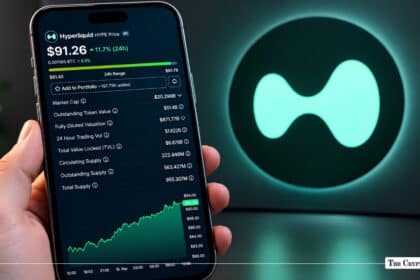
The price chart since tells its own story. As of this week, $WLD trades at roughly $0.26. That is down 97.9% from its March 10, 2024 all-time high of $11.74. Only about 32.9% of the total supply is currently in circulation — meaning the bulk of the dilution is still ahead. More than 90% of all $WLD is concentrated in the top 100 wallets. The Crypto Times has covered the token’s earlier rallies in detail.
And the worst, several analysts argue, is yet to come. A cliff unlock scheduled for July 23, 2026, will release roughly 52.5% of $WLD’s total supply — the equivalent of 169% of today’s float — vesting at about 4.79 million $WLD per day. Analysts have flagged it as one of the most bearish unlock events in recent crypto history.
A questionably thriving black market
The system Worldcoin had built to prove human uniqueness produced, predictably, the opposite of what was on the brochure: a thriving secondary market in human uniqueness.
By May 2023, listings began appearing on Chinese social media and the e-commerce platform Taobao offering verified World App accounts sourced from developing countries. Prices ranged from about $1.40 for a basic account to roughly $70 for a fully verified one — typically built on irises scanned in Cambodia or Kenya. Worldcoin acknowledged the issue but insisted it was minor, citing “a few hundred instances” of fraud across more than 1.7 million sign-ups.
The instances did not stay few. In September 2024, Singapore’s Deputy Prime Minister publicly warned citizens against trading World IDs and disclosed that the police were investigating seven people for suspected illegal account trading. Hackers managed to install malware on several Orb operators’ devices, leaking login credentials onto dark-web marketplaces. ZachXBT this week shared screenshots of escrow listings selling verified accounts for as little as 50 cents.
Regulators worldwide, at varying speeds, began to notice:
- Kenya suspended Worldcoin’s operations in August 2023, weeks after launch, after authorities raided a Worldcoin warehouse and seized Orbs. In May 2025, the country’s High Court declared Worldcoin’s operations illegal and ordered the deletion of all collected biometric data within seven days, citing failures of consent and data protection.
- Spain’s data-protection authority imposed a three-month ban in March 2024, citing GDPR violations and concerns over the collection of minors’ data. Portugal followed with a similar ban the same month.
- Hong Kong’s Office of the Privacy Commissioner for Personal Data raided six Orb operators in early 2024 and, in May, ordered Worldcoin to cease all Hong Kong operations. By that point, the company had already scanned the irises of more than 8,300 Hong Kongers.
- Indonesia suspended Worldcoin in May 2025, saying its operator had been working under a license registered to a different entity.
- Brazil, Germany, Argentina, South Korea, France, the United Kingdom, and Colombia have all opened investigations or issued advisories. Thailand raided a Worldcoin Orb deployment in October 2025, charging an arrested individual under the country’s digital-asset business law.
Kenyan officials at one point told local press that the United States had been pressuring them to lift the ban — a claim that, true or not, captured the awkward geopolitics of an American billionaire collecting irises in the Global South.
By 2025, Worldcoin had quietly rebranded as “World,” dropped the coin from much of its public-facing copy, and was partnering with Tinder Japan, the Razer gaming hardware brand, and a Visa debit card project. It was also, despite vocal warnings from Ethereum Co-Founder Vitalik Buterin that centralized biometric ID could permanently end online pseudonymity, in talks with Reddit about adopting World ID for human verification. Buterin had warned, in a June 2025 essay of political surveillance and the rise of AI-powered tracking tools.
Who was selling, and to whom
If the Orb operators were the visible face of Worldcoin, the wallets were where the money actually moved. And on-chain, the picture has been getting uglier.
In March 2026, Lookonchain flagged that approximately 117 $WLD, roughly worth $38.7 million, had moved through over-the-counter (OTC) transactions routed via Binance and the institutional broker Falcon X, with about $35 million in USDC returning to related wallets. The team was accepting roughly $0.30 per token while the open market sat at $0.32. An analyst on Telegram, Mlm on-chain, traced a multisig wallet linked to the World Foundation that had sold 85.45 million $WLD for $25 million through FalconX at $0.293, deposited another 81.26 million $WLD worth $22 million to Binance, and was sitting on another 40.65 million $WLD worth $10.85 million, presumably destined for the same route.
In April 2026, a World Foundation subsidiary sold another $65 million worth of $WLD via OTC as the token printed an all-time low. The average sale price of $0.27 represented a 76% discount to the $1.13 the foundation had charged in a May 2025 raise that brought in $135 million for U.S. expansion. The discount, in plain English, suggests that someone — or several someones — were liquidating at any price they could get.
ZachXBT, in a latest post, distilled it: a project that “preyed on people from low income countries for biometric data,” whose insiders kept exiting, whose token kept bleeding, and whose marketing copy kept invoking “every human.”
The Farrow story
Then came the New Yorker.
On April 6, 2026, the magazine featured a 15,000 word investigation titled “Sam Altman May Control Our Future. Can He Be Trusted?” by Ronan Farrow and Andrew Marantz. Drawing on over 100 interviews, internal documents, Slack messages, and HR records, the piece described, in clinical and devastating prose, what it called a pattern: senior executives at Microsoft and OpenAI alleging that Altman had repeatedly misrepresented agreements, reneged on commitments, and managed by what one source called “willful information asymmetry.” Several sources drew explicit comparisons to Sam Bankman-Fried; one invoked Bernie Madoff.
In a move that surprised absolutely no one, Elon Musk paid to boost the New Yorker article on X. He reposted Farrow himself. “Calling him ‘Scam’ Altman is accurate,” he wrote. Hours later he posted again: “Sam Altman lies as easily as he breathes.” His own AI chatbot, Grok, when prompted by users, began generating detailed breakdowns of the New Yorker allegations.
$WLD dropped 2.9% that day. It had already been bleeding for a week.
The OpenAI side of the ledger
It would be too neat to read the New Yorker piece, the ZachXBT thread, and Musk’s lawsuit as three independent assessments of the same man. They are not. They overlap, they share sources, and at least one of them — Musk’s — is being financed by a competitor. But the inconvenient thing for Altman is that the strongest evidence on the OpenAI side of the ledger has not come from any of his enemies. It has come from his own employees.
On November 17, 2023, OpenAI’s Board of Directors fired him. The official statement said he had not been “consistently candid in his communications.” The unofficial reason, pieced together since by reporters at Bloomberg, the Wall Street Journal, and The Atlantic, was a 52-page dossier prepared by Ilya Sutskever, the company’s Chief Scientist and Altman’s longtime collaborator, drawing largely on testimony from the Chief Technology Officer, Mira Murati. The dossier accused Altman of playing senior staff against one another, misleading the board about what individual directors had said to him, and undermining safety oversight. Sutskever, in nearly 10 hours of videotaped deposition unsealed in this very Musk lawsuit last fall, testified that he had been planning to remove Altman “for at least a year,” waiting for “a board that is not obviously friendly with Sam.”
What followed was the most expensive, most chaotic five days in the history of U.S’ corporate governance. Altman was reinstated on November 22, after roughly 700 of OpenAI’s 770 employees signed a letter threatening to follow him to Microsoft. Sutskever, having voted to fire Altman on Thursday, signed the letter calling for his return on Monday. Sutskever later said he “deeply regretted” his role in the ouster. He left OpenAI in May 2024 to start his own AI safety lab. The board members who voted to fire Altman are largely gone. Helen Toner, one of them, told colleagues during the crisis, according to Sutskever’s deposition, that destroying OpenAI could be “consistent with the mission.”
The five days are not, strictly, what Musk’s lawsuit is about. But they are what his lawyers will be allowed to remind the jury of, repeatedly.
The witness list is lush: Musk, Altman, Brockman, Microsoft’s Satya Nadella, Sutskever, Murati, and — in a detail that captures the scale of personal entanglement here — Shivon Zilis, a former OpenAI board member who is also the mother of several of Musk’s children. The judge, Yvonne Gonzalez Rogers, has already ruled that Musk can be questioned about, among other things, his attendance at the 2017 Burning Man festival. The trial is expected to run four weeks. Closing arguments are scheduled for mid-May. The jury’s verdict will be advisory; Judge Gonzalez Rogers will issue the final ruling.
If Musk wins on either remaining count, OpenAI’s for-profit conversion could, in theory, be unwound. An IPO that bankers have been quietly pricing as the largest in history would, in less theoretical terms, be in serious trouble.
A complicated detail: The SBF parallel
Crypto Twitter’s working theory is that there is a lineage here. ZachXBT’s thread have, for months, drawn the same diagram: a charismatic founder with an outsized public profile and a public-good mission; a tokenomics design that overwhelmingly favors insiders; jurisdictional arbitrage that places operations precisely where regulation is weakest; a moral vocabulary borrowed from earnest movements — “effective altruism,” “universal basic income” — to make predatory financial engineering sound philanthropic. At FTX, the language was effective altruism. At Worldcoin, it was Universal Basic Income, or UBI.
The complicating detail, the one that crypto reporters keep noting and most legacy outlets keep skipping, is that Worldcoin’s earliest backers actually included SBF and Three Arrows Capital. They were not metaphorical FTX. They were FTX.
That does not make Altman a fraud. It does not make Worldcoin a Ponzi. None of the regulatory bans against Worldcoin allege fraud; they allege violations of consent and data-protection law. The OpenAI lawsuit’s fraud claim was dismissed last week. Altman has not been criminally charged with anything, and barring a development no one currently anticipates, he will not be. The legal questions in Oakland are narrower than the moral questions outside it.
But the moral questions are the ones the public is asking. What does it mean to build a charity, accept tens of millions of dollars in donations on that premise, and then convert it, with shareholder benefit, into a near-trillion-dollar private corporation? What does it mean to scan the irises of villagers in Kenya and Indonesia and Cambodia, hand them tokens that will lose 97% of their value, and call the program a basic income? What does it mean that the same man stands in the middle of both stories?
What is actually new this week
For all the noise, the genuinely new development is the convergence. Until April 2026, the OpenAI story and the Worldcoin story moved on parallel tracks with different audiences. The AI press covered the lawsuit and the IPO. The crypto press covered the token and the bans. Musk’s X account had glanced at Worldcoin only occasionally, mostly to mock Altman’s competing tech ambitions. ZachXBT’s audience was the on-chain bubble.
This week, those tracks merged. Musk amplified the Farrow piece, which mentioned both ventures. ZachXBT, who previously stayed out of legacy-media political feuds, replied directly to Musk’s “Scam Altman” post and tied OpenAI’s nonprofit-to-for-profit pivot to Worldcoin’s tokenomics in a single argument. Altman’s reputation as a careful, technocratic guardian of AGI, the persona that survived the November 2023 ouster, is suddenly being stress-tested in two arenas at once: a federal courtroon and a public ledger.
Altman’s team has esponded to Musk’s lawsuit, by calling it “incoherent” and “frivolous,” noting that Musk had quit OpenAI’s board in 2018 and gone on to launch a competitor. Worldcoin and Tools for Humanity have long maintained that biometric data is processed on-device and deleted, that the token has been distributed to more than 25 million verified users, and that the company has cooperated with every regulator that has approached it. None of those positions are absurd. Some of them are even true. They are also, after this week, no longer the dominant frame.
What happens next
Several things will happen in the next month, and they will happen in public.
Opening arguments in the Musk v. Altman case began today. Altman is expected to take the stand within the first two weeks. Musk could be questioned soon. Microsoft’s Nadella, two former OpenAI board members, and at least three current and former senior researchers will follow. The depositions already in the public record — particularly Sutskever’s — will be cited extensively, which means much of what was said behind closed doors during the November 2023 ouster will now be said in front of a jury.
The $WLD cliff unlock arrives in late July 2026. If the on-chain analysts are right, the float will roughly triple in three months, and the daily emission alone will exceed a meaningful fraction of the token’s daily traded volume. The price action through that window will be its own form of testimony.
OpenAI’s planned IPO, expected later this year, sits inside both windows. So does SpaceX’s, the IPO that is widely expected to make Musk the world’s first trillionaire.
And then there is the question that Musk, for all his theatrics, has framed correctly: whether a public mission, once funded by the public completely, can be redirected into a private one, without the public’s consent. It is a question that applies, with some violence to OpenAI. It applies, with arguably more violence, to Worldcoin. It applies, in a different register, to a great deal of the rest of Silicon Valley right now.
For the millions of people in Kenya, Indonesia, Cambodia, and beyond, who traded their iris scans for a few dollars’ worth of $WLD tokens that have since lost nearly all their value, the courtroom drama in Oakland will not return what they gave up. Their data was collected before most of them had heard of OpenAI, before most of them had heard of Sam Altman, before most of them had any plausible way to know what a fully diluted valuation was. They got the token. The insiders kept the upside. The Orb moved on to the next village.
That, more than any single allegation in any single complaint, is the case against Sam Altman that the next four weeks will be relitigating. It will be relitigated badly, theatrically, and partly in bad faith. But it will be relitigated. And for once, the courtroom and the blockchain will be reading from the same brief.