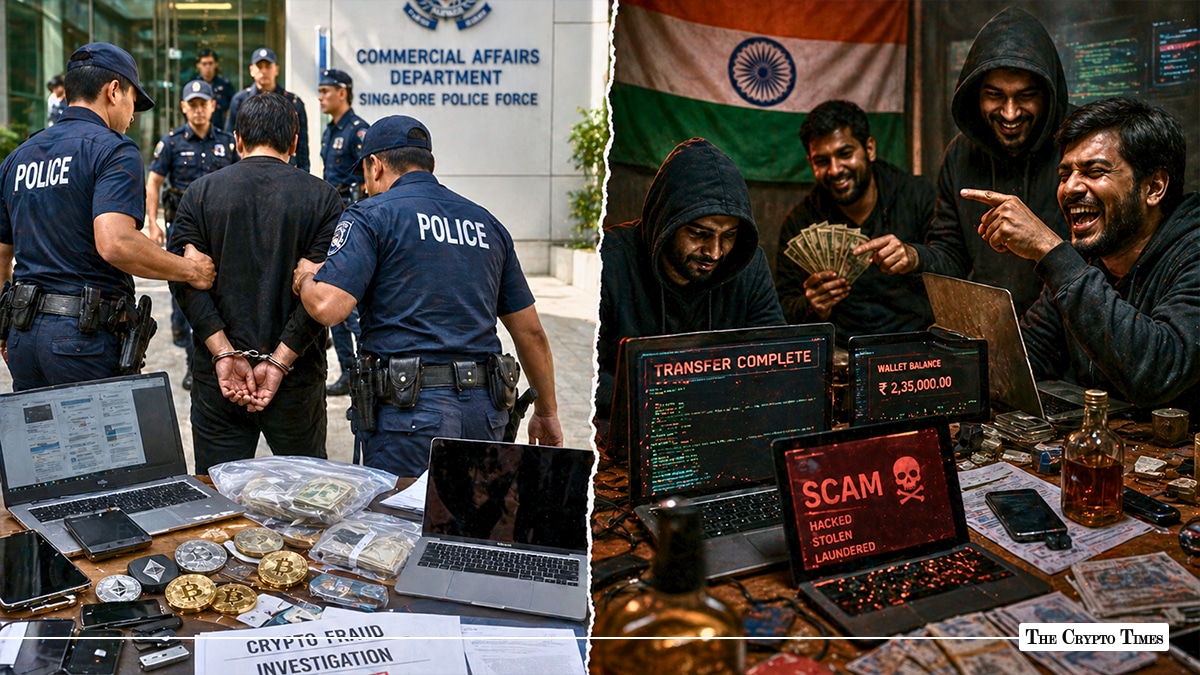
While Singapore saved over $2.86 million (approx. ₹24 crore) in scam losses for 90 victims in just one month, India continues to battle a massive wave of crypto and digital payment scams. The Singapore Police Force’s landmark public-private partnership offers a ready-made blueprint that RBI, Indian exchanges like CoinDCX and WazirX, and everyday users can adopt immediately.
As per Singapore Police’s official statement, the operation ran from March 16 to April 15, 2026. It marked the first major collaboration between Singapore’s Anti-Scam Centre (ASC), Cyber Investigation Branch (CIB), and leading crypto exchanges.
How Singapore Did It: The Winning Model
Singapore authorities partnered with Coinbase, Coinhako, Gemini, Independent Reserve, StraitsX, and Upbit, plus tools from blockchain analytics firms Chainalysis and TRM Labs. Using real-time intelligence sharing and advanced blockchain analysis tools, they:
- Identified suspicious transactions linked to investment, job, romance, and government-impersonation scams.
- Conducted over 90 direct interventions (phone calls and in-person visits) before victims transferred funds.
- Blocked proceeds in crypto wallets in real time.
The result? Over $2.86 million in potential losses prevented in a single month through rapid information exchange and advanced blockchain analysis.
This success builds on Singapore’s broader 2025 efforts, where authorities recovered or averted hundreds of millions in scam losses through proactive crypto tracing.
Why This Is An Urgent Concern for India
India’s digital payments ecosystem is among the world’s largest, but so is its fraud problem. Crypto-related scams have surged dramatically, with reports indicating thousands of cases targeting retail users, especially in the 20–40 age group.
Recent domestic incidents — such as ED raids in Karnataka involving Bitcoin scams and the Yamunanagar crypto fraud probe — highlight how quickly funds move out of the country via crypto rails. RBI’s own data and industry reports show that social engineering (fake apps, impersonation of exchanges, and UPI-to-crypto mule accounts) remains the dominant tactic.
On April 9, 2026, RBI released a discussion paper titled “Exploring Safeguards in Digital Payments to Curb Frauds”. It proposes measures like:
- A one-hour delay for transactions above ₹10,000
- Additional authentication for vulnerable groups (seniors/disabled) above ₹50,000
- Transaction limits and a customer-controlled “kill switch”
CoinDCX CEO Sumit Gupta responded publicly on April 20, supporting the RBI’s intent but suggesting refinements — such as raising thresholds to ₹25,000, applying delays only to first-time recipients, and emphasizing smarter fraud detection over blanket friction.
Actionable Lessons
What RBI, Indian exchanges, and users should do next to combat the growing threat of crypto related scams and frauds:
For RBI & Regulators
- Adopt Singapore’s intelligence-sharing model.
- Mandate or strongly incentivize real-time data exchange between crypto exchanges, banks, and cyber police.
- Require licensed platforms to integrate tools from leading players like Chainalysis or TRM Labs for high-risk wallet monitoring.
- Integrate this with the Indian Cyber Crime Coordination Centre (I4C) and 1930 helpline for faster interventions.
For Indian Crypto Exchanges (CoinDCX, WazirX, etc.)
- Voluntarily implement Singapore-style rapid-freeze protocols.
- Build public dashboards showing blocked scam transactions (transparency builds trust).
- Expand industry projects like CoinDCX’s ₹100 crore Digital Suraksha initiative into a multi-exchange intelligence network.
- Use whitelisting for trusted recipients and enhanced monitoring on first-time large withdrawals.
For Users: The Singapore “ACT” Framework Adapted for India
Singapore promotes a simple ‘Add, Check, & Tell (ACT)’ approach. Here’s how Indians can apply it:
Add Security
- Use Google Authenticator or hardware keys (never SMS OTP).
- Enable SIM PIN and transaction limits on UPI/banking apps.
- Install official ScamShield-like tools and verify app downloads.
Check Everything
- Government officials or exchange staff will never ask for seed phrases, OTPs, or direct crypto transfers.
- Verify URLs and caller IDs. Pause before acting on “too good to be true” investment/job offers.
- Cross-check via official apps/websites.
Tell Immediately
- Report to 1930 national helpline or cybercrime.gov.in within minutes.
- Inform your exchange support and bank.
- Share verified warnings in your networks.
The Road Ahead
Singapore has shown that collaboration between police, exchanges, and analytics firms can deliver fast, measurable results. With India’s massive crypto user base and ongoing RBI reforms, adopting a similar public-private model could prevent crores in losses every month.
As scams grow more sophisticated, technology alongside coordination is the only sustainable answer. Regulators and platforms must move from reactive enforcement to proactive protection — and users must stay vigilant.
The Singapore operation proves it works. India has the scale, the talent, and now the blueprint. The question is — will we implement it fast enough?
Also Read: Fake USDT: What It Is, How to Detect It, and How to Protect Yourself