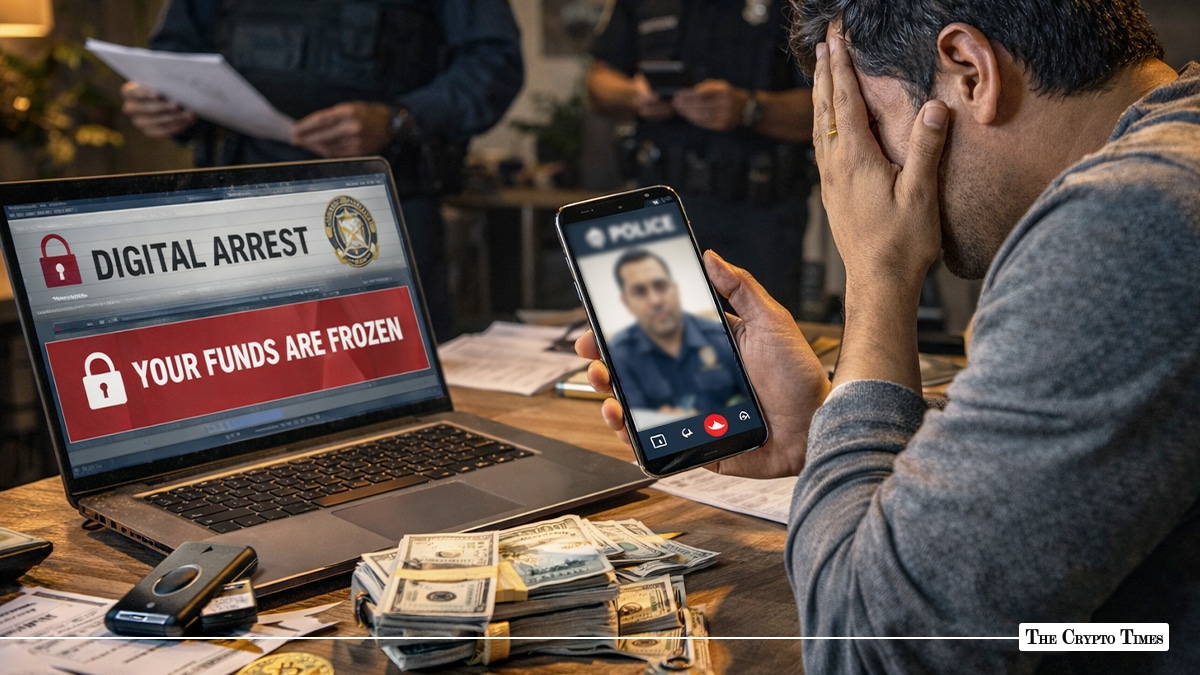
Imagine this: your phone rings and the caller says a parcel sent under your name has been caught at customs. It allegedly contains drugs or fake passports. Before you can think, the call is transferred to someone claiming to be a Central Bureau of Investigation (CBI) officer. A fake arrest warrant with your name shows up on WhatsApp. You’re told to stay in your room, keep the camera on, and send money to “clear your name.”
This is a “digital arrest” scam — one of the fastest-growing forms of cyber fraud in India. It does not involve hacking or malware. Instead, it weaponizes fear, fake authority, and urgency to push victims into transferring their money, often into cryptocurrency, before they have time to think.
This guide breaks the scam down into simple terms so that anyone — regardless of their familiarity with crypto or law — can understand exactly how it works, why people fall for it, and what to do if it happens to them.
What exactly is a “Digital Arrest”?
In simple terms, a digital arrest is a scam where criminals pretend to be government officials and “detain” you over a video call. They claim you are under investigation for a serious crime — money laundering, drug trafficking, or tax evasion — and that you must stay on the call, follow their orders, and pay money to avoid going to jail.
Here is the most important thing to understand: there is no such thing as a digital arrest under Indian law.
Indian law requires that any arrest must be carried out in person, with a physical warrant. No police officer, CBI agent, or Enforcement Directorate (ED) official will ever interrogate you, issue warrants, or demand payments over WhatsApp, Skype, or any video call app.
If someone does this, they are a criminal.
The Supreme Court of India has itself confirmed that the fabrication of judicial orders in these scams constitutes a direct assault on the dignity of the judiciary.
Also Read: ‘Transaction Simulation Spoofing’: A New Scam in the Crypto World
How the scam works: The four phases
Digital arrest scams follow a predictable playbook. Understanding each phase is the best way to protect yourself.
Phase 1: The Hook
The scam starts with an unexpected phone call or message. The caller might claim to be from a courier company like FedEx, a telecom regulator like Telecom Regulatory Authority of India (TRAI), or a bank. They tell you something alarming: your phone number is linked to a criminal case, or a parcel registered under your ID has been seized with illegal contents.
The goal of this phase is simple: create confusion and fear. The claims are entirely fabricated, but they sound specific enough to feel real. Scammers often use caller ID spoofing to make their number appear as an official helpline. In the March 2026 Pune ₹10.74 crore case, an 82-year-old pensioner received calls from numbers that appeared to belong to TRAI and the CBI.
Phase 2: The Fake Authority
Once you’re confused, the call is “transferred” to someone claiming to be a senior officer from the CBI, ED, or Narcotics Control Bureau (NCB). This person appears on a video call wearing a uniform, sitting in what looks like a police station. In some cases, scammers use deepfake videos and AI-cloned voices to impersonate real, high-ranking officials.
To make it convincing, they send you forged documents on WhatsApp — fake arrest warrants, freeze orders supposedly from the Supreme Court, and investigation letters with official-looking seals and signatures. In the case that triggered the Supreme Court’s suo motu intervention, scammers displayed forged Supreme Court orders bearing fake judicial signatures to coerce an elderly couple.
Phase 3: Virtual Isolation
This is the most dangerous phase. You are told to lock yourself in a room, keep your camera on at all times, and cut off contact with everyone — your family, your friends, even your lawyer. They use fear-based language like “this is classified under the Official Secrets Act” to prevent you from seeking help.
Victims have been kept under this kind of surveillance for 40 to 70 hours straight. This leads to sleep deprivation and exhaustion, making it much harder for people to think clearly or question what is happening.
Phase 4: Money Extraction and Crypto Conversion
Once the victim is mentally broken, the financial extraction begins. The scammers demand that you transfer your savings to a “verification account” or “RBI escrow account” to “prove your innocence.” These accounts are controlled by the criminals.
In the most recent cases, victims are not just asked to make bank transfers. They are instructed to purchase cryptocurrency — typically Tether (USDT), a stablecoin pegged to the US dollar — through Indian exchanges and send it to the scammer’s wallet address.
In the February 2026 ₹2.65 crore Punjab case, investigators found that a co-accused used around ₹8.62 lakh to buy crypto through a mobile application, which was then sold and redistributed across multiple accounts.
Why are scammers using crypto?
There is a reason why these scams have pivoted from bank transfers to cryptocurrency. When money is sent through a bank, Indian authorities can freeze accounts and potentially recover funds.
Crypto transactions present a very different challenge. As reported, India has been tightening identity verification rules for crypto exchanges, but scammers continue to exploit peer-to-peer networks and offshore platforms.
| Factor | Why it help scammers |
|---|---|
| Speed | Crypto transfers settle in minutes. Once confirmed on the blockchain, the funds are gone. |
| Irreversibility | Unlike bank transfers, there is no “reverse” button. Blockchain transactions cannot be undone or recalled. |
| Cross-border | Crypto moves across borders instantly. The money can reach wallets in China, Cambodia, or Myanmar within seconds. |
| Layering | Scammers split funds across dozens of wallets, swap between different tokens, and use mixing services to obscure the trail. |
| P2P Networks | Peer-to-peer platforms allow direct INR-to-USDT trades with minimal identity checks, giving scammers easy on-ramps. |
Investigations by Pune Cyber Police in the March 2026 case confirmed that funds from the ₹10.74 crore digital arrest scam were routed through crypto exchanges and traced to handlers in China.
In the ₹640 crore case in February 2026, the ED found that stolen funds were converted into cryptocurrency and moved through over 5,000 Indian bank accounts and even withdrawn as cash in Dubai.
Why do smart people fall for this?
It is tempting to think that only gullible people fall for these scams. The reality is very different. Digital arrest scams are specifically designed to override rational thinking by exploiting well-known psychological weaknesses.
Panic shuts down critical thinking. When someone threatens you with immediate arrest or asset seizure, your brain enters a survival mode. Stress hormones flood your system, and the parts of your brain responsible for logical analysis effectively go offline. You stop evaluating whether the threat is real and start focusing solely on making it stop.
Authority bias makes us obey. Humans are conditioned from childhood to follow orders from authority figures. When someone presents themselves with a uniform, official language, and legal documents — even fake ones — our default instinct is to comply first and question later.
Isolation removes your safety net. By cutting you off from family and friends, the scammers ensure there is no one nearby to say, “Wait, this doesn’t sound right.” The enforced isolation is not incidental — it is a deliberate tactic.
Personal data creates false credibility. Scammers purchase leaked personal data from the dark web — your Aadhaar number, address, and employer details. When they read this back to you on the call, it feels like they genuinely know your file, making their story seem legitimate.
How big is this problem? The numbers
The scale of the crisis has grown exponentially. Data from India’s Cyber Crime Coordination Centre (I4C) paints a stark picture:
| Year | Reported cases | Financial Losses |
|---|---|---|
| 2022 | 39,925 | ₹91 Crore (~$11M) |
| 2023 | 60,676 | ₹339 Crore (~$40M) |
| 2024 | 123,672 | ₹1,935 Crore (~$232M) |
That is a 471% increase in financial losses in just one year. Reported cases doubled. And these are only the cases that are reported — many victims stay silent out of embarrassment.
The Supreme Court steps in
In October 2025, the Supreme Court of India took the extraordinary step of initiating suo motu proceedings (acting on its own, without being petitioned) after a senior citizen couple from Ambala was defrauded of over ₹1 crore.
The scammers had used forged Supreme Court orders with fake judicial signatures to coerce the couple. The case was registered as Suo Motu Writ (Criminal) No. 3/2025.
The Court called the forgery of judicial documents a “direct assault on the dignity of the judiciary,” and directed that all digital arrest FIRs nationwide be handed over to the CBI for a unified investigation.
The CBI has since been granted sweeping powers, including the authority to investigate bankers involved in opening mule accounts used in these scams. As Bar and Bench reported, this was one of 17 suo motu cases the Supreme Court took up in 2025, reflecting the national scale of the crisis.
The international connection: Where does the money go?
Investigations have consistently shown that the command centres behind digital arrest operations are based in Southeast Asia — particularly in fortified compounds in Cambodia, Myanmar, and Laos. These are not small-time scammers. They are large-scale, organized syndicates that operate like call centres, often staffed by trafficked individuals who are forced to run scam scripts against their will.
Once the crypto leaves the victim’s Indian exchange account, it is typically routed through Chinese-Language Money Laundering Networks (CMLNs), which specialize in converting stolen crypto into usable cash through a web of wallets, over-the-counter (OTC) desks, and shell companies. India’s PRAHAAR counter-terrorism strategy, released in February 2026, specifically flagged the use of crypto wallets by these criminal networks. Investigators have also uncovered crypto hawala networks operating through anonymous wallets and VPNs to funnel foreign funds into India.
Red flags: How to spot a digital arrest attempt
If any of the following happens to you, you are dealing with a scammer:
Warning Signs
- An unsolicited call claims a parcel under your name contains drugs, fake passports, or illegal items.
- You are “transferred” to a “senior officer” from CBI, ED, NCB, or police — on a WhatsApp or Skype video call.
- You receive official-looking arrest warrants or court orders on your phone via messaging apps.
- You are told to stay on camera, lock your door, and NOT contact your family, friends, or lawyer.
- You are asked to pay a “security deposit,” “verification fee,” or “bail amount” to a private account.
- You are instructed to buy cryptocurrency (USDT) or send a UPI transfer to “clear your name.”
How to protect yourself
Verify independently. If someone claims to be from a government agency, hang up. Look up the official number of that agency online and call them yourself. No real officer will object to you verifying their identity.
Remember the rule. No Indian law enforcement agency conducts interrogations, serves warrants, or collects payments over WhatsApp, Skype, Telegram, or any other social platform. Period.
Create a family safe word. Agree on a simple code word with your family. If you ever feel you are being coerced, you can send a brief text with that word to signal that you need help.
Guard your personal data. Scammers buy leaked data (Aadhaar numbers, addresses, and employer details) from the dark web. Limit the personal information you share publicly on social media. Just because a caller knows your ID number does not mean they are legitimate.
Resist urgency. The entire scam depends on your acting immediately without thinking. Any time someone pressures you for an instant payment under threat, take a breath, disconnect the call, and consult someone you trust.
What to do if you are targeted
If you realize you are caught in this scam or have already transferred money, act immediately. The window for recovering funds is extremely narrow.
Emergency action steps
- Cut all contact. Drop the call. Block the numbers. Do not share any OTPs or banking details.
- Call 1930 immediately. This is India’s cybercrime helpline. Calling within the first hour (the “golden hour”) triggers an alert to banks, allowing them to freeze suspect accounts before funds are moved further.
- File a report at cybercrime.gov.in. Provide all details: call timeline, phone numbers used, bank transaction IDs, screenshots of fake documents, and chats.
- If you sent crypto, contact the exchange. If you used an Indian exchange like WazirX, CoinDCX, or Binance, contact their fraud/security team with your transaction ID and the receiving wallet address. You can also use Etherscan to track where your funds went and share this on-chain evidence with law enforcement.
The bottom line
The digital arrest scam is not a tech problem — it is a human psychology problem, turbocharged by cryptocurrency’s speed and irreversibility. The scammers are not hackers. They are social engineers who have figured out that fear and fake authority are more effective than any malware.
The Indian Supreme Court, the CBI, and state cyber police units are all now actively cracking down on these networks. India’s PRAHAAR strategy has formalized this as a national security priority. But enforcement can only go so far.
The most powerful defense is awareness: knowing that a digital arrest is not real, that no government agency demands crypto payments over video calls, and that the moment someone pressures you to act immediately, you should do the exact opposite — stop, disconnect, and verify.