Key Highlights
- NCB busted the “Team Kalki” darknet drug syndicate, which used Monero and USDT through layered wallets and mule accounts to launder proceeds from 1,000+ consignments shipped across India since January 2025.
- Pune Cyber Police arrested two suspects in a ₹10.74 crore “digital arrest” scam targeting an 82-year-old pensioner, with part of the stolen funds traced through crypto exchanges linked to handlers in China and Hong Kong.
- Dharavi police booked directors of Bio Estate Solution Pvt. Ltd. for allegedly cheating investors of ₹49.46 lakh through a fake cryptocurrency called “BioCoin.”
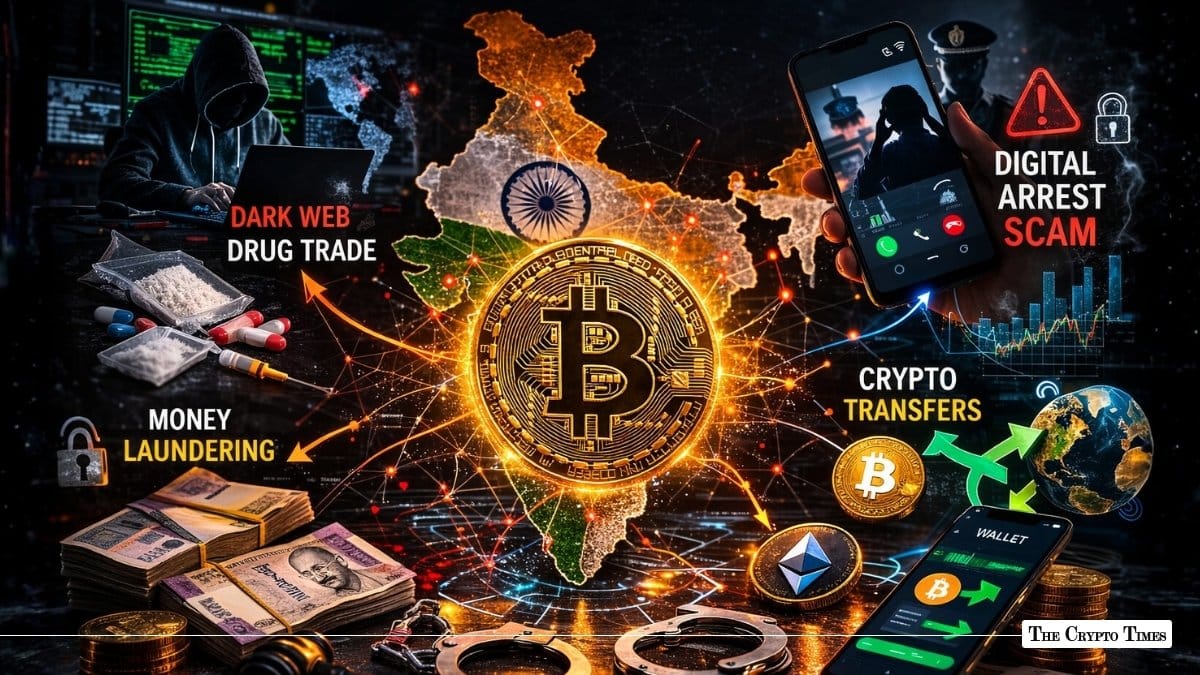
Three separate law enforcement actions this past week have underscored how deeply cryptocurrency has become embedded in India’s criminal economy — not as a fringe tool, but as core infrastructure for fraud, narcotics, and financial deception at every scale.
In New Delhi, the Narcotics Control Bureau (NCB) dismantled a darknet drug syndicate that accepted payments exclusively in privacy coins and stablecoins. In Pune, cyber police traced a multi-crore “digital arrest” scam to overseas crypto exchanges. And in Mumbai, Dharavi Police booked company directors who allegedly cheated dozens of small investors through a fabricated cryptocurrency token.
Taken together, the cases paint a picture of a country where digital assets have become the preferred vehicle for laundering, concealing, and moving illicit money.
NCB Busts “Team Kalki”: Darknet, Dead Drops, and Crypto Laundering
The Narcotics Control Bureau (NCB) on Sunday announced the takedown of a pan-India darknet narcotics distribution network operating under the codename “Team Kalki.” The operation, conducted in New Delhi after three months of intelligence gathering, resulted in the arrest of two individuals and the seizure of drugs valued at an estimated ₹5 crore in the international market.
Authorities recovered 2,338 LSD blotters, 160 MDMA pills, 3.6 kilograms of liquid MDMA, 73 grams of charas, and 3.6 grams of amphetamine from 13 domestically intercepted parcels and two international consignments originating from the Netherlands.
The syndicate was operated by Anurag Thakur and Vikas Rathi, both previously convicted under the Narcotic Drugs and Psychotropic Substances (NDPS) Act. According to investigators, the two met while serving time at Tihar Jail and later built the Team Kalki network together.
They initially established a vendor profile on the dark web forum Dread, where they maintained a four-star rating — a marker of consistent delivery history — before expanding operations to the encrypted messaging platform Session.
What makes this case particularly significant from a crypto standpoint is the sophistication of the financial infrastructure. The network accepted payments exclusively through unhosted cryptocurrency wallets, primarily in Monero and USDT. The proceeds were routed through multiple intermediary wallets, with conversion charges of up to 10%, before being stored in cold wallets.
In some cases, mule wallets with KYC verification were used to funnel funds into the formal banking system. Temporary USDT wallets were dynamically generated for each transaction and immediately emptied through layered transfers designed to obscure the trail.
Deliveries within Delhi relied on a “dead drop” system where parcels were left at pre-designated locations, while pan-India shipments were made via India Post’s Speed Post service and other courier providers. A different booking office was used for each consignment to avoid creating a traceable pattern.
The network is suspected to have dispatched more than 1,000 consignments across India since January 2025. Authorities said the syndicate sourced LSD and MDMA from international darknet vendors based in the Netherlands, Poland, and Germany.
NCB said the investigation is ongoing and efforts are underway to identify associates, trace financial transactions, and dismantle the network’s international supply chain. The operation follows earlier crackdowns including Operation Ketamelon (2025) and Operation Zambada (2023), both of which targeted crypto-linked drug trafficking syndicates.
Pune’s ₹10.74 Crore Digital Arrest Scam: Fake Courts, Real Crypto
In a parallel development, Pune Cyber Police arrested two suspects in connection with a ₹10.74 crore “digital arrest” scam that targeted an 82-year-old pensioner living on Bhandarkar Road, Deccan.
The victim was contacted between January 23 and January 31, 2026, by callers impersonating officials from the Telecom Regulatory Authority of India (TRAI) and the Central Bureau of Investigation (CBI). At times, they also claimed to be speaking on behalf of the judiciary.
The fraudsters told the elderly man that his bank account had been linked to a money-laundering case and warned him of imminent arrest if he did not cooperate. To make the threats appear credible, they arranged video calls designed to look like court proceedings.
Under sustained psychological pressure over a nine-day period, the victim transferred his entire savings — including fixed deposits and money sent by his children from abroad — across seven transactions totalling ₹10.74 crore into bank accounts provided by the fraudsters. He approached the police only after realizing the calls were fraudulent.
The arrested individuals were identified as Harshad Subhash Dhantole (23), a BTech student from Chhatrapati Sambhajinagar staying in Karvenagar, and Samarth Suresh Deshmukh (24), an unemployed graduate from the same district.
Two other suspects — Rohit Rameshwar Jadhav of Pimple Gurav and Amar Attargi from Solapur — remain absconding. Investigators identified the accused through financial trail analysis and ATM surveillance footage from Karvenagar.
Police managed to freeze ₹40 lakh in the suspects’ bank accounts and seized ₹4.78 lakh in cash. Crucially, investigators found that some of the stolen funds had been converted into cryptocurrency and routed through exchanges linked to handlers based in China and Hong Kong.
The case has been linked to at least 11 cybercrime complaints registered across the country, suggesting the involvement of a wider, possibly international, network.
The operation was led by Additional Commissioner of Police (Crime) Pankaj Deshmukh and Deputy Commissioner of Police (Economic & Cyber) Vivek Masal. Pune Cyber Police issued a public advisory urging citizens, particularly senior citizens, to never trust calls claiming to be from law enforcement, and reiterated that no legitimate authority conducts “digital arrests” or financial verification over phone calls.
The advisory follows a similar warning by the CBI after its own coordinated searches across six states in a separate ₹1.86 crore digital arrest fraud earlier this year.
Mumbai’s Dharavi “BioCoin” Fraud: Small Investors, Big Losses
In Mumbai, the Dharavi police registered a cheating case against the Chairman and directors of Bio Estate Solution Pvt. Ltd. for allegedly defrauding a garment trader and his relatives of ₹49.46 lakh through a fake cryptocurrency investment scheme.
According to the FIR filed by complainant Aamir Idris Khan (51), a resident of the 90 Feet Road area in Dharavi and a garment trader by profession, he was introduced to the company in 2019 by a friend who claimed to be receiving returns on an investment in the firm’s “Monthly Rental Income System.” Khan and the friend visited Bio Estate Solution’s Dharavi branch on Sant Rohidas Marg, where Chairman Shivaji Walke allegedly persuaded him to invest in the company’s own cryptocurrency, “BioCoin.”
In January 2019, Khan invested ₹6,46,800 in BioCoin, paying in cash. Walke allegedly promised that the invested amount would double within 48 months. Trusting these assurances, Khan, his wife Sahani, his brother-in-law Amjad, and friend Pushpendra Badala collectively invested ₹43 lakh in various schemes run by the company. The investments were backed by an agreement bond-cum-promissory note.
From July 2019, Khan and his wife received payments totalling ₹3.6 lakh over the next nine months. However, payouts stopped abruptly in May 2020 when the company shut its Dharavi office during the COVID-19 pandemic. Repeated attempts to contact the accused went unanswered.
In February 2023, Khan visited the company’s head office in Kalyan and met directors Ghanshyam Sharma and Shakeel Khan. They allegedly promised a settlement of ₹39 lakh and issued cheques from TJSB Cooperative Bank.
However, cheques amounting to approximately ₹23 lakh bounced when deposited, and Khan later learned that the company was financially insolvent.
Police said several residents from the Dharavi area had invested in various schemes run by Bio Estate Solution but did not receive the promised returns or maturity amounts. A case has been registered under relevant sections of the Bharatiya Nyaya Sanhita (BNS) Act, and further investigation is underway.
The Bigger Picture: Crypto as Common Thread
The three cases, while vastly different in nature and scale, share a common denominator: the use of cryptocurrency — whether real or fabricated — to facilitate, disguise, or profit from criminal activity.
In the NCB’s Team Kalki operation, crypto served as the primary payment and laundering mechanism for an active narcotics supply chain. Monero’s privacy features and USDT’s liquidity were exploited through a multi-layered wallet structure designed to defeat law enforcement tracing.
In the Pune digital arrest case, crypto exchanges became the exit ramp for stolen funds, with the financial trail leading to handlers based outside India. And in the Dharavi case, a fictitious token named “BioCoin” was the bait that drew small investors into a scheme that had no underlying asset, no exchange listing, and ultimately no solvency.
These incidents land at a time when India’s enforcement apparatus is visibly scaling up its crypto-crime capabilities. The government’s “PRAHAAR” counter-terrorism strategy, released in February 2026, specifically flagged the growing use of crypto wallets by criminal and terrorist networks.
A dedicated darknet and cryptocurrency task force under the Multi-Agency Centre has been set up to monitor platforms facilitating narco-trafficking. And the CBI’s coordinated searches across six states in a separate digital arrest fraud underscored how mule bank accounts, SIM card networks, and crypto channels are being used as interconnected tools within the same fraud ecosystem.
In recent months, authorities have also traced a ₹100 crore crypto money trail from Madhya Pradesh to China, while the Supreme Court denied bail in a ₹640 crore crypto scam case involving phishing schemes and layered digital laundering.
Separately, crypto-linked incidents ranging from gunpoint robberies to multi-crore investment frauds have surfaced from Delhi to Odisha, reinforcing the pattern of digital assets being misused at every scale of criminal activity.
For India’s crypto industry, the challenge remains familiar but intensifying: wider adoption continues to bring wider misuse, and the gap between how quickly criminals adapt digital asset tools and how quickly regulators and law enforcement catch up defines the risk landscape for legitimate participants in the space.
Also Read: India’s Women Crypto Investors Up 116.8%, Now 15% of User Base: CoinDCX