Key Highlights
- Europe’s crypto market has narrowed sharply after MiCA, with only 244 digital asset groups allowed to serve EU users from July 1, compared with 3,389 firms that served EU customers under older national regimes.
- ESMA’s first major post-deadline register update added 37 new CASPs, taking the number of authorized crypto-asset service providers to 280.
- EU users are now moving in three directions: MiCA-licensed exchanges, self-hosted wallets, and exit-only transfer routes from firms winding down services.
On July 1, millions of European crypto users woke up to a market that looked familiar on their phones but had changed underneath.
The apps were still there. Balances were still visible. Bitcoin, Ethereum, stablecoins and altcoins still traded across the world. But in Europe, the legal route between a user and a crypto platform had narrowed overnight.
For years, EU users moved between global exchanges, local virtual asset service providers, national registrations and offshore platforms. Some firms were supervised in one country. Others relied on older registration regimes. Many served European clients through global entities that were not built around a single EU-wide rulebook.
The European Union’s Markets in Crypto-Assets Regulation (MiCA) has now pushed the continent into a smaller, licensed crypto market. The question for users is no longer which app has the most tokens or the loudest campaign. It is simpler and more important: where can they legally go now?
Europe’s Crypto Market Has Shrunk
Only 244 digital asset groups were allowed to serve EU customers from July 1, according to a list published by Europe’s markets watchdog. That is a sharp fall from the 3,389 crypto firms that were serving EU customers under the old framework in May 2025. Over 1,738 firms had to cease operations because they lacked the authorization needed under MiCA.
That is the first hard number behind the user migration. Europe did not simply introduce a licensing regime. It cut down the number of legal crypto access points from thousands to a few hundred.
ESMA’s first major register update after the transition deadline added 37 new crypto-asset service providers, taking the number of authorized CASPs to 280. The update also showed how concentrated the market has become, with Germany, France, the Netherlands, Malta and Cyprus among the main licensing hubs.
| Market stage | Number of firms/options | What it means |
|---|---|---|
| Old national and offshore framework | 3,389 firms | Broad market where firms served EU users through different national, local, or offshore structures |
| July 1 MiCA cutoff | 244 digital asset groups | Only authorized groups could continue serving EU users after the transition deadline |
| Firms required to stop or restrict services | 1,738 firms | Non-authorized firms faced wind-down, transfer, or exit pressure |
| First major post-deadline ESMA update | 280 authorized CASPs | The licensed market expanded, but remains far smaller than the old landscape |
The 280 number does not mean EU users suddenly have only 280 full-service retail exchanges. CASPs can include different legal entities, custodians, brokers, trading firms, banks, and group companies. But the direction is clear. The old market had thousands of doors. The new one has fewer, heavier doors, watched by regulators.
Where Are European Users Going Now?
Europe’s crypto users are moving in three clear directions after MiCA narrowed the market. The first route is the most visible, users are moving to MiCA-licensed exchanges. The second and most favorable of all route is self-custody and the third route is exit-only access.
Licensed Apps Are Racing to Capture the Flow
The first winners are already visible. These are platforms that can serve EU users through authorized European entities. OKX, Coinbase, Kraken and Bitpanda are among the names trying to capture the migration. For users, the draw is not only regulation. It is continuity: spot trading, fiat access, withdrawals, stablecoin alternatives, staking or earn products where allowed, and a regulated account structure.
OKX said its European app downloads rose 158% between June 24 and July 5, citing Sensor Tower data. The exchange also said inflows from users migrating from non-MiCA platforms rose by more than 830% compared with the previous 12-day period.
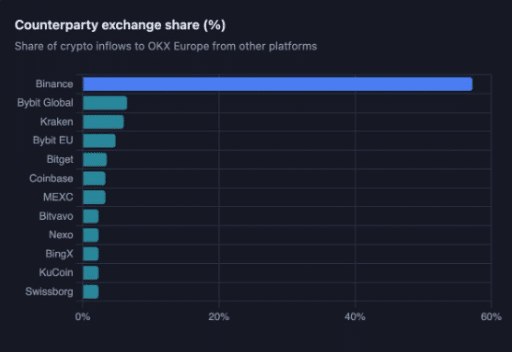
“Getting licensed under MiCA meant having strong AML controls, segregating client funds, meeting strict capital requirements, and the leadership team passing a fit-and-proper test with regulators, among many other requirements. Not all competitors have been able to do that,” said Erald Ghoos, CEO of OKX Europe. “A 158% jump in downloads and massive inflows from unregulated exchanges as the transition period ended shows that users are prioritising picking platforms with the deepest regulated product suite: spot, derivatives, earn and payments, on one platform.”
OKX Europe Limited received its full MiCA license from Malta’s MFSA on January 27, 2025, and says the authorization covers users across all 30 EEA member states through one regulated entity.
Coinbase and OKX also moved early with transfer campaigns before the deadline, as licensed exchanges tried to pull users away from platforms that had not secured MiCA authorization in time.
The competition is now about more than advertising. Users want to know whether their exchange can provide liquidity, fiat rails, trading pairs, stablecoin access, payments, and withdrawals without interruption. A download is the first sign of movement. Balances and trading volume will show whether the migration sticks.
Self-Custody Is the Other Big Destination
The more revealing movement is happening away from exchanges altogether. ESMA and national regulators have told users of unauthorized providers to move assets either to an authorized CASP or to a self-hosted wallet. The AMF, citing ESMA’s position, warned that firms without MiCA authorization must cease activity and that users should transfer crypto-assets to an authorized provider or a self-hosted wallet before access becomes restricted.
That means self-custody is not a side effect. It is now one of the official exit routes for European users leaving non-authorized platforms.
One large affected exchange said 70% of withdrawn EU user funds moved to self-hosted wallets, while only 30% moved to MiCA-regulated entities. Its co-CEO Richard Teng made the comments while discussing post-MiCA licensing talks with EU regulators at Reuters NEXT Asia in Singapore.
The number matters because it points to a broader behavior. Many users are not simply replacing one centralized exchange with another. They are choosing to hold assets directly.
That creates a new tension for Europe’s rulebook.
MiCA can supervise licensed platforms. It can impose governance rules, capital requirements, conduct standards, asset-protection rules and operational controls. The European Commission says MiCA is designed to regulate crypto-asset issuers and service providers, with requirements covering risks such as customer disclosure, market integrity, fraud and prudential controls.
But MiCA cannot protect a user who loses a seed phrase. It cannot reverse a wrong-chain transfer. It cannot recover assets drained through a phishing link. It cannot supervise every wallet into which assets move after users leave an exchange.
That is the first major policy contradiction after the deadline. Europe has reduced the number of unlicensed intermediaries. It may also have pushed part of the market into an environment where consumer protection depends less on regulation and more on personal security habits.
Smaller Firms Face the Hardest Choice
For smaller crypto firms, MiCA has narrowed the road. Unauthorized firms are not supposed to keep operating as normal. They can secure authorization, operate through a properly licensed group entity, refer users to a licensed platform, sell the business, or wind down. What they cannot do is continue serving EU users under the old patchwork of registrations as if nothing changed.
ESMA expects them to stop onboarding new EU clients, stop marketing, and limit services to what is necessary for users to sell, transfer, reallocate assets or close positions. Custody can continue only for the time needed to complete an orderly exit.
This gives larger licensed firms an immediate advantage. MiCA authorization requires compliance staff, capital, governance, AML systems, operational controls, reporting, and the ability to satisfy national competent authorities. That is expensive. It is also difficult to build quickly.
This is the practical reality behind the deadline. Some users are not choosing between exchanges. They are being moved out of platforms that can no longer serve them fully.
The Real Question Is Not Who Left, But Who Absorbs the Users
Too much of the post-MiCA debate has focused on which firms failed to secure licenses.
That is only half the story.
The more important question is where users and assets settle after the first migration wave. If licensed exchanges absorb most of the balances, Europe could become one of the world’s deepest regulated crypto markets. If self-custody absorbs the larger share, exchange liquidity could fragment and user risk could move from platform failure to wallet security. If smaller firms keep exiting, the market could concentrate around a handful of large licensed platforms.
The old European crypto market was broad, uneven and crowded. The new one is narrower, supervised and more competitive. Licensed apps are gaining downloads. Wallets are gaining assets. Exit-only firms are trying to move clients without triggering disorder.
MiCA has already answered one question: who is allowed to operate.
The next question will decide the shape of Europe’s crypto market: where do users actually want to stay?
Also Read: Binance Bets on Europe Despite MiCA Licensing Challenges