Tether (USDT) has become the backbone of the stablecoin market, acting as the primary digital dollar for millions of traders worldwide. But its massive popularity and perceived stability mean that it has become a prime target for scammers.
Most people assume that cryptocurrency living on the blockchain means that it cannot be counterfeited. But scammers aren’t hacking the blockchain. They are exploiting user trust and wallet interfaces to pass off worthless tokens as genuine USDT.
Whether you are a casual crypto investor, a P2P trader, or a business owner, knowing how to identify fake USDT is a mandatory survival skill in the Web3 space. This comprehensive guide breaks down exactly what fake USDT is, the common schemes scammers use, and the step-by-step methods to ensure your funds are authentic.
The Threat Is Real: A Costly Case Study
To understand how deceptive this scam can be, consider this real-world case:
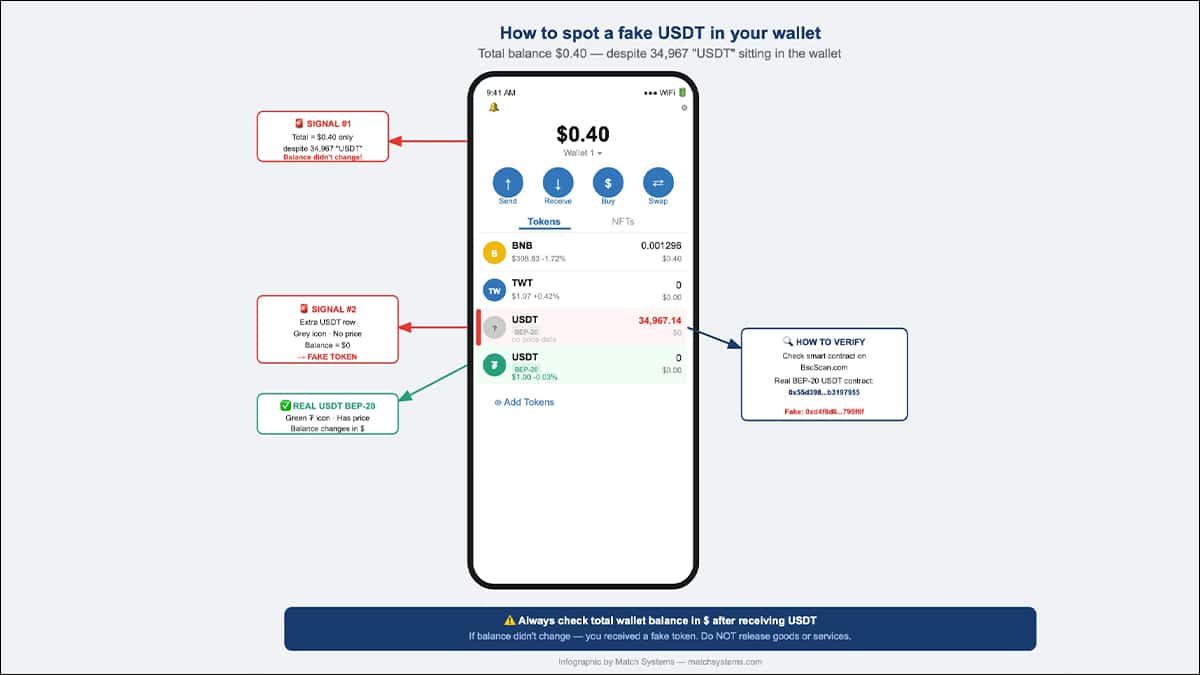
According to a recent incident report analyzed by blockchain security firm Match Systems, a client contacted a crypto exchange requesting a withdrawal. His Trust Wallet displayed a balance of 34,967 USDT on the BEP-20 network, received from a third-party service. To verify the connection, the client sent a test transfer of 50 USDT to the exchange’s address.
The transaction status read “Success,” and the address was perfectly correct. Yet, the exchange never received the funds.
When blockchain specialists audited the wallet, the devastating truth emerged:
- The Illusion: The wallet showed 34,967 “USDT.”
- The Reality: The wallet’s total dollar value balance was exactly $0.40.
- The Verdict: After sending the 50 USDT, the wallet’s real USD balance didn’t drop by a single cent.
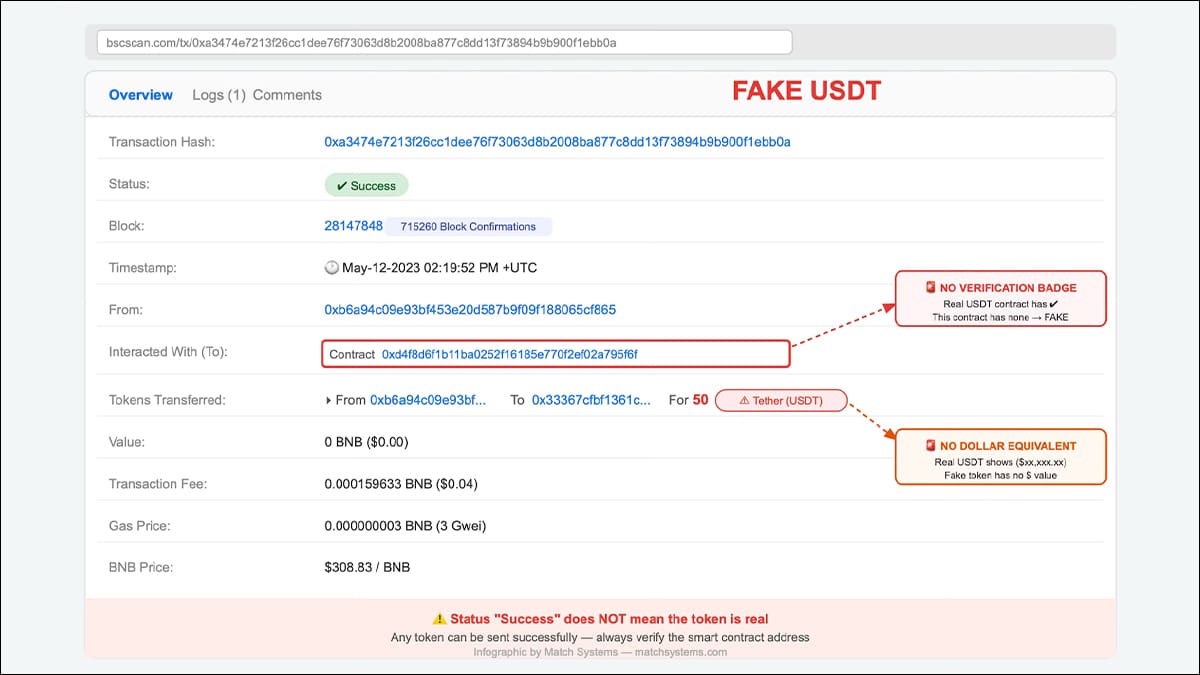
A smart contract check confirmed that the token’s contract address did not match Tether’s official contract. The client had been holding a worthless, counterfeit USDT token valued at $0 the entire time. The funds were effectively lost the very second they were “received.”
What Fake USDT Is — and Why the Scheme Works
Most people believe cryptocurrency cannot be counterfeited. The blockchain is secure. Data is immutable.
That’s true — but only partially.
Scammers do not break blockchain cryptography. Instead, they create a brand-new token from scratch.
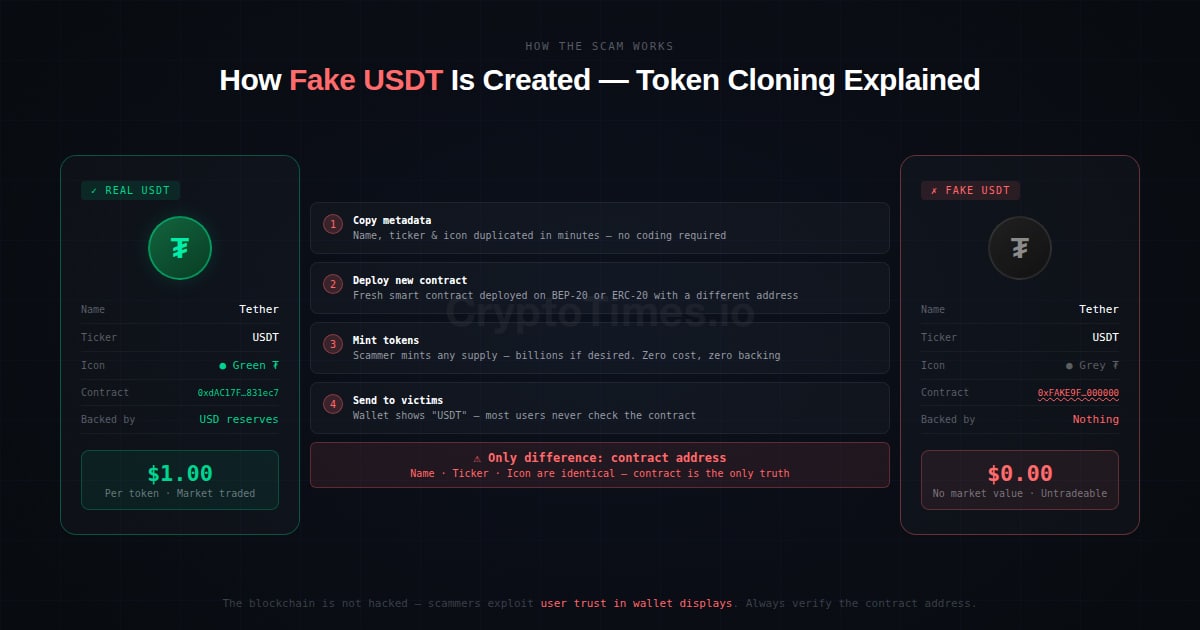
Anyone can issue a new token on networks like BNB Chain (BEP-20) or Ethereum (ERC-20) in minutes, with zero programming knowledge. Scammers simply mint a token and copy Tether’s metadata:
- Same Name: Tether
- Same Ticker: USDT
- Same Icon: The green ₮ logo
The only difference is the smart contract.
The original USDT has a fixed and publicly known contract address. A fake token has a different contract address generated by the scammer. Such tokens are not traded on exchanges, are not backed by assets, and are worth exactly $0.
The problem is that most wallets display tokens by name, not by contract address. Users see “USDT” and do not suspect substitution.
In some wallets, including Trust Wallet, the smart contract address is buried deeper in the interface and rarely checked by users. Scammers rely on this visual similarity.
Common Fake USDT Scam Schemes
Scammers deploy fake tokens across a variety of attack vectors. Here are the most common traps:
- P2P and OTC Deals: This is the most prevalent scenario. A buyer sends fake USDT as payment. The seller sees the notification, releases the fiat money or real crypto, and only later realizes they were paid in ghost tokens.
- Airdrop Traps: Unsolicited “USDT” magically appears in your wallet. When you try to swap or move it, the malicious smart contract requests permission to access and drain your wallet’s real assets.
- Contract Substitution in DeFi: Fraudulent decentralized applications (dApps) replace the real USDT contract address with a fake one in their interface. You think you are staking real stablecoins, but you are interacting with a scam.
- Investment Scams (Ponzi Schemes): A project pays initial returns in real USDT to build trust. Once you deposit a large sum, they switch to paying out in fake tokens.
- Fake “Cleaning Fee” Emails: If you try to withdraw fake USDT to an exchange and it fails, scammers may send a spoofed email pretending to be from Binance or Coinbase, asking for a “cleaning fee” to process the transaction.
⚠️ Crucial Note: Reputable exchanges will never email you requesting money transfers to process a transaction. Any such message is a guaranteed scam.
Address Poisoning: A Related Attack You Must Know
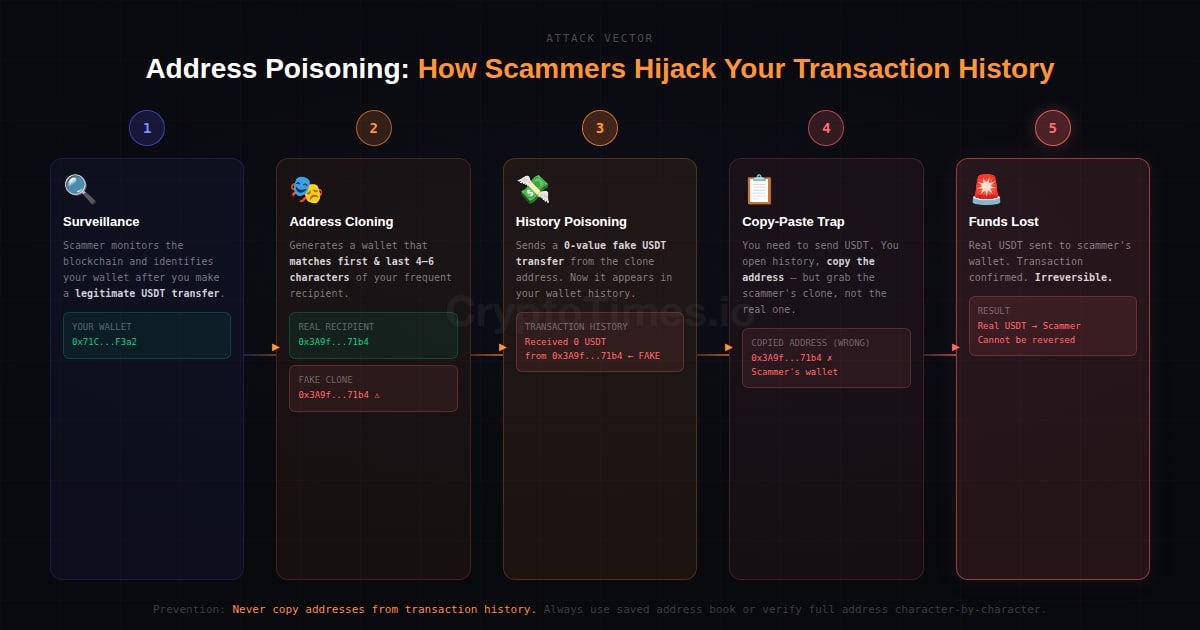
Address poisoning (also called the zero-transfer scam) is a distinct but closely related attack that is rapidly growing in frequency. Understanding it is essential because it looks almost identical to a legitimate USDT transaction in your wallet history.
How Address Poisoning Works
Here is the exact sequence scammers use:
- Surveillance: The scammer monitors the blockchain and finds your wallet address once you make a legitimate USDT transfer.
- Cloning: They generate a new wallet address that shares the first 4–6 and last 4–6 characters with either your address or a recipient you regularly send to.
- Poisoning: They send a 0-value or near-zero fake USDT transfer from the look-alike address to your wallet. This transaction appears in your history.
- The Trap: Next time you want to send USDT to that familiar recipient, you copy the address from your transaction history — and unknowingly copy the scammer’s look-alike address instead.
⚠️ Critical Warning: Never copy a recipient’s address from your transaction history. Always use your saved address book, or re-verify the full address character by character with the recipient each time.
How to Spot a Poisoning Transaction
- Zero or negligible value: The transfer shows 0 USDT or a dust amount like 0.001 USDT.
- You didn’t initiate it: It appears in your history without any action on your part.
- Near-identical address: The sending address looks almost identical to a known contact when you glance at the first and last few characters.
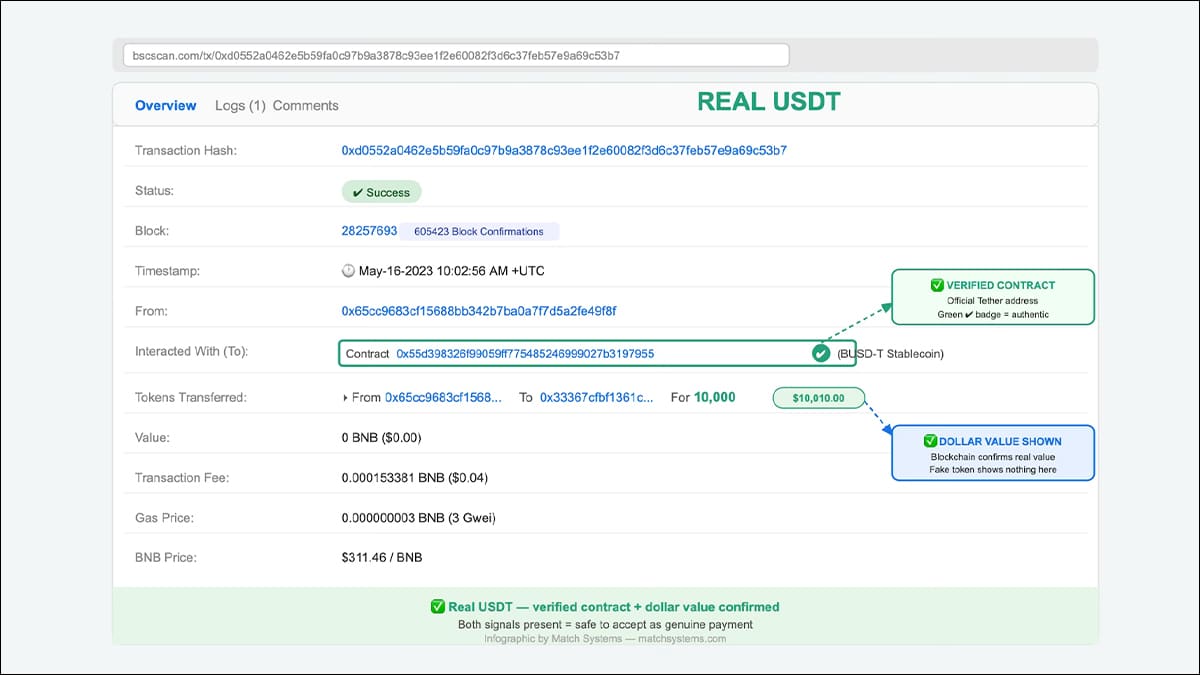
- No USD equivalent: On a blockchain explorer, the “Tokens Transferred” section shows no dollar value.
“Flash USDT” and Fake Sender Tools — The Scam Behind the Scam
If you have spent any time on crypto Telegram groups, you have almost certainly seen advertisements for “Flash USDT” software. These tools are sold as a way to send USDT that “confirms on the blockchain” but disappears after a set number of days. This section exists to be absolutely clear: Flash USDT tools are themselves a scam.
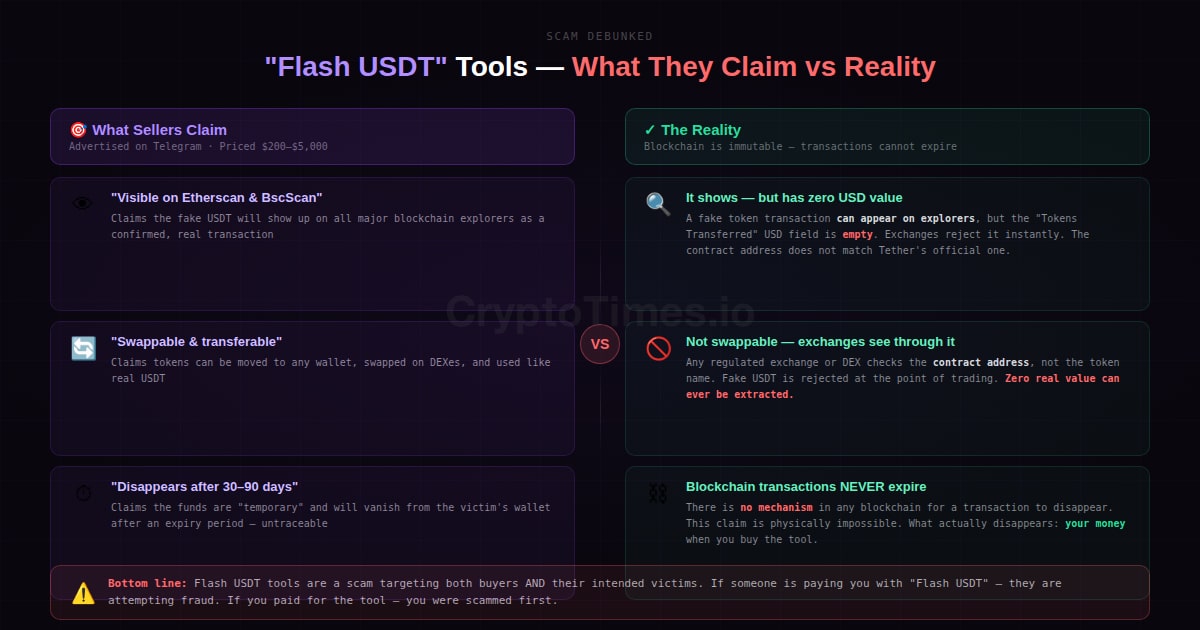
What Sellers Claim
- “Sends real-looking USDT: Visible on Etherscan, BscScan, and Tronscan”
- “Swappable and transferable: Can be moved to any wallet or exchange”
- “Disappears after 30–90 days: Untraceable after expiry”
- Prices: These tools are sold for anywhere from $200 to $5,000+ on Telegram and dark web forums.
The Reality
There is no such thing as a blockchain transaction that “expires” or “disappears.” The blockchain is an immutable ledger. Once a transaction is confirmed, it is permanent. Here is what actually happens when someone buys these tools:
- Scenario A — The buyer is scammed directly: The software is fake. After payment, the buyer receives a script that either does nothing or creates a locally faked token that shows in one wallet but is worthless and invisible to exchanges or other wallets.
- Scenario B — The buyer tries to use it on others: If the tool creates a counterfeit token (as described in the fake USDT section above), it may briefly appear in a victim’s wallet — but will fail on any exchange. The scammer using the tool still gets caught.
How to Detect Fake USDT: Step-by-Step Guide
The only reliable method is to compare the token’s smart contract address with Tether’s official contract.
The name, ticker, and icon can be identical — they prove nothing.
Step 1: Two Quick Signals Inside Your Wallet
Before opening a blockchain explorer, check:
1. Did your total USD balance change?
After receiving genuine USDT, your wallet’s total dollar balance must increase accordingly. If it remains unchanged — the token is fake.
This is exactly how the substitution in the case above was detected: despite holding 34,967 “USDT,” the wallet showed only $0.40.
2. Did a duplicate USDT entry appear without a dollar price?
Fake tokens appear as a separate entry with the same name but no USD price and often a grey icon. Genuine USDT always shows $1.00 and the green ₮ icon.
Step 2: Memorize the Official USDT Contract Addresses
The only reliable source is Tether’s official website: tether.to. You can also verify via CoinMarketCap in the token’s “More” section.
| Network | Official USDT Contract Addresses |
|---|---|
| ERC-20 (Ethereum) | 0xdAC17F958D2ee523a2206206994597C13D831ec7 |
| TRC-20 (Tron) | TR7NHqjeKQxGTCi8q8ZY4pL8otSzgjLj6t |
| BEP-20 (BNB Chain) | 0x55d398326f99059ff775485246999027b3197955 |
| Polygon | 0xc2132D05D31c914a87C6611C10748AEb04B58e8F |
| Solana | Es9vMFrzaCERmJfrF4H2FYD4KCoNkY11McCe8BenwNYB |
⚠️ Never take contract addresses from messengers, social media, or email. Only use tether.to or CoinMarketCap.
Step 3: Check the Contract in a Blockchain Explorer
Copy the smart contract address from your wallet and paste it into the relevant explorer:
- Ethereum → Etherscan
- Tron → Tronscan
- BNB Chain → BscScan
- Polygon → PolygonScan
Compare it to the official address listed above. A key indicator in explorers is the USD equivalent shown in the “Tokens Transferred” section. For genuine USDT, the transaction shows a value such as “For 10,000 ($10,010.00).” For fake tokens, the blockchain does not recognize a price — the USD equivalent field is empty.
Wallet-Specific Verification Guides
The steps to check a token’s contract differ between wallets. Here is how to do it on the most widely used platforms.
Trust Wallet
- Open Trust Wallet and tap the token labelled “USDT”.
- Tap the three-dot menu (top right) and select “More info” or “Token details”.
- The contract address is displayed. Copy it in full.
- Compare it character by character against the official address from the table above for your network (BEP-20, ERC-20, or TRC-20).
- If the address does not match — the token is fake. Do not interact with it.
MetaMask
- Open MetaMask and select the account holding the USDT.
- Click on the USDT token in your asset list.
- On the token detail screen, click the three dots at the top and select “View on Etherscan” (or the relevant explorer for your network).
- On the explorer page, the contract address is displayed at the top. Verify it against the official ERC-20 address: 0xdAC17F958D2ee523a2206206994597C13D831ec7.
- You can also check: does the token have a gold checkmark from Etherscan? Genuine Tether USDT carries this verification badge. A fake token will not.
Coinbase Wallet
- Open Coinbase Wallet and tap the asset you want to verify.
- Tap “View on block explorer” at the bottom of the asset screen.
- On the explorer, locate the “Contract” field and compare the address against Tether’s official contract for that network.
- Also check the token’s market capitalization shown on the explorer page. Real USDT will show tens of billions in market cap. A fake token will show $0 or nothing.
Ledger (Hardware Wallet)
- Connect your Ledger and open Ledger Live.
- Navigate to the relevant account (Ethereum, BNB, Tron, etc.).
- Ledger Live displays the contract address in the token detail view. Tap “View in explorer” to open the full details on the network’s block explorer.
- Cross-reference the contract address against the official Tether contracts. Hardware wallets do not automatically filter fake tokens — any ERC-20, BEP-20, or TRC-20 token can appear in your Ledger Live interface.
USDT on TRC-20 (Tron): Why It Is the Most Scammed Network
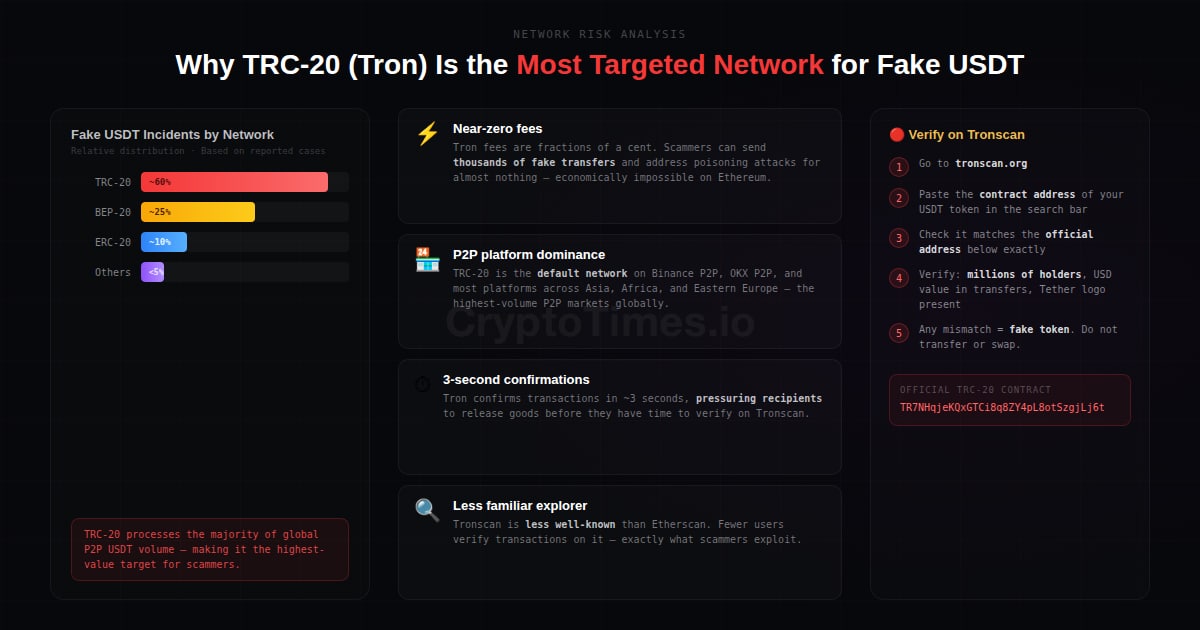
Of all the networks USDT operates on, TRC-20 on the Tron blockchain is disproportionately involved in fake USDT scams. Understanding why helps you stay protected, especially if you use P2P platforms where TRC-20 is the dominant transfer method.
Why TRC-20 Is Targeted
- Near-zero fees: Tron network fees are fractions of a cent. This makes it trivially cheap for scammers to send thousands of fake token transfers at scale, including address poisoning attacks.
- Speed: TRC-20 transactions confirm in seconds, which pressures recipients to release goods or funds before they have time to verify.
- P2P dominance: TRC-20 USDT is the default transfer method on Binance P2P, OKX P2P, and most peer-to-peer platforms in Asia, Africa, and Eastern Europe — the highest-volume P2P markets globally.
- Tronscan complexity: Tronscan’s interface is less familiar to new users than Etherscan, meaning fewer people verify transactions on it.
How to Verify USDT on Tronscan: Step-by-Step
- Go to tronscan.org in your browser.
- Paste the contract address of the USDT token you received into the search bar.
- On the results page, check the “Contract Address” field at the top. The official TRC-20 USDT address is: TR7NHqjeKQxGTCi8q8ZY4pL8otSzgjLj6t.
- Look for the official Tether logo and the verified badge. Genuine USDT on Tronscan will display: market capitalisation data, a large number of token holders (tens of millions), and daily transaction volume in the billions.
- A fake TRC-20 USDT token will show: 0 or negligible market cap, very few holders (often under 100), no USD value in the “Transfers” section.
ℹ️ Tip: On Tronscan, you can search the transaction hash (TXID) directly. For a real USDT transfer, the “Token Transfer” section will show the official Tether contract with its verified logo. A fake token transfer will show a contract with no logo and no USD value.
Precautionary Measures
For Individual Users:
- Check your wallet’s total USD balance immediately after receiving USDT — it must increase accordingly.
- Always verify the smart contract before confirming P2P or OTC transactions
- Do not trust token names displayed in wallets.
- Do not interact with tokens received via unsolicited airdrops.
- Be wary of projects promising guaranteed high returns.
- Exchanges never request transfers via email.
For Businesses (OTC desks, P2P platforms, exchanges)
- Implement mandatory smart contract verification for all incoming USDT transactions.
- Set up automated blockchain verification before crediting funds.
- Conduct regular staff training — scam tactics continuously evolve.
- Develop internal incident response and AML monitoring procedures.
What to Do If You Already Received Fake USDT
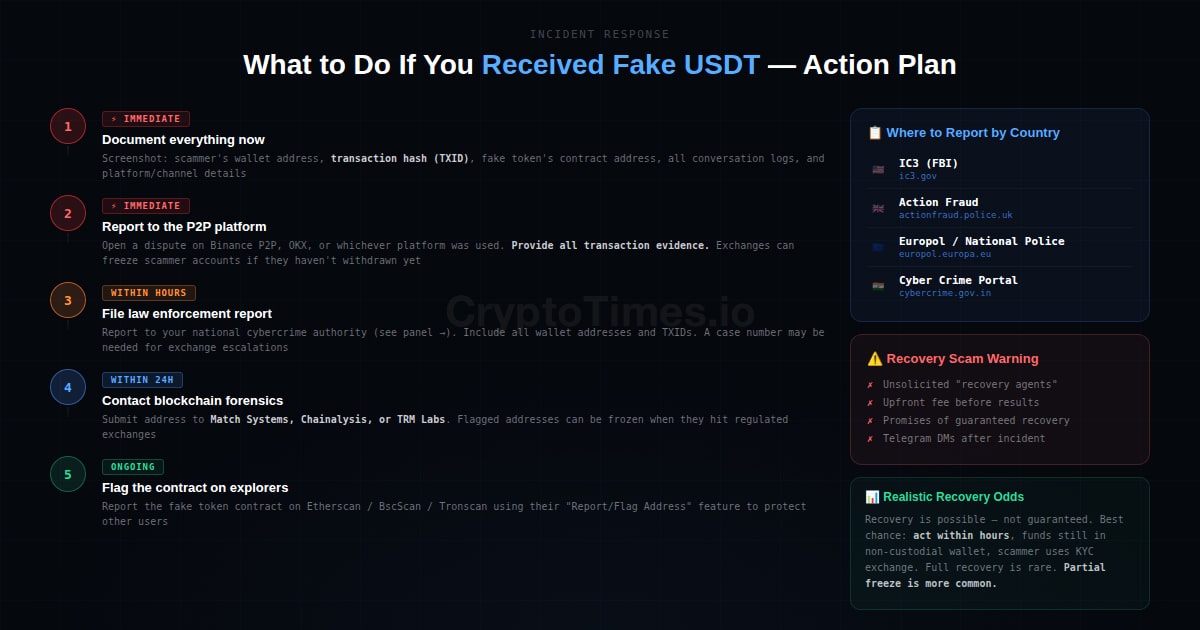
Blockchain transactions are irreversible. If assets have already been transferred to a scammer, there is no guaranteed recovery method. In most cases, stolen funds are moved within minutes or hours. However, prompt action can sometimes prevent further loss and increases the chance of the scammer’s address being flagged and frozen downstream.
Immediate Steps
- Document everything immediately: Record the scammer’s wallet address, the transaction hash (TXID), the fake token’s contract address, all correspondence with the scammer, and the platform or channel through which the deal was made.
- Report to the platform: If the scam occurred on a P2P exchange (Binance P2P, OKX, etc.), open a dispute immediately. Provide the transaction evidence. Exchanges can sometimes freeze a scammer’s account if they have not yet withdrawn.
- Report to law enforcement: File a report with your country’s cybercrime authority. In the US, report to the FBI’s Internet Crime Complaint Center (IC3) at ic3.gov. In the UK, use Action Fraud at actionfraud.police.uk. Include all transaction hashes and wallet addresses.
- Submit to blockchain forensics firms: Companies like Match Systems, Chainalysis, and TRM Labs work with law enforcement to tag scammer addresses. If the stolen funds are still in circulation, a flagged address can be frozen when it hits a regulated exchange. Contact information for Match Systems: match-systems.io.
- Report the contract address: Submit the fake token’s contract address to Etherscan, BscScan, or Tronscan’s phishing/scam reporting tools. This helps get the address tagged for other users.
Understanding What Recovery Actually Looks Like
It is important to have realistic expectations. Full recovery of stolen crypto is rare but not impossible. The most likely path to any recovery is:
- The scammer uses a regulated exchange: If the stolen funds reach a KYC-compliant exchange (Binance, Coinbase, Kraken, etc.) and the address has been flagged, the exchange can freeze the funds pending a legal order.
- Fast action within hours: The window is narrow. Funds that sit in a non-custodial wallet for days are far less likely to be recovered than funds that are still moving through exchanges.
- Jurisdictional cooperation: Cross-border crypto scams are the norm. Recovery often requires law enforcement cooperation between two or more countries, which takes time.
⚠️ Warning — Recovery Scams: Scammers frequently target victims a second time, offering to “recover cryptocurrency” for an upfront fee. These services are almost universally scams. No legitimate recovery firm asks for payment before results. If someone contacts you unsolicited offering to recover your stolen USDT, block them immediately.
Conclusion
Fake USDT is not an exotic, highly technical threat—it is a widespread social engineering scheme that works simply because users trust what they see on their screens without verifying the underlying code.
Protecting yourself takes less than 60 seconds. Always check your total USD balance, and verify the smart contract address on a blockchain explorer.
The Golden Rule: Never release goods, services, or genuine cryptocurrency until you have absolutely verified the authenticity of the stablecoins you received. In crypto, trust nothing—verify everything.
Frequently Asked Questions (FAQs)
How can I tell if the USDT in my wallet is real or fake?
The quickest way to check is by looking at your wallet’s total fiat (USD) balance. If you receive a deposit but your overall dollar value does not increase, the token is fake. For absolute certainty, copy the token’s contract address from your wallet and paste it into a blockchain explorer like Etherscan or BscScan. If the address doesn’t match Tether’s official contract, it is a counterfeit token with zero value.
Why does the blockchain allow scammers to create fake USDT?
Blockchains like Ethereum and BNB Chain are open-source and permissionless. This means anyone can create and deploy a new token in minutes without needing approval. Scammers exploit this feature by minting custom tokens and simply naming them “Tether” with the ticker “USDT.” While the blockchain legitimately processes the transfer of this newly created token, the token itself is worthless because it isn’t backed by Tether’s actual dollar reserves.
Can receiving fake USDT drain my wallet’s other assets?
Simply having a fake USDT token deposited into your wallet—such as through a random, unsolicited airdrop—cannot automatically drain your funds. The risk occurs when you try to interact with it. If you attempt to move, swap, or sell the fake token on a decentralized exchange (DEX), the malicious smart contract may prompt you to sign a transaction that grants the scammer permission to access and steal your legitimate crypto.
What is the difference between ERC-20, TRC-20, and BEP-20 USDT?
These refer to the blockchain network the USDT lives on. ERC-20 USDT exists on the Ethereum blockchain. TRC-20 USDT exists on the Tron blockchain. BEP-20 USDT exists on the BNB Smart Chain. Each has a completely different contract address, transaction fees, and confirmation speed. The most important thing to remember: transferring USDT between networks requires a bridge or exchange — sending ERC-20 USDT to a TRC-20 address will result in permanent loss of funds.
What is Flash USDT, and is it real?
Flash USDT tools are sold on Telegram and dark web forums as software that sends “temporary” USDT that disappears after a set number of days. They are a scam. There is no such thing as a blockchain transaction that expires. If someone is offering to pay you with Flash USDT, or if you have purchased such a tool, no real funds have or will move. See the dedicated “Flash USDT” section above for a full explanation.
Can I reverse the transaction or recover my money if I am scammed?
Blockchain transactions are strictly one-way and irreversible. If you release real money, goods, or legitimate crypto to a scammer in exchange for fake USDT, there is no central authority that can undo the transfer. To maximise any chance of recovery: document everything (wallet addresses, TXIDs, screenshots), report immediately to the P2P platform, file a report with your national cybercrime authority (IC3 in the US, Action Fraud in the UK), and contact a blockchain forensics firm like Match Systems. Beware of anyone offering to recover your crypto for an upfront fee — these are secondary scams targeting victims.
How do I report a fake USDT token contract?
You can submit the scam contract address directly to blockchain explorers: on Etherscan, click “More” on any contract page and select “Report/Flag Address”; BscScan and PolygonScan have the same feature. You can also report to your country’s financial regulator and submit the address to the Google Safe Browsing report tool if there is an associated website. Reporting helps protect the broader community even if it does not recover your funds.