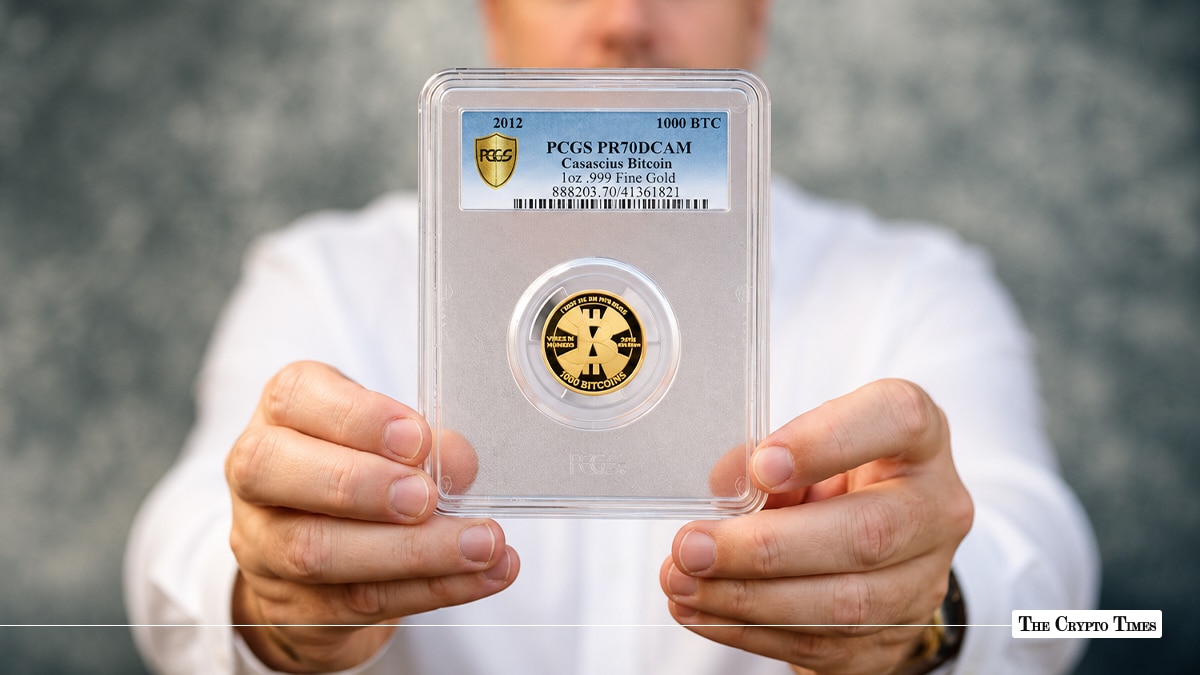
A Casascius bitcoin is a physical metal token with a real Bitcoin private key sealed inside it under a tamper-evident hologram. Created by Utah engineer Mike Caldwell between 2011 and 2013, the coins let people hold and trade Bitcoin as a tangible object. U.S. regulators forced production to stop in late 2013, permanently freezing the supply. More than a decade later, roughly 17,000-plus coins remain unopened — still loaded with tens of thousands of bitcoin — and every time one “wakes up” on the blockchain, the crypto world takes notice.
As of June 4, 2026, Bitcoin trades around $62,000 to $63,000, after sliding sharply over the last 48 hours amid record ETF outflows. Even at these reduced levels, the bitcoin still locked inside unredeemed Casascius coins is worth more than $2.23 billion.
What exactly is a Casascius bitcoin?
A Casascius bitcoin is a physical object, typically brass, silver, or, in its premium tiers, gold, that functions as a self-contained Bitcoin wallet. Each piece carries a public Bitcoin address on its face, while the corresponding private key is printed on a slip of paper hidden inside and covered by a holographic seal designed to show evidence of tampering.
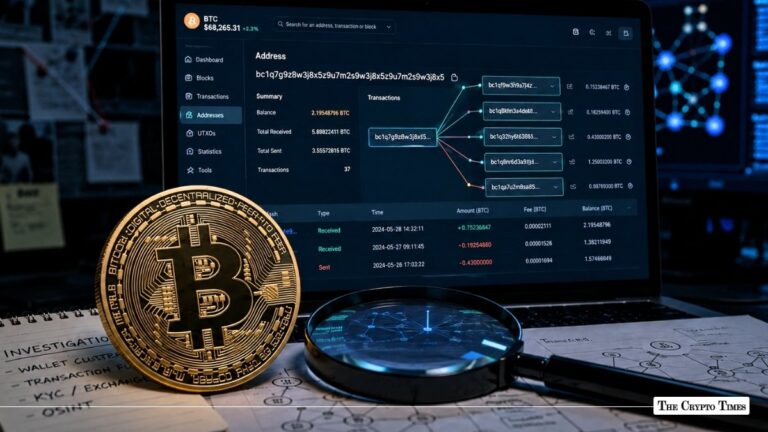
The design is elegant in its simplicity. Anyone can check a coin’s balance by looking up its public address on a blockchain explorer. But spending the bitcoin requires peeling back the hologram to expose the private key, an irreversible act that “redeems” the coin and separates the digital value from the physical object. Once peeled and swept into a software wallet, the coin becomes a collectible shell rather than a funded asset.
The maker, Mike Caldwell of Sandy, Utah, went by the handle “Casascius” on early Bitcoin forums — reportedly a contraction of the phrase “call a spade a spade.” A software engineer by trade, Caldwell began minting the coins in September 2011, when a single bitcoin traded in the low single digits. According to the Bitcoin Wiki, the earliest versions were customized brass coins originally ordered from a mint that produced car-wash tokens. Caldwell is now a Managing Partner at Utah-based Casascius Capital LLC, where he has continued working in crypto-related ventures since the original project wound down.
Collector trivia: The hologram on early coins, specifically the 2011 Series 1 coins, contains a spelling error, reading “CASACIUS” rather than “CASASCIUS” in the fine lettering; a detail collectors now use as an authenticity and series marker.
How big was the project?
The numbers are striking precisely because the supply is fixed and can never grow. According to data compiled by tracking services such as the Casascius Bitcoin Analyzer (casasciustracker.com), Caldwell produced roughly 27,000 to 27,900 units — coins and bars combined — collectively loaded with close to 98,500 BTC at the time of creation.
The coins scaled with Bitcoin’s early, low prices. The denomination ladder, and how rare each tier is today, looks like this:
| Denomination | Typical form & material | Rarity & redemption notes |
|---|---|---|
| 0.1 BTC | Small brass coin | Entry-level tier; widely circulated |
| 0.5 BTC | Brass coin | Common; frequently traded |
| 1 BTC | Brass coin (the classic) | The most recognisable Casascius; redemption rate above 50% |
| 5 BTC | Brass / silver coin | Mid-tier; many still held unopened |
| 25 BTC | Silver round | Scarcer; multiple series (S1, S2, S3). The S1-COIN-25 series totals 345 coins, of which 237 have now been redeemed as of June 3, 2026. |
| 100 BTC | Gold-plated bar / coin | High-value tier; reported redemption rate near 88% |
| 500 BTC | Rare bar tier | Very rare; pieces reported as largely unclaimed |
| 1,000 BTC | Top-tier coin and bar | The rarest: roughly 6 coins and 16 bars ever minted with 1,000 BTC each |
Figures are drawn from public trackers and outlet reporting; exact per-tier mintage and current unredeemed counts should be confirmed against the Casascius Bitcoin Analyzer at publication time.
By units of value, those top tiers are among the most valuable physical objects ever manufactured.
Casascius also inspired a wave of successor physical Bitcoin mints, including Lealana, Denarium, and BTCC, though none has achieved the cultural cachet or collector demand of the original Casascius coins.
Why the project was shut down
The end came not from a hack or a market crash, but from federal guidance. On March 18, 2013, the Financial Crimes Enforcement Network (FinCEN), an arm of the U.S. Treasury Department, issued interpretive guidance. The guidance FIN-2013-G001, titled “Application of FinCEN’s Regulations to Persons Administering, Exchanging, or Using Virtual Currencies,” clarified how the Bank Secrecy Act applies to virtual-currency activity.
The guidance drew a line between ordinary “users” of virtual currency, who are not money services businesses, and “administrators” or “exchangers,” who can be classified as money transmitters subject to federal registration and, typically, state licensing.
That framework is what caught the Casascius project. Pre-loading physical coins with Bitcoin and selling them fell on the wrong side of the line, and Caldwell was advised that his minting operation made him a money transmitter. Rather than take on the federal registration and state-by-state licensing burden, he suspended sales of items containing digital bitcoins on November 26–27, 2013. He continued offering empty coins and holograms for a time, but the era of the funded Casascius coin was over. That decision is what gives the surviving coins their permanent scarcity: no new ones can ever be minted with bitcoin inside.
From currency experiment to coveted collectible
Caldwell’s original vision was practical: a way to spend bitcoin in face-to-face transactions when mobile wallets were primitive and the network was tiny. History had other plans. Once production stopped and Bitcoin’s price climbed by orders of magnitude, the coins transformed into something closer to rare art or numismatic treasure.
The collector market reflects that shift. Authenticated, unpeeled coins routinely change hands for well above the face value of the Bitcoin inside, premiums commonly cited in the range of 1.5x to 4x the underlying BTC. The premium rewards rarity, provenance, and the intact hologram; peeling the seal destroys much of the collectible value.
Auction results underscore the point. A 2023 sale at Stack’s Bowers moved $621,590 worth of physical cryptocurrency coins, with average premiums approaching 200% of face value. Individual examples have sold for striking premiums; a 2013 Casascius “Gold Rim” 1 Bitcoin in gilt silver (graded PCGS PR69DCAM) sold for $78,000 — a specific Series 3 silver variant of which roughly 700 were converted from the original 2,000-piece silver run. With Bitcoin trading around $25,000-$30,000 in June 2023, that $78,000 sale represented a premium of approximately $48,000-$53,000 over the face value of the bitcoin inside. A 2012 Casascius 10 Bitcoin (PCGS Specimen-68) sold for $312,000 in Stack’s Bowers’ August 2023 auction. The highest price ever paid for a Casascius coin at public auction has been reported at approximately $1.7 million.
The 2025–2026 awakenings: Why dormant coins keep making news
What keeps Casascius coins in the headlines is not the minting (long finished) but the redemptions. Because every coin’s address is public and permanently visible on the blockchain, on-chain analysts can watch in real time when a coin that has sat untouched for a decade suddenly springs to life.
The past year produced several such moments:
| Date | Event | Value moved |
|---|---|---|
| May 13, 2025 (gained viral attention in July 2025) | “John Galt” redeems a 100 BTC Casascius bar bought for ~$500 in 2012 | ~$10 million+ (a ~2,000,000% return) |
| October 22, 2025 | An early holder opens nine coins in a few hours | 9.5 BTC (~$589,000) |
| December 5, 2025 | Two 1,000 BTC coins activated after 13–14 years dormant (one minted Dec 2011 at $3.88; the other Oct 2012 at $11.69) | ~2,000 BTC (~$124 million) |
| February 2026 | Two more 1,000 BTC coins activated after 13+ years | ~2,000 BTC |
| June 3, 2026 | A 25 BTC Casascius silver round (S1-COIN-25 series) peeled and swept on-chain after about 15 years | 25 BTC (~$1.55 million) |
In the December 5, 2025 event — the most dramatic of the cycle — one coin had been untouched since October 2012, when Bitcoin traded near $11.69; the other dated to December 2011, when bitcoin was worth just $3.88. The earlier coin represents a theoretical return of roughly 2.3 million percent, before minting costs. On-chain analyst Sani, Founder of Timechain Index, flagged the transfers, which were independently confirmed via blockchain explorers.
The reasons behind these moves are rarely confirmed. Analysts have speculated they could reflect sales, internal wallet reorganizations, or precautionary transfers to preserve access. A practical concern has surfaced too: a user on the Bitcointalk forum, claiming ownership of a 100 BTC bar, reported difficulty importing the decades-old private-key format into modern wallet software after peeling the hologram. As the coins age, the physical paper and the early key formats can become liabilities, giving some long-term holders a reason to redeem before the medium degrades.
A second redemption risk: forked-coin forfeiture. Bitcoin forks between 2017 and 2018 — particularly Bitcoin Cash (BCH), Bitcoin SV, and Bitcoin Gold — created parallel coin balances at every Bitcoin address that existed before the fork dates. When a Casascius coin is peeled and the private key is exposed without proper forked-coin claiming procedures, those parallel balances can be lost. For coins minted before 2017, the forked-coin value can be significant and is easy to forfeit during a rushed redemption.
Why this matters for collectors: Every redemption permanently reduces the supply of intact coins. After December 2025, only 4 of the original 6 1,000-BTC coins remain unopened. Scarcity drives premiums — but it also tempts holders to redeem before further degradation makes the keys harder to extract safely.
How much is still out there?
Estimates vary by tracker and by date, but the broad picture is consistent: well over half the original Bitcoin remains sealed inside unopened coins. As of late 2025, tracking data and outlet reporting placed the number of unredeemed coins at roughly 17,000 to 17,800, holding on the order of 36,000 to 38,000-plus BTC.
The dollar value of that hoard swings with the market. At Bitcoin’s October 2025 highs it was pegged above $4 billion; at the current ~$62,000 price, the same stash is worth somewhere in the neighbourhood of $2.23 billion to $2.35 billion. Either way, it represents one of the largest concentrations of “lost or held” early bitcoin still tied to a single, identifiable artifact.
Redemption patterns also reveal something about holder psychology. Trackers note that high-denomination tiers like the 100 BTC bars have been opened at relatively high rates, while certain series, including some Series 3 silver coins, remain largely untouched. The fewer coins that remain, the higher the collectible premium on those that survive intact, creating a powerful incentive not to redeem.
What it means for collectors and the market
Three takeaways stand out:
1. They are hybrid assets. A funded Casascius coin is simultaneously a bearer instrument (whoever peels it first controls the bitcoin), a collectible with numismatic value, and a piece of crypto history. That combination makes pricing complex and liquidity thin — these coins trade more like rare art than like spot bitcoin.
2. Authenticity is everything. Because the value lives behind a hologram, fraud risk is real. Experts consistently advise verifying provenance, demanding photographic and on-chain transaction evidence, and never paying for a coin that cannot be independently confirmed on the blockchain. The intact, original hologram is central to both authenticity and value.
3. Redemptions are mostly symbolic for the broader market. Even a 2,000 BTC release is small relative to Bitcoin’s daily trading volume — typically tens of billions of dollars — so these movements rarely move the market on their own. Their real significance is historical and cultural: each one is a fragment of Bitcoin’s earliest, most experimental era resurfacing in the present.
Frequently asked questions
Can you still buy Casascius coins?
You can no longer buy them new. Caldwell stopped selling bitcoin-loaded coins in late 2013 after U.S. regulatory guidance classified the activity as money transmission. Existing coins now trade on the secondary collector market.
How much is a Casascius coin worth?
A coin is worth at least the bitcoin sealed inside it, plus a collectible premium that commonly runs 1.5x to 4x the face value for authenticated, unpeeled pieces. Rare high-denomination coins have sold for substantially more — a 2012 Casascius 10 Bitcoin sold for $312,000 at Stack’s Bowers in August 2023, and a 100 BTC bar redeemed in 2025 was worth over $10 million at then-current Bitcoin prices.
Why were Casascius coins discontinued?
In March 2013, FinCEN issued guidance (FIN-2013-G001) clarifying when virtual-currency activity counts as money transmission. Minting and selling pre-funded coins fell under that definition, requiring federal registration and state licenses, so Caldwell halted funded-coin sales in November 2013.
How do you redeem a Casascius coin?
You peel back the holographic seal to reveal the printed private key, then import or sweep that key into a Bitcoin wallet to access the funds. Peeling is irreversible and typically destroys most of the coin’s collectible value. For coins minted before 2017, redeemers should also follow proper forked-coin claiming procedures before exposing the key, to avoid forfeiting parallel balances on Bitcoin Cash, Bitcoin SV, and other forks.
Are Casascius coins legal to own?
Owning and trading existing Casascius coins is generally treated as buying and selling a collectible. The 2013 regulatory issue concerned the manufacture and sale of newly funded coins, not private ownership. (This is general information, not legal advice.)
How many Casascius coins are left unredeemed?
As of late 2025, roughly 17,000 to 17,800 coins remained unopened, holding an estimated 36,000 to 38,000-plus BTC. The figure declines slowly as holders redeem coins; check a live tracker such as the Casascius Bitcoin Analyzer for the current count.
Who is Mike Caldwell?
Mike Caldwell is a Utah-based software engineer who created the Casascius coins beginning in 2011. He went by the username “Casascius” on Bitcoin forums and personally hand-assembled most of the coins. He suspended sales of funded coins in November 2013 after receiving regulatory pressure from FinCEN.
What is the rarest Casascius coin?
The rarest are the 1,000 BTC denominations — only about six coins and 16 bars were ever minted with that face value. After the December 2025 redemptions, only four of the 1,000-BTC coins are believed to remain unopened.
Bottom line
Casascius coins occupy a singular place in financial history — a moment when a software engineer in Utah tried to bridge the digital and physical worlds by stamping bitcoin into metal, only to be stopped by regulators who recognised he’d built something the rules weren’t ready for.
More than a decade on, the experiment endures as buried treasure: thousands of coins still sealed, billions in bitcoin still waiting, and a watchful community ready to chronicle every coin that finally wakes up.
Disclaimer:
The Crypto Times publishes news, analysis, and educational content for informational purposes only. We do not offer financial, investment, legal, or trading advice of any kind. All content on our website is intended to be neutral and fact-based. Readers should always do their own research, consult with licensed professionals, and evaluate risks independently.
The Crypto Times does not endorse or recommend any specific cryptocurrencies, tokens, projects, financial products, or investment strategies. We do not accept legal liability for any financial losses incurred as a result of reliance on information published by us.
Disclaimer:
Some elements of this content may have been enhanced with the help of our artificial intelligence (AI) assistants for purposes such as basic refinement, review, image generation, and translation to deliver high-quality news in a shorter time frame. However, all AI-assisted content is reviewed and approved by our team to ensure accuracy, fairness, and editorial integrity.