Perpetual contracts are one of the most popular ways to trade crypto today — but for newcomers, the mix of leverage, margin, and funding rates can feel intimidating. The good news is that the actual workflow on a modern exchange is far simpler than the jargon suggests. In this guide, we’ll walk through everything you need to know to place your first trade on BYDFi, from opening an account to managing risk like a thoughtful trader rather than a gambler.
BYDFi recently marked its 6th anniversary in April 2026, celebrating six years of operation across 190+ countries with more than 1 million users. The platform has matured into what it now describes as a “CEX + DEX dual-engine” trading platform, with perpetual contracts sitting at the heart of its product suite. Whether you’re entirely new to derivatives or just new to this platform, this tutorial is designed to get you trading confidently — and safely.
What Are Perpetual Contracts (And How Do They Differ From Regular Futures)?
Before placing any trade, it’s worth taking sixty seconds to understand what you’re actually trading.
A perpetual contract is a type of derivative that lets you speculate on the price of a cryptocurrency without ever owning the underlying coin. If you think Bitcoin is going up, you open a “long” position. If you think it’s going down, you open a “short.” Your profit or loss tracks the price movement of BTC, multiplied by any leverage you apply.
The key word here is perpetual: unlike traditional futures contracts, perpetuals have no expiry date. You can hold the position for an hour, a week, or several months — as long as you have enough margin to keep it open.
To keep the perpetual contract price tethered to the underlying spot price, exchanges use a mechanism called the funding rate. Every eight hours on BYDFi, longs and shorts exchange a small payment with each other. If the funding rate is positive, longs pay shorts; if negative, shorts pay longs. The rate is usually tiny, but it’s worth checking before holding a position overnight.
Perpetual contracts vs futures, in one line: Traditional futures have a fixed settlement date; perpetuals don’t, and they use funding rates to track the spot price instead.
Why Beginners Choose BYDFi for Perpetual Trading
There are dozens of exchanges offering crypto derivatives, but a few things make BYDFi a reasonable starting point for someone new to futures:
- 500+ futures trading pairs covering all major coins plus a long tail of altcoins
- Maker fees of 0.02% and taker fees of 0.06% on USDT-margined perpetuals — competitive with most major exchanges
- TradingView integration built directly into the trading interface, so you don’t need to flip between tabs to read charts
- A 50,000 USDT demo account that mirrors live market conditions, so you can practice before risking real capital
- 800 BTC user protection fund combined with regularly published Proof of Reserves
- Low friction onboarding — basic trading is available with a quick signup, and the minimum deposit is just $1
- Newcastle United partnership — BYDFi is the Premier League club’s official cryptocurrency exchange partner, a recognition signal for a platform that started as BitYard in 2020
The platform also offers up to 200x leverage on major pairs like BTC and ETH. We’ll talk about this honestly in the risk section below — high leverage is a tool, not a feature to chase.
Step 1: Create and Set Up Your BYDFi Account
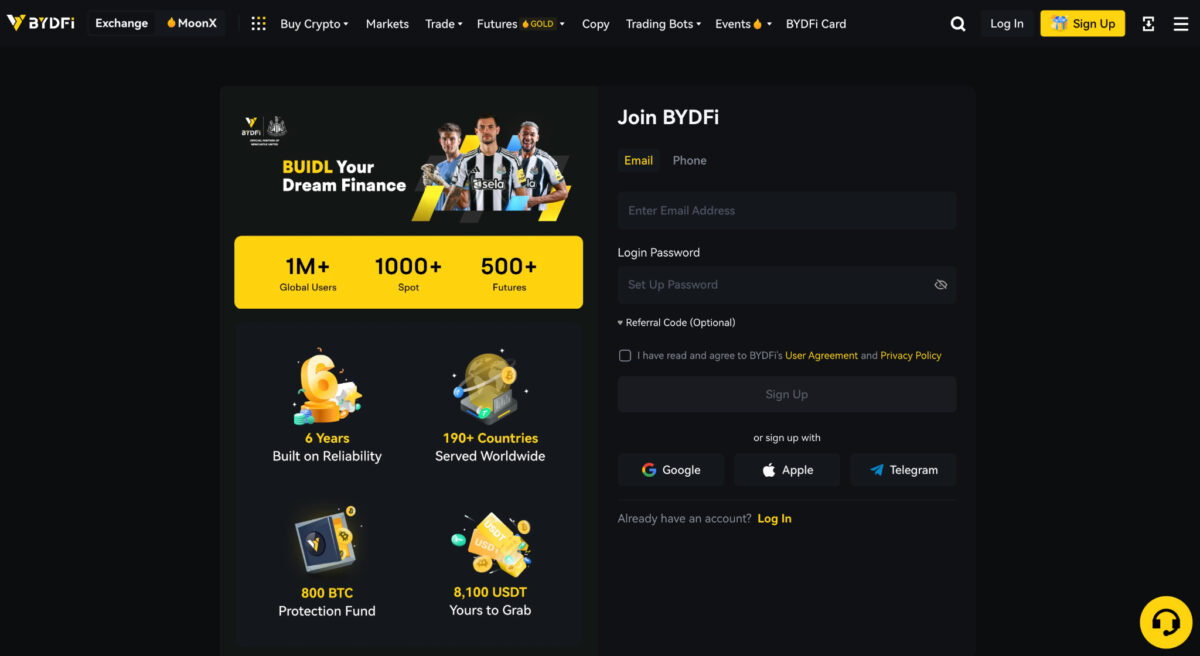
Head to bydfi.com and click “Sign Up.” You can register with an email address or a phone number.
The BYDFi signup screen.
A few setup tips before you do anything else:
- Enable two-factor authentication (2FA) immediately. Use an authenticator app like Google Authenticator or Authy rather than SMS where possible.
- Set an anti-phishing code in your security settings. BYDFi will include this code in all official emails, making phishing attempts easier to spot.
- Decide whether to complete KYC. Basic trading is available without mandatory verification, but completing KYC raises your withdrawal limits and unlocks features like the BYDFi Card. For most active traders, it’s worth doing.
Once your account is live, you can deposit crypto for free using the network of your choice (USDT on TRC-20 is a common low-fee option). If you don’t already hold crypto, BYDFi supports fiat on-ramps through third-party partners — fees depend on the provider.
Step 2: Practice on the Demo Account First (Seriously)
This is the step most beginners skip — and the step most beginners later wish they hadn’t.
BYDFi offers a 50,000 USDT demo account that mirrors live market conditions. There’s no deposit required, and you can access it directly without even registering an account if you want a feel for the platform first.
Try this before risking real money:
- Place a small long position with low leverage (say, 3x or 5x)
- Watch how the position’s unrealized P&L moves
- Set a stop-loss and a take-profit
- Try a short position
- Get liquidated on purpose with high leverage so you understand exactly what it feels like
This last point matters. The single biggest difference between a beginner who blows up an account and one who survives their first six months is whether they internalized what liquidation looks like before it happened with real money.
Step 3: Fund Your Futures Account
When you’re ready to trade for real, you’ll need to transfer funds from your Spot Wallet to your Futures Wallet (sometimes called the Derivatives Wallet on the platform).
On BYDFi, this transfer is instant and free. Most beginners start by moving a small amount of USDT — enough to size positions sensibly without exposing more capital than they’re comfortable losing. A common rule of thumb is to never put more than 5–10% of your total crypto holdings into a derivatives wallet, especially when starting out.
Step 4: Navigate to the Perpetual Contracts Page
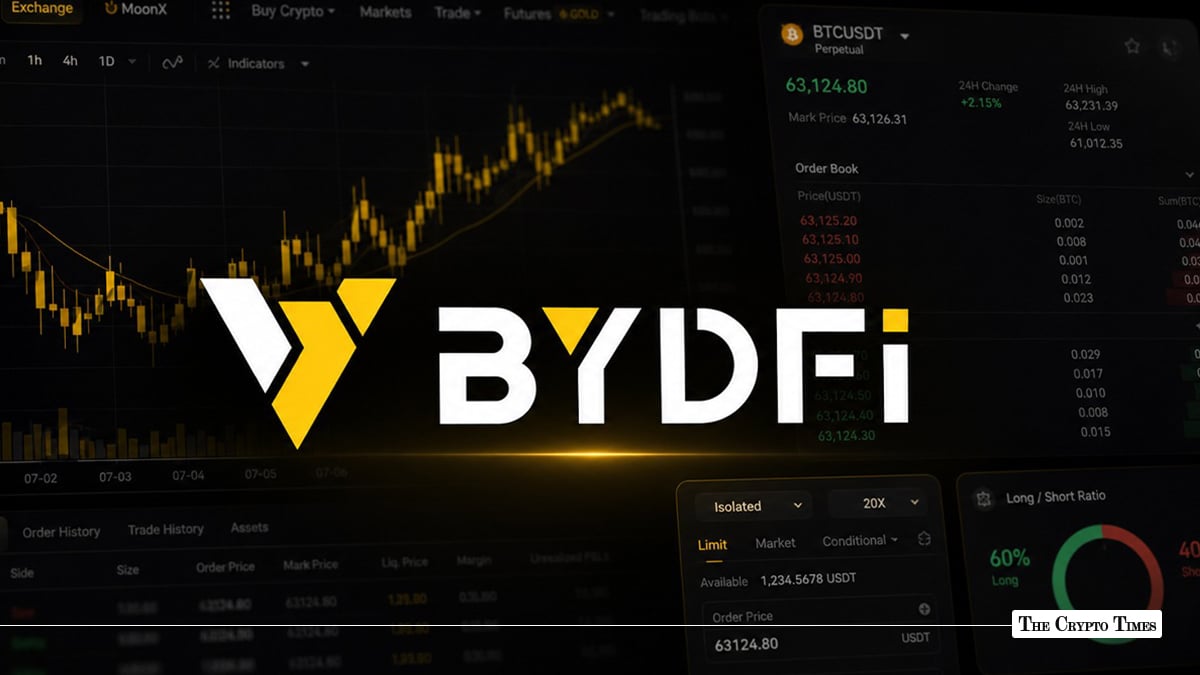
From the top menu, select Derivatives → USDT-M Perpetual. This will take you to the main futures trading interface. If you want to start with the most liquid pair, you can go directly to BYDFi perpetual contracts for BTC/USDT.
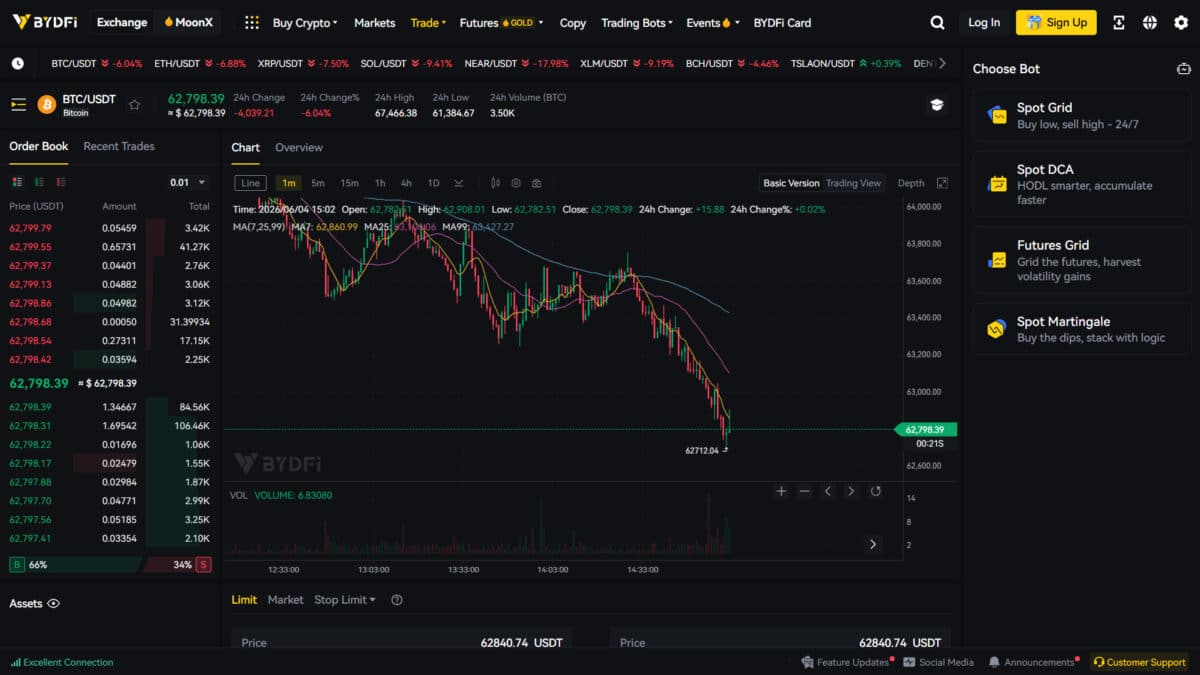
You’ll see a few key panels:
- Chart (center): TradingView-powered candlestick chart with indicators
- Order book (right): Live bids and asks
- Order entry (right side): Where you build and place your trade
- Positions and orders (bottom): Your open positions, pending orders, and history
- Funding rate (top of order entry): Shows the current rate and the time of the next settlement
Step 5: Choose Your Margin Mode and Leverage
This is the most important configuration step in the whole tutorial. Get it right and the rest is straightforward.
Margin Mode: Cross vs Isolated
- Cross Margin uses your entire futures wallet balance as collateral for all open positions. If one trade goes badly, it can pull liquidity from your other positions to stay open. This is more flexible but also more dangerous — a single bad trade can wipe out your whole futures balance.
- Isolated Margin caps the collateral for each position at the amount you assign to it. If the trade gets liquidated, you only lose the margin assigned to that specific position. The rest of your wallet is untouched.
For beginners, isolated margin is almost always the right answer. It puts a hard ceiling on the damage any single trade can cause.
Choosing Leverage
BYDFi lets you select leverage up to 200x on majors like BTC and ETH. This does not mean you should use it.
Here’s a useful mental model: leverage is a magnifier. If you use 10x leverage, a 1% move in the market moves your position by 10%. A 10% move wipes you out. At 100x leverage, a 1% move against you is a full liquidation.
Crypto routinely moves 2–5% in a day. At high leverage, you don’t need to be wrong — you just need to be early.
Sensible starting points for beginners:
- First few trades: 2x–5x
- Once comfortable with the workflow: 5x–10x
Higher leverage should only come after you’ve demonstrated consistent risk management for months, not days
Step 6: Place Your First Order
You have three main order types to choose from:
- Market Order — fills immediately at the best available price. Use for fast entries when you don’t care about a few basis points of slippage.
- Limit Order — fills only at the price you specify or better. Use when you want to enter at a specific level and don’t mind waiting.
- Stop-Limit Order — triggers a limit order once the market hits your stop price. Useful for both entries and risk management.
To place a long position on BTC/USDT:
- Select Open Long (the green button)
- Choose Limit or Market
- Enter the price (for limit orders) and the size
- Set the leverage you chose in Step 5
- Confirm the order
Your position will appear in the “Positions” panel at the bottom of the screen, showing entry price, current price, unrealized P&L, liquidation price, and your margin.
Step 7: Manage Risk — How to Trade Perpetuals Without Getting Liquidated
If there’s one section to actually internalize, it’s this one. The traders who survive aren’t the ones who pick the most winning trades — they’re the ones who control losses on the bad ones.
Always Set a Stop-Loss
Before — not after — you open a position, decide where you’ll exit if you’re wrong. Then place a stop-loss order at that level. BYDFi lets you set a stop-loss directly when opening a position, which means there’s no excuse to skip this step.
A common rule: never risk more than 1–2% of your futures wallet on a single trade. If your stop is 2% away from your entry and you’re risking 1% of your account, your position size should be 0.5x your account balance, not 5x.
Watch Your Liquidation Price
Your liquidation price is the price at which your position will be force-closed because your margin has run out. It’s displayed prominently on BYDFi’s interface. The closer your liquidation price is to the current price, the more dangerous your leverage is.
Rule of thumb: your liquidation price should be well beyond any normal daily price swing. If BTC routinely moves 3% in a session and your liquidation is 2% away, you’re not really trading — you’re flipping a coin.
Be Aware of the Funding Rate
If you’re holding a position across a funding settlement (every 8 hours on BYDFi), you’ll either pay or receive funding. On heavily one-sided markets, funding can become expensive quickly. Check the funding rate before holding positions overnight.
Take Profits Mechanically
Set take-profit levels at the same time you set stop-losses. If you wait to “see how it goes,” you’ll usually give back gains. Mechanical exits remove emotion from the equation.
Use the Tools That Are Already There
BYDFi’s interface includes TradingView charts, which means you have access to professional-grade technical indicators (RSI, MACD, moving averages, Fibonacci levels) without leaving the platform. If you’re going to trade derivatives, learning to read a chart is non-negotiable.
Step 8: Close Your Position
To exit, you have two choices:
- Place a closing order manually — go to the position panel, click “Close,” and choose market or limit.
- Let your take-profit or stop-loss trigger automatically — which is the preferred option if you set them when you opened the trade.
Once the position is closed, your realized P&L is settled to your futures wallet in USDT.
Common Beginner Mistakes (and How to Avoid Them)
A few things almost every new perpetual trader does wrong, and how to sidestep them:
- Trading with too much leverage too early. Start at 2x–5x and stay there until you’ve had at least 50 trades.
- Skipping the demo account. Practice for at least a week on demo before going live.
- Not setting stop-losses. “I’ll just watch the chart” is not a stop-loss. The market doesn’t sleep, and you do.
- Revenge trading after a loss. The single biggest account-killer for beginners. If you lose a trade, walk away for at least an hour before opening another.
- Trading pairs you don’t understand. Stick to BTC and ETH for the first month. Memecoins and low-cap futures move violently and are not beginner territory.
- Holding through funding without checking the rate. A high positive funding rate over several settlements can eat real returns.
Final Thoughts
Perpetual contracts are a serious tool, and they reward patience, discipline, and continuous learning — not bravado. The mechanics of placing trades on BYDFi are straightforward once you understand the building blocks: margin mode, leverage, order types, stop-losses, and funding rates. Master those, and you’ll be ahead of the majority of retail derivatives traders.
Start small. Use an isolated margin. Set stops. Watch the funding rate. And use the demo account until the workflow feels boring — which is exactly when you’re ready to trade live with real capital.
Whether you’re exploring derivatives for the first time or migrating from another platform, the combination of low fees, a beginner-friendly demo environment, TradingView integration, and a six-year operating history makes BYDFi a reasonable home for learning. The 6th anniversary rewards are a useful bonus while you build the only thing that actually matters in this game: consistent, risk-aware execution.
Also Read: ONDO Finance: The Complete Guide to the RWA Token, Its Price, and Its Future (2026 Update)
This article is for educational purposes only and does not constitute financial advice. Crypto derivatives trading carries significant risk, including the potential loss of your entire investment. Trade only with funds you can afford to lose, and consider consulting a qualified financial advisor before engaging in leveraged trading.