Bitcoin’s blockchain is transparent. Bitcoin ownership is not.
Anyone can inspect a Bitcoin address, examine its transaction history and see how many coins it contains. But the blockchain does not automatically reveal whether those coins belong to one individual, an exchange serving millions of customers, an ETF trust, a listed company, a government agency or an institutional custodian.
That distinction is fundamental.
A Binance cold wallet containing nearly 250,000 BTC does not mean Binance shareholders own all of those coins. Most of the balance may belong economically to customers. Similarly, Bitcoin held in a Coinbase-controlled address might back an ETF, belong to an institutional client or form part of Coinbase’s own corporate treasury.
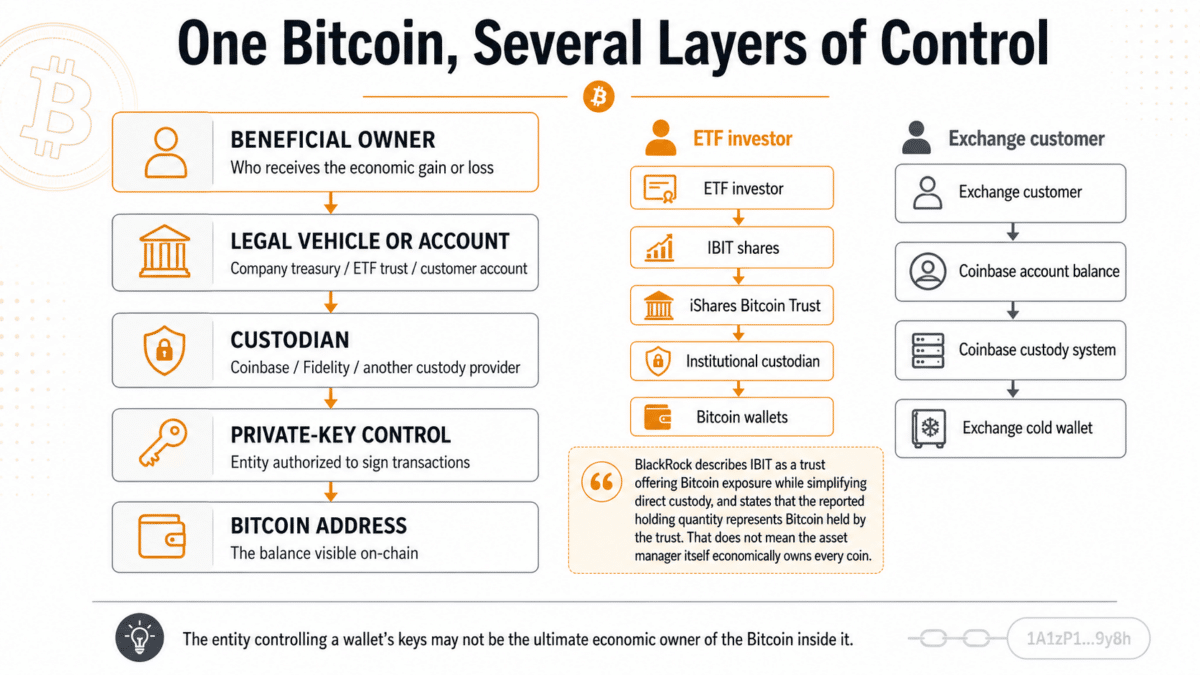
This investigation therefore separates five concepts that are frequently mixed together:
- Beneficial ownership
- Legal ownership
- Custody
- Private-key control
- On-chain attribution
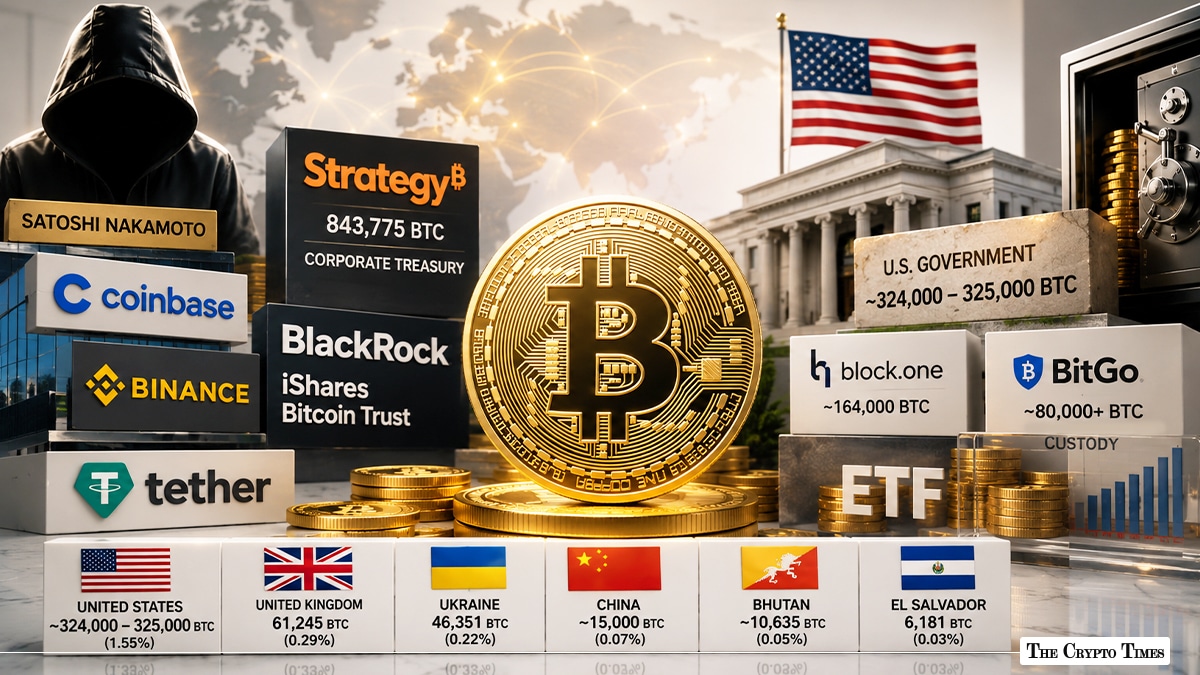
Based on the available evidence, Bitcoin’s pseudonymous creator, Satoshi Nakamoto, remains the most likely largest individual Bitcoin holder. But even that conclusion is based on competing blockchain-attribution models rather than a signed statement or verified list of wallets.
Among public companies, Strategy is the clear leader. Among governments, the United States controls the largest identifiable balance. Exchanges and custodians control even larger wallet clusters, but much of that Bitcoin belongs to customers, funds and institutions rather than the companies operating those wallets.
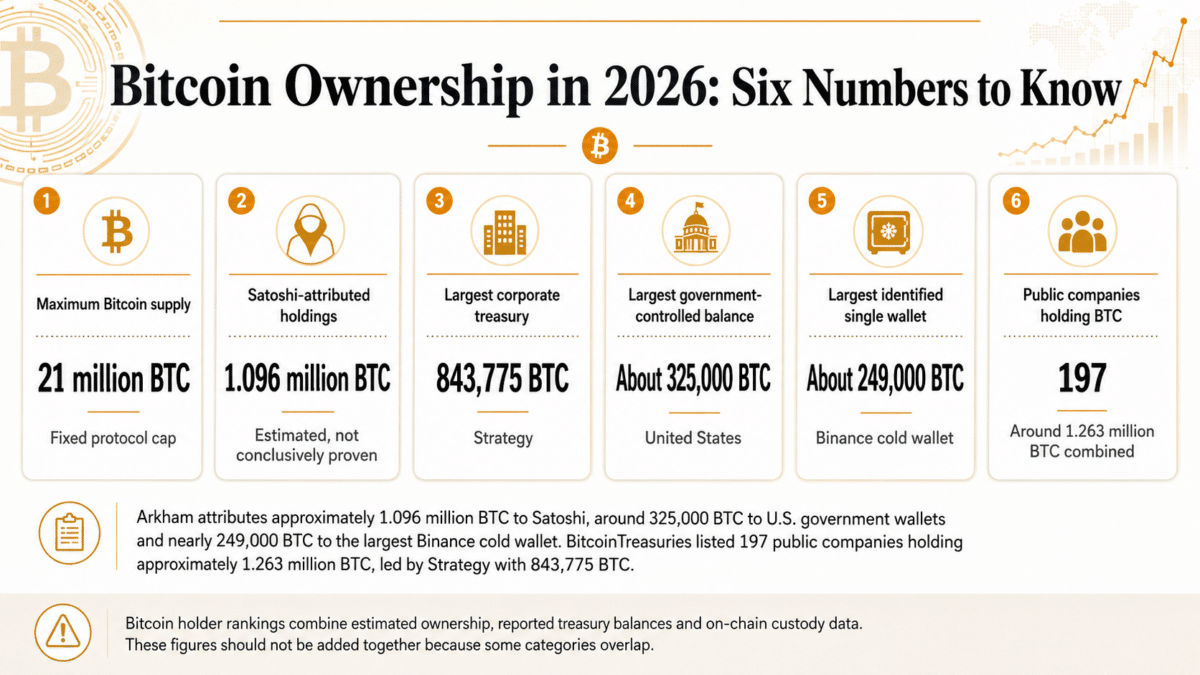
Every balance in this article carries its own underlying reporting date. Holdings are shown primarily in BTC because dollar values become outdated whenever Bitcoin’s price changes.
How We Researched the Largest Bitcoin Holders
No single data provider can independently prove every category of Bitcoin ownership.
This ranking uses a source hierarchy based on the type of holder being examined.
| Holder Type | Primary Evidence | Cross-Check |
|---|---|---|
| Public companies | SEC filings, company disclosures and investor-relations reports | BitcoinTreasuries |
| ETF trusts | Issuer holdings pages, prospectuses and regulatory reports | BitcoinTreasuries and on-chain attribution |
| Governments | Court documents, forfeiture records and official government statements | BitcoinTreasuries and Arkham |
| Exchanges | On-chain entity clustering and known cold-wallet labels | Independent blockchain explorers and company custody disclosures |
| Individuals | Signed wallet proof or credible historical research | Multiple on-chain attribution models |
| Unknown wallets | Blockchain explorer balances | Analytics-platform labels, where available |
BitcoinTreasuries currently tracks approximately 1.263 million BTC across 197 public companies, approximately 650,000 BTC across 13 government-related entities, and more than 1.62 million BTC under its combined ETF-and-exchange category. These categories should not be added together blindly because their definitions and economic owners differ.
Arkham is used primarily for entity clustering: identifying groups of wallets that its researchers believe are controlled by the same organization. BitInfoCharts provides a separate address-level rich list but generally does not establish the beneficial owner behind every wallet.
Confidence labels used in this article
Confirmed: Disclosed in a regulatory filing, official company statement or government record.
Reported: Published by the organization but not independently proven through wallet ownership.
Attributed: Linked to an entity through blockchain analysis.
Estimated: Derived from incomplete evidence or competing research models.
Who Owns the Most Bitcoin? The Quick Answer
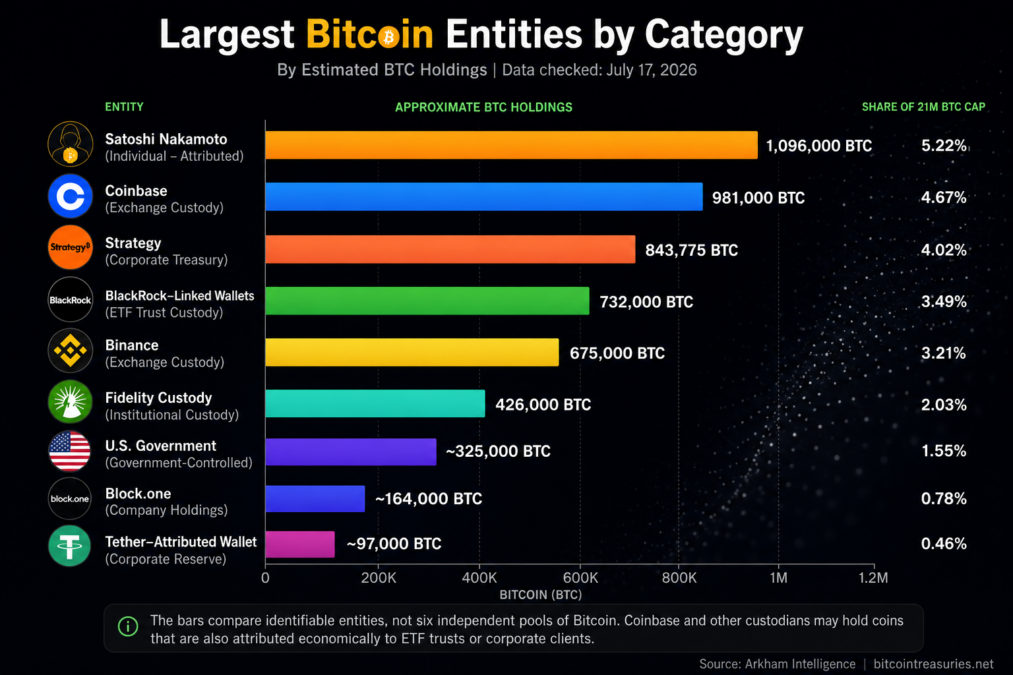
| Holder or Entity | Approximate BTC | Type of Figure | Principal Sources |
|---|---|---|---|
| Satoshi Nakamoto | 600,000–1.096 million | Estimated and attributed | Lerner, BitMEX Research, Arkham |
| Coinbase-linked wallets | Around 981,000 | Custodial attribution | Arkham, Coinbase disclosures |
| Strategy | 843,775 | Confirmed corporate treasury | Strategy, BitcoinTreasuries |
| IBIT-related Bitcoin | Roughly 732,000–735,000 on the July 2026 snapshot | Trust assets and wallet attribution | iShares, Arkham |
| Binance-linked wallets | Around 675,000 | Mainly exchange custody | Arkham, address explorers |
| U.S. government-related BTC | Approximately 324,000–328,372 | Controlled, seized or forfeiture-related | BitcoinTreasuries, Arkham, DOJ |
| Tether-attributed wallet | Around 97,000 | Corporate reserve attribution | Arkham |
These figures are not additive.
For example, Bitcoin attributed to Coinbase wallets may include assets backing investment products and assets belonging to institutional custody clients. Counting Coinbase, ETF trusts, and investors as three independent Bitcoin holders could count the same coins multiple times.
1. Satoshi Nakamoto: The Largest Estimated Individual Holder
Satoshi Nakamoto is generally considered the largest individual Bitcoin holder, but the exact figure remains disputed.
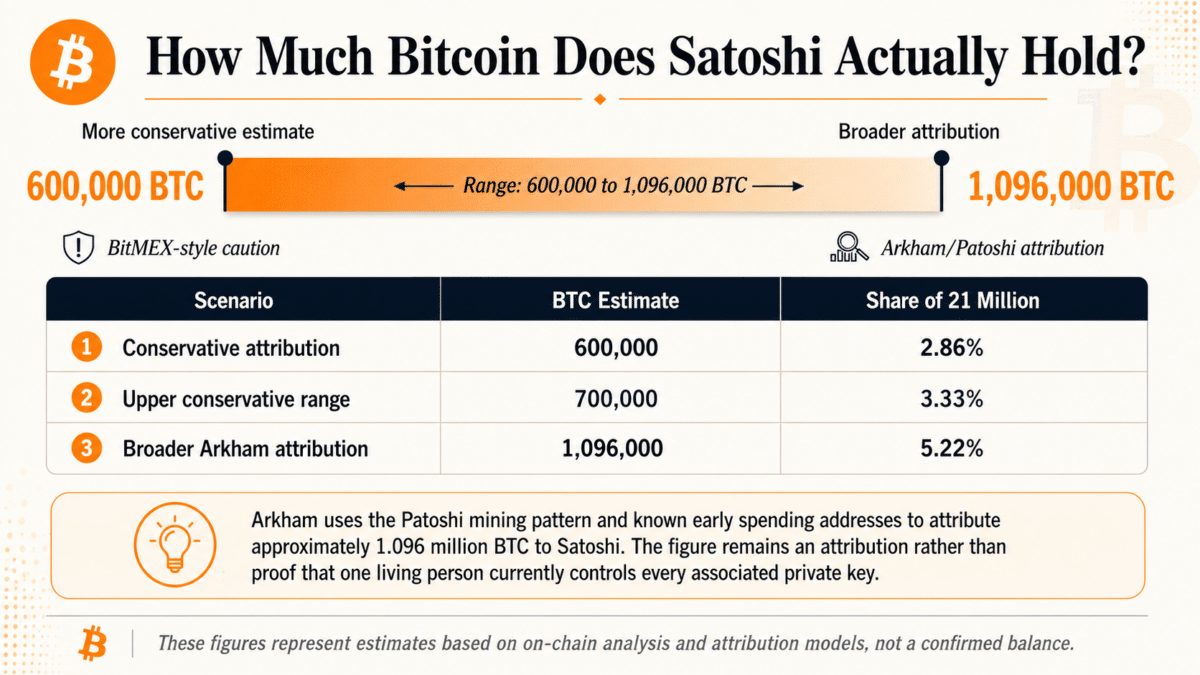
Researcher Sergio Demian Lerner identified a distinctive pattern in early Bitcoin blocks known as the Patoshi pattern. Lerner argued that one dominant miner produced a large proportion of Bitcoin’s early blocks and estimated that this miner accumulated approximately one million BTC. Many researchers believe that dominant miner was likely Satoshi.
Arkham’s broader attribution associates approximately 1.096 million BTC with Satoshi-linked mining addresses, spread across roughly 22,000 wallets.
BitMEX Research reached a more conservative conclusion. After reviewing the early mining patterns, it found reasonable evidence that one dominant miner could have generated around 700,000 BTC but said the evidence was less robust than often presented. BitMEX suggested 600,000 to 700,000 BTC as a more defensible range.
Estimated Satoshi holdings
| Attribution Model | Estimated BTC | Share of 21 Million |
|---|---|---|
| Conservative lower estimate | 600,000 | 2.86% |
| Conservative upper estimate | 700,000 | 3.33% |
| Broader Patoshi attribution | 1,096,000 | 5.22% |
The responsible conclusion is therefore not that Satoshi definitively “owns 1.096 million BTC.”
It is that a dominant early miner—widely believed to be Satoshi—may have mined between approximately 600,000 and 1.096 million BTC.
There are three additional uncertainties:
- The Patoshi miner has not been cryptographically proven to be Satoshi.
- It is unclear whether one person or several people controlled the operation.
- Dormancy does not prove the relevant private keys are still accessible.
Satoshi nevertheless remains the strongest answer to the question of who owns the most Bitcoin because even the conservative estimate exceeds every confirmed corporate treasury.
2. Coinbase: The Largest Identified Bitcoin Custody Cluster
Arkham has attributed approximately 981,000 BTC to Coinbase-linked wallets, making Coinbase one of the largest identifiable controllers of Bitcoin addresses.
This should not be interpreted as Coinbase owning 981,000 BTC for its shareholders.
Coinbase states that assets held in Coinbase accounts are custodied for the benefit of users. Its definition of assets on platform also includes crypto assets held or managed on behalf of customers, including through its institutional custody services.
Coinbase’s wallet cluster may contain Bitcoin belonging to:
- Retail exchange customers
- Institutional custody customers
- ETF trusts
- Wrapped-Bitcoin reserves
- Corporate treasury clients
- Coinbase’s own balance sheet
The company’s own corporate Bitcoin position is therefore substantially smaller than the total balance attributed to Coinbase-controlled wallets.
This is an example of why an on-chain entity ranking is not automatically an ownership ranking. Coinbase may control the keys operationally while the beneficial ownership is distributed across numerous unrelated clients.
3. Strategy: The Company That Owns the Most Bitcoin
Strategy is the largest confirmed corporate Bitcoin owner.
Its official purchase history showed 843,775 BTC following its July 6, 2026 transaction. BitcoinTreasuries independently lists the same balance and ranks Strategy first among public-company Bitcoin treasuries.
That represents approximately 4.02% of Bitcoin’s maximum 21 million supply.
Unlike an exchange cold wallet, Strategy’s Bitcoin is a corporate treasury asset. The economic exposure belongs to the company and ultimately affects its shareholders, creditors and preferred-security holders.
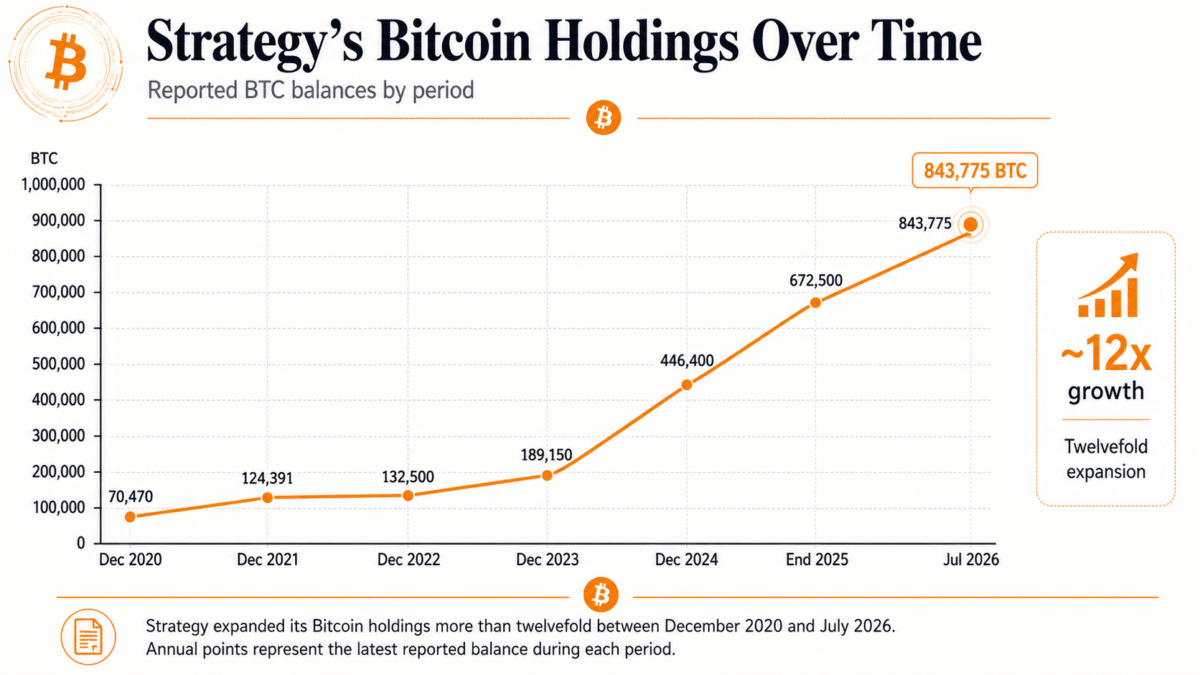
Strategy’s Bitcoin holdings over time
| Reporting Period | BTC Held |
|---|---|
| December 2020 | 70,469 |
| December 2021 | 124,391 |
| December 2022 | 132,500 |
| December 2023 | 189,150 |
| December 2024 | 447,470 |
| December 2025 | 672,500 |
| March 2026 | 762,099 |
| June 2026 | 846,000 |
| July 2026 | 843,775 |
Strategy’s official share and treasury dashboard confirms this progression and shows that the company’s balance declined slightly after reported sales during 2026.
Why Strategy’s on-chain balance may look smaller
A corporation does not need to keep all of its Bitcoin in publicly labelled self-custody addresses.
Its assets may be:
- Distributed among several custodians
- Stored across many addresses
- Held in omnibus custody infrastructure
- Pledged under financing arrangements
- Moved between custody accounts without changing beneficial ownership
For a listed company, regulatory filings and official treasury disclosures are therefore generally more reliable than counting only wallets labelled with the company’s name.
The Largest Public Companies Holding Bitcoin
Among the 197 public companies counted by BitcoinTreasuries, Strategy accounted for roughly two-thirds of that total.
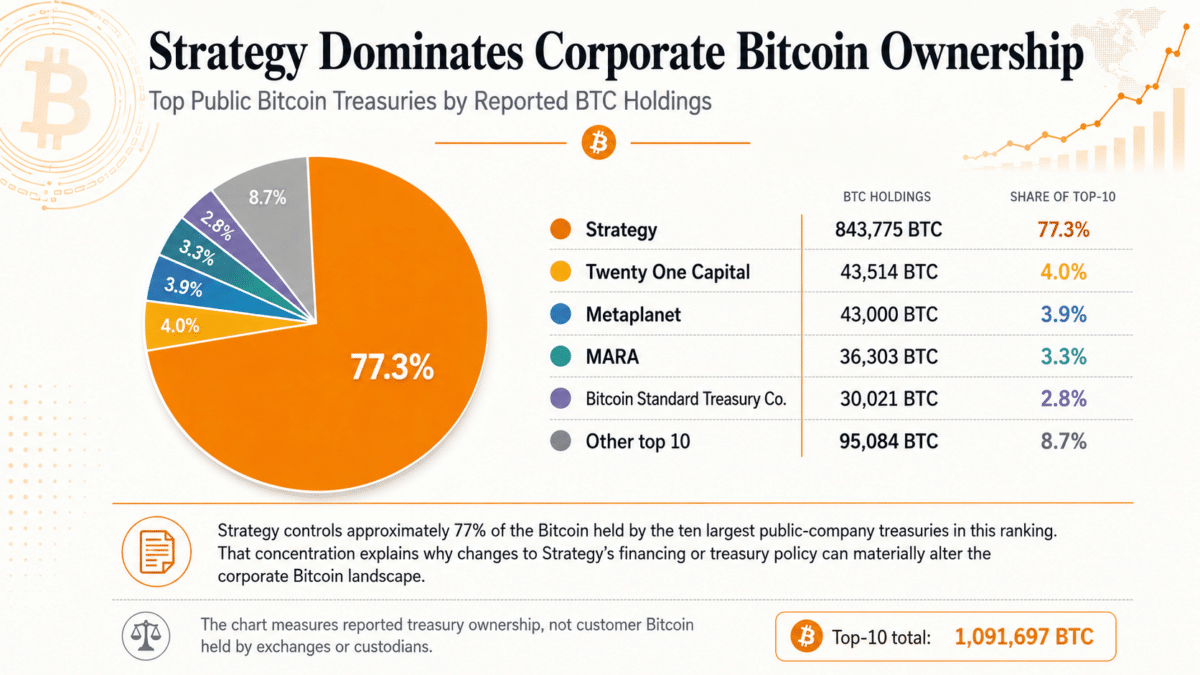
| Rank | Company | BTC | Verification Basis |
|---|---|---|---|
| 1 | Strategy | 843,775 | Official company dashboard and BitcoinTreasuries |
| 2 | Twenty One Capital | 43,514 | SEC filing and BitcoinTreasuries |
| 3 | Metaplanet | 43,000 | Official company disclosure and BitcoinTreasuries |
| 4 | MARA Holdings | 36,303 | BitcoinTreasuries; company balance affected by 2026 sales |
| 5 | Bitcoin Standard Treasury Company | 30,021 | BitcoinTreasuries |
| 6 | Bullish | 24,300 | BitcoinTreasuries |
| 7 | Strive | 19,900 | BitcoinTreasuries |
| 8 | SpaceX | 18,712 | BitcoinTreasuries |
| 9 | Coinbase | 16,492 | BitcoinTreasuries corporate-treasury estimate |
| 10 | Riot Platforms | 15,680 | BitcoinTreasuries |
The table uses BitcoinTreasuries for a consistent sector-wide snapshot, but the highest-confidence balances are those that can also be verified through current company disclosures or regulatory filings.
Twenty One Capital
Twenty One Capital reported 43,514 BTC in its SEC filing for the quarter ended March 31, 2026. Its filing showed 43,515 BTC at the end of 2025 and the disposal of one BTC during the first quarter.
The filing also warns that owning shares in the company does not constitute direct ownership of the Bitcoin held by the company.
This distinction matters because shares represent a claim on the company as a whole, including its liabilities—not a redeemable share of specific coins.
Metaplanet
Metaplanet’s official website and analytics dashboard report 43,000 BTC, matching the figure tracked by BitcoinTreasuries. The company describes Bitcoin as its core treasury reserve asset.
The company reached 43,000 BTC after acquiring 2,823 BTC during Q2 2026 (April-June), a purchase worth approximately $170.7 million announced on July 2, 2026. The Q2 acquisition brought Metaplanet past MARA Holdings into the #3 position among global corporate Bitcoin treasuries, behind only Strategy and Twenty One Capital. Per company disclosures, the average acquisition price for the quarter was roughly $80,000 per BTC, with the effective price falling to ~$77,000 after income from Metaplanet’s Bitcoin Income Generation business is factored in.
MARA Holdings
BitcoinTreasuries lists MARA at approximately 36,303 BTC after the mining company changed its treasury policy and made substantial sales during 2026.
MARA officially disclosed that it sold 15,133 BTC between March 4 and March 25, 2026 to fund convertible-note repurchases and other corporate purposes.
Mining-company balances require more frequent updates than passive corporate treasuries because miners may continuously produce, lend, pledge or sell Bitcoin.
Tesla
Tesla reported 11,509 BTC as of March 31, 2026, with an acquisition cost of $386 million. This figure comes directly from Tesla’s quarterly regulatory filing rather than an on-chain estimate.
This illustrates an important editorial rule: when a public company provides an exact regulatory disclosure, that filing should take priority over third-party wallet estimates.
4. Bitcoin ETF Trusts: Large Balances, Distributed Exposure
Spot Bitcoin investment products are among the largest holders of underlying BTC, but the ownership structure is different from a corporate treasury.
The iShares Bitcoin Trust ETF, or IBIT, reported net assets of approximately $47.12 billion as of July 17, 2026. Its official holdings page states that the quantity shown represents the total number of Bitcoin held by the trust and that the product has one underlying holding.
Using the issuer’s reported net assets and benchmark level implies a balance of roughly 735,000 BTC before allowing for valuation timing, expenses and accounting differences. This is an inference from the issuer’s figures, not a separately reported wallet balance.
Arkham’s on-chain attribution placed BlackRock-linked wallets at approximately 732,000 BTC in its June snapshot. The close relationship between the issuer-derived estimate and the on-chain attribution provides a useful cross-check, although the dates and methodologies differ.
The correct description is:
The iShares Bitcoin Trust holds Bitcoin to back shares owned by investors.
It is less accurate to say:
BlackRock owns all of that Bitcoin.
BlackRock and its affiliates sponsor and administer the product, but the trust is the legal vehicle holding the assets. Investors own shares that provide economic exposure to the trust’s Bitcoin, less fees and liabilities. The shares are not individually redeemable for BTC by ordinary investors.
The ETF ownership chain
ETF Shareholder
↓
Owns Shares in the Bitcoin ETF Trust
↓
The Trust Holds the Underlying Bitcoin
↓
A Qualified Custodian Safeguards the Private Keys
↓
Bitcoin Is Stored in Custodian-Controlled Wallets
This structure creates a major risk of double counting. The same Bitcoin may be described as:
- ETF-held Bitcoin
- BlackRock-linked Bitcoin
- Trust assets
- Coinbase-custodied Bitcoin
- Institutional investor exposure
It is still one Bitcoin.
5. Binance and Other Exchange Wallets
Arkham attributes approximately 675,000 BTC to Binance-linked wallets. Its largest individual wallet contains close to 249,000 BTC.
Independent address-ranking services such as BitInfoCharts confirm the balances and transaction histories of large Bitcoin addresses, but address explorers generally cannot independently prove the legal owner behind every wallet.
Exchange balances usually combine:
- Customer deposits
- Cold-storage reserves
- Operational liquidity
- Margin or collateral balances
- The exchange company’s own assets
A large exchange wallet should therefore be described as Bitcoin controlled or custodied by the exchange, not automatically as Bitcoin beneficially owned by the exchange.
Proof-of-reserves systems can provide evidence that an exchange controls assets backing customer balances, but they may still represent a snapshot and do not necessarily disclose every off-chain liability. Coinbase and Kraken describe proof of reserves as a mechanism for showing that customer assets are supported by real reserves.
The Largest Individual Bitcoin Addresses
The table below ranks individual addresses rather than economic owners.
| Rank | Attribution | Approximate BTC | Classification |
|---|---|---|---|
| 1 | Binance cold wallet | 249,000 | Exchange custody |
| 2 | Binance cold wallet | 181,000 | Exchange custody |
| 3 | Robinhood cold wallet | 141,000 | Exchange custody |
| 4 | Bitfinex cold wallet | 130,000 | Exchange custody |
| 5 | Tether reserve wallet | 97,000 | Corporate reserve attribution |
| 6 | U.S. government recovery wallet | 95,000 | Government-controlled |
| 7 | Unattributed wallet | 92,000 | Unknown |
Arkham supplies the entity labels, while public blockchain explorers can independently confirm the address balances and transaction activity.
Address rankings can change without any purchase or sale occurring. An exchange may reorganize cold storage by moving one balance into several addresses or consolidating several wallets into one.
6. Which Government Holds the Most Bitcoin?
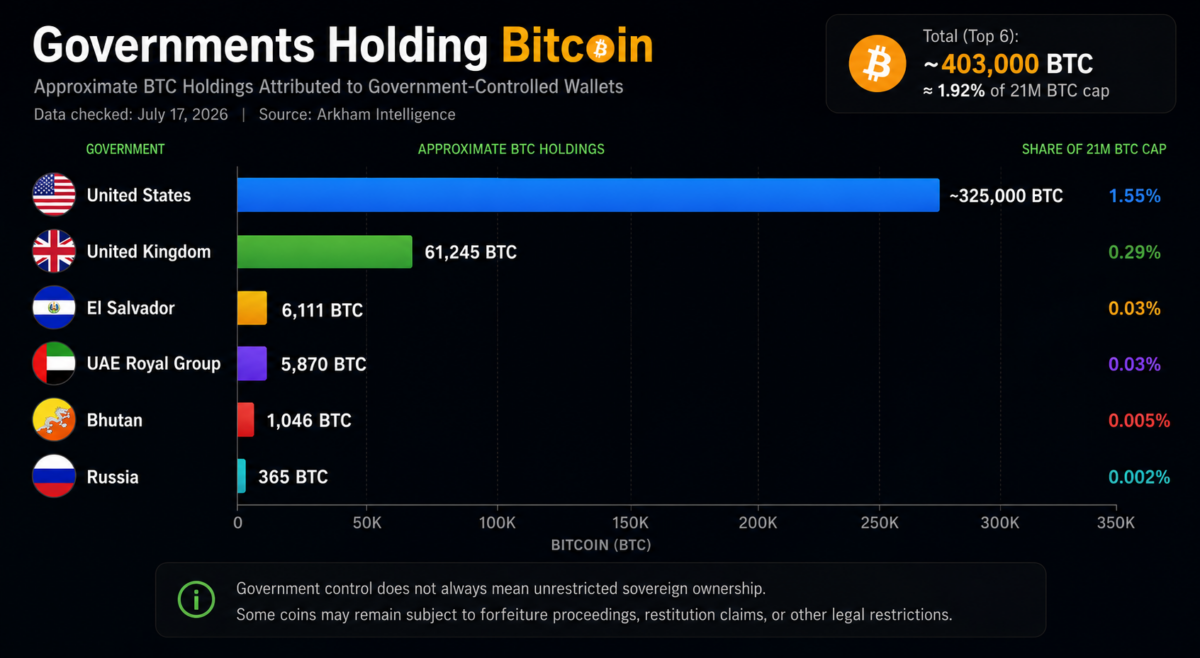
The United States controls the largest identifiable government-associated Bitcoin balance, but its exact total depends on the source and legal definition being used.
BitcoinTreasuries currently tracks 328,372 BTC under the United States. Arkham’s on-chain attribution is closer to approximately 324,000–325,000 BTC.
The difference may reflect:
- Different wallet-clustering methods
- Different snapshot dates
- Assets included before or after transfers
- Whether contested or pending-forfeiture Bitcoin is included
- Whether all government agencies are grouped into one entity
The most defensible formulation is therefore:
U.S. government agencies control approximately 324,000–328,000 BTC, although not all of that Bitcoin has necessarily been finally forfeited or transferred into the Strategic Bitcoin Reserve.
Government Bitcoin estimates
| Government or Government-Related Category | BTC Tracked by BitcoinTreasuries | Editorial Qualification |
|---|---|---|
| United States | 328,372 | Includes seized and government-controlled assets |
| China | 190,000 | Historical confiscation estimate; current custody remains uncertain |
| United Kingdom | 61,245 | Connected to civil recovery proceedings |
| Ukraine public officials | 46,351 | Disclosed by officials, not a national treasury |
| El Salvador | 7,717 | Sovereign accumulation |
| United Arab Emirates | 6,420 | Government or royal-linked attribution |
| Bhutan | 2,400-3,100 | State-linked investment and mining |
| Kazakhstan | 3,544 | Government-associated estimate |
BitcoinTreasuries tracks approximately 649,965 BTC across 13 government-related entities, but this total includes categories that are not directly comparable. For example, its Ukraine entry represents holdings disclosed by public officials rather than a state-controlled national reserve.
United States
A 2025 Department of Justice action placed approximately 127,271 BTC in U.S. government custody as part of a civil forfeiture complaint connected to alleged fraud and money laundering. The DOJ described it as the largest forfeiture action in its history.
But custody is not identical to final ownership.
The White House order establishing the Strategic Bitcoin Reserve, signed March 6, 2025 by President Trump, states that the reserve is to be capitalized with Bitcoin that has been finally forfeited and is not required for other statutory purposes. It also states that Bitcoin deposited into the reserve generally should not be sold, subject to legal exceptions. The White House fact sheet accompanying the order justified the non-sale policy by citing over $17 billion in taxpayer losses from premature Bitcoin sales by prior administrations.
Consequently, at least three government numbers may differ:
- BTC physically controlled by government agencies
- BTC subject to pending forfeiture or victim claims
- BTC finally forfeited and eligible for the Strategic Bitcoin Reserve
These should never be treated as interchangeable.
The cautionary example most often cited by U.S. Strategic Bitcoin Reserve advocates is Germany’s 2024 sale of nearly 50,000 BTC seized from a piracy site. The German government sold at approximately $58,000 per BTC, generating about $3.5 billion. Within four months, Bitcoin had surged past $100,000, meaning the sale left an estimated $2 billion-plus on the table at 2024 prices, or considerably more at subsequent peaks. This is the specific counter-example the U.S. non-sale policy was designed to avoid.
China
BitcoinTreasuries tracks China at approximately 190,000 BTC, largely based on assets confiscated in the PlusToken Ponzi scheme case of 2019-2020, when Chinese authorities seized approximately 194,775 BTC from what remains one of the largest cryptocurrency Ponzi schemes ever prosecuted.
However, there is no equivalent current public wallet disclosure establishing that the Chinese government still controls the entire historical amount. The figure should therefore be labelled as a reported confiscation estimate, not a fully verified current reserve.
United Kingdom
BitcoinTreasuries tracks the United Kingdom at 61,245 BTC. The balance is connected to a major money-laundering prosecution and related civil recovery proceedings rather than a deliberate sovereign Bitcoin-buying policy.
El Salvador
BitcoinTreasuries lists El Salvador at approximately 7,717 BTC, making it the largest transparently tracked government accumulator whose position is primarily associated with an intentional sovereign Bitcoin policy rather than law-enforcement seizures.
Bhutan
BitcoinTreasuries’ historical listing of approximately 4,973 BTC for Bhutan appears to predate the country’s aggressive H1 2026 liquidation. Independent on-chain data from Arkham Intelligence tells a different story: Bhutan’s Bitcoin stack has fallen from a peak of approximately 13,000 BTC in late 2024 to roughly 5,400 BTC by March 2026, then to approximately 3,119 BTC by May 2026, and to approximately 2,400 BTC after a further 738 BTC transfer on June 7, 2026, a decline of more than 80% from peak. The country’s Bitcoin is held by Druk Holding & Investments, Bhutan’s sovereign investment arm, and has been mined via state-backed hydropower operations since 2023.
The liquidation trajectory has been driven by Bhutan’s “555 Million Plan” and the Gelephu Mindfulness City infrastructure project. Per CoinDesk’s March 10, 2026 coverage, Bhutan has been transferring Bitcoin to trading firm QCP Capital and other institutional counterparties in tranches of roughly $5-10 million, generating approximately $42.5 million in disposals in the first quarter of 2026 alone. Arkham warned in May 2026 that Bhutan could exhaust its Bitcoin reserves by the end of September at the observed selling pace, though the treasury still ranked among the world’s largest sovereign holders.
7. The Largest Private Companies Holding Bitcoin
Private-company data is less reliable than public-company data because private firms are not required to publish recurring financial statements with the same level of detail.
BitcoinTreasuries tracks approximately 284,452 BTC across private companies, but individual balances may rely on historical reports, company statements or estimates rather than current regulatory filings.
Block.one
Block.one is frequently estimated to hold approximately 164,000 BTC.
The figure has appeared in treasury databases and industry reporting, but the complete balance cannot be independently verified through publicly attributed wallets. It should be described as a reported estimate rather than a confirmed current holding.
Tether
Arkham attributes approximately 97,000 BTC to a known Tether reserve wallet. This provides stronger on-chain evidence for at least that specific address than exists for many private-company treasury estimates.
The wallet balance may still not represent Tether’s complete Bitcoin exposure if the company uses additional wallets, custodians or investment structures.
Who Are the Largest Individual Bitcoin Whales?
Satoshi is the only individual who can reasonably be placed at the top of a source-backed global ranking, and even Satoshi’s balance is an estimate.
Many articles attach precise Bitcoin holdings to early investors, exchange founders and crypto billionaires. Those figures are often based on:
- A historical purchase announcement
- An old interview
- Unverified wallet attribution
- Company assets incorrectly assigned to a founder
- Custodial assets incorrectly assigned to an executive
- Coins the individual may have sold years ago
Unless an individual signs a message from a wallet or provides another independently verifiable form of proof, precise personal Bitcoin rankings should be treated cautiously.
Why Bitcoin Rankings Double Count Coins
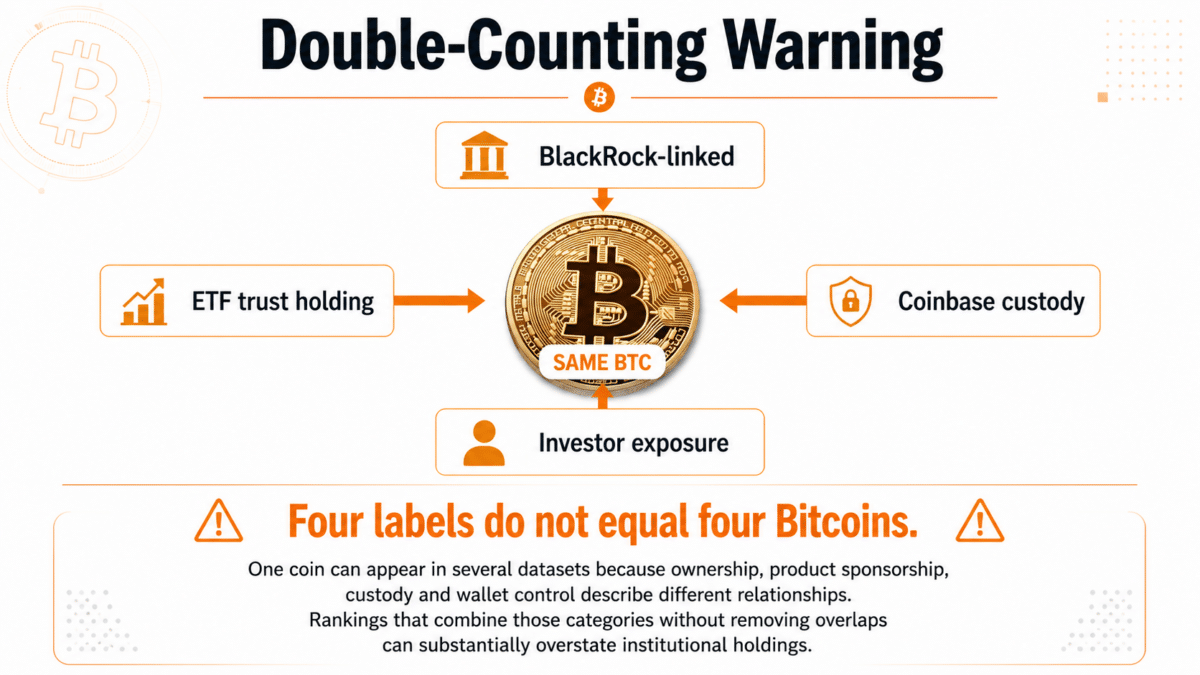
Consider one BTC held for an ETF investor:
Investor Owns ETF Shares
↓
ETF Trust Holds the Economic Asset
↓
BlackRock Sponsors the ETF Product
↓
Coinbase (or Another Qualified Custodian) Controls the Wallet’s Private Keys
↓
Arkham Identifies and Labels the Wallet by Entity
That one Bitcoin might appear in datasets as:
- Investor exposure
- ETF trust holdings
- BlackRock-linked Bitcoin
- Coinbase custody
- Institutional Bitcoin
- A balance in one of the largest Bitcoin addresses
Six descriptions do not equal six Bitcoins.
This is why the following figures should not be added together:
- Exchange wallet balances
- Custodian balances
- ETF holdings
- Asset-manager-linked wallets
- Investor exposure
- Corporate assets stored by those custodians
How Strong Is the Evidence?
| Evidence | What It Establishes | Reliability | Limitation |
|---|---|---|---|
| Regulatory filing | Company-reported treasury ownership | Very high | May not disclose wallets |
| Official ETF holdings page | Trust assets | Very high | Does not mean the sponsor owns the BTC |
| Court filing | Custody and legal claim | Very high | May precede final forfeiture |
| Company treasury statement | Reported corporate balance | High | Must be updated after later transactions |
| BitcoinTreasuries database | Consistent cross-sector ranking | Medium to high | Relies partly on external disclosures and estimates |
| On-chain entity clustering | Probable common wallet controller | Medium to high | Labels and clusters can be revised |
| Blockchain explorer | Exact address balance | Very high | Does not establish the owner |
| Historical media report | Previously reported balance | Medium | May be outdated |
| Social-media claim | Claimed ownership | Low | Often unverifiable |
Does Owning the Most Bitcoin Give Someone Control of Bitcoin?
No.
Bitcoin ownership does not function like corporate voting shares. Holding 5% of Bitcoin does not grant 5% control over the protocol.
A large holder may influence market liquidity and sentiment by moving or selling coins. But it cannot unilaterally:
- Increase the 21 million supply cap
- Reverse another person’s transaction
- Spend coins without the relevant private keys
- Force independent nodes to accept new rules
- Rewrite previously confirmed blocks at will
Bitcoin’s public ledger records transactions, while network participants independently enforce the protocol rules they choose to run.
Final Takeaway
Satoshi Nakamoto remains the most likely largest individual Bitcoin holder, but the exact amount is uncertain.
Strategy is the largest confirmed corporate owner. The United States controls the largest government-associated balance, although controlled, seized and finally forfeited Bitcoin must be treated as separate legal categories.
Coinbase and Binance control some of the largest identifiable Bitcoin wallet clusters, but those holdings primarily reflect custody relationships rather than assets owned entirely by the exchanges. ETF trusts also hold enormous balances, but the economic exposure is distributed among shareholders.
That produces the most important conclusion of this investigation:
The blockchain can prove how much Bitcoin an address contains. It cannot, by itself, prove who ultimately owns the economic interest in every coin.
An accurate Bitcoin holder ranking must combine regulatory filings, company disclosures, ETF data, court documents, treasury databases, and on-chain analytics—and clearly identify where confirmed ownership ends and attribution begins.
Frequently Asked Questions
Who owns the most Bitcoin?
Satoshi Nakamoto is probably the largest individual holder. Estimates range from approximately 600,000–700,000 BTC under the more conservative BitMEX model to approximately 1.096 million BTC under Arkham’s broader Patoshi-pattern attribution.
Which company owns the most Bitcoin?
Strategy owns the largest confirmed corporate treasury, with 843,775 BTC as of its July 2026 disclosure.
How much Bitcoin do public companies hold?
BitcoinTreasuries tracks approximately 1.263 million BTC across 197 publicly traded companies.
Which exchange controls the most Bitcoin?
Arkham attributes approximately 981,000 BTC to Coinbase-linked wallets. Most of that should be classified as custody or customer-related assets rather than Coinbase’s own corporate treasury.
Does BlackRock own more than 700,000 BTC?
The BlackRock-sponsored iShares Bitcoin Trust holds Bitcoin backing its investment shares. The trust’s July 2026 data implies approximately 735,000 BTC, while Arkham attributed approximately 732,000 BTC to BlackRock-linked wallets in its earlier snapshot. It is more accurate to attribute the underlying assets to the trust for the benefit of its shareholders than to say BlackRock itself owns every coin.
Which government holds the most Bitcoin?
The United States controls the largest identifiable government-associated balance. Estimates range from approximately 324,000 BTC under Arkham’s wallet attribution to 328,372 BTC in BitcoinTreasuries. Some assets remain connected to forfeiture proceedings and legal claims.
What is the largest Bitcoin wallet?
The largest known individual address is generally identified as a Binance cold wallet containing approximately 249,000 BTC. The balance is visible on-chain, while the Binance attribution comes from analytics-platform labelling.
How much Bitcoin does Tesla own?
Tesla reported 11,509 BTC in its quarterly filing for the period ended March 31, 2026.
Disclaimer:
Some elements of this content may have been enhanced with the help of our artificial intelligence (AI) assistants for purposes such as basic refinement, review, image generation, and translation to deliver high-quality news in a shorter time frame. However, all AI-assisted content is reviewed and approved by our team to ensure accuracy, fairness, and editorial integrity.