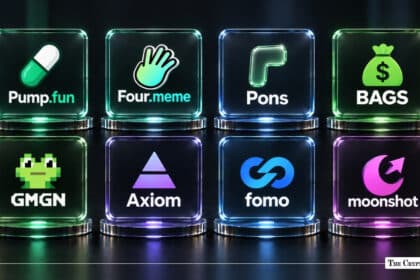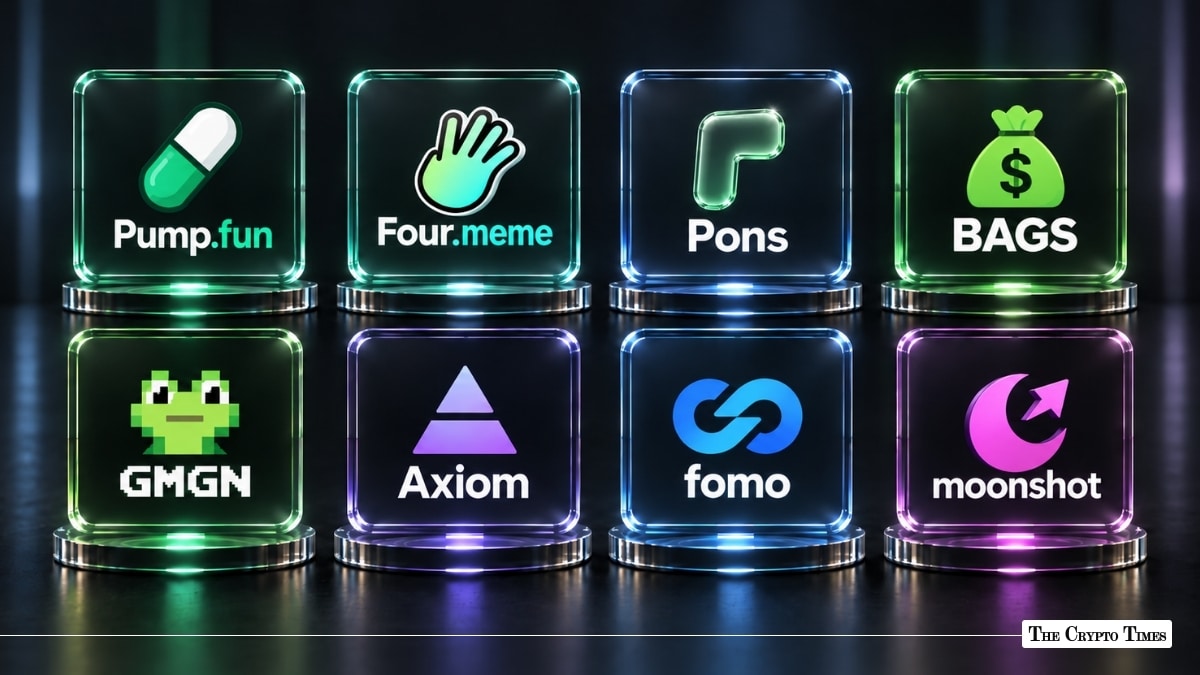
Pump.fun, Four.meme, Pons and Bags are launchpads where new tokens are launched and begin trading. GMGN and Axiom are trading terminals, while Fomo and Moonshot are mobile apps built for simpler buying.
This article explains what each platform does, how it all helps in meme-coin trading and what users should check before trading. An easier interface does not make the assets safer. Meme-coins can lose most of their value within minutes, and no platform removes insider ownership, thin liquidity or malicious contracts.
Key Highlights
- The eight platforms split into launchpads, trading terminals and mobile apps, each serving a different part of the meme coin market.
- Fees range from 0.5% on Fomo to 2.5% on Moonshot, and minimum charges make small orders far more expensive than the headline rate.
- Only about 1.1% of Pons launches had reached a liquidity pool by August 31, despite 22,581 tokens minted in a single day.
- Pump.fun faces a US class action where RICO claims against its operator were allowed to proceed on August 31, 2026. The allegations are unproven.
- The SEC said in February 2025 that meme coins of the type it described are generally not securities, so buyers have no federal securities protection.
What is a meme coin trading platform?
A meme coin trading platform is a service built mainly for discovering, creating or trading meme tokens. Launchpads let a token trade from the moment it is created. Terminals add wallet analytics and fast execution while consumer apps like fomo simplify buying with cards or stablecoin balances.
These services are different from centralized exchanges. Most connect to a self-custody wallet, and trades settle on-chain through smart contracts or liquidity pools.
1. Pump.fun
| Type | Launchpad |
|---|---|
| Network | Solana |
| Operator | Baton Corporation Ltd |
| Trading fee | 1.25% on the bonding curve |
Pump.fun is a Solana-based meme coin launchpad where anyone can buy or create a coin that is tradable from launch. There is no liquidity to seed and no presale.
New coins trade on a bonding curve, a pricing formula where each buy raises the price. When a coin hits the graduation threshold, its liquidity moves automatically to PumpSwap, Pump.fun’s own exchange. Our beginner guide walks through the launch process.
Creating a coin is free. Bonding-curve trades carry a 1.25% total fee split between the creator and the protocol. On PumpSwap, the fee falls from 1.25% to 0.30% as a coin’s market cap rises, according to Pump.fun’s fee documentation.
WARNING: Graduation is not a quality signal. Most coins never reach it, and coins that do can still collapse after migration.
Pump.fun faces a US class action, Aguilar v. Baton Corporation Ltd, in the Southern District of New York. Plaintiffs allege the platform ran a rigged meme coin market and have brought claims under the RICO Act.
According to plaintiffs’ law firm Wolf Popper, Judge Colleen McMahon allowed the RICO claims against Baton and its founders to proceed in an August 31, 2026 order. The allegations have not been proven in court.
2. Four.meme
| Type | Launchpad |
|---|---|
| Network | BNB Chain |
| Graduation venue | PancakeSwap |
| Trading fee | Varies by launch mode |
Four.meme is a no-code meme token launchpad on BNB Chain. Tokens trade on an internal bonding curve first. When the curve completes, Four.meme seeds a PancakeSwap pool and the token opens for wider trading.
Launch modes change the cost of a trade. In X Mode, fees drop block by block after a token launches, a design meant to slow sniper bots, according to a Four.meme product update.
An optional Tax Token setting lets builders apply taxes to trades. Taxes can change the real cost of buying or selling after listing, so check the token’s tax settings in the transaction preview.
The platform is permissionless. A listing on Four.meme is not an endorsement by Four.meme, BNB Chain or PancakeSwap. Keep enough BNB in the wallet for gas.
3. Pons (Pons Family)
| Type | Launchpad |
|---|---|
| Network | Robinhood Chain |
| Operator | Pons Labs, LLC (not a Robinhood product) |
| Launch fee | 0.0005 ETH, per the launch page in September 2026 |
Pons, also known as Pons Family, is a token launchpad on Robinhood Chain. It is a third-party protocol built by Pons Labs, LLC.
Robinhood Chain is an Ethereum layer-2 built on Arbitrum technology. Its public mainnet opened on July 1, 2026, and gas is paid in ETH.
Pons launches fixed-supply tokens into locked Uniswap liquidity. The site says the user’s wallet submits every transaction and Pons does not hold user assets.
Activity has grown fast. Bitquery data shows Pons minted 22,581 tokens on August 30, 2026 alone. Only about 1.1% of all Pons launches had graduated to a pool as of August 31.
Robinhood said at launch it would cover gas fees for swaps and bridge transactions on the chain for 90 days. That window closes around the end of September 2026, so transaction costs on the chain may change. Our analysis of the chain’s memecoin boom has more context.
4. Bags
| Type | Launchpad and trading app |
|---|---|
| Network | Solana |
| Launched | May 2025 |
| Creator royalty | 1% of trading volume |
Bags is a Solana launchpad and trading app built around creator royalties. It runs on Meteora’s Dynamic Bonding Curve infrastructure.
Bags says creators earn 1% of trading volume on their coin. Creators claim those fees after verifying the linked social account, and launchers can split fees with other X accounts.
A coin can be launched around someone’s content without that person’s involvement. A token named after a public figure or project does not mean that person backs it.
Creator royalties reward trading turnover. They are not evidence that a coin has lasting value.
5. GMGN
| Type | Trading terminal with on-chain analytics |
|---|---|
| Networks | 10 chains, including Solana, BNB Chain, Base, Ethereum, Tron and Robinhood Chain |
| Custody | Depends on login method |
| Trading fee | 1% flat |
GMGN is a meme coin trading terminal that pairs execution with on-chain research. GMGN says it supports ten chains, including Solana, BNB Chain, Base, Ethereum, Tron, Monad and Robinhood Chain.
Token pages show holder concentration, developer holdings and wallet labels such as smart money, sniper and insider. Contract security checks come from GoPlus, a third-party engine. GMGN also offers copy trading and automated orders.
GMGN charges a flat 1% trading fee. Network and priority fees are extra.
Custody depends on how you sign in. GMGN can generate an in-app wallet with an exportable private key, but that key sits in a hot environment so trades can sign instantly. Treat it as a spending wallet.
A wallet’s past profits do not reveal who controls it. GMGN’s own documentation says its security and on-chain data come from third-party providers and are for reference only.
6. Axiom
| Type | Trading terminal |
|---|---|
| Networks | Solana, with BNB Chain as a secondary chain |
| Backing | Y Combinator, Winter 2025 batch |
| Trading fee | 1% base, about 0.75% net at the top cashback tier |
Axiom is a Solana-first trading terminal that also supports spot trading on BNB Chain. It is a Y Combinator company from the Winter 2025 batch.
Its Pulse feed follows tokens from launch through bonding-curve completion and migration. Axiom is non-custodial, and users can import the recovery phrase into an external wallet.
The base spot fee is 1%, reduced by SOL cashback tiers to about 0.75% net at the top tier. Perpetual futures run on Hyperliquid, with Axiom adding 0.01% per trade on top of Hyperliquid’s own fee.
Speed tools favor fast wallets, and leverage adds liquidation risk on top of token risk.
7. Fomo
| Type | Social trading app |
|---|---|
| Networks | Solana, Robinhood Chain, BNB Chain, Base, Ethereum, Monad |
| Developer | FOMO Labs, Inc. |
| Trading fee | 0.5% spot, with about a $0.95 minimum on small Solana orders |
Fomo is a social trading app. Its feed shows what followed traders are buying, next to leaderboards and trade alerts.
It functions on multiple blockchain networks, including Solana, Robinhood Chain, BNB Chain, Base, Ethereum and Monad. Users hold one balance and trade across chains without bridging. Fomo covers gas on every supported chain except Ethereum.
The standard spot fee is 0.5%. On small Solana orders a minimum of about $0.95 applies, so a $50 trade pays close to 2% on the way in and again on the way out.
Since June 2026, Fomo has offered perpetual futures executed on outside venues, including Hyperliquid. Perps are not available to US persons and carry a 0.05% Fomo fee per side plus venue fees.
A popular trader can be wrong. Copying entries without planning exits is a common way to lose money on social apps.
8. Moonshot
| Type | Mobile app |
|---|---|
| Network | Solana |
| Ownership | Buy Moonshots, Inc.; Jupiter took a majority stake in January 2025 |
| Trading fee | 2.5% on $2 to $100 trades (about $0.99 minimum); 1% above $100 |
Moonshot is a mobile app for buying and selling Solana meme coins. Buy Moonshots, Inc. publishes the app, and Jupiter took a majority stake in January 2025.
Moonshot is self-custodial. Its app listing says all transactions occur on-chain through the user’s own wallet, with cash balances held in USDC. MoonPay handles card deposits and withdrawals and charges its own fee.
Moonshot’s fee page lists a 2.5% fee on trades from $2 to $100, with a minimum of about $0.99, and 1% on trades above $100. Default slippage tolerance is up to 5%.
Small trades are expensive as a result. A $20 buy pays the $0.99 minimum, close to 5% of the order, before slippage. Download the app only from the official developer listing.
How do meme coin trading platforms work?
The workflow differs by platform, but most on-chain meme coin platforms follow the same sequence:
- Open the verified platform. Use the official domain or app store listing, not a link from a direct message.
- Connect or create a wallet. Check which network and wallet the platform supports.
- Fund the wallet. The required asset may be SOL, BNB, ETH or a stablecoin.
- Find the correct token. Verify the contract address. Names and tickers are easy to copy.
- Review the market. Check liquidity, token age, top holders and recent transactions.
- Check the order preview. Confirm platform fees, network costs, slippage and the amount you will receive.
- Approve the transaction. Read the wallet request before signing it.
- Plan the exit. A displayed price means little if there is not enough liquidity to sell near it.
What should you check before using a meme coin platform?
Is the website or app authentic?
Meme coin traders are frequent targets for cloned websites, fake ads and impersonated accounts. Bookmark the verified domain and check the developer name before installing an app.
Who controls the wallet?
Find out whether the service is custodial or self-custodial. If a platform creates a wallet, learn how the private key is stored and exported. Never share a seed phrase with support staff, a bot or a website form.
What will the trade actually cost?
Some apps charge a minimum fee, so a small order can cost several times the headline percentage. Review the final quote in the app, not a fee table or screenshot.
Can the token be sold?
Market capitalization is not liquidity. A token can show a large valuation with little capital on the sell side. Check the pool, recent sells and any token taxes before buying.
Is ownership concentrated?
Large creator, insider or bundled holdings can let a small group drain liquidity. Review top wallets and developer activity, and remember that one person can control many wallets.
Are meme coin trading platforms safe?
No platform makes meme coins safe. Platform security and token quality are separate questions. A non-custodial service reduces the platform’s control over funds, but users can still approve a malicious contract.
The US Securities and Exchange Commission’s Division of Corporation Finance said in a February 2025 staff statement that transactions in the type of meme coins it described generally did not involve securities. Buyers of those meme coins are not protected by federal securities laws.
The statement is a staff view, not a Commission rule. It does not stop enforcement where a product labeled a meme coin is structured differently or used in fraud.
Practical safeguards:
- Use a separate wallet holding only the amount set aside for trading.
- Verify token contracts through more than one source.
- Start with a small transaction, and account for minimum fees when you do.
- Revoke wallet approvals you no longer need.
- Treat trending labels, security badges and influencer posts as prompts for research, not verification.
- Never give a seed phrase or private key to any platform or support agent.
The bottom line
These eight platforms cover different parts of the meme coin market. Some focus on token creation, while others focus on research or mobile access.
Before using any of them, check who controls the wallet, what a trade of your size actually costs and whether the token can be sold. On most of these platforms, the majority of new tokens never reach a real liquidity pool.
This article is for informational purposes only and does not constitute financial, investment, legal or tax advice. Meme coins are highly speculative and may result in a total loss.
Frequently asked questions
What types of meme coin trading platforms exist?
Launchpads such as Pump.fun, Four.meme, Pons and Bags let users create tokens that trade from launch. Terminals such as GMGN and Axiom add analytics and fast execution. Mobile apps such as Fomo and Moonshot simplify funding and buying.
Is Pump.fun an exchange or a launchpad?
Pump.fun is a Solana launchpad with its own exchange, PumpSwap. Coins start on a bonding curve and move to PumpSwap when they graduate. It is not a centralized exchange.
What blockchain does Pons use?
Pons runs on Robinhood Chain, an Ethereum layer-2 whose public mainnet opened on July 1, 2026. Pons is built by Pons Labs, LLC and is not a Robinhood product.
Is GMGN only an analytics tool?
No. GMGN combines wallet and token analytics with trading, copy trading and automated orders across ten chains. It charges a 1% trading fee, and its security data comes from third-party providers.
Can users buy meme coins with regular money?
Yes, on some apps. Fomo and Moonshot accept card or Apple Pay funding where supported, and Moonshot uses MoonPay for deposits and withdrawals. Payment options and identity checks depend on the user’s country.
Can a meme coin platform prevent rug pulls?
No. Platform rules and automated contract checks can reduce some risks, but they cannot stop insider selling, coordinated wallets, misleading promotion or a collapse in demand.
Also Read: How to Buy Meme Coins on Robinhood Chain: A Complete Beginner’s Guide
Disclaimer: This is an educational list of eight platforms active in September 2026. Details were checked against official documentation, app store listings and public on-chain data, and may change. The platforms appear in no particular order. Inclusion is not a recommendation or endorsement.
Some elements of this content may have been enhanced with the help of our artificial intelligence (AI) assistants for purposes such as basic refinement, review, image generation, and translation to deliver high-quality news in a shorter time frame. However, all AI-assisted content is reviewed and approved by our team to ensure accuracy, fairness, and editorial integrity.