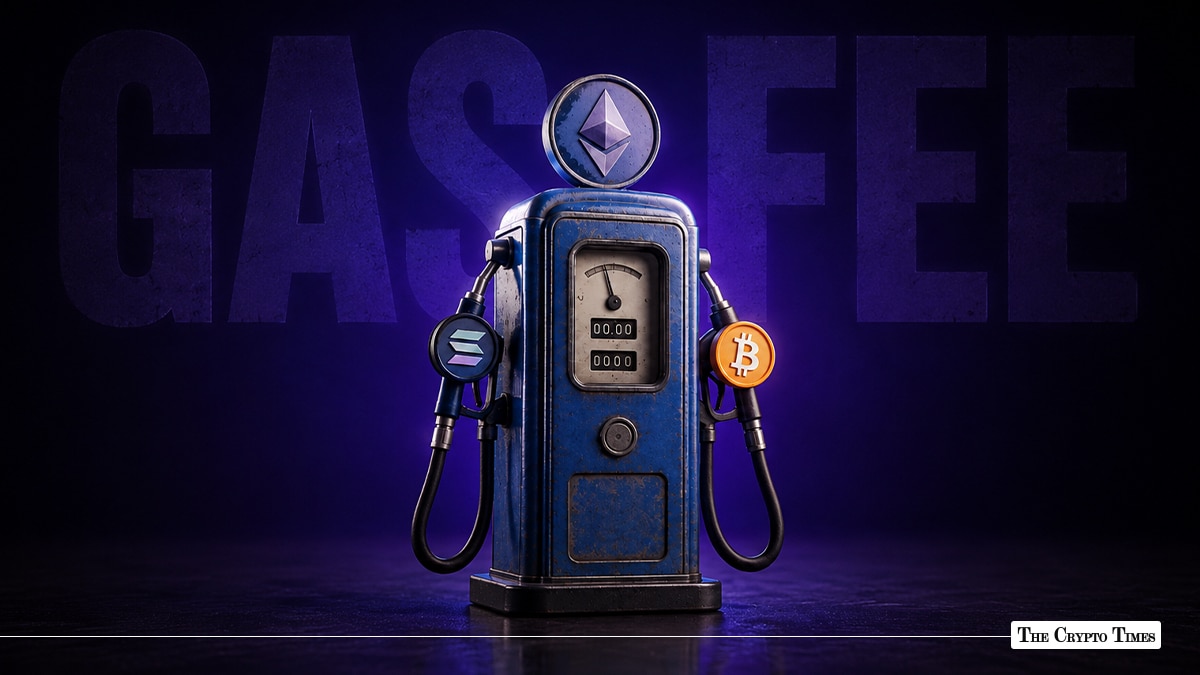
Crypto network fees vary by blockchain, transaction complexity and demand. Here is how fees work on Ethereum, Bitcoin, Solana and major EVM networks—and practical ways to pay less.
Every blockchain transaction has a cost somewhere in the system, but that cost is not always called a gas fee.
Ethereum and other Ethereum Virtual Machine networks measure computational work using gas. Bitcoin users instead pay transaction fees largely according to transaction size and the fee rate needed for block inclusion. Solana charges a base transaction fee and can add an optional prioritization fee based on requested computing resources.
Understanding those differences matters because the best way to reduce a $20 Ethereum smart-contract transaction is not necessarily the best way to reduce a Bitcoin transfer or a Solana transaction.
Key Highlights
- Gas is not a universal term for crypto fees. Ethereum and many EVM networks use gas; Bitcoin and Solana use different fee systems.
- Ethereum transaction costs depend primarily on gas used × effective gas price.
- Under Ethereum’s EIP-1559 model, users pay a protocol-determined base fee plus a priority fee; the base fee is burned.
- Layer 2 networks such as Base, Arbitrum and OP Mainnet can make Ethereum-based transactions significantly cheaper, but their fees can include both L2 execution and Ethereum data costs.
- Bitcoin fees depend largely on transaction virtual size and the prevailing fee rate rather than the amount of BTC transferred.
- Solana charges a base fee per signature and an optional priority fee based on compute-unit settings.
- Waiting for lower network demand can reduce fees, but switching chains or bridging assets introduces additional costs and security considerations.
- A failed blockchain transaction can still consume a network fee on many networks.
What are crypto gas fees?
A gas fee is the amount a user pays to compensate a blockchain network for the computational resources required to execute a transaction or smart-contract operation.
The term is most closely associated with Ethereum and EVM-compatible networks.
On Ethereum, different actions require different amounts of gas.
For example:
- Sending ETH is relatively simple.
- Transferring some tokens requires additional smart-contract execution.
- Swapping tokens on a decentralized exchange requires more computation.
- Lending, borrowing, NFT minting or executing several smart contracts can consume considerably more gas.
Ethereum measures the computational work separately from the price paid for each unit of gas. Gas prices are commonly quoted in gwei, where one gwei equals one-billionth of an ETH.
Gas fee vs network fee: What’s the difference?
These terms are often used interchangeably, but they are not identical.
| Term | Meaning | Common examples |
|---|---|---|
| Gas fee | Payment based on computational resources consumed | Ethereum, BNB Smart Chain, Avalanche C-Chain, Polygon PoS |
| Network/transaction fee | General term for the cost of submitting a blockchain transaction | Bitcoin, Solana, Ethereum |
| Priority fee | Extra amount paid to improve transaction priority | Ethereum, Solana |
| Trading fee | Fee charged by an exchange or liquidity protocol | Centralized exchanges, DEX liquidity pools |
| Bridge fee | Costs associated with moving assets between networks | Ethereum-to-L2 or cross-chain bridges |
| Slippage | Difference between expected and actual trade execution price | DEX token swaps |
Gas is therefore one type of blockchain transaction fee, not the name of every crypto-network fee.
Why do blockchains charge transaction fees?
Network fees serve several purposes.
Compensating network participants
Depending on the blockchain, fees or parts of fees can compensate validators, block producers or other entities involved in processing transactions.
Preventing spam
If transactions were completely costless at the protocol level, an attacker could flood a network with enormous numbers of transactions at little economic cost.
Fees make scarce blockspace and computational resources economically costly to consume.
Allocating limited blockspace
When more users want transactions processed than a blockchain can accommodate immediately, fees can act as a market for blockspace.
Users willing to pay more may receive faster inclusion, depending on the network’s fee mechanism.
Pricing computation
Smart-contract platforms need a way to limit computational work. Gas systems charge more for resource-intensive operations than simple ones.
How Ethereum gas fees work
Ethereum uses gas to measure the computational resources required to execute transactions.
Since the London upgrade activated EIP-1559 in 2021, an Ethereum transaction can include:
- Base fee
- Priority fee
- Maximum fee per gas
The base fee changes according to block demand and is burned by the protocol. The priority fee, commonly called the tip, helps incentivize validators to include a transaction.
Ethereum gas fee formula
A useful simplified formula is: Transaction fee = gas used × (base fee + priority fee)
subject to the maximum fee the sender authorizes.
Suppose an ETH transfer uses 21,000 gas and:
- Base fee = 8 gwei
- Priority fee = 1 gwei
Then: 21,000 × 9 gwei = 189,000 gwei
Since 1 billion gwei equals 1 ETH: 189,000 gwei = 0.000189 ETH
The dollar cost then depends on ETH’s market price.
Gas limit is not necessarily what you pay
The gas limit represents the maximum amount of gas a transaction is permitted to consume.
If the transaction uses less than the limit, the user does not simply pay for every unused unit. Under EIP-1559 transactions, the difference between the user’s maximum authorized fee and the amount actually required is not automatically spent as a fee.
This is an important distinction between:
gasLimitgasUsedbaseFeePerGasmaxPriorityFeePerGasmaxFeePerGas
What determines Ethereum gas fees?
1. Network demand
When demand for Ethereum blockspace increases above its target, the protocol raises the base fee.
When activity falls, the base fee can decline.
2. Transaction complexity
A basic ETH transfer generally consumes less gas than a multi-step DeFi transaction because the latter executes more smart-contract operations.
3. Priority fee
A user can offer an additional priority fee to improve the transaction’s attractiveness to validators.
A larger tip does not necessarily mean a transaction will be instantaneous, but it can improve its position when blockspace is contested.
4. Gas consumed
The actual computational work performed by the transaction matters.
Two transactions submitted at the same gas price can therefore have very different total costs.
5. ETH price
Gas is paid in ETH, so the dollar value of a transaction fee can rise or fall even if its cost in ETH remains unchanged.
How Ethereum upgrades changed transaction fees
The current article should explain this because Ethereum’s fee environment has changed significantly since 2021.
EIP-1559: A more predictable fee market
Ethereum’s London upgrade introduced EIP-1559, establishing a protocol-determined base fee and separate priority fee.
The base fee is burned rather than paid to the validator.
Dencun: Cheaper data for Layer 2 networks
The Dencun upgrade, activated in March 2024, introduced EIP-4844 and temporary data objects known as blobs.
Rollups can use blobs to publish data to Ethereum at a lower cost than relying solely on normal calldata, substantially reducing the data component of many Layer 2 transaction fees.
Pectra: More blob capacity
Ethereum’s Pectra upgrade went live on May 7, 2025 and increased blob capacity, expanding the amount of data available to rollups.
Pectra also introduced EIP-7702, which expanded smart-account capabilities for externally owned accounts and enables applications to support features such as transaction batching and fee sponsorship.
Fusaka: Scaling rollup data availability
Ethereum’s roadmap records Fusaka as activated on December 3, 2025, with PeerDAS designed to make rollup data availability more scalable.
The important takeaway is that Ethereum’s scaling strategy increasingly separates:
- Ethereum Layer 1 execution
- Ethereum settlement and security
- Lower-cost execution on Layer 2 networks
How Layer 2 transaction fees work
Using an Ethereum Layer 2 can reduce transaction costs, but an L2 transaction is not necessarily priced only by activity on that network.
A typical rollup fee can contain two broad components:
Layer 2 execution cost + Layer 1 data/security cost
For example, Base documentation states that Base transactions contain an L2 execution fee and an L1 security fee associated with publishing transaction information to Ethereum.
OP Mainnet similarly charges an L1 data component determined partly by the cost of publishing transaction data or blobs to Ethereum.
This means L2 fees can change because of:
- Activity on the L2 itself
- Ethereum data prices
- Blob demand
- Transaction size
- Network-specific fee parameters
Is Polygon an Ethereum Layer 2?
Polygon PoS is not an Ethereum rollup.
Polygon’s own documentation describes Polygon PoS as an EVM-compatible sidechain for Ethereum that uses its own proof-of-stake architecture and periodically checkpoints state to Ethereum.
This distinction matters when comparing both fees and security assumptions.
How fees work on different crypto networks
| Network | Fee terminology/model | Native fee token | Main drivers |
|---|---|---|---|
| Ethereum | Gas: base fee + priority fee | ETH | Gas used, blockspace demand, priority |
| Base | L2 execution + L1 security/data fee | ETH | L2 demand, Ethereum/blob data costs |
| OP Mainnet | L2 execution + L1 data fee | ETH | L2 execution and Ethereum data costs |
| Polygon PoS | EVM gas | POL | Gas consumed and network fee market |
| BNB Smart Chain | EVM-style gas | BNB | Gas consumed and network demand |
| Avalanche C-Chain | Dynamic EVM-style gas | AVAX | Gas use and C-Chain demand |
| Solana | Base transaction fee + optional priority fee | SOL | Signatures and requested compute resources |
| Bitcoin | Transaction fee based on transaction size and fee rate | BTC | Virtual transaction size and mempool demand |
The table deliberately does not provide average dollar fees. Those figures change constantly and can become stale quickly.
How Bitcoin transaction fees work
Bitcoin does not use Ethereum-style gas.
A Bitcoin transaction fee is broadly influenced by:
Transaction virtual size × fee rate
Fee rates are commonly expressed in satoshis per virtual byte, or sat/vB.
The amount of BTC being transferred does not determine the transaction’s size. Sending 10 BTC can sometimes require less blockspace than sending 0.1 BTC.
What matters is the transaction structure, including the number and type of inputs and outputs.
Bitcoin Core’s fee-estimation system estimates an appropriate fee rate based on the number of blocks within which the user wants the transaction to begin confirming.
Why can a small Bitcoin payment have a high fee?
Suppose a wallet received many small BTC payments over time.
To spend them, a transaction may need to combine numerous UTXOs as inputs. More inputs increase transaction size, potentially increasing the required fee.
This is why UTXO management can matter more than the dollar value being transferred.
How Solana transaction fees work
Solana also does not use Ethereum’s gas model.
A Solana transaction fee includes:
- Base fee
- Optional prioritization fee
Solana’s documentation currently specifies a base fee per signature. The prioritization fee depends on the requested compute-unit price and compute-unit limit.
A simplified priority-fee formula is:
Priority fee = compute-unit price × compute-unit limit
with the required unit conversion into lamports.
A key technical point is that the priority fee is based on the requested compute-unit limit, not simply the amount of compute ultimately consumed. Developers can therefore avoid unnecessary expense by estimating compute requirements rather than requesting excessively high limits.
How BNB Smart Chain fees work
BNB Smart Chain is EVM compatible and uses BNB as its native gas token.
As with other EVM networks, users pay according to the gas consumed by the transaction and the applicable gas price.
The amount required varies by operation. Sending BNB is generally less computationally intensive than performing complex smart-contract interactions.
Do not describe lower fees as guaranteed. Fee markets and protocol parameters can change.
How Polygon PoS fees work
Polygon PoS uses an EVM-compatible gas model and POL as its native gas and staking token.
Polygon maintains an official Gas Station that provides safeLow, standard and fast fee estimates based on recent network activity.
Polygon PoS often offers lower transaction costs than Ethereum Layer 1, but users must understand that it has a separate validator architecture rather than the security model of an Ethereum rollup.
How Avalanche C-Chain fees work
Avalanche C-Chain supports EVM transactions and uses a dynamic fee mechanism.
Its base fee rises during periods of higher network utilization and falls when demand declines, following an EIP-1559-style model with Avalanche-specific parameters.
Fees are paid in AVAX.
Why are crypto gas fees sometimes so high?
High transaction fees usually come from one or more of the following factors.
| Factor | Why it increases fees |
|---|---|
| Network congestion | More users compete for limited blockspace |
| Complex smart contract | More computation or storage is required |
| High priority setting | User voluntarily bids more for faster inclusion |
| Expensive L1 data | Can raise the data component of some L2 fees |
| Large Bitcoin transaction | More virtual bytes require a larger total fee |
| Inefficient smart contract | Code consumes unnecessary computation |
| Poor wallet estimation | Fee settings may be higher than necessary |
| High native-token price | Same fee in crypto becomes more expensive in fiat |
How to reduce crypto gas and transaction fees
There is no universal trick, but several strategies can reduce costs.
1. Wait for lower network demand
If a transaction is not urgent, compare the current recommended fee with recent network conditions before submitting it.
This can be useful on:
- Ethereum
- Bitcoin
- Polygon PoS
- Avalanche
- some Layer 2 networks
However, avoid relying on simplistic rules such as “Sunday is always cheapest.” Crypto networks operate globally around the clock, and major market events can create congestion at any time.
2. Use an appropriate Ethereum Layer 2
For many Ethereum-based activities, Base, Arbitrum or OP Mainnet can offer lower execution costs than Ethereum Layer 1.
But consider the complete cost:
Bridge/on-ramp cost + L2 transaction fees + eventual withdrawal cost
Moving $20 of tokens to an L2 through an expensive L1 bridge simply to save a few cents on one transaction may not make economic sense.
3. Let reputable wallets estimate fees
Modern wallets generally estimate appropriate network fees automatically.
Manual fee modification can sometimes save money, but setting the fee too low can delay a transaction or leave it pending.
On EIP-1559 networks, users should understand the difference between:
- Maximum fee
- Priority fee
- Current base fee
before changing advanced settings.
4. Reduce unnecessary smart-contract interactions
Every additional on-chain action can cost money.
Before interacting with DeFi protocols, check whether an action requires:
- Token approval
- Deposit
- Swap
- Withdrawal
Some applications can combine operations efficiently, while others require separate transactions.
5. Avoid unlimited or repeated token approvals when unnecessary
Approvals themselves consume gas.
Users should not repeatedly submit new approval transactions if a valid approval already exists, but they should also understand the security trade-off of granting unlimited spending permission to smart contracts.
Saving gas should never take priority over wallet security.
6. Compare the total cost before bridging
A cheaper destination chain does not automatically mean moving assets there is cheaper.
Check:
- Source-chain transaction fee
- Bridge fee
- Destination-chain fee
- Liquidity
- Exchange spread
- Withdrawal fee
- Bridge security
Sometimes withdrawing directly from an exchange to the target network is cheaper than first withdrawing to Ethereum and bridging—provided the exchange supports the correct network and the user carefully verifies it.
7. Optimize Bitcoin UTXOs
Bitcoin users can reduce future transaction size by managing UTXOs carefully.
Consolidating small UTXOs during periods of low fee rates can sometimes reduce the size of a future urgent transaction.
But consolidation itself is an on-chain transaction and consumes blockspace, so it should only be considered when current fee rates and privacy considerations make sense.
8. Use sensible priority settings
A transaction that does not need immediate confirmation generally does not require the highest priority setting.
This applies differently by network but can be relevant to Ethereum, Solana and other fee-market systems.
9. Avoid failed transactions
On many smart-contract networks, a failed transaction can still consume fees because validators performed computational work before the failure occurred.
Before confirming:
- Check that you have enough native token for gas
- Verify the contract and network
- Check token balances and allowances
- Review wallet warnings
- Avoid manually setting an unrealistically low gas limit
10. Consider sponsored or abstracted fees
Some applications support gas sponsorship, allowing a protocol or another party to pay the network fee on behalf of the user.
Ethereum’s evolving smart-account architecture, including capabilities enabled through EIP-7702, can support richer fee-sponsorship and batching designs.
The cost has not disappeared—it has simply been paid or abstracted by another party.
Does lowering slippage reduce gas fees?
No, not directly.
Slippage and gas fees solve different problems.
Gas fee: Pays for blockchain computation and inclusion.
Slippage tolerance: Defines how much price movement a trader is willing to accept before a swap fails.
Setting slippage too low can cause a volatile trade to revert. If the transaction has already executed enough computation before failing, the user can still lose the network fee.
Setting slippage excessively high may improve the chance of execution but expose the user to a worse trade price or MEV-related risks.
Therefore:
Do not increase slippage simply to “save gas.”
Choose slippage based on liquidity and market conditions, not as a fee-reduction mechanism.
Why can a failed crypto transaction still cost gas?
A blockchain charges for work performed, not simply for a successful economic outcome.
Suppose a smart contract begins executing several operations before encountering a condition that causes it to revert.
Validators still performed computational work.
On Ethereum, the state changes from the failed transaction are generally reverted, but the gas consumed is not returned to the sender.
Solana likewise charges transaction fees even when a transaction fails.
This is why repeated failed transactions can become expensive.
Are Layer 2 fees always cheaper than Ethereum?
Usually for comparable execution, but not necessarily in every circumstance.
Layer 2 transactions can contain:
- L2 execution costs
- L1/blob data costs
- bridge costs
- additional protocol-specific fees
Base, for example, explicitly separates its transaction cost into L2 execution and L1 security components.
A user making a single transaction should therefore compare the total end-to-end cost, not simply the fee displayed after funds have already arrived on the L2.
Should you switch blockchains just to save gas?
Not automatically.
A cheaper network may have different:
- Security assumptions
- Validator structure
- Liquidity
- Applications
- Bridges
- Wallet support
- Stablecoin availability
- decentralization characteristics
Saving $2 in fees is not worthwhile if the user accidentally chooses the wrong network, uses an unsafe bridge or transfers an unsupported asset.
The blockchain should fit the transaction—not just the fee.
How to check gas fees before making a transaction
Users should prioritize official or established network tools.
| Network | Useful fee information |
|---|---|
| Ethereum | Wallet fee estimator and Ethereum-compatible explorers |
| Bitcoin | Wallet fee estimator or mempool/Bitcoin Core fee estimator |
| Solana | Wallet estimate and Solana fee data |
| Polygon PoS | Polygon Gas Station |
| Base | Wallet and Base network-fee information |
Never send a transaction based solely on an old article saying a network “normally costs $0.01” or “normally costs $10.”
Network conditions change continuously.
Gas fee vs exchange withdrawal fee
This distinction should be very clear.
Suppose an exchange charges a user $5 to withdraw ETH.
That does not necessarily mean the Ethereum network charged $5.
Centralized exchanges can determine their own withdrawal charges, which may incorporate:
- Estimated network cost
- Operational costs
- A fixed platform fee
- A margin
Likewise, an exchange may sometimes charge less than the actual network cost because it batches withdrawals or subsidizes part of the transaction.
Always distinguish: Blockchain network fee ≠ exchange withdrawal fee
What happens if you set the gas fee too low?
The exact result depends on the network.
On Ethereum and similar systems, a transaction whose maximum fee cannot cover the required base fee may remain pending rather than being included.
Base, for example, notes that a transaction can remain pending where its maxFeePerGas is below the current base fee.
Some wallets allow users to speed up or replace a pending transaction by submitting a replacement with an appropriate higher fee.
Never repeatedly send new transactions without checking the nonce and status of the original transaction.
Will crypto gas fees ever disappear?
Network resource costs are unlikely to disappear entirely, but users may increasingly stop seeing or directly paying them.
Several trends are changing the experience:
Layer 2 scaling
Ethereum rollups process activity more cheaply while using Ethereum for settlement and data availability.
More efficient data availability
Dencun introduced blobs, Pectra expanded blob capacity, and subsequent Ethereum scaling upgrades have continued to improve rollup data availability.
Fee sponsorship
Applications can pay users’ fees or abstract them behind another payment model.
Transaction batching
Some applications can bundle multiple actions, reducing duplicated transaction overhead in appropriate circumstances.
Alternative fee tokens and account abstraction
Wallet infrastructure is increasingly capable of hiding technical fee management from users.
Therefore, the more accurate prediction is:
Blockchain execution will continue to have an economic cost, but future users may interact with applications without thinking about “gas” at all.
Crypto gas-fee comparison: What users should remember
| Question | Answer |
|---|---|
| Does every blockchain use gas? | No |
| Does sending more crypto automatically cost more? | Usually no |
| Can network congestion increase fees? | Yes |
| Can complex smart contracts cost more? | Yes |
| Are Layer 2 networks generally cheaper than Ethereum L1? | Often, for comparable activity |
| Is Polygon PoS an Ethereum rollup? | No |
| Can failed transactions still cost money? | Yes |
| Does higher slippage lower gas? | No |
| Can waiting reduce fees? | Sometimes |
| Can a transaction fee be completely hidden from users? | Yes, through sponsorship—but someone still bears the network cost |
| Is an exchange withdrawal fee the same as gas? | No |
| Does Bitcoin use gas? | No |
| Does Solana use Ethereum-style gas? | No |
Conclusion
Crypto transaction fees are easier to understand once one distinction is clear: not every network uses the same fee system.
Ethereum and EVM networks price computation through gas. Bitcoin largely prices scarce blockspace according to transaction size and fee rate. Solana combines a base transaction fee with optional priority pricing based on compute requirements. Layer 2 networks add another dimension because their costs can include both local execution and data published to Ethereum.
For users, the goal should therefore not be to “avoid gas” at any cost. It should be to understand what fee is being charged, why it is being charged and whether there is a safer or more efficient way to complete the same transaction.
Waiting for lower demand, choosing an appropriate Layer 2, avoiding failed transactions and reviewing wallet estimates can reduce costs. Switching networks simply because one appears cheaper can introduce bridge, liquidity or security risks that outweigh the fee savings.
Frequently asked questions
1. What are crypto gas fees?
Crypto gas fees are charges for computational resources used to execute transactions on gas-based blockchain networks such as Ethereum. Other blockchains charge transaction fees using different systems, so “gas fee” should not be used as a universal term.
2. Why are Ethereum gas fees high?
Ethereum gas fees rise when demand for blockspace increases, when a transaction performs more complex computation or when users offer higher priority fees. The fiat cost also depends on ETH’s market price.
3. How are Ethereum gas fees calculated?
A simplified calculation is: Gas used × (base fee + priority fee)
The sender also specifies a maximum fee they are willing to pay. Ethereum’s protocol determines the base fee, while users can specify a priority fee.
4. What is gwei?
Gwei is a denomination of ETH commonly used to quote Ethereum gas prices.
1 gwei = 0.000000001 ETH, or one-billionth of an ETH.
5. Does Bitcoin have gas fees?
No. Bitcoin has transaction fees rather than Ethereum-style gas. Fees depend largely on the transaction’s virtual size and the fee rate offered for inclusion in a block.
6. Does Solana charge gas?
Solana uses its own transaction-fee model. Transactions pay a base fee and can include an optional prioritization fee based on requested compute resources.
7. Can I avoid crypto gas fees entirely?
Not for normal direct on-chain transactions unless another party sponsors the fee. Users can often reduce fees by waiting for lower demand, using appropriate Layer 2 networks or choosing less expensive execution paths.
8. What time are Ethereum gas fees cheapest?
There is no guaranteed cheapest hour. Ethereum operates globally 24/7, and fees depend on real-time blockspace demand. Historical patterns can help, but users should check live conditions rather than relying on a fixed day or time.
9. Are Layer 2 gas fees cheaper?
Layer 2 transactions are often cheaper than comparable Ethereum Layer 1 transactions. Their total cost can nevertheless include L2 execution and Ethereum data costs, and moving assets to or from an L2 can create additional expenses.
10. Can a failed transaction still charge gas?
Yes. A transaction may still consume computational resources before failing, meaning network fees can remain payable even though the intended state change does not occur.
Disclaimer: This article is for educational purposes only and does not constitute financial or investment advice. Blockchain fees, network parameters and protocol features can change over time. Always verify the network and transaction details before transferring digital assets.
Also Read: What Is an Ethereum Staking Pool? How It Works, Rewards and Risks