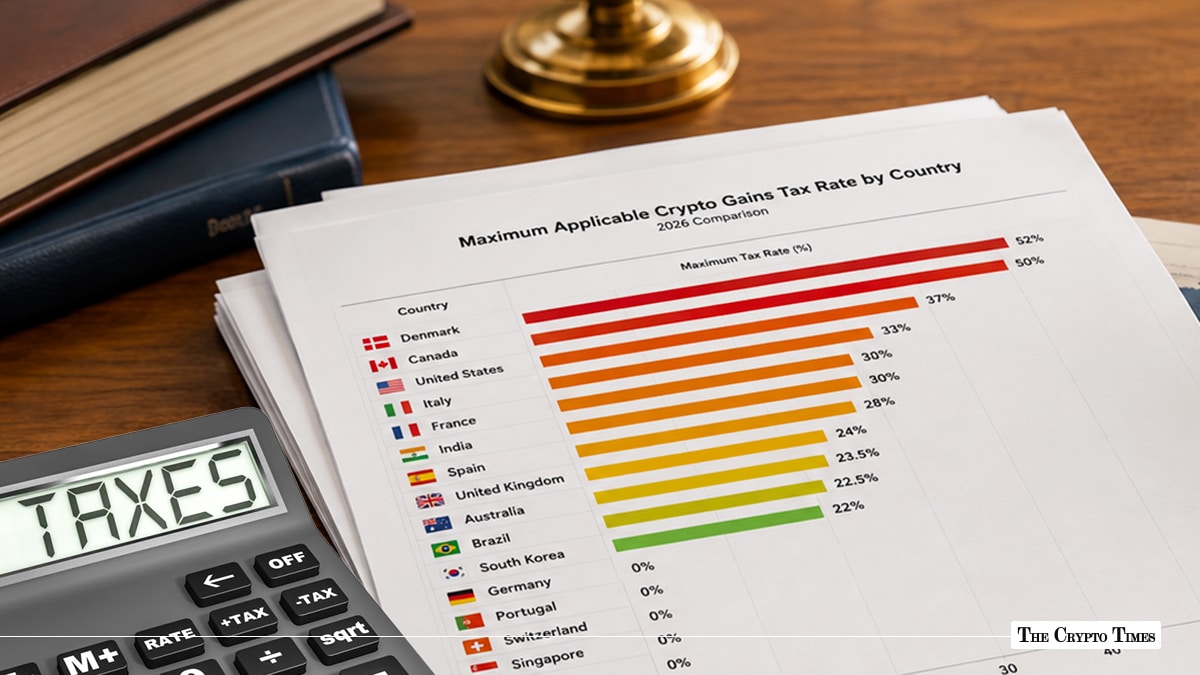
Crypto tax rates vary widely by country, transaction type and investor status. Here is how Bitcoin and other crypto are taxed in the U.S., UK, India, Canada, Australia and other major markets in 2026.
There is no single “crypto tax rate.”
A Bitcoin investor in the United States could owe 0%, 15% or 20% federal long-term capital-gains tax, while a short-term gain may fall into an ordinary federal bracket as high as 37%. An investor in India faces a 30% tax on every positive income from transfers of virtual digital assets, plus applicable surcharge and cess. Meanwhile, qualifying private capital gains can generally be tax-free in countries such as Switzerland, while Singapore generally does not tax gains treated as personal investments.
What a crypto holder actually owes can depend on:
- Their tax residence, not simply their citizenship
- Whether crypto was sold, swapped, spent, mined or staked
- How long the asset was held
- The cost basis and sale value
- Whether the activity is investment or business activity
- Available exemptions and losses
- State, provincial, cantonal or local taxes
- The specific type of digital asset
Methodology: The Crypto Times reviewed official tax-authority guidance and legislation available as of August 7, 2026. The country comparison primarily covers individual tax residents investing on their own account, not companies, professional traders or investment funds. Tax laws and individual circumstances can materially change the outcome.
Key Highlights
- Crypto does not have one worldwide tax rate.
- The U.S. treats digital assets as property. Long-term gains can be taxed federally at 0%, 15% or 20%; short-term gains generally use ordinary income-tax rates of up to 37% for 2026.
- India generally taxes positive income from VDA transfers at 30% plus surcharge and cess and restricts loss set-offs; qualifying transfers can also face 1% TDS on consideration.
- The UK generally applies Capital Gains Tax (CGT) to investment disposals, with individual CGT rates of 18% or 24% and a £3,000 annual exempt amount for 2026/27.
- Some jurisdictions distinguish sharply between private investment and professional trading. Singapore and Switzerland, for example, may not tax qualifying private capital gains but do tax certain business or income-producing activities.
- Swapping one crypto asset for another is taxable in countries including the U.S. and UK, but countries such as France and Portugal provide different treatment for certain crypto-to-crypto exchanges.
- Tax reporting is becoming more coordinated internationally through the OECD’s Crypto-Asset Reporting Framework, or CARF
Crypto tax rates by country in 2026
The table below is a quick reference, not a substitute for determining individual tax liability.
| Country | General treatment for individual investors in 2026 | Important point |
|---|---|---|
| United States | Short-term gains: ordinary federal rates of 10%-37%. Long-term gains: 0%, 15% or 20% | 3.8% NIIT and state taxes may also apply. |
| United Kingdom | Investment gains generally subject to 18% or 24% CGT | £3,000 annual exempt amount in 2026/27. |
| India | Positive VDA transfer income generally taxed at 30% plus surcharge and cess | Loss set-off is restricted; qualifying transfers can face 1% TDS on consideration. |
| Canada | For capital treatment, 50% of the gain is included in taxable income | This is a 50% inclusion rate, not a 50% tax rate. Business profits are treated differently. A proposed increase to 66.7% was formally cancelled in March 2025; 50% remains current for 2026. |
| Australia | Net capital gains form part of taxable income | Eligible individuals may generally reduce a gain by 50% after holding an asset at least 12 months. |
| Germany | Qualifying private disposals within one year can be taxable under personal income-tax rules | A qualifying disposal after more than one year generally falls outside the private-sale rule. |
| France | Private-investor digital-asset gains generally face a 31.4% PFU under current guidance | Rate rose from 30% to 31.4% effective January 1, 2026. Certain crypto-to-crypto exchanges receive tax deferral. |
| Portugal | Qualifying crypto gains generally subject to a 28% special rate | Gains on qualifying crypto held at least 365 days are generally excluded; important exceptions apply. |
| Singapore | Qualifying personal-investment gains are generally not taxable | Trading or business profits can be taxable as income. |
| Switzerland | Qualifying private-investment capital gains are generally tax-free | Wealth tax and tax on staking or professional trading can still apply. |
| United Arab Emirates | Qualifying personal investment income is outside the natural-person corporate-tax business scope | Business activity can become taxable where UAE business turnover exceeds AED 1 million. |
| Japan | Crypto sale/use gains generally treated as miscellaneous income unless another classification applies | National income-tax rates are progressive from 5% to 45%, with reconstruction surtax also relevant. |
| South Korea | Dedicated virtual-asset gains tax is not in force in 2026 | Implementation was postponed until 2027; other tax rules may still apply depending on the activity. |
What is the crypto tax rate?
The crypto tax rate is the percentage of taxable cryptocurrency gains or income owed to a tax authority. It depends on the jurisdiction and on how the crypto was acquired, held, and disposed of.
Broadly, countries use one or more of four approaches:
| Approach | How it works | Examples |
|---|---|---|
| Capital-gains treatment | Tax applies when an asset is disposed of for a gain | U.S., UK, Australia |
| Ordinary/income treatment | Gain or reward is included in taxable income | U.S. short-term gains/staking; Japan crypto income |
| Special crypto-specific rate | Legislation establishes a dedicated regime | India |
| Private capital-gain exemption | Qualifying investment gains may not be taxed | Singapore, Switzerland |
One of the biggest mistakes readers make is assuming that the headline rate equals their effective tax rate. Often it does not.
For example, Canada’s rule that half of a qualifying capital gain is included in income does not mean Canadians pay a 50% crypto tax. It means 50% of the gain enters the income calculation, where the taxpayer’s applicable federal and provincial rates determine the final liability.
Australia’s 50% CGT discount works similarly: it can reduce an eligible capital gain before the remaining amount enters the income-tax calculation.
How are cryptocurrencies taxed in the United States?
The IRS treats digital assets as property. General tax principles applying to property therefore apply to crypto transactions.
For an investor, the key distinction is the holding period:
- One year or less: short-term capital gain or loss
- More than one year: long-term capital gain or loss
U.S. short-term crypto tax rates for 2026
Short-term crypto capital gains generally fall under ordinary federal income-tax rates.
| Rate | Single | Married filing jointly | Head of household | Married filing separately |
|---|---|---|---|---|
| 10% | $0-$12,400 | $0-$24,800 | $0-$17,700 | $0-$12,400 |
| 12% | $12,401-$50,400 | $24,801-$100,800 | $17,701-$67,450 | $12,401-$50,400 |
| 22% | $50,401-$105,700 | $100,801-$211,400 | $67,451-$105,700 | $50,401-$105,700 |
| 24% | $105,701-$201,775 | $211,401-$403,550 | $105,701-$201,750 | $105,701-$201,775 |
| 32% | $201,776-$256,225 | $403,551-$512,450 | $201,751-$256,200 | $201,776-$256,225 |
| 35% | $256,226-$640,600 | $512,451-$768,700 | $256,201-$640,600 | $256,226-$384,350 |
| 37% | Over $640,600 | Over $768,700 | Over $640,600 | Over $384,350 |
These are 2026 taxable-income brackets, per IRS Revenue Procedure 2025-32, and the rates are marginal: moving into a higher bracket does not cause all of a taxpayer’s income to be taxed at the higher rate.
U.S. long-term crypto capital-gains rates for 2026
| Rate | Single | Married filing jointly | Head of household | Married filing separately |
|---|---|---|---|---|
| 0% | Up to $49,450 | Up to $98,900 | Up to $66,200 | Up to $49,450 |
| 15% | $49,451-$545,500 | $98,901-$613,700 | $66,201-$579,600 | $49,451-$306,850 |
| 20% | Above $545,500 | Above $613,700 | Above $579,600 | Above $306,850 |
The thresholds apply based on taxable income and the interaction between ordinary income and capital gains, so a taxpayer should not simply multiply their entire gain by the rate shown in the table.
Could U.S. crypto investors pay another 3.8%?
Yes.
The Net Investment Income Tax, or NIIT, may impose another 3.8% on the lesser of net investment income or modified adjusted gross income above:
- $200,000 for single or head-of-household filers
- $250,000 for married couples filing jointly
- $125,000 for married filing separately
State taxes may also apply and can materially raise the total tax burden.
Which crypto transactions are taxable?
Tax rules differ by country, but this provides a useful starting point.
| Crypto activity | U.S. | UK | General observation |
|---|---|---|---|
| Buy crypto with fiat and hold | Generally no taxable disposal | Generally no disposal | Usually not taxed merely for buying |
| Hold crypto while its price rises | No realized gain | No realized disposal | Unrealized gains are commonly not taxed under conventional regimes |
| Sell crypto for fiat | Taxable disposal | Taxable disposal | Common taxable event |
| Swap BTC for ETH | Taxable | Taxable | Not universal: France and Portugal have special crypto-to-crypto rules |
| Spend crypto on goods | Generally taxable disposal | Taxable disposal | Spending can realize a gain or loss |
| Transfer between your own wallets | Normally not a sale | Not a disposal where beneficial ownership remains unchanged | Fees can require separate analysis |
| Receive staking rewards | Income can arise | Income can arise | Treatment differs significantly by country |
| Mine crypto | Income/business rules may apply | Income or trading rules may apply | Depends on activity and jurisdiction |
| Receive crypto as salary | Income | Income | Generally treated as compensation |
| Donate crypto | Special charitable rules can apply | Special rules can apply | Jurisdiction-specific |
HMRC specifically treats selling tokens, exchanging one token for another and using crypto to buy goods or services as disposals. Moving tokens between wallets where beneficial ownership remains the same is not a disposal.
This distinction makes a crypto swap one of the most important international differences. France currently provides tax deferral for qualifying digital-asset exchanges without cash consideration, while Portugal generally defers taxation where consideration for qualifying crypto is received in crypto, subject to its statutory conditions and jurisdictional exceptions.
Crypto tax rates by country: Detailed guide
United States
The IRS classifies digital assets as property. Selling crypto for dollars, exchanging it or otherwise disposing of it can generate a capital gain or loss. The holding period determines whether the gain is short-term or long-term.
Short-term gains generally use ordinary federal rates of up to 37% in 2026, while long-term capital gains use 0%, 15% or 20% federal rates depending on taxable income and filing status. NIIT and state taxes can add to the bill.
U.S. crypto tax example
Suppose an investor:
- Buys Bitcoin for $20,000
- Sells it 18 months later for $32,000
- Has no relevant transaction-cost adjustment for this simplified example
Capital gain = $32,000 − $20,000 = $12,000
Because Bitcoin was held for more than one year, the $12,000 is a long-term capital gain.
If that entire gain falls within the investor’s 15% long-term capital-gain band:
Federal capital-gains tax = $12,000 × 15% = $1,800
That simplified calculation does not include possible NIIT, state tax or other circumstances.
United Kingdom
For most individual investors, HMRC generally treats crypto investing as an investment activity subject to Capital Gains Tax when tokens are disposed of. HMRC says only exceptional levels of frequency, organization and sophistication normally turn individual crypto dealing into financial trading for Income Tax purposes.
For the UK tax year beginning April 6, 2026, individual CGT rates are 18% and 24%, depending on taxable income and gains, the same rates that have applied to shares, property and crypto alike since the October 2024 Budget aligned them. The annual exempt amount is £3,000.
Crypto-to-crypto exchanges are disposals. Own-wallet transfers are generally not disposals where the same taxpayer retains beneficial ownership.
India
India has one of the clearest dedicated crypto-tax regimes among major markets.
The Income Tax Department says income from transferring a Virtual Digital Asset is computed after deducting the cost of acquisition, while other expenditure or allowances and loss set-offs are restricted. Positive income is taxed at a flat 30% plus applicable surcharge and cess.
Qualifying transfers can also trigger 1% TDS on the consideration, subject to statutory thresholds and conditions. TDS is a withholding mechanism; it should not be described as an additional 1% tax on the investor’s profit.
India crypto tax example
Suppose an investor:
- Buys crypto for ₹300,000
- Later transfers it for ₹500,000
- Has a positive VDA income of ₹200,000
Simplified base tax: ₹200,000 × 30% = ₹60,000
Surcharge and cess may then apply. Separately, 1% TDS can apply to qualifying consideration, rather than to the ₹200,000 profit.
Canada
Canada does not have one standalone “crypto tax rate.”
The Canada Revenue Agency (CRA) first determines whether a crypto disposition is on a capital account or business account.
Under capital treatment, CRA’s current crypto guidance says half of a capital gain is included in income as a taxable capital gain. Half of a capital loss is an allowable capital loss and generally offsets taxable capital gains rather than employment or other ordinary income.
The 50% is an inclusion rate, not the investor’s final tax rate. The taxable portion is subject to the person’s applicable federal and provincial tax rates. It is also worth noting explicitly for 2026: Ottawa proposed raising this inclusion rate to 66.7% on gains above CAD 250,000 in 2024, deferred that change in January 2025, and formally cancelled it in March 2025, so the 50% rate remains the operative figure for the 2026 tax year, with no two-tier structure.
Australia
Crypto held as an investment is generally a CGT asset in Australia. Capital gains form part of the taxpayer’s income rather than being taxed under a completely separate crypto rate.
Eligible Australian-resident individuals who hold an asset for at least 12 months can generally access the 50% CGT discount, meaning the eligible gain is reduced before being included in taxable income.
Again, 50% is a discount to the gain, not a 50% tax rate.
The Australian Taxation Office (ATO) also emphasizes detailed crypto recordkeeping, including transaction dates, Australian-dollar values, wallet records, exchange records and relevant costs.
Germany
Germany’s treatment can be particularly favorable for qualifying long-term private holdings.
Under Section 23 of Germany’s Income Tax Act, private disposals of “other assets” fall within the private-sale regime where the period between acquisition and disposal is no more than one year. Germany’s Finance Ministry applies this framework to relevant crypto assets.
For a qualifying private investor, this generally means a disposal after a holding period of more than one year falls outside the private-sale rule.
The statute also provides that total profit from private sale transactions remains exempt where it is less than €1,000 in the calendar year. This is a threshold rather than a conventional deduction, so wording matters.
Business and professional circumstances require a different analysis.
France
France changed in an important way that makes many older online crypto-tax guides stale.
Effective January 1, 2026, French guidance confirms that gains realized by private investors managing personal digital-asset portfolios are generally subject to a 31.4% PFU, up from 30% in 2025, consisting of 12.8% income tax plus 18.6% social charges. Taxpayers can opt for the progressive income-tax scale where appropriate.
France also provides tax deferral for qualifying crypto-to-crypto exchanges without cash consideration. Annual gross disposals of up to €305, excluding deferred exchanges, can fall within its exemption.
Mining and staking profits are treated under the BNC category under current tax-authority guidance.
Portugal
Portugal should not be described simply as a “crypto tax-free country.”
For qualifying crypto assets that are not treated as securities, Portugal generally applies a 28% special rate on taxable gains. However, gains on qualifying crypto held for at least 365 days are generally excluded from taxation.
Qualifying crypto-to-crypto exchanges generally do not trigger immediate taxation; the acquisition value can carry into the received crypto until a later taxable disposal.
Important exceptions apply, including rules involving certain non-EU, non-EEA or non-information-exchange jurisdictions and crypto treated as securities.
Singapore
Singapore does not impose a general capital-gains tax.
IRAS states that profits and losses from buying and selling financial instruments, including digital tokens, are generally viewed as personal investments when held in a personal investment capacity. Such capital gains are generally not taxable.
That does not mean all crypto activity is tax-free.
Businesses trading digital tokens in the ordinary course of business are subject to normal income-tax rules, and IRAS considers factors such as purpose, frequency and holding period when determining whether a gain is capital or trading income.
Switzerland
Switzerland likewise requires a distinction between private investment and professional activity.
The Swiss Federal Tax Administration states that gains from buying and selling payment tokens held as private assets by an individual generally constitute tax-free private capital gains. Depending on the type, volume and financing of transactions, activity can instead amount to self-employment and become taxable.
Crypto assets can also be relevant for cantonal wealth tax.
Staking-pool rewards are generally treated as income from movable property at their value when received.
Therefore, “Switzerland has 0% crypto tax” would be inaccurate.
United Arab Emirates
The UAE is frequently described online as having “0% crypto tax,” but that statement needs qualification.
For natural-person UAE corporate-tax purposes, the Federal Tax Authority says personal investment income is not considered a business or business activity. A natural person is generally brought into the corporate-tax regime where they conduct a business or business activity in the UAE and related annual turnover exceeds AED 1 million.
Accordingly, a qualifying personal crypto investment is different from operating a crypto trading, mining or other business.
Residency, business status and the nature of the activity should be evaluated before presenting any individual as paying “zero tax.”
Japan
Japan generally treats gains arising from selling or using crypto as miscellaneous income, unless the gain arises in circumstances that fall under another income category.
Japan’s national income-tax scale progresses from 5% to 45%, depending on taxable income. A reconstruction special income tax generally adds 2.1% of the base income-tax amount through 2037.
Local taxation may also be relevant, so the 45% national headline rate should not be treated as the taxpayer’s complete or automatic effective crypto rate.
South Korea
South Korea’s dedicated taxation regime for virtual-asset gains is not yet effective in 2026.
The Ministry of Finance and Economy said implementation was postponed by two years, until 2027.
That does not mean every form of crypto-related income is automatically tax-free. Business, employment or other types of income may still fall within existing tax rules.
How do you calculate crypto capital gains?
A simplified capital-gain calculation is:
Capital gain or loss = disposal proceeds − adjusted cost basis − allowable disposal costs
The exact definition of basis, deductible transaction costs, and matching method differs by jurisdiction.
For example, if someone buys 1 BTC for $40,000 and later sells it for $55,000:
- Proceeds: $55,000
- Cost basis: $40,000
- Simplified capital gain: $15,000
The $15,000 gain is then processed under the taxpayer’s country’s rules.
It is not automatically the tax due.
What is crypto cost basis?
Crypto cost basis is generally the amount used to determine the gain or loss when a digital asset is disposed of.
Depending on the jurisdiction, it can include:
- Purchase price
- Certain transaction fees
- Acquisition expenses
- Adjustments from prior taxable or non-taxable transactions
The calculation becomes more complicated when an investor has bought the same crypto at multiple prices.
Different countries use different identification, pooling and matching rules.
In the U.S., current IRS guidance includes specific identification requirements and default rules for digital-asset units held in hosted and unhosted wallets.
How are crypto staking rewards taxed?
United States
Under IRS Revenue Ruling 2023-14, staking rewards received by a cash-method taxpayer are generally included in gross income at fair market value when the taxpayer obtains dominion and control over the rewards.
A later sale of those tokens can then create another gain or loss relative to their tax basis.
United Kingdom
Where staking activity does not amount to a trade, HMRC says the pound-sterling value of tokens received is generally taxable as miscellaneous income. A later disposal can result in Capital Gains Tax.
France
French guidance places profits from staking and mining in the BNC category.
Switzerland
Staking-pool compensation is generally treated as income from movable property at its value when received.
Are crypto-to-crypto trades taxable?
It depends on the country.
In the U.S., exchanging one crypto asset for another can produce a taxable disposal because digital assets are treated as property.
The UK similarly treats exchanging one type of token for another as a disposal.
By contrast:
- France provides tax deferral for qualifying digital-asset exchanges without cash consideration.
- Portugal generally defers tax on qualifying crypto-to-crypto consideration until a later non-crypto disposal, subject to applicable conditions.
Are transfers between your own crypto wallets taxable?
Generally, merely moving crypto between wallets controlled by the same beneficial owner does not represent a sale by itself in jurisdictions such as the UK.
HMRC explicitly says there is no disposal where the individual retains beneficial ownership while moving tokens between addresses they control.
However, there is an important complication: transaction fees.
For example, HMRC says a network or transaction fee paid in tokens can itself constitute a separate disposal of those tokens.
Can crypto losses reduce your tax bill?
Again, country matters.
| Country | General treatment |
|---|---|
| U.S. | Capital losses can generally offset capital gains, subject to broader U.S. loss rules |
| UK | Allowable crypto capital losses can generally offset chargeable gains under CGT rules |
| Canada | Allowable capital losses generally offset taxable capital gains, not employment income |
| Australia | Capital losses can generally offset capital gains and unused losses can be carried forward |
| India | VDA loss set-offs are heavily restricted |
| France | Current digital-asset losses have specialized same-category and same-year limitations |
Canada’s CRA, for example, says allowable capital losses generally cannot be deducted against employment income and may be carried back three years or forward indefinitely against taxable capital gains.
India’s regime is considerably less generous: its Income Tax Department says VDA income is calculated without a set-off of losses under the special regime.
France currently says digital-asset losses may offset gains of the same nature for the same year but cannot be carried forward under this particular private-investor framework.
Do you owe crypto tax if your exchange sends no tax form?
Potentially, yes.
Tax liability generally arises under tax law, not because an exchange sends a form.
In the U.S., taxpayers are required to report applicable taxable digital-asset transactions even if no information return is received. The reporting infrastructure is nevertheless becoming more detailed.
For 2026, Form 1099-DA reporting expands, including cost-basis reporting for covered digital assets under applicable broker rules.
How tax authorities can track crypto transactions
The idea that “crypto is invisible to tax authorities” is increasingly outdated.
Exchange KYC records, blockchain analytics and domestic reporting regimes already provide authorities with considerable information. International information sharing is also expanding.
The OECD’s Crypto-Asset Reporting Framework took effect January 1, 2026, with reporting crypto-asset service providers in the first-wave jurisdictions beginning due diligence and data collection; 76 jurisdictions are now formally committed to implementing CARF in total, with the first group of roughly 47–48 exchanging data automatically beginning in 2027, a further group beginning in 2028, and the United States, which is relying on its own domestic Form 1099-DA broker-reporting regime rather than signing the CARF multilateral agreement, beginning international exchanges in 2029.
Under CARF, participating jurisdictions establish systems through which reporting crypto-asset service providers collect relevant user and transaction information for exchange between tax authorities.
What crypto records should investors keep?
Even investors using exchanges should maintain their own records.
For each transaction, retain:
- Date and exact time of transaction
- Crypto asset and quantity
- Acquisition price in local fiat currency
- Disposal value in local fiat currency
- Transaction and network fees
- Cost basis
- Exchange statements
- Wallet addresses
- Transaction hashes
- Staking, mining and airdrop records
- Transfers between personally controlled wallets
- Any tax forms received
- Evidence supporting specific-identification methods where applicable
The Australian Taxation Office, for example, tells crypto investors to retain receipts, transaction dates, counterparty or address information, exchange records, local-currency values and wallet records.
Records matter even more for users operating across:
- Multiple centralized exchanges
- DEXs
- Self-custody wallets
- Bridges
- DeFi protocols
- Staking platforms
- NFT marketplaces
Common crypto tax mistakes
Treating crypto-to-crypto swaps as automatically tax-free
They are taxable disposals in several major jurisdictions, including the U.S. and UK.
Confusing a tax discount with a tax rate
Canada’s 50% capital-gain inclusion and Australia’s 50% CGT discount do not mean taxpayers owe 50% tax.
Calling India’s 1% TDS an additional 1% profit tax
TDS is withheld against transaction consideration under qualifying circumstances and interacts with the taxpayer’s tax account.
Assuming a wallet transfer is always irrelevant
Moving assets between wallets may not be a disposal, but the movement should still be documented, and network fees can have separate consequences.
Ignoring staking income
Staking can create taxable income before tokens are eventually sold.
Assuming an overseas exchange avoids domestic tax
Tax residence usually matters more than where an exchange is incorporated.
Assuming “0% capital gains” means “no crypto taxes”
Singapore, Switzerland and the UAE all demonstrate why capital gains, professional activity, income and business taxation must be considered separately.
FAQs about crypto taxes
How much tax do I pay on crypto?
There is no universal rate. Your tax depends on tax residence, gain or income, holding period, transaction type, investor or business status and other income. U.S. federal investment rates can range from 0% on certain long-term gains to ordinary income rates as high as 37% on short-term gains, before considering possible NIIT or state tax.
What is the U.S. crypto tax rate in 2026?
Short-term gains are generally taxed at ordinary federal rates of 10%-37%. Long-term capital gains are generally taxed at 0%, 15% or 20%, depending on taxable income and filing status.
Is crypto taxed if I don’t sell it?
Simply buying and holding crypto generally does not create a U.S. capital-gain realization. Tax can arise when the asset is sold, exchanged or otherwise disposed of, while rewards or compensation can create income before disposal.
Is swapping crypto taxable?
It depends. Crypto-to-crypto exchanges are taxable disposals in the U.S. and UK. France and Portugal provide different treatment for certain qualifying crypto-to-crypto transactions.
Is moving crypto between wallets taxable?
A transfer between wallets beneficially owned by the same person is generally not a disposal under UK guidance, for example. Network fees or a change in beneficial ownership may still have separate tax consequences.
Are staking rewards taxable?
They can be. The U.S. generally includes staking rewards in gross income when a cash-method taxpayer obtains dominion and control. The UK generally taxes non-trading staking rewards as miscellaneous income on receipt. Other countries use different classifications.
What is the crypto tax rate in India?
Positive income from transferring a VDA is generally taxed at 30% plus applicable surcharge and cess. The special regime restricts deductions and loss set-offs. Qualifying transfers can also be subject to 1% TDS on consideration.
Is crypto tax-free in Portugal after one year?
Qualifying gains from crypto assets that are not securities and have been held for at least 365 days are generally excluded under Portugal’s current regime. There are important exceptions, including jurisdiction-specific conditions.
Which countries generally do not tax private crypto capital gains?
Singapore generally does not tax gains treated as personal investments because it has no general capital-gains tax, while Switzerland generally treats qualifying private capital gains on payment tokens as tax-free. UAE personal investment income is outside the natural-person corporate-tax business-activity scope. Each jurisdiction can still tax professional, business or income-producing crypto activities.
Can crypto losses reduce taxes?
Often, but the rules vary. Canada allows allowable capital losses against taxable capital gains, while India severely restricts VDA loss set-offs.
Can tax authorities see crypto transactions?
Increasingly, yes. Domestic information reporting, exchange records and international systems are expanding. The OECD says 76 jurisdictions have formally committed to CARF, with the first group scheduled to begin automatic exchange of crypto-asset information in 2027.
Do I owe tax if my exchange does not send me a form?
Potentially. Tax liability is determined by applicable law rather than whether a platform supplied a tax form. Investors should maintain independent transaction and cost-basis records.
Does moving to another country eliminate crypto tax?
Not automatically. Tax residence, departure or exit-tax rules, the date residence changes, asset location rules and tax treaties can all matter. Anyone changing tax residence with substantial crypto holdings should obtain cross-border professional advice before making transactions.
Is there a global crypto tax rate?
No. Every jurisdiction applies its own income, capital-gains, wealth, business and reporting rules. International initiatives such as CARF concern reporting and information exchange; they do not create a single global crypto tax rate.
Conclusion
Crypto taxation in 2026 is becoming more formalized, but it remains highly fragmented.
The U.S. distinguishes between short- and long-term capital gains. India applies a dedicated 30% VDA regime. The UK uses its broader Capital Gains Tax system. Germany and Portugal can reward longer holding periods under qualifying circumstances, while Singapore and Switzerland generally do not tax qualifying private capital gains.
At the same time, a low headline capital-gains rate does not necessarily mean a low total crypto tax bill. Staking, mining, business activity, employment income, wealth taxes, local taxes and cross-border rules can produce completely different results.
Investors should therefore begin with three questions:
- Where am I tax resident?
- What exactly did I do with the crypto?
- And how does that country classify the activity?
Those questions are more important than any global “crypto tax rate” comparison.
Tax disclaimer: This article is for general informational and educational purposes only and does not constitute tax, legal, accounting, or financial advice. Crypto tax treatment depends on individual facts and can change. Readers should consult the relevant tax authority and a qualified tax professional before filing a return or making tax-related decisions.
Disclaimer:
Some elements of this content may have been enhanced with the help of our artificial intelligence (AI) assistants for purposes such as basic refinement, review, image generation, and translation to deliver high-quality news in a shorter time frame. However, all AI-assisted content is reviewed and approved by our team to ensure accuracy, fairness, and editorial integrity.