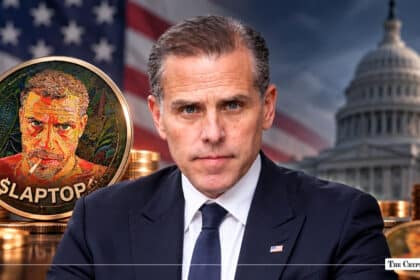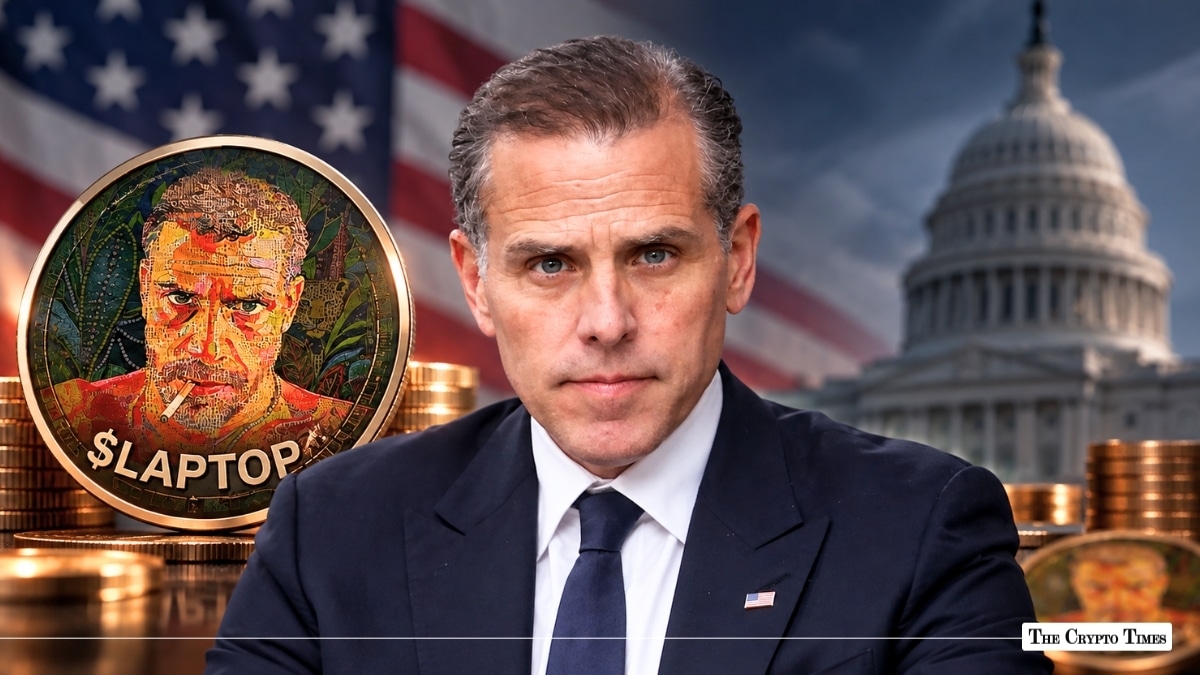
Hunter Biden, son of former US President Joe Biden, is turning one of the most controversial episodes of his public life into a cryptocurrency. Called $LAPTOP, the memecoin is scheduled to launch on September 9, 2026, on Base, the Ethereum Layer 2 developed by Coinbase. The token takes its name from the laptop Biden left at a Delaware computer repair shop in 2019, which became a major political controversy during the 2020 U.S. presidential election.
Importantly, $LAPTOP is not being presented as a cryptocurrency with a product or protocol behind it. Its own disclosures describe the token as a digital collectible with no utility. It provides no staking, governance, dividends, revenue rights or ownership in the entities behind the project. Its market value, if any, will depend largely on demand and community sentiment.
Key Highlights
- $LAPTOP launches September 9 on Base with a 1 billion supply, founded by Hunter Biden through a Cayman Islands foundation.
- The project’s own disclosures say the token has no utility, no staking and no ownership rights.
- 20 million tokens go to users who lost money on $TRUMP, 80 million to Substack subscribers. Unclaimed tokens burn after 30 days.
- 30% of supply is tied to 30 predefined events, including a Democratic win in 2028. Tokens burn if the event happens, go to charity if it does not.
- At least 14 copycat tokens appeared before launch, generating $6.9 million in volume within an hour.
The launch has attracted additional attention because part of the token supply is being offered to people who lost money trading President Donald Trump’s Official Trump ($TRUMP) memecoin. Here is how $LAPTOP works, who may qualify for its airdrop and what traders should understand before interacting with the token.
What Is $LAPTOP?
$LAPTOP is an ERC-20 memecoin founded by Hunter Biden and launching initially on Base. The project describes its purpose as an attempt to “reclaim the narrative” surrounding the laptop story that followed Biden for years. Biden publicly confirmed the token on September 7 by posting “$LAPTOP September 9” on X alongside a video montage referencing coverage of his computer.
The Crypto Times reported the planned launch shortly before Biden’s post. According to the project’s official disclosures, $LAPTOP is issued by Phoenix Veritas Foundation, a Cayman Islands foundation company, and Phoenix Veritas Ventures Ltd, a British Virgin Islands company controlled by the foundation. The project documentation identifies Biden among the founders, while its FAQ describes him as the project’s founder.
$LAPTOP Quick Facts
| Detail | Information |
|---|---|
| Token | Hunter Biden’s Laptop |
| Ticker | $LAPTOP |
| Network | Base |
| Token standard | ERC-20 |
| Launch date | September 9, 2026 |
| Maximum supply | 1 billion LAPTOP |
| Supply at TGE | 350 million, or 35% |
| Founder allocation | 30% |
| Airdrop allocation | 20% |
| Predictions allocation | 30% |
| Utility | None |
| Staking | No |
| Governance rights | No |
| Audit | Hacken |
| Official Base contract | 0xB095274743941e953c746F9C228DA9c18Bb6ec29 |
Users should verify the contract directly against the project’s official website before connecting a wallet or trading. The project says exchange listings will be announced at launch. As of September 8, its website still labels its buying and airdrop functions as “coming soon.”
Why Is It Called $LAPTOP?
The name refers to the MacBook Pro Hunter Biden left at a computer repair shop in Wilmington, Delaware, in April 2019. The FBI later obtained the computer.
Its contents became a political flashpoint after the New York Post published stories based on material attributed to the computer on October 14, 2020, shortly before the presidential election. Social-media companies initially restricted distribution of that reporting: Twitter blocked links under its hacked-materials policy, and Facebook reduced the story’s distribution pending fact-checking.
Fifty-one former U.S. intelligence officials signed a letter saying the episode had “all the classic earmarks of a Russian information operation.” The letter did not establish that the laptop itself was Russian disinformation.
The provenance of different copies of the laptop data subsequently became important. A Washington Post forensic review authenticated nearly 22,000 emails using cryptographic signatures, while cautioning that much of a widely circulated copy could not be conclusively verified because of its chain of custody and handling. A separate CBS News–commissioned analysis of a copy represented as the data supplied to the FBI found no evidence of tampering or fabrication.
The physical laptop later appeared as evidence in Hunter Biden’s 2024 federal gun trial in Delaware. An FBI agent identified the MacBook Pro by serial number and described how investigators connected the device and its data to Biden, including by cross-checking it against iCloud backups.
The repair-shop owner, John Paul Mac Isaac, later sued Politico, Hunter Biden, and the Biden campaign for defamation over statements tying the laptop story to Russian disinformation. In Isaac v. Politico LLC, et al. (Del. Aug. 25, 2025), the Delaware Supreme Court affirmed dismissal of Mac Isaac’s claims, holding that the statements did not concern him and were not actionable as defamation. The court also affirmed dismissal of Hunter Biden’s invasion-of-privacy counterclaims as time-barred, finding he was on inquiry notice by October 14, 2020, when the New York Post story appeared. The opinion recounts the same core timeline: the April 2019 drop-off, Mac Isaac’s later copy of the data, the FBI handover, and the 2020 publication chain.
$LAPTOP effectively turns that history into the token’s branding. The project describes the strategy as taking control of a story that had previously been told about Biden by others.
How Does the $LAPTOP Airdrop Work?
The project has reserved 200 million LAPTOP, or 20% of the maximum supply, for airdrops. Half of that allocation—100 million tokens—is designated as the Day-1 community airdrop. Another 100 million tokens are reserved for future distributions at the discretion of Phoenix Veritas Foundation.
The latest official disclosures divide the Day-1 allocation into two groups:
$TRUMP loss allocation: 20 million LAPTOP, or 2% of total supply. Participating exchanges and retail apps may distribute tokens to users who recorded negative profit and loss on $TRUMP. The individual platforms determine how their allocations are distributed.
“Where’s Hunter?” subscribers: 80 million LAPTOP, or 8% of supply. Users who subscribed to Hunter Biden’s Substack before September 6, 2026, may qualify, with allocations weighted according to subscription tier. The disclosure says Coinbase Embedded Wallet will be used for this cohort.
Eligible recipients will have 30 days after the token-generation event to claim their allocation. Any Day-1 airdrop tokens left unclaimed after that window are supposed to be permanently burned.
Early news reports also mentioned subscribers to video journalist Andrew Callaghan’s Channel 5 mailing list. However, that group is not included in the project’s current official token disclosure, which assigns the entire Day-1 allocation between $TRUMP-loss users and Hunter Biden’s Substack subscribers. Prospective claimants should therefore rely on the latest official documentation rather than earlier airdrop trackers or social-media posts.
Importantly, the disclosure does not establish a blanket reimbursement for everyone who lost money on $TRUMP. Distribution depends on participating platforms, and the document does not specify a general method for identifying losses held entirely in self-custody wallets.
Why Target People Who Lost Money on $TRUMP?
The airdrop is the clearest political element of the project.
Official Trump ($TRUMP) launched in January 2025 and reached an all-time high of $73.43 on January 19, 2025, according to data from CoinGecko. By early September 2026, it was trading around $2.30, roughly 97% below its peak, with about 273 million tokens circulating from a maximum supply of 1 billion.
Offering $LAPTOP to traders who lost money on $TRUMP therefore creates a direct contrast between two highly political memecoins.
However, recipients should not interpret the airdrop as compensation equivalent to their $TRUMP losses. The amount and market value of $LAPTOP received may bear little relationship to any previous loss, and the token itself can decline sharply or become worthless.
$LAPTOP Tokenomics Explained
$LAPTOP has a fixed maximum supply of 1 billion tokens.
Its official allocation is:
| Allocation | Tokens | Share |
|---|---|---|
| Founders | 300 million | 30% |
| Predictions | 300 million | 30% |
| Day-1 airdrop | 100 million | 10% |
| Future airdrops | 100 million | 10% |
| Liquidity | 100 million | 10% |
| Foundation treasury | 50 million | 5% |
| Charity | 50 million | 5% |
| Total | 1 billion | 100% |
At the token-generation event, 350 million tokens, or 35% of supply, are available as unlocked allocations. Founder tokens receive a six-month lock followed by 24 months of linear monthly vesting. The 300 million prediction tokens are locked for 12 months and then vest over 24 months. Founder tokens therefore become fully vested 30 months after launch, while the prediction allocation completes its schedule after 36 months.
The foundation also says it has loan agreements with market-making firms identified as GSR and G20 covering a combined 20.5 million LAPTOP tokens. Those tokens form part of the existing liquidity allocation and do not increase the 1 billion maximum supply.
What Is the $LAPTOP Prediction Mechanism?
One of the unusual parts of $LAPTOP’s tokenomics is the 300 million-token prediction allocation, representing 30% of supply. The project has attached portions of this supply to 30 predefined real-world events involving politics, cryptocurrency and culture.
Examples displayed on the project website include whether Bitcoin reaches another all-time high, whether a Democrat wins the 2028 U.S. presidential election and whether $LAPTOP’s fully diluted valuation eventually exceeds that of $TRUMP. Some of the events reference markets on prediction platforms including Kalshi and Polymarket.
The mechanism works differently from betting with the tokens themselves. If a specified event occurs within its defined period, the LAPTOP tokens assigned to that event are burned. If the event does not occur, the associated tokens are instead directed to the project’s charity allocation, subject to the relevant vesting schedule.
That means the mechanism can reduce $LAPTOP’s eventual circulating supply, but a smaller supply does not guarantee a higher token price. Demand remains an independent factor.
Does $LAPTOP Have Any Utility?
No. This is unusually clear in the project’s own disclosure documents.
$LAPTOP cannot be staked and does not provide voting, governance, dividend, yield, profit-sharing, or ownership rights. The project states that it has no plans to develop future utility and describes the token as a cultural digital collectible whose value derives from community sentiment.
That distinction matters because buyers are not purchasing an interest in Hunter Biden’s businesses, the foundation or any underlying revenue stream.
There is also no stated price floor, guaranteed buyback or mechanism guaranteeing that holders will recover their purchase price.
Has the $LAPTOP Contract Been Audited?
Yes. Hacken conducted a technical audit of the LaptopOFT token contract, a LayerZero Omnichain Fungible Token on Base, with a final report dated April 23, 2026. The review found no critical, high, or medium issues. It identified four findings in total, one low-severity and three informational, all of which the project says were fixed before the final report.
The audited contract has a fixed global supply of 1,000,000,000 tokens, initially minted on Base. It does not implement pausing, blacklist/freeze, or upgradeability. There are also no transfer restrictions encoded at the contract level, and the whitepaper states that the issuer cannot modify the token’s rights, features, or functionalities. It is not a mint-on-demand token in the usual sense, but it is an OFT: cross-chain transfers use burn-and-mint, and the owner can authorize remote OFT peers. The Hacken review covers LaptopOFT. The whitepaper does not state that vesting, airdrop-distributor, or prediction/burn contracts were in scope.
An audit should not be interpreted as a guarantee that the token or its surrounding infrastructure is risk-free. The whitepaper itself warns that undiscovered smart-contract vulnerabilities remain possible and that front-end and other off-chain systems can be attacked independently of the token contract.
The whitepaper also does not specify the airdrop claim design. It only allocates 10% of supply to a day-1 community airdrop (plus another 10% for future airdrops) and says unclaimed tokens are reallocated to charity after a 30-day window. If claims use backend-signed authorization rather than a fixed on-chain Merkle root, eligibility would depend in part on infrastructure operated outside the blockchain.
Beware of Fake $LAPTOP Tokens and Airdrop Scams
Copycats appeared before the official token’s scheduled September 9, 2026 launch on Base.
As The Crypto Times reported, LAPTOP copycat was already live on Robinhood Chain at about 14:50 UTC on September 7. Within the following hour, at least 14 different LAPTOP-branded tokens appeared across Robinhood Chain and other networks, including TON. By about 15:45 UTC that day, those tokens had generated a combined $6.9 million in trading volume, according to DEX Screener data. None of them was the official project.
A separate Solana token called “Hunter Biden’s Laptop,” deployed in 2024, also jumped after the announcement. As of about 05:48 UTC on September 8, trackers showed it up roughly 200% over the prior 24 hours. The token is not affiliated with Hunter Biden or the planned Base launch.
The ticker alone is therefore not enough to identify the official token. The project currently lists its official token as an ERC-20 on Base at: 0xB095274743941e953c746F9C228DA9c18Bb6ec29.
That address is also published on the project website. Anyone interacting with $LAPTOP should independently compare the full address and network with that site. Tokens that appeared before the September 9 Base launch, or on other chains, should be treated as unrelated.
Avoid contracts or claim pages promoted through unsolicited direct messages, emails, replies, or unofficial “airdrop” sites. The project has said part of supply is reserved for airdrops, including some wallets that lost money on $TRUMP and some Substack subscribers. That does not mean every page using the LAPTOP name can pay a claim.
What Are the Main Risks of $LAPTOP?
$LAPTOP combines several of the risks commonly associated with newly launched memecoins.
First, it has no underlying utility or cash flow, leaving price discovery almost entirely dependent on attention and speculative demand.
Second, 30% of the supply belongs to founders. Although that allocation begins with a six-month lock, tokens subsequently enter the unlocked supply over two years.
Third, substantial additional supply can become available over time through vesting, liquidity arrangements and other allocations. Increased circulating supply can create selling pressure if demand does not grow alongside it.
Fourth, politically themed memecoins can move sharply in response to news, social-media activity and public figures rather than fundamental measures of value.
Finally, copycat contracts and fake airdrop pages create an immediate phishing and wallet-security risk.
The project’s own disclosure explicitly acknowledges that digital-asset buyers can suffer substantial losses, while its website warns that token prices can fall to zero.
The Bottom Line
$LAPTOP is best understood not as a new blockchain product but as a politically charged memecoin built around Hunter Biden’s attempt to reclaim one of the defining controversies associated with his name.
Its September 9 launch combines three attention mechanisms: Biden’s personal history, an airdrop aimed partly at people who lost money on $TRUMP, and a token-supply system linked to future political, crypto, and cultural events.
That may make $LAPTOP unusual among celebrity memecoins, but it does not change its underlying economics. The project itself says the token has no utility and derives its value from community sentiment.
For prospective users, the most important distinction is therefore between the story surrounding $LAPTOP and the asset itself. A compelling political narrative can generate attention. It cannot guarantee liquidity, demand, or investment returns.
Frequently Asked Questions
What is $LAPTOP?
$LAPTOP is a 1 billion-supply memecoin founded by Hunter Biden and launching on Base on September 9, 2026. The project says it has no utility and functions as a digital collectible.
Is Hunter Biden really behind $LAPTOP?
Yes. Biden publicly announced the ticker and launch date on his verified X account, and the project’s official FAQ identifies him as its founder.
Who qualifies for the $LAPTOP airdrop?
Current official disclosures allocate 20 million Day-1 tokens to users with negative $TRUMP PnL through participating exchanges or retail apps and 80 million to eligible “Where’s Hunter?” Substack subscribers.
Is $LAPTOP compensating everyone who lost money on $TRUMP?
No. Only part of the airdrop is intended for $TRUMP-loss users, participating platforms control distribution criteria, and the tokens are not guaranteed to equal recipients’ previous losses.
Is $LAPTOP safe to buy?
No cryptocurrency can be described as risk-free. $LAPTOP has undergone a Hacken contract audit, but it remains a speculative memecoin with no utility, guaranteed value or price floor. Its official disclosures acknowledge that holders may suffer significant or complete losses.