Privacy has become one of crypto’s most important and most debated use cases. While popular networks like Bitcoin leave a public paper trail of your entire spending history, privacy coins act like digital cash, hiding your balance and identity from prying eyes.
Most public blockchains make transactions visible to anyone. Wallet addresses, transaction amounts and payment histories can often be examined through a block explorer. Privacy-focused cryptocurrencies try to change that by hiding some or all of this information using technologies such as zero-knowledge proofs, stealth addresses, ring signatures and confidential transactions.
Key Highlights
- Privacy coins hold roughly $24.2 billion in combined market cap as of August 2026, with Zcash and Monero taking most of it.
- Zcash leads at $14.2 billion after its July Ironwood upgrade replaced the Orchard pool following a May vulnerability disclosure.
- Monero sits second at $8.8 billion and remains the only major coin where privacy applies by default.
- Privacy coins and ZK coins are not the same. Monero achieves privacy without zk-SNARKs, while Aleo uses ZK for applications rather than payments.
- The EU will prohibit service providers from supporting anonymity-enhancing coins from July 10, 2027, affecting exchange access rather than ownership.
In 2026, the privacy sector is also expanding beyond traditional payment coins. Newer blockchain networks are using zero-knowledge cryptography to build private payments, confidential smart contracts and applications that can verify information without publicly exposing the underlying data.
As of August 2026, dedicated privacy coins tracked by CoinGecko had a combined market capitalization of roughly $24.2 billion, with Zcash and Monero accounting for the overwhelming majority of the category. Zcash alone was valued at about $14.2 billion, compared with roughly $9.6 billion for Monero.
So, which privacy cryptocurrencies deserve attention in 2026?
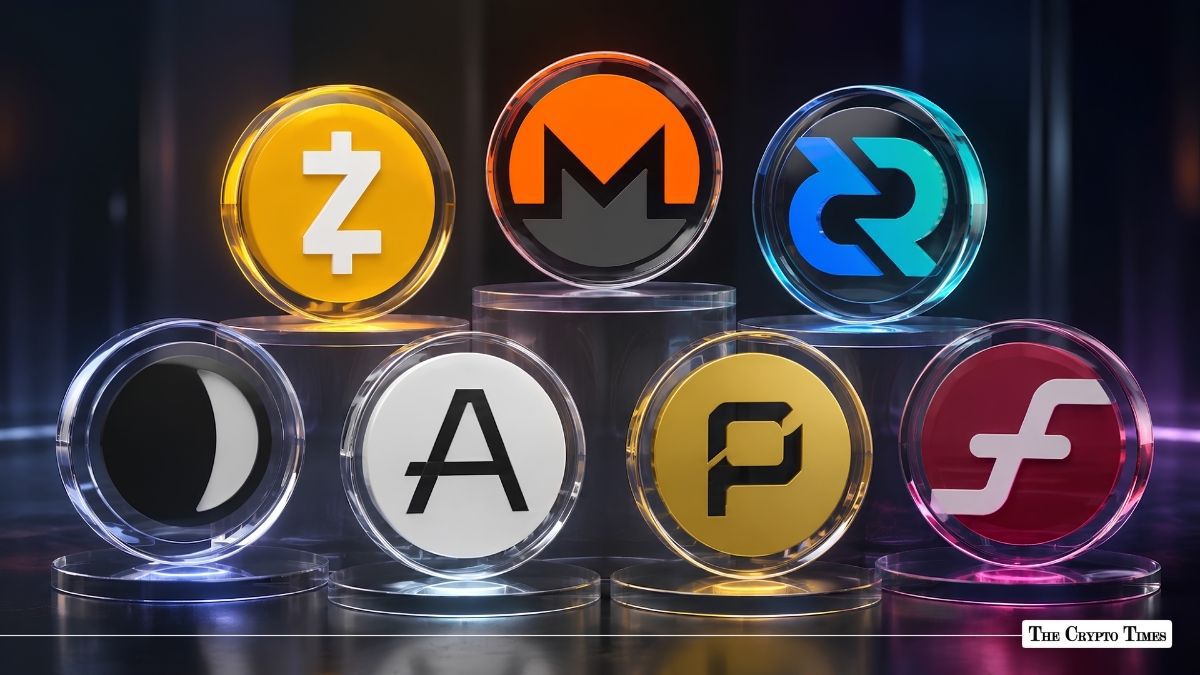
Here are seven projects worth watching based on their privacy technology, adoption, development activity, market relevance and role in the evolving privacy ecosystem.
Note: This list is not a prediction of investment returns or a recommendation to buy any cryptocurrency. “Watch” refers to projects worth following from a technology, adoption and market-development perspective.
Top Privacy and ZK Coins at a Glance
| Coin | Symbol | Main Privacy Technology | Privacy Model | Main Focus |
|---|---|---|---|---|
| Zcash | ZEC | Halo 2 zero-knowledge proofs | Optional shielded privacy | Private digital payments |
| Monero | XMR | Ring signatures, RingCT, stealth addresses | Private by default | Private payments |
| Dusk | DUSK | Zero-knowledge proofs | Public + confidential | Regulated onchain finance |
| Aleo | ALEO | Zero-knowledge proofs | Public + private state | Private applications |
| Decred | DCR | CoinShuffle++ | Optional | Payments and governance |
| Pirate Chain | ARRR | zk-SNARKs | Private by default | Private payments |
| Firo | FIRO | Lelantus Spark | Privacy-focused | Private payments |
1. Zcash (ZEC): Leading the Privacy-Coin Market in 2026
Zcash is the privacy coin to watch first in 2026.
Zcash was one of the earliest major cryptocurrencies to apply zero-knowledge proofs to blockchain payments. It allows transactions to be either transparent or shielded.
When ZEC is transferred through Zcash’s shielded system, transaction information such as addresses and amounts can remain encrypted while the network still verifies that the transaction is valid.
Zcash initially upgraded its privacy architecture with Network Upgrade 5 (NU5). The upgrade introduced the Orchard shielded payment protocol and the Halo 2 proving system, removing the need for the trusted setup previously associated with Zcash’s earlier privacy technology.
However, on 29 May 2026, security researcher Taylor Hornby, engaged by Shielded Labs in April 2026, identified a counterfeiting vulnerability in the Orchard circuit using Anthropic’s Claude Opus 4.8 model. Shielded Labs said the flaw had been present from Orchard’s activation in May 2022 until an emergency fix deployed on 1 June 2026, and stated there is no definitive way to determine using cryptography alone whether it was exploited. ZEC fell 38% over 24 hours following the 5 June disclosure.
Zcash founder Zooko Wilcox subsequently proposed the Ironwood upgrade to let users independently verify circulating supply. Ironwood activated in July 2026, replacing the Orchard shielded pool with a new private pool and introducing quantum-resistant transaction records.
Unified Addresses also aimed to make it easier for compatible wallets to support shielded transactions and automatically move received funds into private pools.
Unified Addresses also aimed to make it easier for compatible wallets to support shielded transactions and automatically move received funds into private pools.
Zcash has become particularly noteworthy in 2026 because of its renewed market momentum. As of late August, CoinGecko ranked ZEC as the largest dedicated privacy coin, with a market capitalization of around $14.2 billion.
Why Zcash is worth watching
Zcash combines several characteristics rarely found together: a long operating history, Bitcoin-like monetary characteristics, advanced zero-knowledge cryptography and optional transaction privacy.
Its biggest question remains adoption of shielded transactions. Zcash supports transparent transactions as well, meaning using ZEC does not automatically guarantee privacy. Users need wallets and services that properly support the shielded ecosystem.
Grayscale Research has argued ZEC has scope to capture Bitcoin market share, citing features it says Bitcoin lacks.
Best for watching: Zero-knowledge payments, shielded adoption and privacy-focused financial infrastructure.
2. Monero (XMR): Privacy by Default
If Zcash represents programmable zero-knowledge privacy, Monero represents mandatory transaction privacy.
Unlike Zcash, Monero does not offer ordinary transparent transactions. Privacy protections are applied by default.
Monero combines several technologies. Stealth addresses create unique one-time addresses for transactions, while ring signatures make it difficult for outside observers to determine which member of a group actually authorized a transaction. Ring Confidential Transactions, or RingCT, hide transaction amounts.
That design is scheduled to change. Full-Chain Membership Proofs, known as FCMP++, would replace ring signatures with proofs spanning the entire chain, expanding the anonymity set from 16 decoys to the full set of chain outputs. As of late August 2026 the upgrade was in stressnet testing and had not been deployed to mainnet.
That distinction has helped Monero remain one of the most recognized privacy cryptocurrencies in the market. As of August 2026, XMR had a market capitalization of roughly $8.8 billion, making it the second-largest dedicated privacy coin behind Zcash.
Also Read: Zcash vs. Monero: The 2026 Privacy Coin War Just Got Decided in One Week
Why Monero is worth watching
Monero remains an important benchmark for evaluating private digital cash because privacy is integrated into normal network use rather than provided as an optional feature. Privacy protections apply to normal network use rather than functioning as an optional mode, which is why Monero is used as a reference point in comparisons of private digital cash.
That architecture also creates exchange-listing and regulatory friction, and access to XMR varies by jurisdiction and platform. THORChain’s v3.20 upgrade, released 25 August 2026, added native XMR support, enabling non-custodial swaps between XMR and other assets without wrapped tokens.
However, that same architecture creates regulatory and exchange-listing challenges. Access to XMR can therefore vary significantly depending on jurisdiction and trading platform.
Best for watching: Default-private cryptocurrency payments and censorship-resistant digital cash.
3. Dusk (DUSK): Privacy Designed for Regulated Finance
Dusk takes a different approach from both Zcash and Monero.

Rather than focusing mainly on anonymous peer-to-peer payments, Dusk is building blockchain infrastructure for financial applications that need both confidentiality and regulatory controls.
Its architecture uses zero-knowledge proofs and supports two transaction models. Phoenix provides confidential shielded transfers, while Moonlight supports transparent account-based transactions. Dusk also supports selective disclosure, allowing information to be revealed to authorized parties when necessary.
This makes Dusk particularly interesting for areas such as tokenized securities, institutional settlement and financial applications where making every balance or transaction publicly visible may be undesirable.
Why Dusk is worth watching
One of the major challenges facing blockchain finance is finding a middle ground between complete transparency and unrestricted anonymity.
Dusk is explicitly targeting that middle ground by combining privacy with identity, access-control and disclosure mechanisms.
Best for watching: Privacy-preserving institutional finance, tokenization and compliant ZK applications.
4. Aleo (ALEO): Building Private Applications With Zero-Knowledge Proofs
Aleo expands privacy beyond payments.

It is a programmable Layer 1 blockchain designed around zero-knowledge cryptography, allowing developers to build applications where sensitive information can remain private while computations are still verifiable.
Even its native credits can exist in different forms. Private Aleo credits are stored as encrypted records, while public credits can exist in transparent onchain accounts.
The network is therefore better described as a privacy-focused ZK blockchain than a traditional privacy coin.
Aleo has also increasingly focused on private payments and stablecoin infrastructure. In 2026, the Aleo Network Foundation published work exploring how zero-knowledge technology could support private stablecoin payments while still providing mechanisms needed for financial compliance.
Why Aleo is worth watching
Aleo provides a useful test of whether blockchain privacy can expand from simple cryptocurrency transfers into full applications.
Its long-term relevance will depend heavily on developer adoption, usable applications and whether private-by-design applications gain mainstream demand.
Best for watching: Private smart contracts, ZK applications and confidential stablecoin infrastructure.
5. Decred (DCR): Optional Privacy Through CoinShuffle++
Decred is primarily known for its governance and hybrid blockchain design, but it also includes a privacy system based on CoinShuffle++.
Decred’s CoinShuffle++ implementation creates CoinJoin transactions that make it harder to connect transaction inputs with outputs.
Importantly, it does not provide the same privacy model as Monero or shielded Zcash. Decred’s documentation notes that CoinShuffle++ anonymizes outputs but transaction amounts remain visible.
Still, Decred remains significant because it is one of the larger cryptocurrencies classified within the dedicated privacy-coin market. Its market capitalization was approximately $242 million in late August 2026.
Why Decred is worth watching
Decred demonstrates another approach to blockchain privacy: adding optional privacy tools to a broader cryptocurrency ecosystem rather than making privacy the entire purpose of the network.
Best for watching: Optional transaction privacy combined with decentralized governance.
6. Pirate Chain (ARRR): Mandatory zk-SNARK Privacy
Pirate Chain is a smaller project, but technologically it belongs in any serious discussion of privacy coins.

ARRR uses zk-SNARK technology and focuses on shielded peer-to-peer payments.
Unlike cryptocurrencies where private transactions are optional, Pirate Chain is designed around mandatory shielded transfers. CoinGecko describes it as using zk-SNARKs to shield peer-to-peer transactions across its blockchain.
That makes Pirate Chain an interesting comparison with Zcash. Both have roots in zero-knowledge privacy, but Pirate Chain emphasizes mandatory privacy whereas Zcash continues to support both transparent and shielded transaction types.
Why Pirate Chain is worth watching
Its technology provides a useful example of what happens when zero-knowledge payment privacy is made the standard rather than an optional transaction mode.
Its considerably smaller market size and liquidity, however, mean readers should distinguish technological relevance from market maturity.
Best for watching: Mandatory zero-knowledge transaction privacy.
7. Firo (FIRO): Private Payments With Lelantus Spark
Formerly known as Zcoin, Firo has spent years developing privacy-focused cryptocurrency technology.
Its current privacy system, Lelantus Spark, is designed to hide the sender, recipient and transaction amount from public blockchain observers.
Spark uses zero-knowledge proofs without requiring a trusted setup. Firo’s official wallets make Spark private payments the default, while view keys can be used for voluntary disclosure when transaction information needs to be shared.
Why Firo is worth watching
Firo is much smaller than Zcash or Monero, but Spark makes it technically relevant to the continuing evolution of privacy-preserving digital cash.
Its progress can also help demonstrate whether smaller dedicated privacy networks can remain competitive as zero-knowledge technology becomes available across larger blockchain ecosystems.
Best for watching: Privacy-by-default wallets and next-generation private payments.
Privacy Coins vs. ZK Coins: What Is the Difference?
The terms privacy coin and ZK coin should not be used interchangeably.
A privacy coin is primarily designed to prevent transaction information from becoming publicly visible.
Zero-knowledge, meanwhile, is a cryptographic technique. A zero-knowledge proof allows one party to prove that something is true without revealing the underlying information.
Zcash, for example, uses zero-knowledge proofs specifically to provide private payments. Aleo uses zero-knowledge technology much more broadly for private applications and computations.
At the same time, Monero provides strong transaction privacy without using the same zk-SNARK architecture as Zcash.
This distinction matters because not every ZK blockchain is a privacy blockchain, and not every privacy coin relies primarily on zero-knowledge proofs.
How to Evaluate a Privacy Coin in 2026
Instead of evaluating privacy cryptocurrencies only by price, readers should consider several factors.
- Privacy by default: Is every transaction protected automatically, or must the user actively choose a private transaction?
- What information is hidden: A system may hide the sender while leaving the transaction amount visible. Stronger privacy systems can protect the sender, receiver and amount.
- Privacy-set size: Privacy tends to become stronger when a transaction can blend into a larger group of possible transactions or participants.
- Selective disclosure: Financial privacy does not always require permanent secrecy. View keys and ZK-based credentials can allow users to prove information to auditors or other authorized parties without exposing everything publicly.
- Wallet support: Advanced cryptography provides limited benefit when exchanges and wallets only support transparent transactions.
- Liquidity and accessibility: Several privacy coins face more restricted exchange access than conventional cryptocurrencies.
- Development activity: Privacy technology evolves quickly, making active research, audits and network upgrades particularly important.
Are Privacy Coins Legal?
There is no single global legal status for privacy coins.
Rules differ by jurisdiction, and regulation increasingly focuses on whether centralized exchanges and other crypto service providers can support anonymity-enhancing cryptocurrencies.
The European Union provides an important example. Under its Anti-Money Laundering Regulation, crypto-asset service providers will be prohibited from maintaining accounts that anonymize customers or increase transaction obfuscation, including through “anonymity-enhancing coins.” The regulation is scheduled to apply from July 10, 2027.
This should not be interpreted as a universal worldwide prohibition on owning privacy-focused cryptocurrency. However, regulation can significantly affect exchange listings, custody services and accessibility.
Users should therefore check local laws and exchange rules before acquiring or transferring privacy coins.
Privacy Coins to Watch: Final Take
Privacy in crypto is no longer one single technology.
Zcash currently leads the dedicated privacy-coin market and remains one of the most important real-world applications of zero-knowledge cryptography.
Monero continues to set the benchmark for default-private cryptocurrency transactions.
Meanwhile, networks such as Dusk and Aleo are pushing blockchain privacy toward programmable applications, institutional finance and selective disclosure.
Smaller projects such as Pirate Chain and Firo continue experimenting with privacy-by-default payment architectures.
The bigger trend to watch in 2026 is therefore not simply whether privacy coins rise or fall in price. It is whether privacy technology becomes an integrated layer of mainstream blockchain infrastructure.
As zero-knowledge systems improve, the line between a “privacy coin” and a privacy-enabled blockchain may continue to become less clear.
Frequently Asked Questions
What is the top privacy coin in 2026?
Zcash is currently the largest dedicated privacy coin by market capitalization, according to CoinGecko data from August 2026. Monero remains the second-largest and is notable for making transaction privacy mandatory by default.
Is Zcash more private than Monero?
They use different privacy models. Monero applies privacy protections to every transaction, while Zcash supports both transparent and shielded transactions. Properly used Zcash shielded transactions can hide addresses and transaction amounts using zero-knowledge proofs.
Which privacy coins use zero-knowledge proofs?
Zcash, Pirate Chain and Firo use zero-knowledge technology in their privacy systems. Privacy-oriented networks such as Aleo and Dusk also use zero-knowledge proofs for private transactions or applications.
Is Monero a ZK coin?
Not in the same sense as Zcash or Aleo. Monero primarily relies on technologies including ring signatures, stealth addresses and Ring Confidential Transactions to provide transaction privacy.
Are all zero-knowledge cryptocurrencies privacy coins?
No. Zero-knowledge proofs can also be used for blockchain scaling, identity verification and computation. A blockchain using ZK technology does not automatically provide transaction privacy.
Are privacy coins illegal?
Privacy coins are not universally illegal. Regulations vary by country, and restrictions often apply to exchanges, custodians and other service providers rather than creating a worldwide ban on possession. Users should check the applicable rules in their jurisdiction.
What should investors check before buying a privacy coin?
Important factors include the project’s privacy model, liquidity, wallet support, development activity, exchange availability and regulatory environment. Privacy technology alone does not determine the value or investment risk of a cryptocurrency.