The United States already has a Strategic Bitcoin Reserve under a 2025 executive order. Congress is now considering legislation that would put a more detailed version of that policy into federal law and set long-term rules for how government-held Bitcoin is stored, reported, and potentially sold.
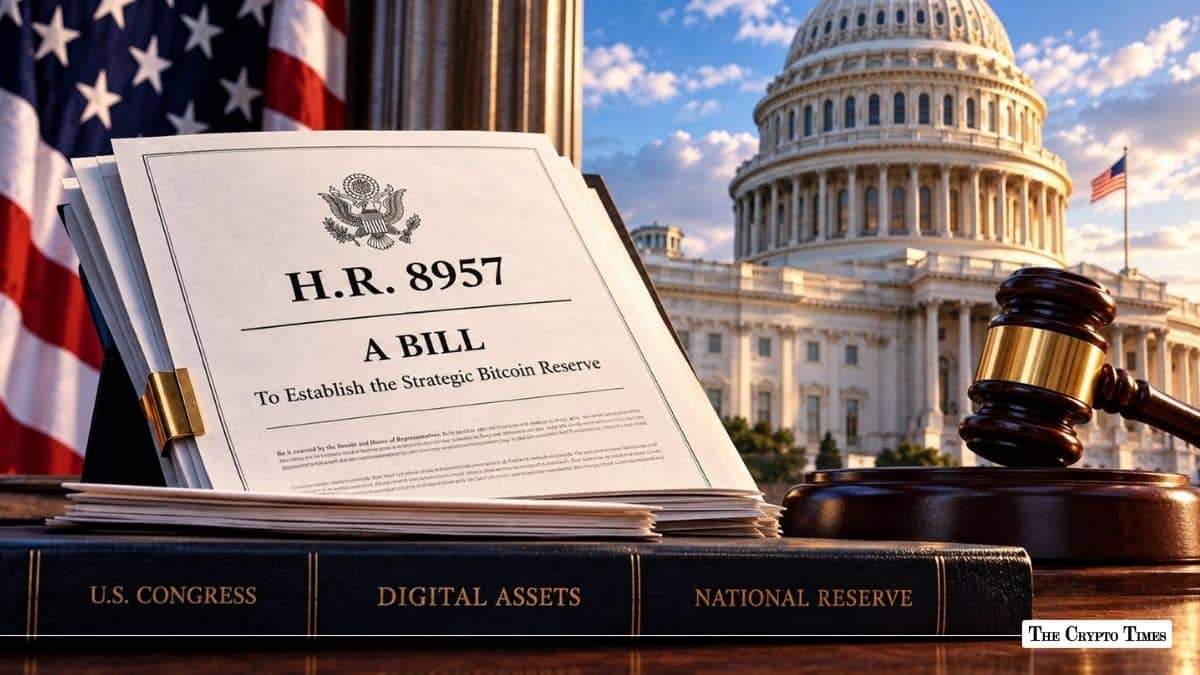
The proposal at the center of the debate is H.R. 8957, the American Reserve Modernization Act of 2026, or ARMA. Introduced on May 21, 2026, the legislation would create a Treasury-managed Strategic Bitcoin Reserve, consolidate qualifying federal Bitcoin holdings, and generally require reserve Bitcoin to remain untouched for 20 years. The official text of H.R. 8957 published by the U.S. Government Publishing Office identifies Rep. Nick Begich of Alaska as the sponsor and Rep. Jared Golden of Maine among its original co-sponsors.
That does not mean the federal government is preparing to spend taxpayer money buying one million Bitcoin (BTC).
That proposal belongs to a different measure: the BITCOIN Act, which proposes a government acquisition program of as much as one million BTC. The distinction between these two bills is essential to understanding the U.S. Bitcoin reserve debate.
Key Highlights
- H.R. 8957, or ARMA, is primarily a custody, retention, and transparency bill, rather than an order for the government to make large open-market Bitcoin purchases.
- The House Financial Services Committee considered the measure on September 16, 2026, and advanced the amended bill by a 28-21 vote. It has not become law.
- The committee substitute would generally require Bitcoin in the reserve to remain there for at least 20 years from enactment.
- Treasury would have to establish a public proof-of-reserve system, including annual reporting and independent verification.
- ARMA is different from Sen. Cynthia Lummis’s BITCOIN Act, which proposes acquiring up to one million BTC through a federal purchase program.
What Is the Strategic Bitcoin Reserve Bill?
The current legislation is formally known as the American Reserve Modernization Act of 2026.
Rep. Nick Begich introduced H.R. 8957 on May 21, 2026, alongside Democratic co-lead Rep. Jared Golden. The bill was referred to the House Financial Services Committee. Readers can review both the official H.R. 8957 bill record on GovInfo and Begich’s announcement introducing the American Reserve Modernization Act.
At its core, ARMA would establish two distinct structures within the Treasury Department:
- a Strategic Bitcoin Reserve for qualifying Bitcoin; and
- a Digital Asset Stockpile for qualifying non-Bitcoin digital assets.
This distinction matters because Bitcoin would be subject to a special long-term retention regime, while Treasury would have greater flexibility in managing other digital assets.
Is the Strategic Bitcoin Reserve Bill Law?
No.
As of September 17, 2026, H.R. 8957 has advanced through the House Financial Services Committee, but it has not been approved by the full House and Senate and has not been signed into law.
The committee held its markup on September 16 and considered an amendment in the nature of a substitute offered by Rep. Bryan Steil. The official House Financial Services Committee markup page lists both H.R. 8957 and Steil’s substitute amendment.
The amended bill was subsequently reported favorably by a 28-21 vote, according to contemporaneous coverage of the committee action.
For the legislation to become law, it still needs to move through the remaining congressional process and ultimately receive presidential approval.
Current status of H.R. 8957
| Item | Status |
|---|---|
| Bill | H.R. 8957 |
| Official name | American Reserve Modernization Act of 2026 |
| Introduced | May 21, 2026 |
| Sponsor | Rep. Nick Begich |
| Committee | House Financial Services Committee |
| Committee vote | 28-21 on Sept. 16, 2026 |
| Full House passage | Not yet |
| Senate passage | Not yet |
| Federal law | No |
Last updated: September 17, 2026
For evergreen maintenance, this is the section that should be updated first whenever Congress takes another formal action.
Why Does the U.S. Already Have a Strategic Bitcoin Reserve?
Congress did not create the original reserve.
President Donald Trump established the federal Strategic Bitcoin Reserve and U.S. Digital Asset Stockpile on March 6, 2025, through an executive order.
Under the White House executive order establishing the Strategic Bitcoin Reserve, finally forfeited Bitcoin owned by the Treasury can be placed into the reserve. Bitcoin deposited into it is not supposed to be sold and is instead maintained as a reserve asset of the United States.
The order also established a separate stockpile for forfeited digital assets other than Bitcoin.
Importantly, the executive order did not direct Treasury to begin buying large quantities of Bitcoin on cryptocurrency exchanges.
Instead, it instructed the Treasury and Commerce departments to develop potential budget-neutral strategies for acquiring additional Bitcoin, provided those strategies impose no incremental costs on U.S. taxpayers. The accompanying White House Strategic Bitcoin Reserve fact sheet explains the policy in more detail.
The White House also argued that previous government sales of Bitcoin had resulted in more than $17 billion in foregone appreciation. That figure is best understood as an opportunity-cost estimate based on later Bitcoin prices, rather than a realized accounting loss recorded by Treasury.
Why Does Congress Need a Bill if the Reserve Already Exists?
The central issue is legal durability.
The existing reserve was created through executive action. A later president could potentially modify or rescind that executive policy, subject to applicable law.
A statute passed by Congress has a different legal footing. Changing its requirements would generally require new legislation or other congressional action.
ARMA therefore seeks to move the Bitcoin reserve from an executive-branch policy into a framework established by Congress.
It also goes further than the March 2025 executive order by addressing issues such as a 20-year holding period, public proof-of-reserve reporting, federal-agency consolidation, state participation, and private-property protections.
How Would the Strategic Bitcoin Reserve Work Under H.R. 8957?
Treasury would play the central role.
Under the committee substitute, the Treasury secretary would have up to 180 days after enactment to establish a Strategic Bitcoin Reserve for qualifying Bitcoin and a Digital Asset Stockpile for qualifying non-Bitcoin digital assets.
The bill defines qualifying Bitcoin broadly around Bitcoin owned by the federal government that is not legally required for other purposes, including assets finally forfeited through criminal or civil proceedings.
The goal is partly to consolidate a system in which government digital assets can otherwise remain distributed among different agencies and custody arrangements.
Bitcoin Would Be Held for at Least 20 Years
One of ARMA’s most consequential provisions is the proposed 20-year holding period.
The committee substitute to H.R. 8957 states that Bitcoin deposited in the Strategic Bitcoin Reserve would have to be held for not less than 20 years from the date of enactment, regardless of how the Bitcoin was acquired.
During that period, reserve Bitcoin could not ordinarily be:
- sold;
- swapped;
- auctioned;
- encumbered; or
- otherwise disposed of.
This is an important change from the introduced version because the substitute establishes a common enactment-based holding period rather than effectively giving individual deposits separate clocks.
What happens after 20 years?
The legislation does not order Treasury to liquidate the reserve when the 20-year period ends.
Two years before the holding period expires, Treasury would submit recommendations to Congress on whether the government should continue holding its Bitcoin or permit a gradual release.
After the minimum holding period, the Secretary may recommend selling up to 10% of the reserve during any two-year period. The wording is important: the provision is framed as a recommendation process, not an automatic liquidation schedule.
Treasury Would Have to Publish Proof of Reserve
Cryptocurrency presents a different custody challenge from traditional government assets because ownership depends on control over cryptographic keys.
ARMA therefore includes a dedicated Proof of Reserve System.
The amended legislation would require Treasury to publish an annual report containing detailed information on:
- total Strategic Bitcoin Reserve holdings;
- transactions involving the reserve; and
- control of private keys associated with the reserve.
An independent third-party auditor with expertise in cryptographic attestations would verify the report, while the Comptroller General would conduct continuing oversight.
Readers who want the primary source can review the House committee’s amended H.R. 8957 text covering the Proof of Reserve System.
The original bill contemplated more frequent reporting, while the committee substitute uses an annual reporting framework.
What Happens to Ethereum and Other Government-Held Crypto?
ARMA does not treat every digital asset as a strategic reserve asset.
Bitcoin would be held in the Strategic Bitcoin Reserve, while qualifying non-Bitcoin assets would be placed in the Digital Asset Stockpile.
That follows the general architecture of the 2025 executive order, under which Treasury is given greater discretion in managing non-Bitcoin stockpile assets. The White House order also states that additional stockpile assets should not be acquired except through forfeiture without further executive or legislative action.
Calling the entire framework simply a “U.S. crypto reserve” can therefore be misleading.
Bitcoin and non-Bitcoin digital assets receive different treatment.
What Happens if Bitcoin Forks?
Blockchains can split into competing networks, creating new assets associated with existing holdings.
That raises an unusual question for a government reserve: What happens if Bitcoin held by Treasury produces another asset through a blockchain fork?
The committee substitute requires assets resulting from forks and airdrops to be accounted for and generally prevents their sale for one year.
After that period, Treasury would assess the resulting assets and identify the fork with the highest publicly traded market capitalization. The legislation also gives Treasury some flexibility to retain a non-dominant fork if it has separate technological utility or strategic value.
The introduced version proposed a longer waiting period, making the one-year rule another notable committee-level change.
States Could Store Bitcoin Through the Federal Framework
ARMA would also permit voluntary state participation.
Within one year of enactment, Treasury would establish a program allowing states to store Bitcoin in segregated accounts associated with the Strategic Bitcoin Reserve.
Participating states would retain legal title to their Bitcoin, including legal interests in relevant forked or airdropped assets.
They would also be responsible for the costs of the service and would acknowledge the inherent risks of digital-asset custody.
This means state Bitcoin would not automatically become federal property merely because Treasury provides custody infrastructure.
Is the U.S. Government Going to Buy More Bitcoin?
H.R. 8957 does not create the one-million-Bitcoin purchase program often associated with Strategic Bitcoin Reserve proposals.
Instead, the committee substitute orders Treasury and Commerce to study whether the government could acquire additional Bitcoin through genuinely budget-neutral mechanisms.
The study would have to examine the risks, costs, and potential benefits of additional Bitcoin acquisitions and determine whether they could occur without increasing the national debt economically or nominally.
The legislation specifically says the provision should not be interpreted as authorizing:
- borrowing or other financing;
- using federal assets as collateral;
- new taxation; or
- deficit spending
for Bitcoin acquisition.
That makes the provision a study requirement, not an authorization for Treasury to begin buying a predetermined amount of Bitcoin.
Strategic Bitcoin Reserve Bill vs. BITCOIN Act
Much of the confusion around U.S. Bitcoin reserve policy comes from treating ARMA and the BITCOIN Act as though they are the same proposal.
They are not.
| Feature | ARMA — H.R. 8957 | BITCOIN Act — S. 954 |
|---|---|---|
| Main purpose | Hold, consolidate, and govern federal Bitcoin | Build a substantially larger federal reserve |
| Mandated new purchases | No | Yes |
| Purchase target | None | Up to 1 million BTC |
| Purchase schedule | None | Up to 200,000 BTC annually for five years |
| Forfeited Bitcoin | Important source | Can also enter reserve |
| Long-term holding | Yes | Yes |
| Budget-neutral provisions | Acquisition study | Purchase-financing framework |
| Legislative track | House | Senate |
The official S. 954 BITCOIN Act record confirms that Sen. Cynthia Lummis’s legislation was referred to the Senate Banking Committee.
The bill’s text establishes a Bitcoin Purchase Program aimed at acquiring one million BTC.
The simplest way to remember the distinction is:
ARMA is primarily about keeping and governing Bitcoin the federal government owns. The BITCOIN Act goes further by proposing that the government acquire substantially more Bitcoin.
How Much Bitcoin Does the U.S. Government Hold?
There is no single public, audited Treasury dashboard establishing exactly how much Bitcoin the federal government can permanently retain in a Strategic Bitcoin Reserve.
Third-party estimates are useful, but they should not be treated as equivalent to an audited government balance sheet.
As of September 17, 2026, BitcoinTreasuries.NET’s U.S. government Bitcoin tracker attributes approximately 328,372 BTC to U.S. government entities, equivalent to about 1.56% of Bitcoin’s 21 million maximum supply. Its dollar estimate changes continuously with Bitcoin’s market price.
Wallet control is not the same as unrestricted legal ownership
This distinction is important.
An analytics service may associate a wallet with a U.S. government agency, but that does not necessarily mean every Bitcoin in that wallet is legally available for permanent inclusion in the reserve.
Assets may still be affected by:
- victim restitution;
- court orders;
- pending forfeiture proceedings;
- statutory forfeiture requirements;
- third-party ownership claims; or
- transfers among government agencies and custodians.
The White House executive order itself preserves exceptions involving court orders, victim restitution, law-enforcement activity, and existing forfeiture statutes.
For that reason, an evergreen article should describe these numbers as estimated government-controlled or government-attributed Bitcoin, rather than presenting them as an audited Treasury reserve balance.
Why Did the U.S. Stop Treating Seized Bitcoin Like an Asset to Auction?
Historically, seized cryptocurrency was generally treated like other forfeited property and could be sold by the government.
Bitcoin’s subsequent appreciation changed the political debate over whether automatically selling forfeited BTC was the best long-term policy.
When announcing the reserve in 2025, the White House claimed premature Bitcoin sales had cost taxpayers more than $17 billion in foregone value.
That wording requires context.
The government did not necessarily book a $17 billion cash loss. The calculation compares previous sale proceeds with what those Bitcoin holdings would have been worth at a later market price.
It is therefore more accurately described as an opportunity-cost estimate.
Why Supporters Want a Strategic Bitcoin Reserve
Supporters generally argue that Bitcoin’s fixed supply gives it characteristics of a scarce reserve asset.
The committee substitute itself includes congressional findings describing Bitcoin as a decentralized, finitely scarce digital asset that could complement existing national reserves. Those statements represent the policy findings contained in the legislation, rather than settled economic conclusions.
Supporters also argue that the government already obtains Bitcoin through forfeitures, making retention fundamentally different from financing a large new purchase program.
Other arguments include:
- reducing the possibility of selling an appreciating asset prematurely;
- consolidating fragmented federal custody;
- improving transparency through proof-of-reserve reporting;
- creating clearer cybersecurity standards; and
- providing long-term continuity across presidential administrations.
What Are the Arguments Against a Government Bitcoin Reserve?
Critics raise different concerns.
One is Bitcoin’s price volatility. The dollar value of a government reserve could fluctuate substantially even when no Bitcoin is bought or sold.
Another is the definition of a strategic reserve itself. Assets such as oil are traditionally stockpiled partly so they can be released during emergencies. A Bitcoin reserve deliberately locked for decades has a different economic function.
Questions have also been raised about the meaning of “budget neutral” when governments contemplate acquiring additional Bitcoin.
Economist George Selgin of the Cato Institute, for example, has argued that financing mechanisms associated with Bitcoin reserve purchase proposals can still impose economic and opportunity costs even when they do not involve an explicit new tax or conventional increase in federal debt. Readers can review his critique of Strategic Bitcoin Reserve economics at the Cato Institute.
That criticism is particularly relevant to proposals involving significant new Bitcoin purchases and therefore applies more directly to acquisition programs such as the BITCOIN Act than to simply retaining forfeited Bitcoin.
Other concerns include:
- custody and private-key security;
- concentration of valuable digital assets under federal control;
- political influence over reserve policy;
- market distortion from government participation; and
- uncertainty over how much seized Bitcoin the government can legally retain.
The broader policy question is therefore not simply whether Bitcoin’s price will rise or fall, but what assets governments should hold, why they should hold them, and under what constraints.
Does the Strategic Bitcoin Reserve Threaten Private Bitcoin Ownership?
The committee substitute explicitly addresses private-property concerns.
Section 10 states that nothing in the legislation should be interpreted as authorizing the federal government to seize, confiscate, or impair property rights in lawfully acquired Bitcoin or other digital assets.
It also includes language protecting lawful rights to purchase, hold, transfer, and dispose of digital assets and expressly refers to self-custody of private keys.
The relevant language can be reviewed directly in the committee substitute’s private-property and due-process provisions.
This is a statutory rule of construction and policy statement; it should not be described as a new constitutional right.
Would Bitcoin Become Legal Tender?
No.
Neither the March 2025 executive order nor H.R. 8957 makes Bitcoin legal tender in the United States.
The legislation concerns the management of digital assets owned by the federal government.
It does not:
- replace the U.S. dollar;
- require businesses to accept Bitcoin;
- require Americans to own cryptocurrency; or
- make Bitcoin an official unit of account for federal payments.
Would the Strategic Bitcoin Reserve Bill Affect Bitcoin’s Price?
The bill could affect market expectations, but it does not provide a reliable basis for forecasting Bitcoin’s future price.
ARMA’s mechanism is substantially different from that of a government purchase program.
Preventing a major holder from selling qualifying Bitcoin for decades could reduce one potential source of future market supply. But ARMA does not mandate a large new federal bid for Bitcoin.
That distinction matters.
A policy that effectively says “retain qualifying Bitcoin already held” affects supply expectations differently from one that instructs the government to buy hundreds of thousands of new Bitcoin.
How Does the U.S. Compare With Other Governments Holding Bitcoin?
Governments acquire Bitcoin for different reasons, meaning simple rankings can be misleading.
The BitcoinTreasuries.NET government Bitcoin holdings database currently lists the United States at about 328,372 BTC and China at about 190,000 BTC, with other governments holding smaller estimated amounts.
But this does not mean all of those countries operate a formal Strategic Bitcoin Reserve.
Some holdings arose from criminal seizures. Others came from purchases, mining, or other mechanisms.
That leads to an important distinction:
A government holding Bitcoin is not the same thing as a government adopting a strategic Bitcoin reserve policy.
The United States is notable because the White House explicitly established such a reserve through executive action, and Congress is now considering legislation that would govern it.
What Happens Next for H.R. 8957?
Committee approval is an important legislative step, but it is not final passage.
The proposal would still need to progress through the broader legislative process before becoming federal law.
The exact route could change. Congress could consider the measure independently, amend it further, combine parts of it with other legislation, or take no additional action.
Readers should therefore focus on formal congressional actions, rather than treating committee passage as enactment.
What to watch next
The most important developments are:
- whether H.R. 8957 receives full House consideration;
- whether senators advance comparable reserve legislation;
- whether the 20-year retention provisions change;
- whether acquisition language changes from a study into actual authority;
- whether Treasury releases more authoritative information about federal Bitcoin holdings; and
- whether court or restitution proceedings change how much forfeited Bitcoin the government can legally retain.
Frequently Asked Questions About the Strategic Bitcoin Reserve
What is the Strategic Bitcoin Reserve bill?
The current House bill is H.R. 8957, the American Reserve Modernization Act of 2026. It would establish a statutory Treasury framework for holding and managing qualifying government Bitcoin, including a 20-year minimum holding period and public reserve reporting.
Has the Strategic Bitcoin Reserve bill passed?
The House Financial Services Committee advanced the amended legislation 28-21 on September 16, 2026, but the bill has not become federal law.
Does the U.S. already have a Strategic Bitcoin Reserve?
Yes, as an executive-branch policy. President Trump established the Strategic Bitcoin Reserve through a March 6, 2025 executive order. H.R. 8957 would create a statutory framework for the reserve.
Is the U.S. buying one million Bitcoin?
Not under H.R. 8957.
The separate BITCOIN Act of 2025, S. 954, proposes a five-year program targeting the acquisition of one million BTC, with qualifying federal Bitcoin transfers able to offset the purchase requirement.
Where would the government’s reserve Bitcoin come from?
The bill covers qualifying Bitcoin already owned by the federal government and not legally required for other purposes, including Bitcoin finally forfeited through criminal or civil proceedings.
Can the government sell Bitcoin in the reserve?
The committee substitute required Bitcoin deposited into the reserve to remain there for at least 20 years from enactment, during which it could not be sold, swapped, auctioned, encumbered, or otherwise disposed of. After that period, Treasury can make recommendations concerning continued retention or gradual sales, including a recommendation of up to 10% during a two-year period.
What happens to Ethereum and other seized cryptocurrencies?
Qualifying non-Bitcoin digital assets would be placed in a separate Digital Asset Stockpile, rather than receiving the same treatment as Bitcoin.
Does the bill allow the government to confiscate privately owned Bitcoin?
The committee substitute says the bill does not authorize the federal government to seize or confiscate lawfully acquired Bitcoin or other digital assets. It also states that lawful rights to purchase, hold, transfer, and dispose of digital assets are not impaired.
A separate “Sense of Congress” provision recognizes self-custody of private keys as part of lawful control over digital assets.
How much Bitcoin does the U.S. government hold?
Third-party tracker BitcoinTreasuries.NET currently attributes approximately 328,372 BTC to U.S. government entities, although its underlying holdings figure is dated December 12, 2025. The figure should not be treated as an audited Treasury reserve balance because government-controlled Bitcoin can include assets affected by forfeiture proceedings, restitution obligations, or other legal claims.
The Bottom Line
The U.S. Strategic Bitcoin Reserve debate involves three separate layers of policy that should not be confused.
The first is the March 2025 executive order, which established a Strategic Bitcoin Reserve based primarily on finally forfeited government Bitcoin and directed that reserve Bitcoin not be sold.
The second is H.R. 8957, the American Reserve Modernization Act, which would create a statutory framework for a Treasury-managed reserve, consolidate qualifying government holdings, require proof-of-reserve reporting, and generally impose a 20-year holding period.
The third is the BITCOIN Act of 2025, a separate proposal that would establish a five-year program targeting the acquisition of one million BTC, while allowing qualifying federal Bitcoin transfers to offset required purchases.
Keeping those policies separate is crucial.
The central question raised by H.R. 8957 is not whether Washington should immediately buy one million Bitcoin. It is whether the United States should codify, centralize, secure, and retain qualifying Bitcoin the federal government already owns—and what rules should govern that reserve for the next two decades.