Key Highlights
- Coinbase CEO Brian Armstrong has reversed his stance and now supports the CLARITY Act after previously blocking it twice over stablecoin yield rules.
- A coordinated push from Washington, including Scott Bessent and Paul Atkins, appears to have triggered the shift.
- The bill’s passage could reshape U.S. crypto regulation, even as it threatens a key portion of Coinbase’s $1.35B stablecoin revenue.
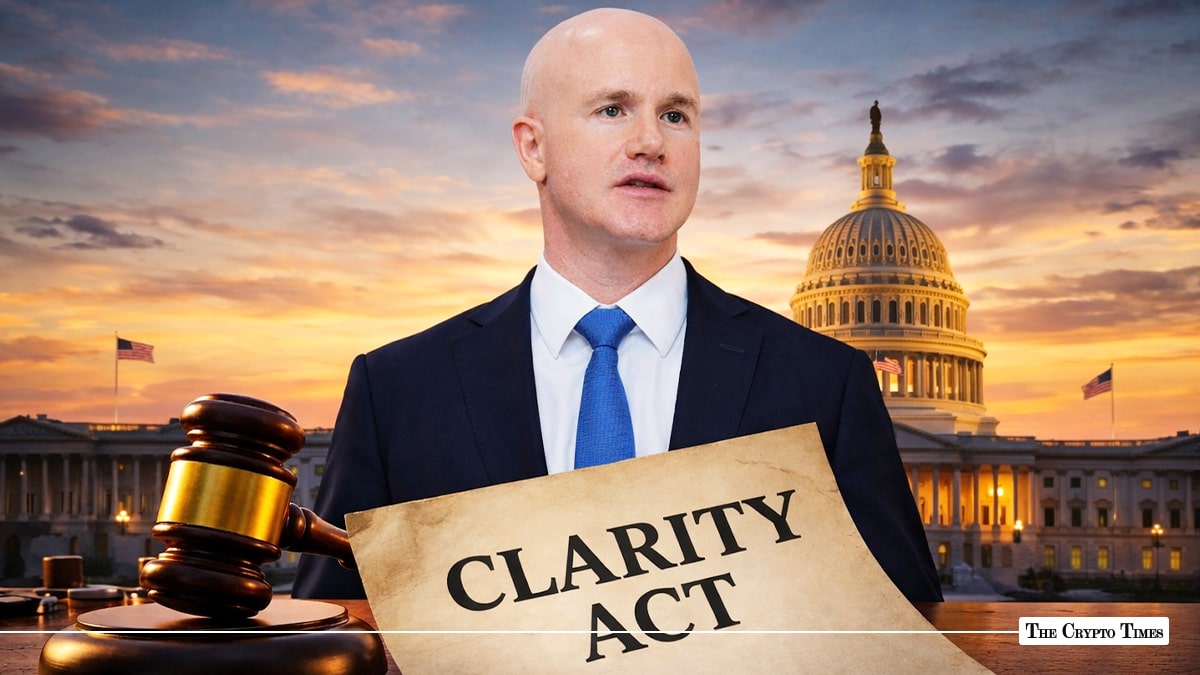
Coinbase CEO Brian Armstrong has publicly endorsed the passage of the Digital Asset Market Clarity Act, known as the CLARITY Act, marking a dramatic reversal from the exchange’s months-long opposition to the bill. Armstrong made the statement on X on April 9, responding directly to U.S. Treasury Secretary Scott Bessent’s call for swift Senate action on the legislation.
“We agree. Thank you @SecScottBessent for saying it. It’s time to pass the Clarity Act. Grateful for all the bipartisan work among Senators and staff over the past several months to make this a strong bill,” Armstrong wrote on X.
The post is significant because Armstrong has been the single most influential industry figure standing between the CLARITY Act and its passage. His opposition derailed the bill twice this year, first in January and again in March, each time over provisions that would restrict stablecoin yield payments to users.
What triggered this shift
Armstrong’s endorsement arrives just hours after Treasury Secretary Scott Bessent published an op-ed in The Wall Street Journal urging Congress to act on the CLARITY Act without delay. Bessent posted on April 9: “It is time for @BankingGOP to hold a markup and send the CLARITY Act to President Trump’s desk. Senate time is precious, and now is the time to act.”
In his WSJ piece, Bessent framed the bill as a national security priority. He warned that the United States risks falling behind countries like Singapore and Abu Dhabi, which have already built clear crypto regulatory frameworks. He also pointed out that one in six Americans now owns some form of digital asset, and the global crypto market cap sits between $2 trillion and $3 trillion.
Bessent also connected the CLARITY Act to the GENIUS Act, the stablecoin law signed by President Donald Trump in July 2025. He argued that the stablecoin framework cannot function properly without the broader market structure rules that the CLARITY Act would establish.
The coordinated push did not stop there. SEC Chairman Paul Atkins backed Bessent’s call the same day, posting on X, “It’s time for Congress to future-proof against rogue regulators & advance comprehensive market structure legislation to President Trump’s desk.” Atkins added that “Project Crypto is designed so once Congress acts, @SECGov & @CFTC are ready to implement the CLARITY Act.”
Former White House AI and Crypto Czar David Sacks, whose 130-day term expired last month, also weighed in on X, urging lawmakers to move quickly. Senator Cynthia Lummis echoed the sentiment, calling on Congress to act and citing growing momentum behind the bill. Senator Bill Hagerty said at the Vanderbilt University Digital Assets and Emerging Tech Policy Summit that he believes April will see the bill out of the Banking Committee.
The message from Washington was clear and coordinated. And for the first time in months, Armstrong chose to stand with it rather than against it.
The full timeline of Armstrong’s opposition
Armstrong’s relationship with the CLARITY Act has been turbulent since the start of 2026. Here is how it played out.
The CLARITY Act passed the U.S. House of Representatives in July 2025 with a 294-134 vote. It was designed to create a federal regulatory framework for the crypto industry by dividing oversight between the SEC and the CFTC.
Armstrong himself had celebrated the vote on X, writing, “Huge! GENIUS ready to be signed into law. CLARITY heading the senate next. We are getting incredibly close to finally having clear rules for crypto to grow this industry in the United States of America.”
But when the Senate Banking Committee rewrote the bill in late 2025 and early 2026, things changed. The new draft included provisions that would restrict stablecoin yield payments. Banks, led by the American Bankers Association, had been lobbying to close what they called a “loophole” that allowed exchanges like Coinbase to offer rewards on USDC balances even though the GENIUS Act had already banned stablecoin issuers from paying direct interest.
On January 14, 2026, just hours before the Senate Banking Committee was set to begin its markup session, Armstrong posted, “After reviewing the Senate Banking draft text over the last 48hrs, Coinbase unfortunately can’t support the bill as written. There are too many issues.”
He listed four major objections: a de facto ban on tokenized equities, DeFi prohibitions that would give the government broad access to user financial data, erosion of the CFTC’s authority in favor of the SEC, and draft amendments that would restrict stablecoin rewards. He concluded with a line that became the defining quote of the entire CLARITY Act saga: “We’d rather have no bill than a bad bill.”
The Senate Banking Committee postponed its markup that same night. The CLARITY Act was frozen. The White House was reportedly displeased. Patrick Witt, the executive director of the President’s Council of Advisors for Digital Assets, fired back publicly: “You might not love every part of the Clarity Act, but I can guarantee you’ll hate a future Dem version even more.”
The industry fractured. Andreessen Horowitz (a16z) publicly supported the bill despite Armstrong’s withdrawal. Ripple CEO Brad Garlinghouse called the CLARITY Act a “massive step forward.” The Digital Chamber urged the industry to remain aligned with the White House. But Armstrong held firm, and without Coinbase’s backing, the bill had no path forward.
February: A brief thaw
In February, the tone shifted. At the World Liberty Forum at Mar-a-Lago, Armstrong appeared alongside Senator Bernie Moreno on CNBC and struck a more optimistic note. He described behind-the-scenes negotiations as constructive and said he saw a path toward a “win-win-win outcome” for the crypto industry, the banks, and the American consumer.
Armstrong told CNBC he believed there was a 90% chance the CLARITY Act would pass by the end of April. He said the Senate had been meeting daily to resolve remaining issues. Polymarket odds for the bill’s passage briefly spiked to 90% on the back of those comments.
He also met President Trump at the White House on March 3. Hours after that meeting, Trump posted on Truth Social accusing banks of threatening and undermining the GENIUS Act and calling on Congress to pass the CLARITY Act immediately.
But Coinbase never formally re-endorsed the bill during this period. The company stopped actively opposing it, but the official support never came back.
March: The second rejection
On March 23, Senators Thom Tillis and Angela Alsobrooks circulated a new compromise on the stablecoin yield question. The text banned passive yield on stablecoin balances but allowed limited activity-based rewards such as loyalty programs and promotions. The SEC, CFTC, and Treasury would be given 12 months to jointly define what qualifies as a permissible reward.
Coinbase reviewed the text. On March 25, the exchange told Senate offices it could not support the latest version. It was the second formal rejection.
The COIN stock dropped to $181.10 that day. Circle shares also fell sharply. The #BoycottCoinbase movement gained traction on X, primarily from the XRP community.
Armstrong himself stayed silent on the new text. He did not comment publicly for two weeks. But his Chief Legal Officer, Paul Grewal, went on Fox Business on April 1 and said the stablecoin yield deal was “very close” and that he expected progress “within 48 hours.” Grewal also said there was no evidence supporting banks’ claims that stablecoin rewards would cause deposit flight.
Coinbase’s Chief Policy Officer Faryar Shirzad had also been vocal throughout March, posting on X that banks were trying to take rewards out of consumers’ pockets to protect their own profits.
The revised text was never released before the Senate broke for Easter recess on March 26. When the Senate returns on April 13, the CLARITY Act enters its final realistic window for passage before the 2026 midterm elections consume the legislative calendar.
What changed for Armstrong
Multiple factors appear to have converged.
First, the White House released an economic analysis from the Council of Economic Advisers this week showing that a full stablecoin yield ban would deliver negligible benefits to banks while costing consumers roughly $800 million in lost returns. The report undercut the banking industry’s core argument about deposit flight risk. The Crypto Times covered the study in detail on April 8.
Second, reports from Crypto in America suggest that banking and crypto stakeholders may have finally reached a compromise on the stablecoin yield language. The final text is expected to be circulated as early as this week.
Third, Coinbase received conditional approval from the Office of the Comptroller of the Currency (OCC) to charter Coinbase National Trust Company on April 2. This is a significant regulatory milestone that gives Coinbase a federally regulated custody path for institutional clients, and it signals that the company’s relationship with Washington is evolving beyond just the CLARITY Act.
Fourth, the political clock is ticking. Senator Hagerty has said the bill needs to clear the Banking Committee in the second half of April. Senator Lummis has confirmed the same timeline. Analysts have warned that if the bill does not advance from committee before May, it effectively gets pushed past the November 2026 midterms, meaning potentially years of continued regulatory uncertainty.
Armstrong appears to have concluded that the compromise, while imperfect, is better than the alternative of no legislation at all.
What Coinbase stands to lose and gain
The commercial stakes for Coinbase are enormous. Stablecoin-related revenue reached $1.35 billion for the full year 2025, accounting for roughly 20% of the company’s total net revenue of $6.88 billion. In Q3 2025 alone, stablecoin income was $355 million.
This revenue comes primarily from Coinbase’s distribution agreement with Circle, under which the exchange receives a share of the interest income generated by the U.S. Treasury bills and cash reserves backing USDC.
If the final CLARITY Act restricts passive yield on stablecoin balances, Coinbase would need to restructure how it delivers USDC rewards to users. The current draft allows activity-based rewards but bans anything that resembles bank interest. Whether Coinbase’s existing USDC rewards program survives under whatever definition the SEC, CFTC, and Treasury jointly produce remains an open question.
On the other hand, the passage of the CLARITY Act would deliver something Coinbase has wanted for years: a clear federal framework that ends the era of regulation by enforcement. It would define which assets are securities and which are commodities, establish rules for exchanges and brokers, and create the legal foundation for institutional participation in crypto at scale. JPMorgan has called the bill’s passage a potential “positive catalyst” for digital asset markets.
What happens next
The Senate returns from its Easter recess on April 13. The Senate Banking Committee markup is targeted for the second half of April. Senate Banking Committee Chairman Tim Scott controls the calendar. The stablecoin yield text needs to hold, and outstanding issues beyond yield, including DeFi provisions, token classification, and tokenization treatment, need resolution.
If the bill clears the Banking Committee, it would need to be combined with the Senate Agriculture Committee’s version before heading to a full Senate floor vote. That vote would require 60 votes, meaning bipartisan support is essential. Democrats have signaled they want ethics provisions barring government officials from profiting off personal crypto holdings, a demand directly aimed at the Trump family’s crypto interests.
The window is narrow. The stakes are high. And for the first time since January, the biggest player in the U.S. crypto industry is no longer standing in the way.
Also Read: SEC Chair Backs Fast-Track Approval of CLARITY Act Amid Senate Push
The Crypto Files: The Clarity Act Explained