Key Highlights
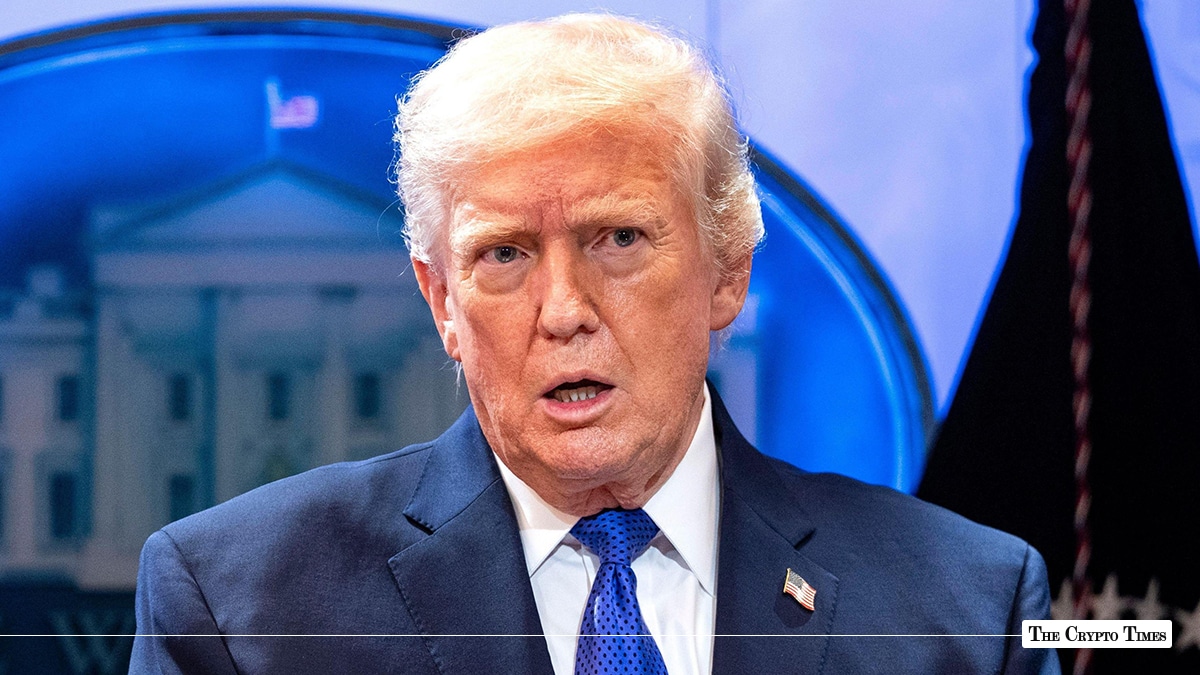
- President Donald Trump publicly accused U.S. banks of attempting to sabotage his crypto legislative agenda, warning that they are undermining the landmark GENIUS Act.
- A fierce lobbying battle has erupted over whether third-party platforms like Coinbase should be allowed to pass stablecoin yield on to retail customers—a practice banks want outright banned.
- Following a missed March 1 compromise deadline, a Coinbase delegation led by CEO Brian Armstrong arrived at the White House today for high-stakes talks.
- Crypto leaders, including Cardano Founder Charles Hoskinson and Eric Trump, slammed traditional banks for introducing endless amendments to stall the bill.
The battle for the future of American digital finance has reached a boiling point. On Wednesday, President Donald Trump has directly accused U.S. banks of sabotaging his crypto legislative agenda, warning in a Truth Social post that the GENIUS Act, the landmark stablecoin law he signed last July, “is being threatened and undermined by the Banks.”
The remarks, amplified across social media, arrived on the same day a Coinbase delegation led by CEO Brian Armstrong paid a visit to the White House, according to journalist Eleanor Terrett, who cited three people familiar with the meeting.
Trump fires back at banks over stablecoin standoff
In a sharply worded post, Trump called on Congress to pass the CLARITY Act without delay, framing inaction as an existential threat to U.S. crypto dominance.
“The U.S. needs to get Market Structure done, ASAP. Americans should earn more money on their money. The Banks are hitting record profits, and we are not going to allow them to undermine our powerful Crypto Agenda that will end up going to China, and other Countries if we don’t get The Clarity Act taken care of,” Trump wrote.
He went further, warning banks directly: “The Banks should not be trying to undercut The Genius Act, or hold The Clarity Act hostage. They need to make a good deal with the Crypto Industry because that’s what’s in the best interest of the American People.”
Senator Cynthia Lummis quickly reposted Trump’s message with her own call to action: “America can’t afford to wait. Congress must move quickly to pass the Clarity Act.”
What is the CLARITY Act and why is it stuck?
The GENIUS Act, signed into law in July 2025, established the first federal framework for payment stablecoins. The CLARITY Act is its sequel: a broader market structure bill that would assign clear regulatory jurisdiction to the Securities and Exchange Commission and the Commodity Futures Trading Commission over the crypto industry, and is widely seen as the piece of legislation needed to unlock large-scale institutional participation in digital assets.
The bill cleared the House comfortably but has been mired in Senate gridlock since January, when the Senate Banking Committee indefinitely postponed a planned markup vote. The trigger was Coinbase withdrawing support over a proposed amendment that would have restricted stablecoin rewards for users.
At the heart of the conflict is a gap in the GENIUS Act: it bars stablecoin issuers from paying interest directly to holders, but does not explicitly prevent third-party platforms, such as Coinbase and Kraken, from passing yield on to customers. Banks have labeled this a loophole. At two White House-brokered meetings in early February, banking representatives reportedly arrived demanding a blanket ban on stablecoin yield, a position the crypto side rejected as anticompetitive.
No compromise emerged. The White House had set a tentative end-of-February deadline for a deal; that deadline passed without resolution. The CLARITY Act remains stuck in the Senate Banking Committee with no new markup date announced.
Industry voices pile on
Cardano founder Charles Hoskinson’s reacted to the post with: “I agree with the President. The banks amended the bill 137 times. They have to stop messing with it and trying to shut down the industry.”
Brad Garlinghouse, CEO of Ripple shared, “This is, and always has been, about what’s in the best interest of the American people.”
The President’s son Eric Trump echoed the sentiment in starker terms, accusing traditional financial institutions of hypocrisy and panic. “The ‘Big Banks’—the very institutions that have held a monopoly and screwed their customers for years… are now doing everything they can to block the Crypto industry from offering real benefits, perks, and rewards on their platforms,” he wrote on X. “They are the greatest hypocrites and are in mass panic given they know they are losing the digital finance race!”
The Trump family’s intervention aligns with a broader pattern: crypto-aligned voices have increasingly framed the legislative impasse as banks defending incumbency rather than raising legitimate regulatory concerns.
Coinbase heads to the White House
On the same day, journalist Eleanor Terrett reported that a Coinbase group that included CEO Brian Armstrong visited the White House. Three people familiar with the matter confirmed the visit to Terrett, though she noted she could not confirm whether the delegation met directly with President Trump. Coinbase did not respond to requests for comment.
The visit is the latest in a series of high-level engagements between the exchange and Washington officials. Armstrong had previously described the White House as “super constructive” amid reports of tensions over the CLARITY Act negotiations. At a World Liberty Forum event at Mar-a-Lago in February, Armstrong pointed the finger at banking trade groups rather than individual banks for the stalemate, arguing that the groups were operating with a zero-sum mindset — “for the banks to win, crypto has to lose.”
Earlier this week, JPMorgan Chase CEO Jamie Dimon pushed back on that framing, telling CNBC that firms offering yield on stablecoin balances are functionally operating as banks and should face corresponding regulation. He suggested a compromise in which rewards tied to transactions — rather than idle balances — could be permitted, but drew a clear line at interest-like payouts. Banking trade groups, led by the Bank Policy Institute, have warned that unrestricted stablecoin yield could trigger deposit outflows of up to $6.6 trillion, citing U.S. Treasury Department analysis.
The clock is ticking
With a summer recess ahead and the 2026 midterm campaign season accelerating, the legislative window for the CLARITY Act is narrowing. The Senate Banking Committee is reportedly targeting a mid-to-late March markup, which would need to be followed by reconciliation with a parallel bill from the Senate Agriculture Committee before a full Senate floor vote.
Prediction markets have taken note of Trump’s intervention. Polymarket currently prices the CLARITY Act’s likelihood of becoming law in 2026 at 72%, up from around 62% a week prior.
For now, the most public face of the standoff is a U.S. president directly at war with the banking sector on behalf of an industry that, just two years ago, was locked in existential legal battles with federal regulators. Whether Trump’s pressure breaks the deadlock — or hardens the banks’ position — may become clear within weeks.
Also Read: U.S. Senate Moves to Ban Retail CBDC, Adds 2030 Sunset Clause