Key Highlights
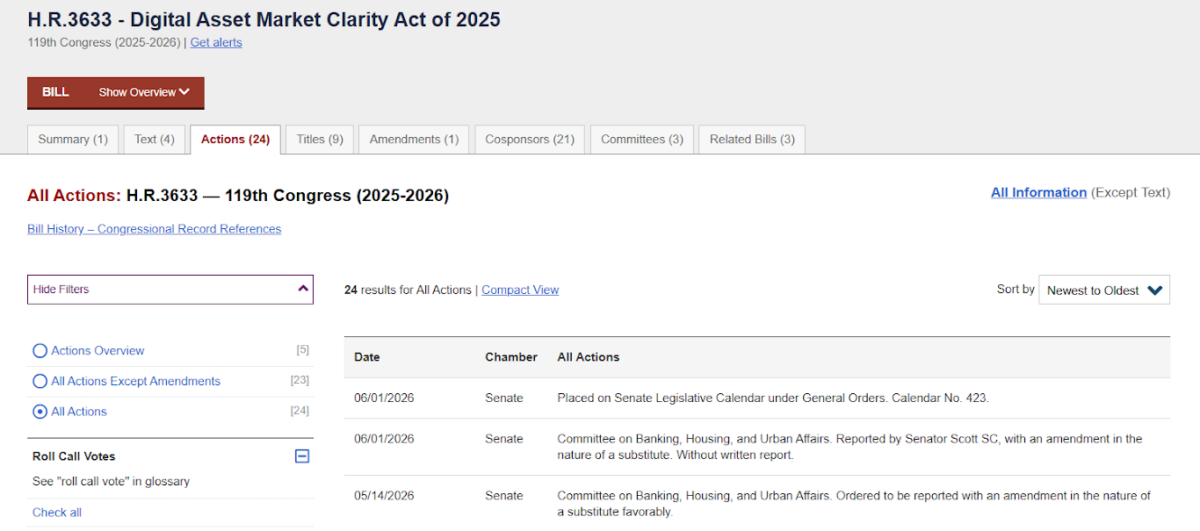
- The Digital Asset Market Clarity Act (CLARITY Act) has been added to the U.S. Senate calendar under General Orders (Calendar No. 423).
- The bill previously passed the Senate Banking Committee with a bipartisan 15-9 vote and is now awaiting floor debate and a Senate vote.
- Supporters, including Senators Tim Scott and Cynthia Lummis, argue the legislation will strengthen U.S. leadership in digital assets and encourage innovation.
The U.S. Senate placed the Digital Asset Market Clarity Act (CLARITY Act, H.R. 3633) on its legislative calendar under General Orders (Calendar No. 423) today, marking a key procedural milestone. After months of negotiations and a 15-9 bipartisan vote in the Senate Banking Committee in mid-May, the legislation is now positioned for potential floor debate.
Supporters argue the bill could strengthen the United States’ position in digital finance. As jurisdictions such as the European Union, through MiCA, and Singapore continue advancing their regulatory frameworks, some lawmakers and industry participants have argued that prolonged U.S. uncertainty risks reducing its competitiveness.
Progress of the bill
The CLARITY Act seeks to establish a comprehensive federal framework by delineating responsibilities between the Securities and Exchange Commission (SEC) and the Commodity Futures Trading Commission (CFTC).
Digital assets that function primarily as commodities, such as Bitcoin, and decentralized networks that meet certain maturity criteria would fall under CFTC oversight for spot markets. Meanwhile, the SEC would retain authority over offerings that resemble securities, particularly during the early stages of a project’s development.
So far, the bill has cleared all committee hurdles and is now positioned for debate on the Senate floor. The next step is scheduling and conducting a full Senate debate, followed by a floor vote.
Completed Stages:
- Introduced — May 29, 2025
- Committee Hearings — Completed
- Committee Markup — Completed
- Passed Senate Banking Committee — Completed (May 14, 2026)
- Placed on Senate Calendar — Completed (June 1, 2026)
Pending Stages:
- Full Senate Debate & Amendments — Pending
- Senate Floor Vote — Pending
- House-Senate Reconciliation (if needed) — Pending
- Presidential Signature — Pending
The Digital Asset Market Clarity Act has progressed through the legislative process. It has been officially introduced, undergone committee hearings, and completed the markup process. Most notably, the bill passed the Senate Banking Committee with a bipartisan 15-9 vote. On June 1, 2026, it was formally placed on the Senate Calendar, marking another milestone.
The bill has now cleared all committee stages and is ready for the next phase. Full Senate debate and amendments are pending, followed by a Senate floor vote. If the Senate and House versions differ, a reconciliation process will be required. The bill would then require the president’s signature to become law.
Division over the bill
Supporters, including Senators Tim Scott and Cynthia Lummis, argue that swift passage would foster job creation, a technological edge, and tax revenue from a maturing $2+ trillion market. Following the advancement, Lummis posted, “We are closer to a functioning digital asset market structure than we have ever been. Now is not the time to flinch.”
In another X post, Lummis said America’s capital markets became globally dominant due to transparent regulations and abundant liquidity. She believes the same winning formula, clear rules paired with deep liquidity, can be successfully applied to digital assets today to restore U.S. leadership.
Critics, including JPMorgan CEO Jamie Dimon, have expressed dissatisfaction with the existing version of the CLARITY Act, arguing that it would allow crypto firms to pay interest on deposits and stablecoins without protections.
Dimon has also said that major banks, including JPMorgan, would continue to oppose the legislation in its current form.
The debate reflects broader disagreements over how digital assets should be regulated. Industry participants have long criticized what they describe as “regulation by enforcement,” while opponents argue that stronger protections are needed before expanding the sector’s regulatory framework.
Also Read: Zodiac Reveals Flaw Behind Gnosis Pay Exploit, Safe Unaffected