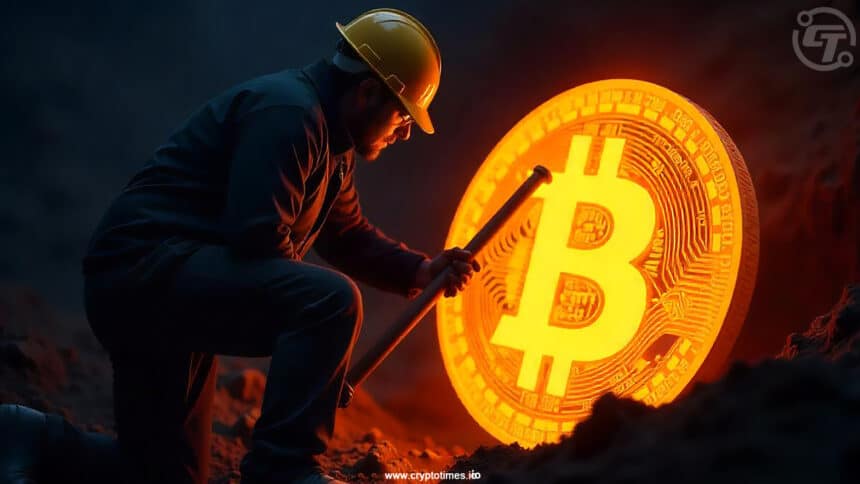
Bitcoin mining uses specialized computers to verify transactions, produce new blocks and secure the Bitcoin network. Here is how the process works, what equipment miners need and whether mining remains profitable in 2026.
Bitcoin does not rely on a bank, payment company or central administrator to maintain its transaction history. Instead, a global network of miners competes to add new blocks of transactions to the Bitcoin blockchain.
This process, known as Bitcoin mining, performs three essential functions: it confirms transactions, protects the network against manipulation and distributes newly issued Bitcoin according to a fixed monetary schedule.
Mining has changed significantly since Bitcoin’s early years. A person could once mine Bitcoin with a home computer. In 2026, the industry is dominated by specialized application-specific integrated circuit machines, or ASICs, operating in professional data centers with access to large amounts of electricity.
Mining can still generate a profit, but it is not automatically profitable. The result depends on the efficiency and purchase price of the mining hardware, electricity and cooling costs, Bitcoin’s price, network difficulty, transaction fees, pool charges, taxes and operational uptime.
Data note: Bitcoin mining economics change continuously. The profitability examples in this article use a July 2026 market snapshot and should not be treated as guaranteed future returns.
What Is Bitcoin Mining?
Bitcoin mining is the proof-of-work process through which computers validate transactions, create new blocks and protect the Bitcoin blockchain.
Miners repeatedly process block data through Bitcoin’s SHA-256 hashing algorithm. Their objective is to produce a hash below a target established by the network. The miner that finds a valid result can broadcast the proposed block to the network.
After other Bitcoin nodes verify that the block follows the protocol’s rules, it is added to the blockchain. The successful miner receives the block reward, consisting of newly issued Bitcoin and the transaction fees included in the block.
Mining therefore does more than create new coins. It makes Bitcoin’s transaction history difficult and expensive to alter, helping a decentralized network reach agreement without relying on a central authority.
Bitcoin Mining at a Glance: July 2026
| Metric | July 2026 snapshot |
|---|---|
| Bitcoin block subsidy | 3.125 BTC |
| Approximate Bitcoin price on July 28 | $63,511 |
| Network difficulty | 126.23 trillion |
| Estimated seven-day network hashrate | Approximately 871 EH/s |
| Latest published weekly USD hashprice | $32.34 per PH/s per day |
| Average block interval | Approximately 10 minutes |
| Estimated Bitcoin issued | Approximately 20.06 million BTC |
| Maximum Bitcoin supply | 21 million BTC |
Bitcoin’s difficulty adjusted downward by 0.74% on July 25, 2026, to 126.23 trillion, while the network’s seven-day estimated hashrate was approximately 871 exahashes per second.
Luxor’s July 20 mining report placed Bitcoin hashprice at $32.34 per petahash per second per day. Hashprice is a commonly used measure of the gross revenue miners can expect from a unit of computing power.
Why Does Bitcoin Need Miners?
Bitcoin is a decentralized payment network. There is no central database administrator with the authority to approve transactions or decide which version of the transaction history is correct.
Mining solves this problem by making miners compete through proof of work.
The competition helps Bitcoin:
- Confirm valid transactions.
- Prevent the same Bitcoin from being spent twice.
- Establish an agreed order of transactions.
- Make previously confirmed blocks increasingly difficult to rewrite.
- Introduce new Bitcoin according to a predictable issuance schedule.
- Allow the network to operate without a central clearing authority.
A dishonest miner cannot simply edit an old transaction. To make the altered history accepted, the attacker would need to redo the proof of work for the changed block and every block created after it, then overtake the honest network’s cumulative work.
How Does Bitcoin Mining Work?
Although Bitcoin mining is often described as “solving a mathematical puzzle,” miners are more accurately performing an enormous number of trial-and-error hash calculations.
1. Bitcoin transactions enter the network
When users send Bitcoin, their transactions are broadcast to Bitcoin nodes. Valid but unconfirmed transactions are held in a waiting area commonly called the mempool.
Transaction fees generally influence which transactions miners select. When demand for block space increases, users may pay higher fees to encourage faster confirmation.
2. A miner builds a candidate block
Mining software selects transactions and organizes them into a proposed block.
The candidate block includes:
- A reference to the previous block.
- A list of selected transactions.
- A coinbase transaction that pays the miner.
- A timestamp.
- A difficulty target.
- A variable value known as a nonce.
- A Merkle root summarizing the block’s transactions.
The coinbase transaction allows the miner to claim the block subsidy and the transaction fees paid by transactions in the block.
3. ASIC miners calculate hashes
ASIC machines repeatedly change values in the candidate block and run the block header through the SHA-256 algorithm.
Each calculation produces a hash. A valid block requires a hash that is numerically lower than the target established by the network.
There is no shortcut that guarantees a successful result. A miner’s probability of finding a block is broadly proportional to its share of the total network hashrate.
4. A miner discovers a valid block
When a miner finds a valid hash, it broadcasts the block to Bitcoin’s peer-to-peer network.
Other nodes independently check the block. They verify its proof of work, transactions, block size and all other consensus rules.
5. Nodes add the block to the blockchain
When the block is accepted, the included transactions receive their first confirmation. Each block added afterward provides an additional confirmation.
The winning miner can claim the block reward, although newly mined coins cannot be spent until the coinbase output has matured for 100 blocks.
6. The mining competition begins again
Miners immediately begin working on the next block using the newly accepted block as the previous block in the chain.
This process repeats continuously.
What Is the Bitcoin Block Reward?
The Bitcoin block reward has two components:
- Block subsidy: Newly issued Bitcoin created according to the protocol’s monetary schedule.
- Transaction fees: Fees paid by users whose transactions are included in the block.
Following Bitcoin’s April 2024 halving, the block subsidy is 3.125 BTC per block. The subsidy will remain at that level until block 1,050,000, when it is programmed to fall to 1.5625 BTC.
Transaction fees fluctuate depending on demand for block space. During the week ending July 20, 2026, fees represented approximately 0.65% of total miner block rewards, according to Hashrate Index. That percentage can become considerably higher during periods of network congestion.
What Is the Bitcoin Halving?
The Bitcoin halving is a programmed event that reduces the block subsidy by 50% every 210,000 blocks, or approximately once every four years.
Bitcoin’s subsidy began at 50 BTC per block in 2009 and has followed this schedule:
| Period | Block subsidy |
|---|---|
| 2009–2012 | 50 BTC |
| 2012–2016 | 25 BTC |
| 2016–2020 | 12.5 BTC |
| 2020–2024 | 6.25 BTC |
| 2024–approximately 2028 | 3.125 BTC |
| Approximately 2028–2032 | 1.5625 BTC |
The exact calendar date of a halving cannot be known far in advance because blocks do not arrive at perfectly fixed intervals. The event is determined by block height, not by a calendar date.
Halvings reduce the amount of new Bitcoin miners receive. Unless Bitcoin’s price, transaction-fee revenue or hardware efficiency increases enough to compensate, a halving puts pressure on mining margins.
How Many Bitcoins Have Been Mined?
By late July 2026, the Bitcoin blockchain had passed block 959,900.
Applying Bitcoin’s programmed block-subsidy schedule to that height gives an estimated 20.06 million BTC issued, representing approximately 95.5% of Bitcoin’s maximum 21 million supply. This is a protocol-level issuance calculation and does not subtract coins that may have been permanently lost or rendered unspendable.
Fewer than one million new BTC remain to be issued, but they will enter circulation increasingly slowly because of future halvings.
When Will Bitcoin Mining End?
Bitcoin’s block subsidy is expected to decline toward zero around the year 2140.
However, Bitcoin mining itself is not scheduled to end. After the final subsidy is issued, miners can continue producing blocks and securing the network. Their compensation would then come primarily from transaction fees.
The long-term transition from subsidy-based revenue to fee-based revenue is one of Bitcoin’s most important economic questions. It will depend on future transaction demand, fee-market development, Bitcoin’s price and the amount of security the network requires.
Solo Mining vs. Pool Mining
Bitcoin miners can mine independently or contribute their computing power to a mining pool.
Solo mining
A solo miner attempts to discover a valid block independently. If successful, the miner receives the full block reward, subject to operating costs.
The disadvantage is extreme payout uncertainty.
At a network hashrate of approximately 871 EH/s, a single 270 TH/s Antminer S21 XP would have an average statistical wait of roughly 61 years to find one solo block. This is only an expected average: the machine could find a block immediately or could operate for much longer without finding one.
Pool mining
A mining pool combines the hashrate of many operators. When the pool finds a block, it distributes revenue among participating miners according to their contributed work and the pool’s payout method.
Pool mining produces smaller but more frequent payments, making revenue more predictable. Bitcoin’s developer documentation identifies solo mining and pooled mining as the two principal mining arrangements.
Common pool payout structures include:
- Pay Per Share, or PPS.
- Full Pay Per Share, or FPPS.
- Pay Per Last N Shares, or PPLNS.
- PPS Plus.
Miners should compare pool fees, payout rules, minimum withdrawal thresholds, server locations, historical uptime and counterparty risk.
What Equipment Is Needed to Mine Bitcoin?
A serious Bitcoin mining operation normally requires:
- A SHA-256 ASIC miner.
- A compatible high-voltage electrical connection.
- Adequate circuit protection and power-distribution equipment.
- Ethernet connectivity.
- Ventilation, immersion cooling or hydro-cooling infrastructure.
- Mining-pool credentials or solo-mining software.
- A secure Bitcoin wallet.
- Monitoring and temperature-management systems.
- A location capable of handling substantial heat and noise.
Modern air-cooled ASIC miners can produce noise levels comparable to industrial equipment and consume several kilowatts continuously. Many are not suitable for an apartment or ordinary office.
Hydro-cooled and immersion-cooled machines may offer higher hashrates and more controlled temperatures, but they require specialized infrastructure and are generally designed for industrial deployments.
Current Bitcoin Mining Hardware in 2026
The table below compares selected current-generation ASIC miners from Bitmain, MicroBT and Canaan. Manufacturer specifications are typical ratings, and actual hashrate and power consumption can vary with temperature, firmware, voltage and operating conditions.
The profitability estimates use a hashprice of $32.34 per PH/s per day and electricity priced at $0.06 per kWh. They exclude pool fees, cooling, hosting, maintenance, taxes, downtime and hardware depreciation.
| ASIC miner | Hashrate | Power | Efficiency | Cooling | Gross revenue/day | Electricity/day at $0.06 | Power-only margin/day |
|---|---|---|---|---|---|---|---|
| Bitmain U3S23H | 1,160 TH/s | 11,020 W | 9.5 J/TH | Hydro/rack | $37.51 | $15.87 | $21.65 |
| Bitmain S23 Hyd. | 580 TH/s | 5,510 W | 9.5 J/TH | Hydro | $18.76 | $7.93 | $10.82 |
| Bitmain S21 XP Hyd. | 473 TH/s | 5,676 W | 12 J/TH | Hydro | $15.30 | $8.17 | $7.12 |
| Canaan Avalon A16XP-300T | 300 TH/s | Approx. 3,840 W | 12.8 J/TH | Air | $9.70 | $5.53 | $4.17 |
| Bitmain S21 XP | 270 TH/s | 3,645 W | 13.5 J/TH | Air | $8.73 | $5.25 | $3.48 |
| MicroBT WhatsMiner M70S | 248 TH/s | Approx. 3,348 W | 13.5 J/TH | Air | $8.02 | $4.82 | $3.20 |
| Bitmain S19 Pro | 110 TH/s | 3,250 W | 29.5 J/TH | Air | $3.56 | $4.68 | -$1.12 |
The Canaan and MicroBT power figures are calculated from the manufacturers’ stated hashrate and efficiency ratings. The S19 Pro is included to illustrate how an older machine can become unprofitable even when newer hardware remains above its electricity cost. Its official rating is 110 TH/s at 3,250 watts, or 29.5 J/TH.
Hardware purchase prices are deliberately excluded because ASIC prices can change rapidly with Bitcoin’s price, hashprice, inventory levels, tariffs, shipping conditions and delivery dates.
How Is Bitcoin Mining Profitability Calculated?
The simplest mining-profitability calculation has three stages.
Step 1: Calculate gross mining revenue
A practical method is to use hashprice:
Daily gross revenue = Miner hashrate in PH/s × USD hashprice
For an Antminer S21 XP:
- Hashrate: 270 TH/s, or 0.27 PH/s.
- July 2026 hashprice: $32.34 per PH/s per day.
- Gross revenue: 0.27 × $32.34.
- Estimated gross revenue: $8.73 per day.
Step 2: Calculate electricity cost
Daily electricity cost = Power in kW × 24 × electricity rate
For the same S21 XP:
- Power consumption: 3.645 kW.
- Electricity rate: $0.06 per kWh.
- Daily electricity cost: 3.645 × 24 × $0.06.
- Estimated electricity cost: $5.25 per day.
Step 3: Deduct every other expense
Estimated operating profit = Gross revenue − electricity − pool fees − cooling − hosting − maintenance − other operating costs
The S21 XP would produce a power-only margin of approximately $3.48 per day under these assumptions.
However, its actual profit would be lower after pool fees, cooling, downtime, maintenance and administrative expenses.
The hardware purchase price and infrastructure cost must also be recovered before the operation produces a true investment profit.
What Electricity Price Can a Bitcoin Miner Afford?
A miner’s theoretical electricity break-even point can be calculated by dividing its daily gross revenue by its daily energy consumption.
Under the July 2026 hashprice assumption:
- A 9.5 J/TH machine has a power-only break-even rate of approximately $0.142 per kWh.
- A 12 J/TH machine has a power-only break-even rate of approximately $0.112 per kWh.
- A 13.5 J/TH machine has a power-only break-even rate of approximately $0.10 per kWh.
- A 29.5 J/TH S19 Pro has a power-only break-even rate of approximately $0.046 per kWh.
These are not recommended electricity rates. They are theoretical limits before deducting any other expenses. A commercially viable operation generally requires a meaningful margin below the power-only break-even rate.
The Cambridge Centre for Alternative Finance reported median electricity-only costs of $45 per MWh, equivalent to $0.045 per kWh, among surveyed mining firms. Median all-in cash costs were $55.50 per MWh, or approximately $0.0555 per kWh. These figures describe surveyed professional operators and should not be confused with residential electricity prices.
Is Bitcoin Mining Still Profitable in 2026?
Bitcoin mining can still be profitable in 2026, primarily for operators using efficient ASICs, low-cost electricity and professionally managed infrastructure. It is generally much harder for home miners and operators using older machines.
The July 2026 mining market is highly competitive. Bitcoin’s price was around $63,500 on July 28, while network difficulty remained above 126 trillion and hashprice was close to historically pressured levels.
Hashrate Index estimated the following gross compute revenue by fleet efficiency on July 20:
| Fleet efficiency | Approximate mining revenue per MWh |
|---|---|
| Under 14 J/TH | $111 |
| 14–19 J/TH | $81 |
| 19–25 J/TH | $61 |
| 25–38 J/TH | $42 |
At an electricity price of $60 per MWh, or $0.06 per kWh, machines in the 25–38 J/TH range would generally fail to cover electricity alone under that snapshot. Machines in the 19–25 J/TH range would have little room for pool fees, cooling, repairs or capital recovery.
Mining is more likely to remain profitable when an operator has:
- ASIC efficiency near or below 15 J/TH.
- Electricity significantly below the hardware’s break-even rate.
- High operational uptime.
- Low cooling and maintenance costs.
- Reasonable hardware-acquisition costs.
- Access to demand-response or energy-curtailment programs.
- Efficient firmware and thermal management.
- A strategy for selling or holding mined Bitcoin.
- Financial reserves for price and difficulty fluctuations.
Mining becomes less attractive when operators use older hardware, pay residential electricity rates, finance equipment with expensive debt or fail to account for cooling and infrastructure.
Also Read: Mining vs. Staking: The Difference Between Energy and Assets
How Long Does It Take to Mine One Bitcoin?
It does not take 10 minutes to mine one Bitcoin.
Approximately one Bitcoin block is produced by the entire network every 10 minutes. The block currently contains a 3.125 BTC subsidy plus transaction fees, and the reward goes to the miner or pool that discovers the valid block.
The time required for an individual miner to earn one BTC depends on its hashrate, pool payout, uptime, network difficulty and fees.
Using the July 20 BTC hashprice of 0.00049705 BTC per PH/s per day:
- A 270 TH/s S21 XP represents 0.27 PH/s.
- Expected gross earnings would be approximately 0.000134 BTC per day.
- At unchanged conditions, accumulating one BTC would take roughly 20 years.
This estimate excludes pool fees and downtime and assumes difficulty and fee revenue never change, which is unrealistic. It should therefore be understood only as an illustration of scale.
A pool miner receives small Bitcoin payments over time. A solo miner receives nothing unless it finds an entire block.
What Determines Bitcoin Mining Profitability?
Bitcoin’s price
Miners earn revenue in BTC but commonly pay electricity, salaries and equipment bills in local currency. A falling Bitcoin price can therefore reduce USD revenue immediately.
Hashprice
Hashprice combines the effects of Bitcoin’s price, network difficulty, block subsidy and transaction fees into a revenue-per-unit-of-hashrate metric.
A rising BTC price does not always result in higher mining revenue if network hashrate and difficulty rise at the same time.
Network difficulty
Bitcoin adjusts mining difficulty every 2,016 blocks to keep the average block interval close to 10 minutes.
When more hashrate joins the network, difficulty generally rises. An individual machine then earns a smaller share of expected network rewards unless its hashrate also increases.
Transaction fees
Miners receive the fees attached to transactions in their blocks. Fee revenue can increase sharply when block-space demand rises, but it is unpredictable.
ASIC efficiency
Efficiency is measured in joules per terahash, or J/TH. A lower figure is better because the miner performs more calculations for each unit of electricity consumed.
Electricity and energy-contract terms
The advertised energy rate may not include transmission charges, demand charges, taxes or curtailment requirements.
Professional operators evaluate the full delivered cost of power rather than only the headline energy price.
Hardware cost
An efficient machine can still be a poor investment when purchased at an excessive price.
The payback period depends on the hardware cost, infrastructure spending and future net daily profit. Because mining revenue and difficulty change, a simple static payback calculation can be misleading.
Cooling and climate
ASICs convert most of the electricity they consume into heat.
Hot climates may require additional ventilation or cooling, while colder climates may reduce cooling costs. Hydro and immersion systems can improve thermal control but require specialized capital and maintenance.
Uptime
A profitable machine must remain online. Power interruptions, internet failures, overheating, defective hashboards and pool outages all reduce realized revenue.
Also Read: Bitcoin Price History: From Inception to Future Predictions
Can You Mine Bitcoin With a Laptop, Phone or GPU?
Technically, any computer capable of performing SHA-256 calculations can attempt to mine Bitcoin.
Economically, ordinary laptops, smartphones and GPUs cannot compete with modern ASIC machines. Their hashrate is extremely small compared with dedicated mining hardware, while their energy cost and risk of damage make direct Bitcoin mining impractical.
Applications claiming to mine meaningful amounts of Bitcoin directly on a phone may instead be offering cloud-mining contracts, rewards, advertising-based points or exposure to another service. Users should verify exactly how rewards are generated before depositing money.
Is Cloud Mining Profitable?
Cloud mining allows a customer to rent hashrate or purchase a mining contract instead of owning and operating physical hardware.
The model removes some technical responsibilities, but it introduces additional risks:
- The provider controls the equipment and revenue reporting.
- Contract fees may exceed the value of mined Bitcoin.
- Contracts may be terminated when mining becomes unprofitable.
- Customers may have no ownership rights over the machines.
- Fraudulent platforms may falsely claim to operate mining facilities.
- Withdrawals may be restricted by contractual conditions.
Before entering a cloud-mining agreement, users should examine the operator’s identity, facilities, fee schedule, contract-termination clauses, proof of hashrate and legal jurisdiction.
What Is the Environmental Impact of Bitcoin Mining?
Bitcoin mining consumes substantial electricity because proof of work intentionally requires miners to expend computing resources.
The most recent comprehensive Cambridge Digital Mining Industry Report available in July 2026 estimated annual Bitcoin electricity use at 138 TWh, representing approximately 0.54% of global electricity consumption. The study was based on data from 49 mining firms representing about 48% of the Bitcoin network’s hashrate during data collection.
Bitcoin mining’s energy mix
Surveyed miners reported that 52.4% of their electricity came from sustainable energy sources:
- 42.6% from renewables.
- 9.8% from nuclear energy.
- 38.2% from natural gas.
- 8.9% from coal.
Natural gas had overtaken coal as the largest single energy source in the survey. However, the results should not be interpreted as a real-time measurement of every mining facility worldwide.
Greenhouse-gas emissions
Cambridge estimated annual Bitcoin mining emissions of approximately 39.8 million tonnes of carbon-dioxide equivalent using its survey-based approach.
An IP-location model produced a much higher estimate of 69.6 million tonnes, demonstrating how strongly the result depends on assumptions about where miners operate and which electricity sources they use.
Electronic waste
Bitcoin ASICs can become economically obsolete before they physically stop working.
Cambridge estimated Bitcoin mining-related electronic waste at approximately 2.3 kilotonnes in 2024. Surveyed miners reported that 86.9% of decommissioned equipment was resold, repurposed or recycled rather than immediately discarded.
Grid flexibility and curtailment
Bitcoin miners can reduce power consumption more rapidly than many traditional industrial facilities.
Surveyed miners reported curtailing 888 GWh of electrical load during 2023. This suggests that mining facilities can participate in demand-response programs, although the environmental and grid effects depend on the location, market design and source of electricity.
Ways miners can reduce environmental impact
Mining operators can reduce their environmental footprint by:
- Using more efficient ASIC machines.
- Locating near low-carbon or surplus electricity.
- Participating in demand-response programs.
- Reducing consumption during periods of grid stress.
- Recovering and reusing waste heat.
- Repairing, reselling or recycling older hardware.
- Measuring energy sources and emissions transparently.
- Avoiding locations where mining would intensify local power shortages.
- Using closed-loop cooling systems where water scarcity is a concern.
The environmental debate should consider both the absolute electricity consumed and the source, location and timing of that consumption.
What Are the Risks of Bitcoin Mining?
Market risk
Bitcoin’s price and hashprice can fall faster than an operator can reduce fixed expenses.
Difficulty risk
New machines entering the network can raise difficulty and reduce expected revenue for existing hardware.
Halving risk
Each halving cuts the subsidy in half. Machines with thin margins may become unprofitable immediately unless other revenue factors improve.
Hardware-obsolescence risk
New ASIC generations can deliver more hashrate with less power, reducing the resale value and competitiveness of older machines.
Operational risk
Heat, dust, humidity, unstable voltage, defective fans and network outages can damage equipment or reduce uptime.
Pool and counterparty risk
A pool or hosting company can experience downtime, withhold funds, change fees or fail financially.
Regulatory and tax risk
Mining rules vary by jurisdiction. Operators may face licensing, zoning, import, tax, energy-use or environmental requirements.
Financing risk
Debt-funded mining can be especially vulnerable when Bitcoin prices decline or difficulty rises. Loan payments remain fixed while mining revenue fluctuates.
Fraud risk
Fake hardware sellers, fraudulent hosting companies and unrealistic cloud-mining schemes frequently target inexperienced users.
How to Start Bitcoin Mining Responsibly
1. Check the legal and electrical requirements
Confirm that mining is permitted at the proposed location. Review zoning, noise, tax, import and utility rules.
An electrician should confirm that the site can safely supply the machine’s voltage and continuous load.
2. Calculate several profitability scenarios
Run calculations using low, base and high assumptions for:
- Bitcoin’s price.
- Hashprice.
- Network difficulty.
- Electricity cost.
- Machine uptime.
- Pool fees.
- Repair expenses.
- Hardware resale value.
Do not calculate a payback period using only the most optimistic scenario.
3. Choose hardware based on efficiency
Compare J/TH, not only headline hashrate.
Also consider purchase price, cooling type, required voltage, warranty, repair-part availability and expected delivery date.
4. Build adequate cooling and ventilation
Air-cooled miners require high airflow and heat removal. Hydro and immersion systems require compatible pumps, fluids, heat exchangers and monitoring.
5. Select a reputable pool
Compare payout methods, fees, geographic server coverage, transparency, security and uptime.
6. Use a secure Bitcoin wallet
Pool payouts should be sent to a wallet controlled by the miner or to a trusted custody setup appropriate for the operation.
7. Monitor the operation
Track hashrate, rejected shares, chip temperatures, fan speeds, power consumption, pool payments and machine downtime.


Conclusion
Bitcoin mining is the competitive proof-of-work process that validates transactions, creates new blocks and protects the Bitcoin blockchain.
In 2026, mining is a specialized energy and computing business rather than an easy source of passive income. Efficient ASICs can remain profitable when paired with inexpensive electricity and strong operational management. Older hardware and high electricity prices can quickly turn the same activity into a loss.
Prospective miners should evaluate hashprice, energy costs, ASIC efficiency, cooling, pool fees, downtime, hardware depreciation and regulation before making an investment. Profitability calculators are useful, but their output is only as reliable as the assumptions entered.
Bitcoin mining will continue to evolve as block subsidies decline, hardware improves and miners compete for cheaper and cleaner energy. Its long-term role remains the same: securing a decentralized monetary network through verifiable computational work.
Frequently Asked Questions
Is Bitcoin mining still profitable in 2026
Bitcoin mining can still be profitable in 2026 for operators using efficient ASICs and low-cost electricity. Machines near or below 15 J/TH had significantly stronger margins than older models under July 2026 conditions. Profitability is much less likely for home miners paying high residential power rates or operators using machines such as the S19 Pro at electricity prices near $0.06 per kWh or higher.
How much does a Bitcoin miner earn per day?
Daily earnings depend on hashrate and hashprice. At a hashprice of $32.34 per PH/s per day, a 270 TH/s miner would generate approximately $8.73 in gross daily revenue before electricity and other expenses.
How much electricity does a Bitcoin miner use?
A modern air-cooled ASIC may consume roughly 3–4 kW continuously. A 3.645 kW machine uses approximately 87.5 kWh per day. Larger hydro-cooled systems can consume 5 kW to more than 11 kW per unit.
How long does it take to mine one Bitcoin?
There is no fixed time. A miner’s expected earnings depend on its share of global hashrate. Under July 2026 conditions, a 270 TH/s machine operating through a pool would require roughly 20 years to accumulate one BTC if every variable remained unchanged. In reality, difficulty, fees, uptime and hardware performance continuously change.
Can I mine Bitcoin at home?
It is technically possible, but modern ASIC miners require significant power, ventilation and noise management. High residential electricity prices often make home mining unprofitable.
What is the best Bitcoin miner in 2026?
There is no universally best miner. The most important variables are energy efficiency, purchase price, cooling requirements, voltage, warranty and electricity cost. A highly efficient hydro machine may be ideal for an industrial facility but unsuitable for a home operator.
Is Bitcoin mining legal?
Bitcoin mining is legal in many jurisdictions, restricted in others and subject to changing energy, tax, zoning or licensing rules. Operators should check current local requirements before purchasing equipment.
What happens when all 21 million bitcoins are mined?
The block subsidy will eventually decline to zero, but miners can continue earning transaction fees for producing blocks and securing the network.
Is mining Bitcoin better than buying Bitcoin?
Mining and buying Bitcoin are different financial decisions. Buying BTC provides direct exposure to Bitcoin’s price. Mining involves hardware, electricity, maintenance, operational execution and exposure to network difficulty. A mining operation can lose money even when Bitcoin’s price rises.
Does Bitcoin mining harm the environment?
Bitcoin mining consumes substantial electricity and can produce significant emissions when powered by fossil fuels. Its impact varies according to the energy source, location, hardware efficiency and whether miners provide grid flexibility or use otherwise curtailed energy. The latest Cambridge survey estimated that 52.4% of surveyed miners’ energy came from renewable or nuclear sources, while fossil fuels still represented 47.1% of the reported mix.
Disclaimer:
Some elements of this content may have been enhanced with the help of our artificial intelligence (AI) assistants for purposes such as basic refinement, review, image generation, and translation to deliver high-quality news in a shorter time frame. However, all AI-assisted content is reviewed and approved by our team to ensure accuracy, fairness, and editorial integrity.