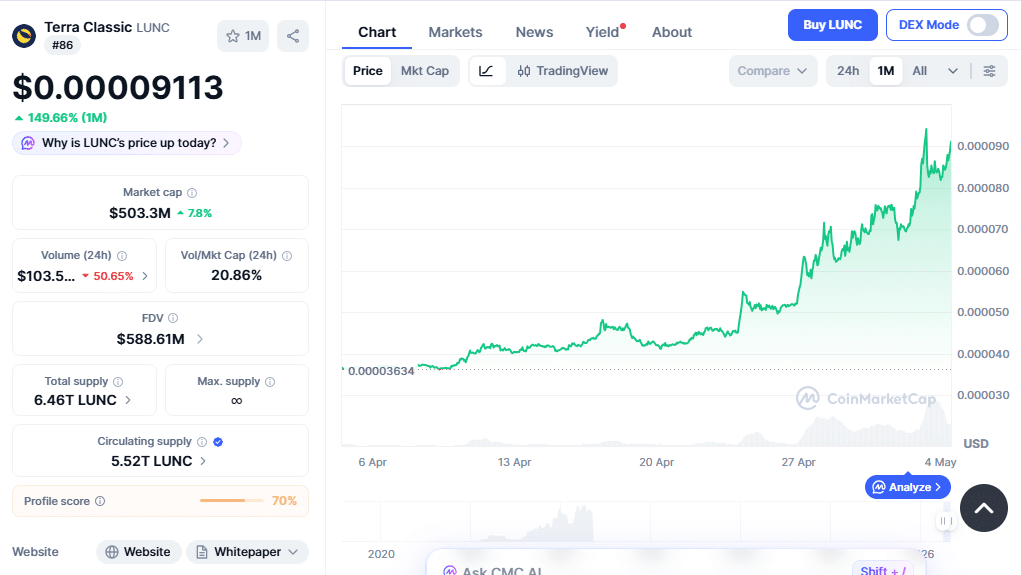
Terra Luna Classic has rallied to $0.00009113 as of May 4, up +149.66% over the past 30 days, after Binance executed its monthly buyback-and-burn on May 1—permanently removing 923,238,508 LUNC from circulation and delivering the largest single LUNC burn in months.
The rally and the burn together have produced one of the cleanest examples in 2026 of a token where supply mechanics, governance momentum, and speculative front-running have converged into a parabolic move — and where the next 72 hours will determine whether the move consolidates or reverses.
Per CoinMarketCap data, LUNC’s market cap now sits at $503.3 million, with fully diluted valuation at $588.61 million. A 24-hour trading volume of $103.5 million reflects a 50.65% decline from its peak, but Vol/Mkt Cap remains elevated at 20.86%—indicating the rally still has speculative depth, even as the most aggressive buying appears to have already played out.
The Burn That Set the Floor
The May 1 burn was funded by Binance’s April 2026 spot and margin trading fees, then executed on-chain and sent to the official LUNC burn wallet,(terra1sk06e3dyexuq4shw77y3dsv480xv42mq73anxu), permanently removing the tokens from circulation. Per LUNC Burn Tracker, Binance’s cumulative contribution to the LUNC burn program has now exceeded 80 billion tokens, representing more than 19% of total community burn activity since the program launched in late 2022.
Beyond the headline May 1 figure, the broader supply reduction picture is sharper than the 923 million number alone suggests. According to community data, roughly 2.15 billion LUNC were burned in the single week—a sustained pace driven by both the 0.5% on-chain transaction tax (terra blockchain transactions automatically route 0.5% to the burn address) and exchange contributions. Daily burns are averaging between 105 million and 125 million LUNC as of late April.
The cumulative total now stands at approximately 446 billion LUNC burned since 2022. That figure is structurally meaningful but operationally limited: with 5.52 trillion LUNC still in circulation out of 6.46 trillion total, the daily burn rate of ~307 million tokens is marginal against the float.
Why the Rally Is Not Just About the Burn
The +149.66% monthly move is not explained by the burn in isolation. Per detailed analysis, LUNC’s structural setup shifted materially in early 2026 when the token avoided new swing lows during a February market selloff and started forming higher lows—a technical regime change that flipped traders’ default behavior from “exit on rallies” to “buy the dip.”
LUNC then broke above the $0.000045 resistance zone that had capped every rally since late 2022 and closed a daily candle above $0.000072—the first such close in over a year. With that resistance flipped to support, the path opened for the burn-driven momentum trade that played out across April and into early May.
The more important context: LUNC has decoupled from Bitcoin’s flat trend during this rally. Bitcoin posted modest gains over the same period, while LUNC delivered three-figure percentage moves—meaning this is coin-specific alpha driven by token-specific catalysts, not broader altcoin beta. Decoupling matters because it isolates the upside drivers and means the next 48-72 hours will be determined primarily by execution on the v4.0.1 governance vote rather than macro market direction.
The May 6 Vote Is the Next Hard Date
The most important near-term catalyst is the Terra Classic v4.0.1 community upgrade vote, currently in progress on the Terra Classic governance forum and closing May 6. The upgrade is substantial—it addresses historical blockchain vulnerabilities, fixes legacy staking data errors, and integrates Cosmos SDK v0.53, which improves Inter-Blockchain Communication (IBC) protocol functionality and enables LUNC to interact more fluidly with the broader Cosmos ecosystem.
For a chain that has been criticized since the 2022 collapse for technical stagnation, v4.0.1 is the strongest signal yet that active development continues. Successful passage and execution would restore LUNC’s standing as a functional Cosmos chain rather than a memorial token—a meaningful narrative shift for institutional and infrastructure considerations.
The upgrade also plays into a longer-running supply story. Approximately 932 billion LUNC tokens are currently staked—locked up and removed from the immediate trading float. Combined with cumulative burns, the effective tradable supply is materially smaller than the 5.52 trillion circulating headline number suggests. That lockup is a structural floor under price action; if the v4.0.1 vote passes cleanly and validators commit to longer-term staking, the float tightens further.
The “Sell the News” Risk
The sharpest near-term risk is precisely that the burn—the catalyst traders front-ran for weeks—is now priced in. Analyst commentary across the past 48 hours has flagged LUNC as technically overbought, with RSI in stretched territory and the rally extended well beyond its 7-day moving average. The 50.65% drop in 24-hour volume since the peak suggests aggressive buyers have largely deployed.
The bullish scenario hinges on whether LUNC can hold support around the $0.00008 zone that has formed during the past 48 hours of consolidation. A sustained close above that level would set up a test of the $0.0001 psychological resistance—the next major round-number target. A break above $0.0001 would be the first time LUNC has traded with a “delete a zero” proximity since well before the 2022 collapse and would likely trigger another wave of speculative interest.
The bearish scenario triggers if profit-taking accelerates after the burn settles. A breakdown below the 7-day moving average near $0.000074 with conviction would suggest mean reversion is underway, with the next support sitting around the $0.000064 Fibonacci retracement zone—a level traders are watching closely. Beneath that, the rally’s structural underpinnings start to weaken.
The Math That Hasn’t Changed
Even at a +149.66% monthly rally, LUNC’s structural challenges remain. With a 6.46 trillion total supply, hitting any meaningful price level—even $0.001—would require a $6.5 billion market cap, multiples of where the token currently sits. Hitting $1 would require a $5.5 trillion market cap, which is roughly three times the entire crypto market today and effectively mathematically impossible without orders of magnitude more burns than the current program delivers.
The burn discipline is genuine, and the community persistence is admirable, but the daily burn rate of 307 million LUNC against a 5.52 trillion circulating supply means structural deflation at the current pace would take decades to materially compress price. Every LUNC rally since 2022 — and there have been many — has shared this same characteristic: the supply mechanics are real, the speculative momentum is real, and the mathematical ceiling is also real.
The cleaner read on this rally is that LUNC has shifted regimes from “permanently bearish” to “tradable momentum with defined catalysts.” That’s a meaningful change for traders, but it’s not a fundamental revival.
Also Read: LAB Token Surges 161% in 24 hours to $1.80 on Mobile App Launch Catalyst