The U.S. Securities and Exchange Commission (SEC) on Thursday canceled its scheduled open meeting for Friday, August 14, at which the Commission was set to vote on proposing the agency’s first formal crypto-specific rulemaking, a tailored offering regime known as Regulation Crypto Assets (or Reg Crypto). An SEC spokesperson attributed the cancellation to an “unforeseen scheduling issue” and said the meeting would be moved to a later date, without providing one. The formal Sunshine Act notice recorded only that the session “has been cancelled.”
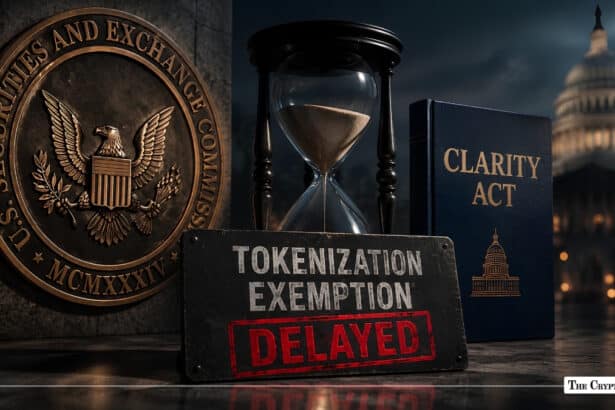
The cancellation coincides with a parallel further delay of the SEC’s long-anticipated “innovation exemption” for tokenized securities. That measure, which had been expected to ease regulatory hurdles for issuing and trading tokenized securities on blockchain rails under existing securities laws, was reported as “further delayed” by crypto policy journalist Eleanor Terrett on August 13, 2026, with details expected to remain “under wraps for the time being,” per Terrett’s source familiar with the matter.
Reporting from CoinDesk the same day linked the delay to White House concerns and to opposition from the Securities Industry and Financial Markets Association (SIFMA).
The twin setbacks arrive days after the Senate departed for its August recess without advancing the Digital Asset Market CLARITY Act (H.R. 3633), the crypto industry’s top legislative priority. Senate Majority Leader John Thune has scheduled a cloture vote on the bill for September 15, 2026, after lawmakers return.
The developments underscore the persistent gap between agency rulemaking and congressional action on digital assets, even under a more crypto-friendly SEC led by Chairman Paul Atkins. They also arrive at a moment when tokenization projects and crypto startups have been anticipating clearer U.S. pathways for capital raising and on-chain securities trading.
What was on the table: Reg Crypto’s expected pathways
The August 14 meeting, announced with unusually short notice on August 10, carried a single agenda item: whether the Commission should issue a release proposing new rules to create “a tailored offering regime for certain investment contracts involving crypto assets.” A vote to propose would have opened a public comment period, typically lasting one to three months, rather than immediately creating binding exemptions. Final adoption would have required a subsequent Commission vote after staff review of comments.
The strongest evidence that the proposal remains active rather than withdrawn comes from the federal regulatory review system. Reginfo.gov currently lists the SEC’s “Crypto Assets” proposal, identified as RIN 3235-AN38, as pending review.
SEC Chair Paul Atkins first outlined the core elements of what became known as Regulation Crypto Assets in a March 17, 2026, speech titled “Regulation Crypto Assets: A Token Safe Harbor,” delivered at The Digital Chamber’s 2026 Blockchain Summit. He described three components intended to provide bespoke pathways for crypto innovators to raise capital while retaining investor protections:
- A time-limited “startup exemption” for offerings of investment contracts involving certain crypto assets. Atkins suggested it could last up to four years and allow developers to raise a defined amount, illustratively $5 million, during that period. Projects would provide principles-based disclosures resembling today’s white papers, made available on a public website, and notify the Commission when relying on and exiting the exemption. The exemption was described as non-exclusive, leaving other capital-raising exemptions available.
- A larger “fundraising exemption” allowing entrepreneurs to raise to a defined amount, illustratively $75 million, during any 12 months. Issuers would file a disclosure document covering the investment contract and underlying crypto asset, a discussion of the issuer’s financial condition, and financial statements. This pathway would impose heavier obligations than the startup exemption meaningfully while remaining lighter than full registered offerings.
- An investment-contract safe harbor that would allow mature, sufficiently decentralized tokens to exit securities classification once the team ceases performing essential managerial efforts.
These contours, repeatedly referenced in subsequent reporting and Atkins’s public remarks, represented the first attempt at durable, crypto-specific rulemaking rather than the staff interpretations and enforcement actions that dominated prior years. Atkins has positioned the framework as a bridge while Congress works on broader market-structure legislation, and as part of the SEC’s broader Project Crypto initiative to bring more digital-asset activity onshore.
The parallel delay: Innovation exemption for tokenization
Separately, the SEC has again delayed its planned innovation exemption for tokenized securities. The exemption was expected to facilitate limited trading of certain tokenized securities, often described as digital twins of existing registered equities or other assets, under existing securities laws, potentially via an exemptive order rather than full notice-and-comment rulemaking.
Earlier iterations faced pushback over third-party tokens issued without the underlying issuer’s consent. More recent reporting links the latest delay to White House concerns that advancing the measure could complicate ongoing CLARITY Act negotiations, and to opposition from traditional financial institutions, including the Securities Industry and Financial Markets Association (SIFMA), which has argued that sweeping market-structure changes should proceed through formal rulemaking.
Industry sources have indicated the effort may need to wait for clearer direction on the legislation’s tokenization provisions.
The exemption had been expected, at least in part, to be discussed alongside the now-canceled Reg Crypto meeting, though it was not listed as a formal agenda item for a notice-and-comment release.
Section 10505 of the CLARITY Act addresses tokenization of securities. It generally provides that tokenization does not alter the substantive securities-law character of the underlying asset, equity tokens remain equity, debt tokens remain debt, while directing the SEC to study their treatment, including custody requirements, consumer protection, cross-border issues, and coordination between regulators, per the Senate Banking and Agriculture committees’ July 22, 2026 section-by-section summary of the merged text, as reported by CryptoTimes.
The overlap between the agency’s exemption work and the pending legislative language has been cited as a reason for caution.
Timing and the CLARITY Act vacuum
The Senate left Washington on August 8 without a floor vote on the CLARITY Act, heading into a five-week recess. The bill, which passed the House 294-134 on July 17, 2025 and cleared the Senate Banking Committee 15-9 on May 14, 2026, would establish a clearer division of responsibilities between the SEC and the Commodity Futures Trading Commission (CFTC), create tailored rules for digital commodities and investment-contract assets, and address market structure, custody, and related issues.
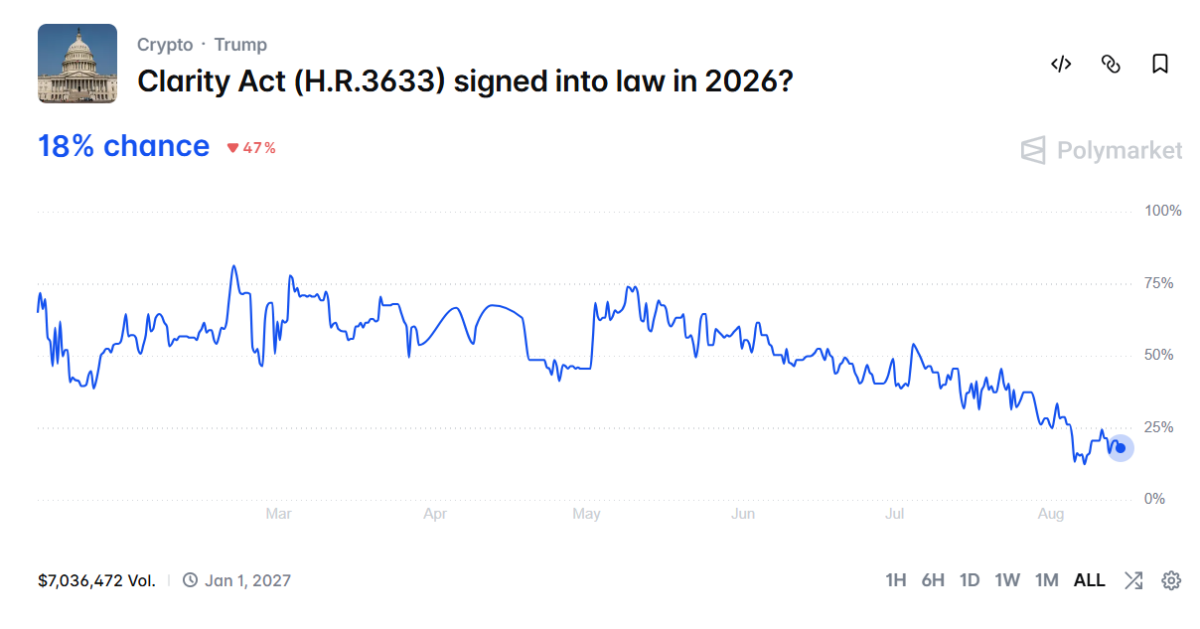
Passage odds have fallen sharply. At the time of this writing (on August 14 at 20:40 IST), Polymarket data shows traders are assigning an 18% probability that the CLARITY Act will be signed into law in 2026. The market has a $7.04 million trading volume, with the probability trending lower in recent months. The contract is set to resolve on January 1, 2027.
Meanwhile, Atkins has repeatedly stated that the SEC stands ready to advance its own rules if Congress does not deliver a comprehensive framework. In July remarks and the agency’s updated 2026 regulatory agenda, he highlighted clear rules for capital raising with crypto assets and facilitation of tokenized securities trading as priorities consistent with the administration’s goal of making the United States the crypto capital of the world.
The short-notice scheduling of the August 14 meeting had raised expectations that the SEC could advance its own framework while Congress works on broader legislation. The cancellation leaves both tracks, agency rulemaking and legislation, in a holding pattern.
White House plans crypto, prediction market meeting
Against that backdrop, the White House is reportedly planning to host a meeting next Wednesday with representatives from the cryptocurrency and prediction-market industries, according to a Politico report. The attendee list and agenda have not been finalized, and executives from traditional financial firms could also participate. It remains unclear whether President Donald Trump will attend, while the White House has not confirmed or denied the planned gathering.
The meeting would bring together two sectors facing ongoing questions over federal oversight, market structure and the division of regulatory authority. It is expected to take place one day before the CFTC’s Innovation Advisory Committee holds its inaugural meeting on August 20.
The CFTC’s four-hour session will cover cryptocurrency regulation, artificial intelligence in financial markets and prediction markets. The meeting is advisory and does not include a vote on new crypto rules.
The additional policy discussions come as both the SEC and Congress remain in flux on digital-asset regulation, leaving the industry watching several parallel tracks for signs of movement.
Near-term impact on startups and tokenization projects
For crypto startups, the delay extends the period of uncertainty around capital-raising options. Projects that had hoped for a clearer onshore path under the illustrative $5 million startup exemption or the larger $75 million fundraising lane must continue navigating existing exemptions (such as Regulation D or Regulation A+), staff guidance, or offshore structures.
The absence of a formal proposal means eligibility criteria, disclosure standards, resale restrictions, and the precise contours of any decentralization safe harbor remain undefined. Founders and counsel note that even a successful proposing vote would have left months of comment and revision before any final rule.
Tokenization projects face a similar pause. Firms preparing issuer-sponsored tokenized equity or other on-chain securities have been waiting for clearer exemptive relief that would reduce friction under existing market-structure rules. The repeated delays, this is not the first time the innovation exemption has been pushed back, favor more cautious, regulated approaches (digital twins with full corporate-action rights) over synthetic or third-party wrappers that have drawn greater scrutiny.
Traditional exchanges and market participants have previously raised concerns about fragmentation, investor protection, and operational challenges around dividends and voting. The current pause reinforces those voices while the CLARITY Act’s tokenization language remains under negotiation.
Market reaction has been muted so far. Crypto prices showed limited immediate movement in response to the cancellation reports, consistent with a view among traders that the delay is procedural rather than a substantive policy reversal. Longer-term, prolonged uncertainty could affect competitive dynamics with jurisdictions that have more advanced frameworks, such as the European Union’s Markets in Crypto-Assets (MiCA) regime, which entered full application on December 30, 2024.
Institutional caution and path forward
The official explanation remains an unforeseen scheduling issue. Reporting from multiple outlets, however, places the cancellation and the tokenization delay in the context of White House sensitivity to the CLARITY Act negotiations, Wall Street preference for formal process over exemptions, and the political calendar. Atkins’s three-member Republican Commission had been viewed as favorably positioned to advance the proposal while the current composition holds; Commissioner Hester Peirce, a longstanding advocate for crypto clarity, is scheduled to depart later in 2026.
A rescheduled meeting could still open the Reg Crypto proposal for comment in the coming weeks or months. The innovation exemption could emerge in narrowed form or after legislative clarity improves. September 15, 2026, when the Senate’s cloture vote on the CLARITY Act is scheduled, offers the next legislative catalyst. Until then, market participants are left watching both tracks and calibrating plans against the possibility that durable U.S. rules for crypto fundraising and tokenization will arrive later than many had anticipated.
The episode illustrates the friction inherent in building a new regulatory architecture for digital assets: agency agility versus legislative durability, innovation versus institutional caution, and the challenge of coordinating parallel efforts without one undermining the other. For now, both the Reg Crypto vote and the tokenization innovation exemption remain on hold.
Also Read: CLARITY Act Timeline Update: Missed August Deadline, September Window, Ethics Compromise