Key Highlights
- Grayscale said proposed changes to Ethereum and Solana tokenomics could reduce annual inflation and make ETH and SOL relatively scarcer.
- Under Grayscale’s projections, annual supply inflation by 2031 could fall to approximately 0.4% for ETH and 1.1% for SOL, assuming the proposals take effect immediately and other conditions remain unchanged.
- The proposals remain under discussion and have not been implemented, meaning the projected inflation rates are not guaranteed.
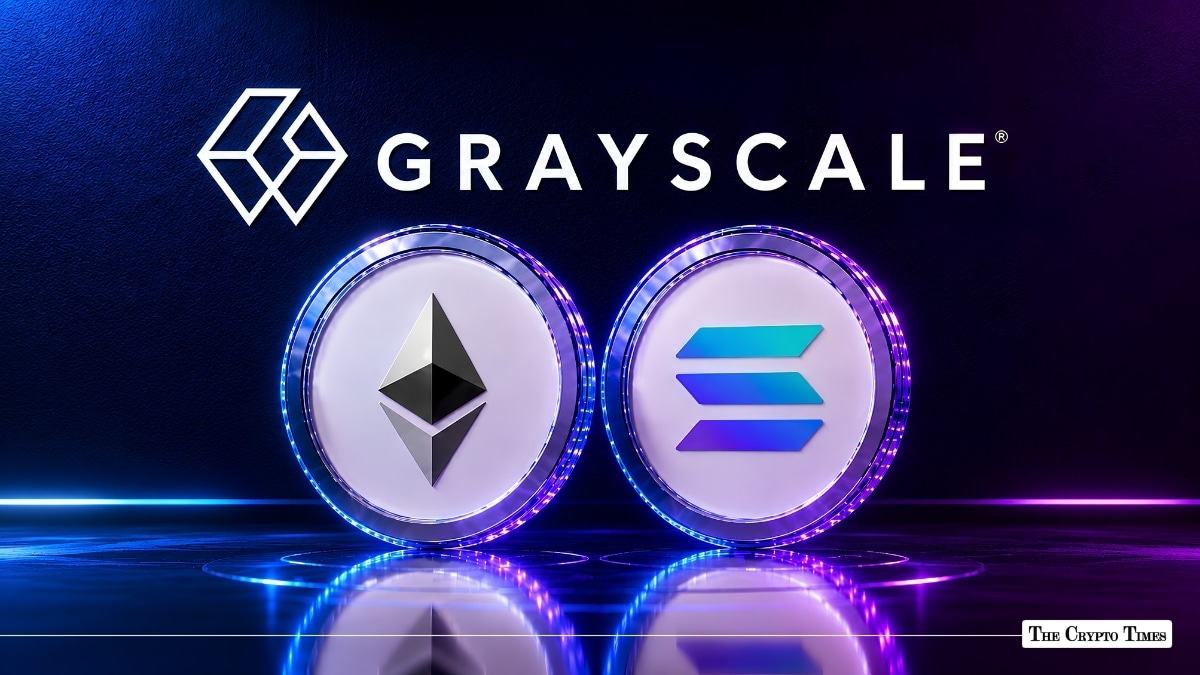
Grayscale, a major digital asset management company, reported that Ethereum and Solana are considering changes to their tokenomics, Ethereum EIP-8361 and Solana SIMDs 550/553. The networks’ native tokens, ETH and SOL, are subject to proposals that would cut annual inflation and reduce future token supply. The firm stated that both ETH and SOL would become relatively scarce under the proposed changes to their tokenomics, resulting in lower inflation.
Grayscale shared a chart titled “Annual Token Supply Inflation with Recent Ethereum and Solana Proposals” on August 13 that compares estimated year-over-year inflation rates for Bitcoin (BTC), Ethereum (ETH), and Solana (SOL) with data shown from 2017 through projections to 2031.
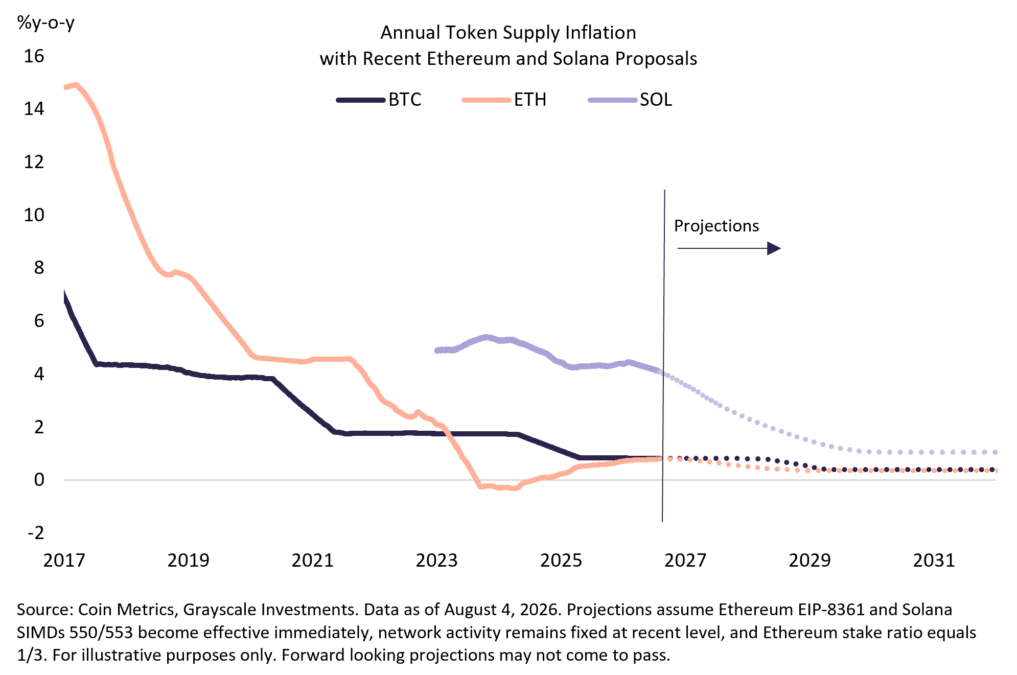
The source is Coin Metrics and Grayscale Investments, with data as of August 4, 2026. Projections assume Ethereum EIP-8361 and Solana SIMDs 550/553 become effective immediately, network activity remains fixed at recent levels, and the Ethereum stake ratio equals one-third. The chart is labeled for illustrative purposes only, with a note that forward-looking projections may not come to pass.
Projected inflation rates
Under the assumptions, by the end of 2031 annual inflation for both BTC and ETH would stand at approximately 0.4 percent per year. For SOL the figure would be approximately 1.1 percent per year. These levels are shown relative to annual supply inflation of 1.8 percent for gold and 3.3 percent for U.S. CPI inflation.
Historical data on the chart indicate that ETH inflation declined from levels above 14 percent in 2017 to near zero and slightly negative in recent years before rising modestly. BTC inflation fell from above 6 percent to around 1 percent. SOL inflation is shown starting later, remaining in the 4–5 percent range before the projected decline.
Ethereum proposal details
The Ethereum proposal is known as EIP-8361: Tapered Issuance Burn. It was submitted on August 4 by Ethereum contributors Jerome de Tychey, Pintail, Dapplion, pa7x1, Ladislaus, and Justin Drake. The proposal aims to slow the growth of Ethereum staking once it reaches 50 percent of the total ETH supply by gradually reducing staking rewards.
Under the existing design, staking rewards do not disappear entirely. Even if every ETH in circulation were staked, validators would still earn approximately 1.5 percent in annual rewards. The current reward model provides an ongoing incentive for additional participation.
Solana proposal details
Solana’s developer community is advancing two interconnected governance proposals documented in the official Solana Improvement Documents repository on GitHub. SIMD-0553 focuses on restructuring transaction fees so that a larger share of economic activity on the network translates into token burns.
SIMD-0550 doubles the rate at which Solana’s inflation schedule declines. The proposals note that even the increased burn figures remain modest compared with daily issuance under current conditions.
Community status on proposals
The proposed changes are under debate by the respective communities. Grayscale stated that the Solana proposals appear to have broader agreement. If implemented, staking rewards paid through new token inflation would be lower. The chart projections incorporate the assumed immediate effectiveness of the referenced Ethereum and Solana proposals.
The information presented covers the stated aims of the proposals, the comparative inflation figures shown in the chart, and the technical descriptions provided for EIP-8361, SIMD-0553, and SIMD-0550.
Also Read: Upbit Operator Dunamu’s Q2 Profit Falls 85% as Trading Slows