Crypto Times Logo Black
Google News Follow Banner
  • News
    • Market
    • Bitcoin
    • Ethereum
    • Altcoins
    • Regulations & Policies
    • DeFi News
    • Blockchain News
    • Industry
  • Exclusive
    ExclusiveShow More
    Is ‘Paul Le Roux’ Really Satoshi Nakamoto What the Record Actually Shows
    Is ‘Paul Le Roux’ Really Satoshi Nakamoto? What the Record Actually Shows
    Bitget exchange coin token set in front of a blurred FTX building backdrop.
    Is Bitget the Next FTX? What the $351.6 Million Hack Does and Doesn’t Have in Common
    Gold Bitcoin BTC coin standing vertically in front of a rising green financial candlestick chart
    Inside Bitcoin’s September 2026 Rally: BTC Reclaiming $87K, $2B in ETF Inflows and a Short Squeeze
    CLARITY Act Fails 49-50 in US Senate as SEC & CFTC Move Ahead on Crypto Rules Within 48 Hours
    CLARITY Act Fails 49-50 in US Senate as SEC & CFTC Move Ahead on Crypto Rules Within 48 Hours
    Illustrated collage featuring diverse people surrounded by crypto symbols and a corporate boardroom backdrop.
    Quiet Racism in Crypto Gets “Obvious” During Circle’s Arc Mainnet Launch
  • Opinion
    OpinionShow More
    Comparison of Bybit 12-hour, Bitget 85-hour, and WazirX 463-day response timers
    Bitget, Bybit Paid in Hours; WazirX Lost Least in Hacks at $235M, Held Users Hostage for 463 Days
    Jackson Hole 2026: Crypto Is No Longer Outside the Fed’s Door
    Jackson Hole 2026: Crypto Is No Longer Outside the Fed’s Door
    The Architecture of Trust Same Routes, New Risks in Global Tokenisation
    The Architecture of Trust: Same Routes, New Risks in Global Tokenisation
    The Architecture of Trust What 4,000 Years of Trade Teach Us About RWA Tokenisation
    The Architecture of Trust: What 4,000 Years of Trade Teach Us About RWA Tokenisation
    One P2P Trade, Months of Limbo Why Innocent Indian Crypto Users Keep Paying the Price
    One P2P Trade, Months of Limbo: Why Innocent Indian Crypto Users Keep Paying the Price
  • Learn
    • Explained
    • How To
    • Insights
  • IndicesNew
    • India USDT Premium Index
    • India USDC Premium Index
  • Videos
  • More
    • About Us
    • Our Authors
    • Contact Us
    • Editorial Policy
    • Daily Crypto Puzzles
The Crypto TimesThe Crypto Times
  • All News
  • Market
  • Bitcoin
  • Ethereum
  • Altcoins
  • Regulations & Policies
  • Blockchain
  • DeFi
  • Industry
  • Exclusive
  • Opinion
Search
  • News
    • Market
    • Bitcoin
    • Ethereum
    • Altcoins
    • Regulations & Policies
    • Blockchain
    • DeFi
    • Industry
    • Exclusive
    • Opinion
  • Learn
    • Explained
    • How To
    • Insights
  • IndicesNew
    • India USDT Premium Index
    • India USDC Premium Index
  • Quick Links
    • About Us
    • Our Authors
    • Contact Us
    • Editorial Policy
    • AI Policy
    • Sponsored & Advertorial Policy
    • Daily Crypto Puzzles
  • Videos
  • Glossary
Follow US
© 2026 By Crypto Times. All Rights Reserved.
Industry

Chainlink CCIP 2.0 Goes Live With New Institutional Guardrails, LINK Surges

Chainlink’s CCIP 2.0 adds independent verification, configurable settlement, and compliance controls as institutions expand cross-chain tokenization.

Written By Shubham Soni
Published 39 minutes ago
Make The Crypto Times preferred on GoogleGoogle
Chainlink CCIP 2.0 Goes Live With New Institutional Guardrails, LINK Surges
AI Summary
Show
CCIP 2.0 launched on September 28, introducing custom verifiers, compliance controls, and flexible settlement options.
Earlier September 22, Infosys announced a partnership to develop cross-chain verification and compliance services with Chainlink.
Following the launch, LINK rose to $14.81 on September 28, reflecting market reaction to the upgrade.

Chainlink has launched CCIP 2.0, adding custom verification, programmable compliance controls, and configurable settlement options to its cross-chain infrastructure as financial institutions increasingly use blockchain networks for tokenized assets.

The upgrade, which went live on September 28, allows institutions and digital-asset issuers to add their own Cross-Chain Verifiers (CCVs), apply transaction policies, and choose different confirmation requirements for cross-chain transfers. Chainlink said the changes are intended to address security, compliance, and settlement requirements for institutional users.

CCIP 2.0 is officially live.

The infrastructure for the next $600 trillion in onchain finance is now in your hands.

🧵⬇️ pic.twitter.com/5fvK4A4X40

— Chainlink (@chainlink) September 28, 2026

LINK rose to about $14.81 during the session before giving back some gains, according to data from CoinGecko (on September 28 at 13:50 UTC), up sharply from its level earlier in September.

CCIP adds independent verification

A central change in CCIP 2.0 is the ability for asset issuers and other users to place an additional verification layer on top of CCIP’s existing infrastructure. Users can operate their own CCVs or use third-party providers. A destination chain can require specified verifiers to attest to a transaction before it is executed.

Chainlink’s documentation shows that CCIP 2.0 supports policies requiring specific CCVs, as well as configurations in which a threshold of optional verifiers must approve a message.

The company said CCVs can be deployed on infrastructure including Amazon Web Services and Google Cloud, while firms such as Infosys and Nethermind are developing verification services.

The structure is aimed at institutions that want additional checks without relying solely on the default CCIP verification process.

Compliance controls move into cross-chain transfers

CCIP 2.0 also incorporates Chainlink’s Automated Compliance Engine, or ACE, into the cross-chain framework. The system allows issuers to define controls for transfers, including allowlists, sanctions screening, transaction limits, and other eligibility requirements. Chainlink says those policies can be applied as assets move between supported networks.

That matters for tokenized securities and other assets that may be subject to restrictions on who can hold or transfer them. Rather than treating compliance as a separate process after a transfer, CCIP 2.0 is designed to make the checks part of the transaction flow.

Chainlink has increasingly positioned CCIP as infrastructure for tokenized assets moving between public and private blockchains. Its broader platform also provides data, identity, and compliance services for blockchain-based financial applications.

Issuers can choose settlement speed

The upgrade gives issuers more control over transaction confirmation.

CCIP’s default configuration waits for source-chain finality, but issuers can set different confirmation thresholds where faster execution is acceptable. This allows lower-value or higher-frequency transactions to use shorter confirmation periods, while larger transfers can wait for stronger finality.

Chainlink said the system is designed to accommodate different settlement requirements rather than applying a single confirmation model to every transaction.

The distinction is particularly relevant for institutional payment and settlement workflows, where speed and transaction assurance can carry different priorities depending on the value and purpose of a transfer.

CCIP’s institutional footprint

Chainlink said more than $84 billion in cross-chain token value is secured through CCIP and that more than $15 billion in token value has migrated to the infrastructure over the past four months.

The company cited assets including BitGo’s WBTC, Coinbase’s cbBTC and Kraken’s kBTC among the tokens using the system. Those figures are Chainlink’s own measurements rather than independently verified market totals.

Financial institutions and infrastructure providers cited by Chainlink include Swift, DTCC, Euroclear, UBS, ANZ Bank, Fidelity International and SBI Digital Markets. Earlier institutional experiments have used CCIP for cross-chain messaging, tokenized assets and financial-market infrastructure.

Recent partnerships expand Chainlink’s institutional push

Chainlink’s CCIP 2.0 launch follows a series of partnerships aimed at applying its infrastructure to institutional finance and public-sector data. On September 22, Infosys said it would work with Chainlink on cross-chain connectivity, compliance, financial data, and reserve verification, using services including CCIP, the Chainlink Runtime Environment, Automated Compliance Engine, and Proof of Reserve. No specific financial institution, production timeline, or financial terms were disclosed.

Chainlink also partnered with payments infrastructure provider Bottomline to explore cross-chain and cross-border payment applications for its network of more than 600 banking clients. Separately, Chainlink said U.S. economic data from the Bureau of Economic Analysis would be made available on 10 blockchains through feeds covering real GDP, the PCE Price Index and Real Final Sales to Private Domestic Purchasers.

The developments add to Chainlink’s push to connect blockchain networks with existing financial infrastructure, while CCIP 2.0 adds controls for verification, settlement speed and compliance.

LINK gains after the upgrade

LINK initially climbed after the CCIP 2.0 announcement, reaching about $14.81 according to data from CoinGecko (on September 28 at 13:50 UTC). Its trading volume reached $812 million, with the market cap standing at $11.09 billion.
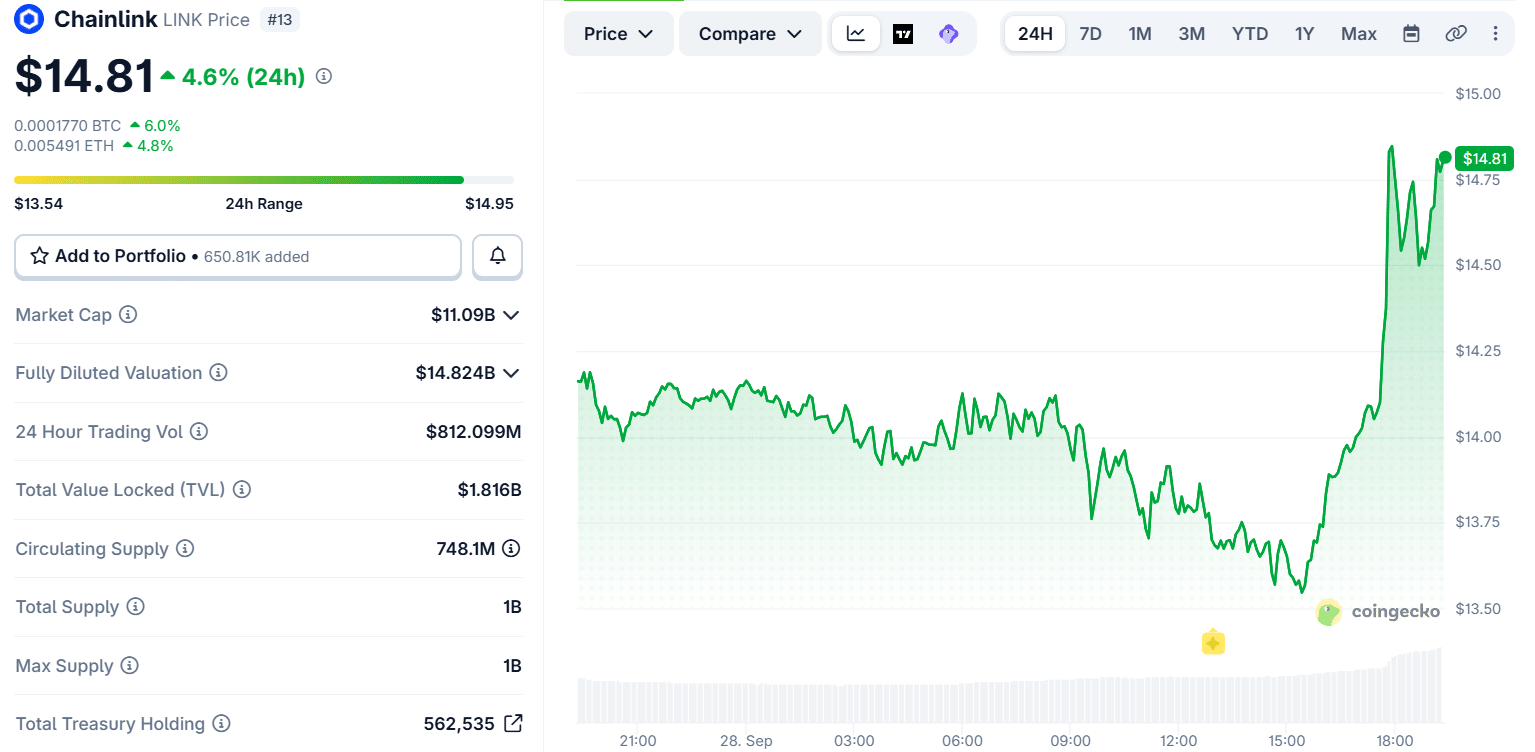
Chainlink Price Movement
Chainlink Price Movement (on September 28 at 13:50 UTC) | Source: CoinGecko

The move gives LINK a near-term market reaction to the software upgrade, although the launch itself does not establish a direct relationship between CCIP usage and demand for the token. LINK remains well below its previous all-time high of $52.70, according to current market data.

Chainlink’s push into tokenized markets

CCIP 2.0 arrives as banks, asset managers and other financial firms develop systems for issuing and moving tokenized securities, funds and other financial assets across blockchain networks.

The challenge is not limited to transferring tokens. Institutions also need to maintain their existing risk controls, compliance requirements and operational procedures when assets move between different networks.

Chainlink’s latest upgrade addresses those requirements through configurable verification, policy enforcement, and settlement settings rather than relying on a single cross-chain configuration.

The company has described CCIP 2.0 as infrastructure capable of supporting what it estimates could become a $600 trillion onchain financial market. That figure is a Chainlink projection about the potential size of assets moving onchain, not the current size of the market.

Also Read: Bybit Adds Franklin Templeton Tokenized Funds as Off-Exchange Collateral

Disclaimer: The information researched and reported by The Crypto Times is for informational purposes only and is not a substitute for professional financial advice. Investing in crypto assets involves significant risk due to market volatility. Always Do Your Own Research (DYOR) and consult with a qualified Financial Advisor before making any investment decisions.

Follow The Crypto Times on Google News to Stay Updated!      Google News

Daily Crypto Puzzles
Tickerdle Tickerdle Crypto Connections Crypto Connections Crypto Crossword Crypto Crossword
TAGGED:Chainlink (LINK)
Share This Article
Whatsapp Whatsapp LinkedIn Telegram Copy Link

Daily Crypto Puzzles

Tickerdle crypto game Tickerdle Crypto Connections game Crypto Connections Crypto Crossword game Crypto Crossword

Latest News

Trump's 2 p.m. Oval Office Announcement What It Could Mean for Bitcoin
Trump’s 2 p.m. Oval Office Announcement: What It Could Mean for Bitcoin
The Bybit and Franklin Templeton logos side by side on square plaques against a blue background.
Bybit Adds Franklin Templeton Tokenized Funds as Off-Exchange Collateral

Vivek Ramaswamy’s Strive Adds 1,107 BTC to Its Bitcoin Treasury
Vivek Ramaswamy’s Strive Adds 1,107 BTC to Its Bitcoin Treasury, Now Holds 27,462 Coins 
A gold Bitcoin coin in front of an illuminated lime green Bitmine logo on a dark wall.
Bitmine Crosses 6M ETH After 17,362 Token Weekly Buy, Holdings Reach $17.2 Billion
Comparison of Bybit 12-hour, Bitget 85-hour, and WazirX 463-day response timers
Bitget, Bybit Paid in Hours; WazirX Lost Least in Hacks at $235M, Held Users Hostage for 463 Days

Find Us on Socials

You may also like

The Citi and Coinbase logos displayed side by side against a blue gradient background.

Citi Expands Coinbase Deal to Let Corporates Accept Stablecoin Payments

India's ED Expands Crypto & Cyber Tracing Under Renewed NFSU Pact

India’s ED Expands Crypto & Cyber Tracing Under Renewed NFSU Pact

ZachXBT Exposes 5 Launderers Moving $387.5M Bitget Hack Funds for North Korea

ZachXBT Exposes 5 Launderers Moving $387.5M Bitget Hack Funds for North Korea

A gloved hand holding a smartphone displaying the Bitget logo in front of a hooded, shadowed figure.

Bitget Resumes BTC Withdrawals Four Days Following $387.5M Hack

The Crypto Times Logo PNG

News

All News
Market News
Bitcoin News
Ethereum News
Altcoin News
Regulations & Policies
DeFi News
Blockchain News
Industry News

Sections

Exclusive
Opinions
Learn
Insights
Videos
Glossary

India Premium Indices

Stablecoins
USDT
USDC

Play

Daily Crypto Puzzles
Tickerdle
Crypto Connections
Crypto Crossword

Company

About Us
Our Authors
Editorial Policy
AI Policy
Advertorial Policy
Contact Us
Career

Follow Us

X-twitter Linkedin Telegram Youtube Instagram

© 2026 The Crypto Times | A BITROCK TECHNOLOGIES L.L.C. Company.

DMCA.com Protection Status
  • Terms and Conditions
  • Disclaimer
  • Privacy Policy
  • Cookie policy
Do Not Sell or Share My Personal Information