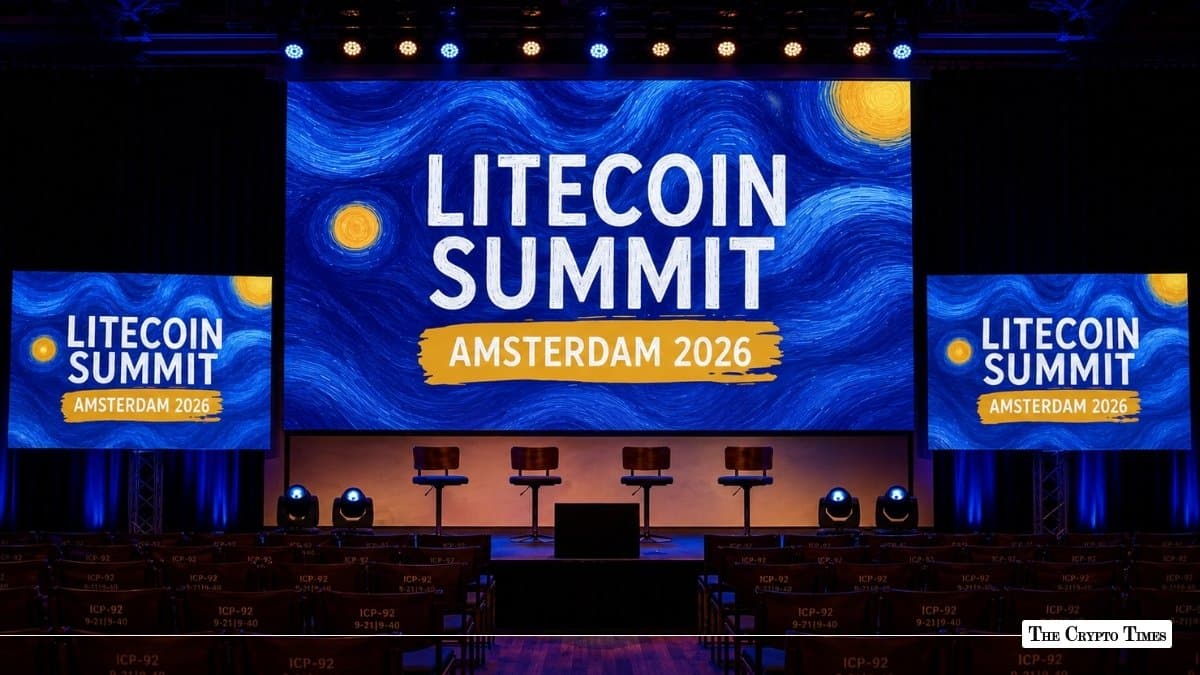
The Litecoin Summit 2026 wrapped its two-day run in Amsterdam on Tuesday, June 23, closing out the first time the event has ever been held outside the United States.
Day 2 at the Tobacco Theatre saw BasicSwapDEX Founder Dr. Kapil Amarasinghe call his decentralized atomic swap protocol “the biggest world first since Satoshi invented Bitcoin,” LitVM co-founder Aztec Amaya present a zero-knowledge Layer-2 smart contract roadmap backed by Nasdaq-listed Lite Strategy at a $50 million valuation, and a privacy panel featuring NYM, Stack Wallet, and others push back against the idea that surveillance is the unavoidable cost of regulatory compliance.
The closing session brought the full Litecoin Foundation leadership together on stage for the first time across both days, with Charlie Lee, Alan Austin, David Schwartz, Jay M, and Kyle Eber fielding questions about what the next twelve months should look like.
“Day 2 is live beaches! Come get you some Litecoin!” Litecoin posted on X as the morning sessions began, keeping the informal tone he had set on Day 1 when he kicked off the livestream with a similar call to the community.
Where Day 1 dealt in existential warnings and hard data, Day 2 was about products, infrastructure, and adoption. The schedule ran tighter, the sessions skewed more commercial, and the conversations moved from “what could break us” to “what are we actually building.”
Using information shared through the summit’s official YouTube livestream and posts on X, here is everything that happened on the closing day of the Sixth Annual Litecoin Summit.
Day 1 Recap: What Happened on June 22
Day 1 delivered more substance in a single day than most multi-day crypto conferences manage across their full run.
Charlie Lee opened with his annual State of the Coin and shared a previously undisclosed story from 2014 about Coinbase hiring Andreas Antonopoulos to perform a proof-of-solvency check on their cold storage after the Mt. Gox hack.
MWEB lead developer David Burkett followed with the summit’s most consequential session, revealing that quantum computing will eventually break the math that protects every cryptocurrency, including MWEB’s privacy layer.
A defense mechanism called switch commitments already exists in the code, but activating it would strip the privacy features that make MWEB worth using. “Anyone who tells you otherwise is lying to you,” he told the room.
Two researchers from TNO, the Netherlands Organisation for Applied Scientific Research, presented peer-reviewed findings covering every MWEB transaction from May 2022 through November 2025. Their conclusion: Litecoin has displaced Dash in the top three privacy coins, alongside Zcash and Monero.
NYM’s Alexis Roussel demonstrated network-level privacy already working inside Edge Wallet. And On-Ramper co-CEO Rick Thomas confirmed Litecoin as the fourth most-purchased cryptocurrency on their platform, then warned that MiCA’s July 1 compliance deadline will cut European on-ramps from 26 to roughly 8.
The day closed with an evening mixer sponsored by Luxxfolio and a DJ party sponsored by LitVM that ran late into the Amsterdam night.
Day 2: Everything that happened on June 23
Marty Simpson opened the day at 9:00 AM with brief remarks that set the tone for a schedule built around products, infrastructure, and real-world adoption rather than the research and existential warnings that had defined Day 1.
Luxxfolio: Scrypt Mining Infrastructure Update
Zayn Kalyan took the stage at 9:10 AM CEST with an operational update on Luxxfolio, the digital asset company that had sponsored the previous night’s mixer. Luxxfolio operates Bitcoin and Litecoin mining infrastructure and has been expanding its Scrypt mining capacity throughout 2026.
The session built on Day 1’s merged mining panel, which had brought together Kalyan, Ben Miklozek of Lokotech, David Eichel of Pepecoin, and Tony Lu to examine how multiple coins share Litecoin’s Scrypt proof-of-work and what that means for security and decentralization.
Kalyan’s Day 2 update narrowed the focus to Luxxfolio’s specific growth trajectory and what rising hashrate participation means for the network going forward.
Nexus Wallet: Progress Toward Rollout
Loshan, a core Litecoin developer and the architect of Nexus Wallet, returned at 9:40 AM for his second appearance at the summit. Nexus Wallet was first unveiled at the 2025 Litecoin Summit in Las Vegas as a non-custodial wallet featuring opt-in confidential transactions, Flexa integration for spending LTC at over 40,000 retailers, and planned support for Lightning Network and LTC-BTC atomic swaps.
The Amsterdam session covered the project’s progress toward broader rollout, focusing on UI refinements and how the wallet handles MWEB privacy features from the user’s side. With TNO’s Day 1 data showing 88% of MWEB blocks still empty, the wallet layer is where adoption either gains traction or continues to stall. Nexus is one of the ecosystem’s core bets that better UX can close that gap.
BasicSwapDEX: “The Biggest World First Since Satoshi Invented Bitcoin”
Dr. Kapil Amarasinghe had the 10:00 AM slot and the most deliberately provocative session title of the entire two-day event. An emergency medicine physician by profession and lead advisor to BasicSwapDEX, Amarasinghe did not soften the claim once he took the stage.
BasicSwapDEX is a decentralized exchange built entirely around atomic swaps, enabling cross-chain, peer-to-peer trading without wrapped tokens, without intermediaries, and without centralized bridges. At the 2025 summit in Las Vegas, Amarasinghe demonstrated the platform’s swap mechanics live.
In Amsterdam, his pitch went further: that trustless atomic swaps, where two parties on different blockchains can trade directly without any third party holding funds at any point, represent not an incremental improvement but a category change in how value moves between networks.
The Litecoin Foundation supports BasicSwapDEX development through its community projects page, and Charlie Lee has personally matched donations to the project. That level of backing from the network’s creator signals where the Foundation ranks decentralized exchange infrastructure on its priority list.
Whether the “biggest world first since Satoshi” framing holds up is a question the broader technical community will have to evaluate. Atomic swaps are not a new concept. But a working, usable, no-intermediary exchange with active Foundation funding and the creator’s personal financial support is a different conversation than academic papers about cross-chain trading.
LitVM: Litecoin’s $50 Million Layer-2 Play
Aztec Amaya, co-founder of LitVM, followed at 10:20 AM with a session titled “The Heart of Web3” that amounted to the most forward-looking technical roadmap of the entire summit.
LitVM is a zero-knowledge Layer-2 built on Litecoin, designed to bring smart contracts, DeFi, and real-world asset tokenization to a network that has never natively supported them in its 14-year history.
First announced at the 2025 summit, the project crossed a major milestone just four days before Amsterdam when Lite Strategy (Nasdaq: LITS) closed a $1.0 million lead investment in ZK Innovations, the company behind LitVM. The deal was structured as a SAFE at a $50 million valuation, with governance rights and an option on future network tokens.
The technical stack runs on Arbitrum Orbit for execution, Espresso for decentralized sequencing, Succinct’s SP1 zkVM for zero-knowledge validity proofs, and BitcoinOS’ Grail Bridge for trustless LTC bridging. The gas token is zkLTC, which is Litecoin bridged trustlessly to the Layer-2, meaning every transaction on the network runs on hard money rather than a separate speculative token.
“In my opinion, it’s going to be different,” Amaya told the audience when asked what sets LitVM apart. “There are projects like Midas that are building on top of LitVM.”
Midas, a prediction market, is already live on the platform with FIFA World Cup 2026 markets active. CoinMarketCap selected LitVM as a CMC Labs incubatee earlier this month, providing ecosystem support ahead of mainnet. And Lite Strategy CEO Jay File said before the summit that his company’s “investment thesis isn’t speculative, but infrastructure-focused.”
LitVM also posted summit highlights on X, including the announcement that iconic Litecoin artist and collectibles creator BitsToys revealed a special game coming to LitVM in the future.
The question the session left open is whether developers will actually build on LitVM in numbers. The infrastructure and institutional money are in place. Mainnet is on the horizon. But a Layer-2 without a developer ecosystem is just architecture.
The Privacy Panel: Pushing Back on Surveillance as Default
At 10:40 AM, Jay M moderated a panel under the single-word title “Privacy” that brought together Alexis Roussel of NYM, Diego Salazar of Cypher Stack and Stack Wallet, and Rigved Bhatt.
Everything Day 1 built pointed toward this conversation. Burkett had established that quantum computing will eventually break the cryptographic foundations of every privacy system in crypto. Roussel had shown in his individual Day 1 session that on-chain privacy without network-level protection is incomplete because ISPs and server operators can still see who connects to which nodes.
TNO’s research has proved that MWEB carries genuine economic activity. The panel now had to deal with what all of that means when European regulators are tightening compliance requirements with MiCA just eight days from taking full effect.
Salazar brought a perspective most privacy panels lack. He runs Cypher Stack, a privacy-focused development firm, and also builds Stack Wallet, a product that ships to real users on real phones. He knows the theory, and he knows what happens when theory meets a download button.
Roussel reinforced his Day 1 argument that on-chain encryption without network-level protection is a half-measure because metadata leaks identity even when the transaction data is fully hidden.
The panel did not treat surveillance as an inevitability that crypto projects must accept. It challenged that framing directly while acknowledging the regulatory environment is moving in the opposite direction.
Q&A with Charlie Lee
Alan Austin, Director of Operations at the Litecoin Foundation, moderated a live Q&A with Charlie Lee at 11:20 AM. Unlike the scripted Day 1 keynote, this was open format. Lee took questions from the audience directly.
These sessions have become a summit tradition and tend to produce the most unguarded moments. At the 2025 summit in Las Vegas, Lee used the format to push back on narratives that Litecoin is outdated and to restate the project’s founding principles: no pre-mine, no hype, no founder stash. “Litecoin has one of the best, most non-toxic communities in crypto,” he said at that event.
In Amsterdam, after two days covering quantum threats, Layer-2 roadmaps, institutional treasury companies, and a ticking regulatory deadline, the range of questions reflected how much the project’s scope has expanded in a single year.
Bridging the Self-Custody Gap
Nikita Eriashev took the 11:40 AM slot with a focused session on why self-custody adoption remains stuck despite years of evangelism. The core problem is not technical. Custodial services are simply easier to use, and most people will not tolerate friction even when the security argument is clear.
Eriashev examined specific UX failures that keep users on custodial platforms and what wallet developers can do about it without compromising the security guarantees that make self-custody meaningful.
Future of Crypto Wallets Panel
At noon, a panel expanded the self-custody conversation by bringing together Eriashev, Loshan, John Kim (Litecoin Foundation Ambassador), and Zey. The discussion covered multi-chain support, privacy integration at the wallet layer, and the persistent gap between what developers consider usable and what actual users experience when they try to send a confidential transaction for the first time.
The session closed out the morning block and left the room with a question that both days had been circling: if the best privacy technology in the world sits inside wallets that people find confusing, does the technology actually matter?
After Lunch: Merchant Adoption, MWEB Deep Dives, and Institutional Money
The afternoon schedule shifted from infrastructure and privacy toward the commercial and institutional side of the Litecoin ecosystem, with sessions covering MWEB’s design challenges, real-world merchant spending, and a panel that brought European fund managers onto the Litecoin Summit stage for the first time.
MWEB UX/UI: The Design Problem Nobody Talks About
Diego Salazar returned at 2:00 PM for a session that attacked MWEB from the design side. Not the cryptography. Not the on-chain data. The interface.
As the creator of Stack Wallet, Salazar sits at the exact point where MWEB’s theoretical privacy guarantees meet a user staring at a screen. How does someone understand what happens when they peg into MWEB? How do they know their transaction is actually private? What does the wallet show when something goes wrong?
TNO’s Day 1 data showed 2.6 million LTC pegged into MWEB cumulatively by November 2025, but 88% of blocks remain empty. The privacy layer works, but it is not saturating. Salazar’s session went directly at the possibility that part of the adoption gap is a design problem, not a technology problem.
Spend Litecoin Anywhere: Coinsbee
Ivan Escamilla Rodriguez, Product and Growth Lead at Coinsbee, delivered the most grounded session of the day at 2:20 PM. While the rest of the summit had been debating quantum computing, zero-knowledge proofs, and atomic swap architecture, Rodriguez showed how someone can use Litecoin to buy groceries, phone credit, or a gift card for a major retailer today. Not after mainnet launches. Not after wallet redesigns. Right now.
Coinsbee lets users purchase gift cards and vouchers for retailers using cryptocurrency. For a community that has always positioned Litecoin as money you spend rather than money you hold and speculate on, this session landed differently than the developer talks. It was a practical reminder that adoption does not only happen at the protocol layer. It also depends on whether a person in Amsterdam or anywhere else can walk into a store and pay with LTC without friction.
MWEB Technical Analysis Review
Stack Wallet followed at 2:40 PM with a protocol-level technical review of MWEB that went deeper into the internals than anything else on the Day 2 schedule. Where TNO examined on-chain transaction patterns, where Salazar examined wallet design, and where Burkett examined quantum threats on Day 1, this session examined MWEB from a developer’s perspective.
It was the most granular MWEB session of the summit and gave the technically minded attendees the detail they had been waiting for across both days.
Institutional and Fund Interest in Crypto
The 3:20 PM panel brought the institutional thread that Day 1’s Lite Strategy session had started and placed it squarely in a European context. Akram Hamam, Constance Scholten, and Michael van de Poppe discussed how European funds and institutional investors are approaching digital asset allocation in 2026.
Van de Poppe, Founder and CIO of MN Capital and MN Fund, is one of the most recognized crypto analysts in the Netherlands with over 700,000 followers across platforms.
He was also scheduled to speak later in the week at the Dutch Blockchain Week Summit at the Johan Cruijff ArenA. His appearance on the Litecoin stage brought a macro and trading perspective that the summit’s developer-heavy schedule had been missing.
The institutional case for Litecoin has more substance behind it right now than at any point in the project’s history. The Canary spot Litecoin ETF launched on the Nasdaq in October 2025.
The SEC issued guidance in March 2026 describing LTC with digital commodity characteristics. Lite Strategy holds roughly 894,000 LTC according to its most recent SEC filing. And on Day 1, Lite Strategy became the first Nasdaq-listed digital asset treasury company to ever appear on the Litecoin Summit stage when Charlie Lee and Josh Riezman of GSR discussed Litecoin’s evolution as a reserve asset.
“Each year the Litecoin Summit brings together the builders, allocators, and institutions that are shaping where this asset class goes next,” Lee said ahead of the event. “This year, for the first time, we have a NASDAQ digital asset treasury company on the stage, and that shows the institutional direction where Litecoin is being adopted.”
The Litecoin Foundation Panel: How it All Ended
The final session at 4:00 PM put the people who run the Litecoin project in front of the crowd one last time: Charlie Lee, Alan Austin, David Schwartz, Jay M, and Kyle Eber.
Eber’s inclusion alongside the Foundation executives was notable. He runs The84Million.com, a podcast he started because nobody was producing long-form Litecoin content. His guests have included Lee, Burkett, and Stephen McClurg of Canary Capital. “Bitcoin has a billion advocates. But who’s talking about Litecoin?” he said during Day 1’s builders panel.
The Foundation does not treat community media as a side project. Eber was on the closing panel because the Foundation considers what he does part of the project’s core infrastructure.
After two days that covered quantum threats, privacy breakthroughs, regulatory deadlines, Layer-2 roadmaps, institutional treasury models, decentralized exchange architecture, wallet UX problems, and merchant adoption tools, the Foundation panel had more threads to pull together than any closing session in the summit’s six-year history.
Marty Simpson closed the event with final remarks at 4:30 PM.
What Both Days Added Up To
The 2026 Litecoin Summit ran June 22 to 23 at the Tobacco Theatre in Amsterdam’s historic Nes district, with up to 600 attendees across nine rooms and tickets priced at EUR 84 for both days. The event served as the official kickoff to Dutch Blockchain Week, which runs through June 28 with over 40 side events and 5,000 expected attendees across the city.
On the threat side, quantum computing could break MWEB’s privacy guarantees on a timeline that has shortened from 2050 to possibly 2029 or 2030. Post-quantum signature schemes exist but are 40 to 70 times larger than current ones, making them impractical for a payments network.
MiCA will reshape European crypto access starting July 1. And Bitcoin’s governance, in Burkett’s assessment, is “a disaster” that could not deploy a quantum fix even if one existed today.
On the building side, BasicSwapDEX is creating trustless cross-chain trading without intermediaries. LitVM is bringing smart contracts to Litecoin with $1 million in institutional capital at a $50 million valuation. Nexus Wallet is pushing toward broader rollout. Stack Wallet is attacking MWEB’s design gap. Coinsbee is making LTC spendable at everyday retailers.
On the institutional side, the project now has a spot ETF on Nasdaq, SEC digital commodity guidance, a Nasdaq-listed treasury company holding 894,000 LTC, and European fund managers appearing on the Litecoin Summit stage for the first time.
And on the community side, a 24-year-old named Claudia runs the entire official Litecoin Shop solo after her father spotted a volunteer ad in 2021. Craig of ArtToy.org hand-makes limited-edition trading cards that sell for $1,000 each and designed every banner and graphic at the Amsterdam venue. These are not corporate employees. They are people who showed up because they believe in the project, and they are part of the reason the project still works.
That’s a Wrap for Litecoin Summit 2026
The Sixth Annual Litecoin Summit is in the books. For an event that started in San Francisco in 2018 and spent its first five years on American soil, Amsterdam was a statement.
“I turned Amsterdam into a blue light special!” Litecoin posted on X as the summit wound down, staying in character one last time before the community scattered into the rest of Dutch Blockchain Week.
The MiCA deadline hits July 1. The quantum clock is running. LitVM is heading toward mainnet. BasicSwapDEX is building trustless infrastructure. And the Canary spot ETF and Lite Strategy’s 894,000 LTC treasury are writing a new institutional chapter in real time.
The Litecoin Foundation pulled off a two-day conference on a new continent, during a regulatory transition that is about to reshape European crypto access, on a nonprofit’s budget. What the project does with the momentum from Amsterdam is the only question that matters now. The Seventh Annual Litecoin Summit, wherever it lands, will be the answer.
Also Read: Litecoin Summit Day 1: Quantum Warnings, Privacy Coin Breakthroughs, & MiCA’s Looming Deadline