Key Highlights
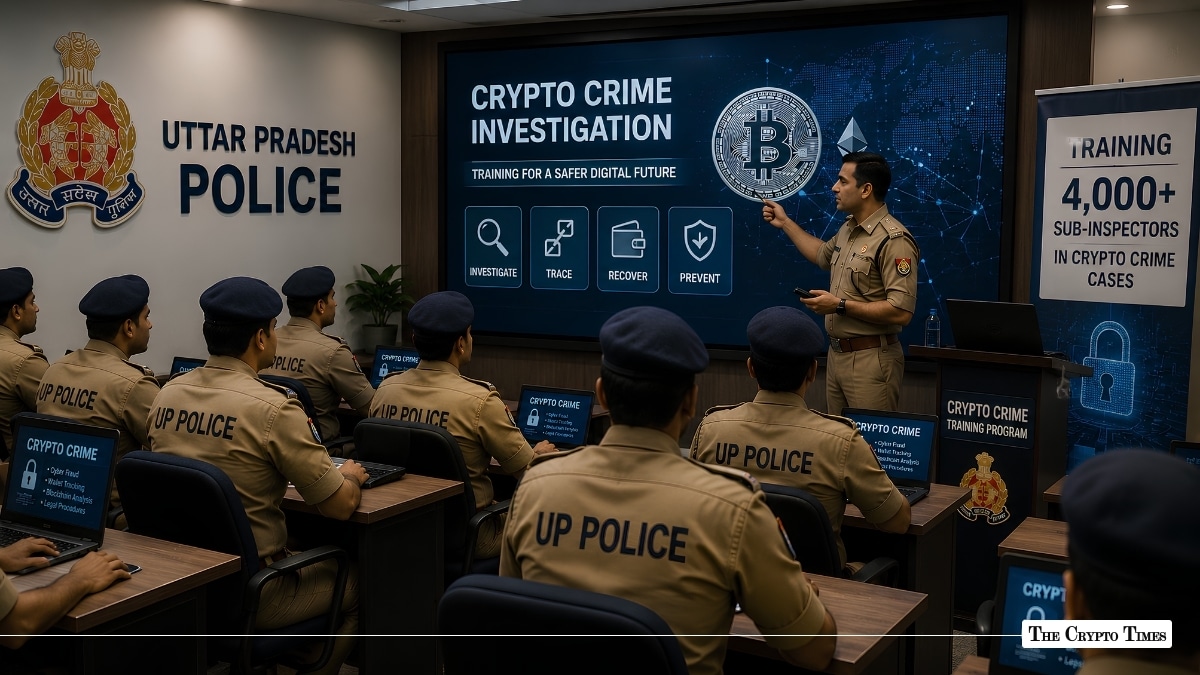
- More than 4,000 newly recruited UP Police sub-inspectors will receive training in cryptocurrency crime investigation.
- A dedicated crypto investigation module will be added to their basic training course.
- The training will cover blockchain basics, digital wallets, and tracing cryptocurrency transactions.
India’s Uttar Pradesh Police is set to train more than 4,000 newly recruited sub-inspectors in cryptocurrency crime investigation.
According to a report by The Times of India on Monday, the training will be conducted at the Dr BR Ambedkar Police Academy in Moradabad and at other Police Training Schools (PTS) across Uttar Pradesh. Officials said the course is expected to begin shortly.
The new module will introduce recruits to the basics of blockchain technology, digital wallets, and methods for identifying and tracing cryptocurrency transactions.
Crypto investigation added to police training
According to officials familiar with the programme, the module will focus on helping officers understand how cryptocurrency is used in financial crimes and how digital asset transactions can be investigated. The training will cover areas including identifying, tracing, and probing crypto-related offences, with officers from central investigative and financial agencies expected to participate in the sessions.
Cryptocurrency-related cases in India often require specialized expertise, particularly when investigations involve tracing funds across multiple wallets, exchanges, and blockchain networks.
Central agencies to assist state police
Major cryptocurrency-related cases have often been handled by agencies such as the Enforcement Directorate (ED), Financial Intelligence Unit (FIU), and Central Bureau of Investigation (CBI), depending on the nature of the offence. State police officers have generally had more limited exposure to the technical aspects of blockchain-based investigations.
Officials said the new training is intended to give district-level officers the basic knowledge required to identify potential crypto-related offences and preserve relevant information before cases are escalated to specialized agencies.
Rajeev Sabharwal, DG (Training HQ), said the upcoming course will include a dedicated crypto investigation module, with Deputy SPs and inspectors who have already received specialised training in cryptocurrency investigations helping train the recruits. Sabharwal added that central agencies and subject experts have also received specialized training from private-sector firms.
What recruits will learn about crypto
The crypto investigation module will introduce recruits to several areas relevant to cybercrime investigations. These include:
- Basic blockchain technology
- Cryptocurrency transactions
- Digital wallets
- Tracing on-chain transactions
- Identifying movement of crypto assets
- Investigating crypto-linked financial offences
The training is intended to give frontline personnel enough technical understanding to recognize crypto-related activity and begin an investigation before referring cases to specialized units when necessary.
Rising crypto fraud drives focus
The curriculum change comes amid reports of cybercrime involving cryptocurrency and digital investment platforms in Uttar Pradesh. Officials said victims are increasingly reporting fraud linked to digital assets, online investment schemes and cryptocurrency platforms.
In many such cases, investigators need to follow the movement of funds across blockchain addresses before identifying exchanges, intermediaries or individuals connected to the transactions. The new training is intended to help local police teams to handle the initial stages of crypto-related complaints before cases are referred to specialized agencies.
Blockchain use expands across India’s public sector
The UP Police initiative comes as Indian authorities are also examining blockchain technology for uses beyond cryptocurrency.
On August 7, 2026, the Centre told the Supreme Court that a 10-layer security overhaul of the NEET medical entrance examination was underway following the 2026 paper-leak controversy. Among the measures being considered is blockchain-based record management, alongside AI-powered monitoring and other security mechanisms.
The NEET overhaul is focused on securing examination records rather than cryptocurrency, but its inclusion of blockchain reflects a broader shift in how Indian authorities are evaluating the technology for record integrity, traceability and security.
For law enforcement, the application is more direct: blockchain data can provide a transaction trail that investigators can analyze when digital assets are involved in fraud or other financial crimes.
Tamil Nadu police has taken a similar step
Uttar Pradesh’s move follows a recent blockchain-forensics training programme for police personnel in Tamil Nadu.
In May 2026, Digital South Trust trained 26 Tamil Nadu DSP trainees in Chennai in blockchain forensics and cryptocurrency crime investigation. The program included practical instruction on tracing illicit funds across major blockchain networks and introduced officers to tools used for crypto investigations.
The two initiatives reflect the expansion of blockchain-related training within India’s state-level law enforcement system, alongside the work of central agencies and specialist units.
4,000+ recruits set to begin training
More than 4,000 sub-inspectors have recently been recruited, with their basic training scheduled to begin soon. The revised curriculum will be implemented at the Moradabad police academy as well as other training schools across the state.
For UP Police, the training will need to prepare officers to handle cases involving rapidly moving funds, multiple wallets, centralized exchanges and transactions spanning several jurisdictions.
The addition of cryptocurrency investigation to basic police training indicates that blockchain-related investigations are becoming part of broader law enforcement training in India, rather than remaining limited to specialist agencies.
Also Read: FATF Sets New DeFi Framework Using ‘Control or Influence’ Test