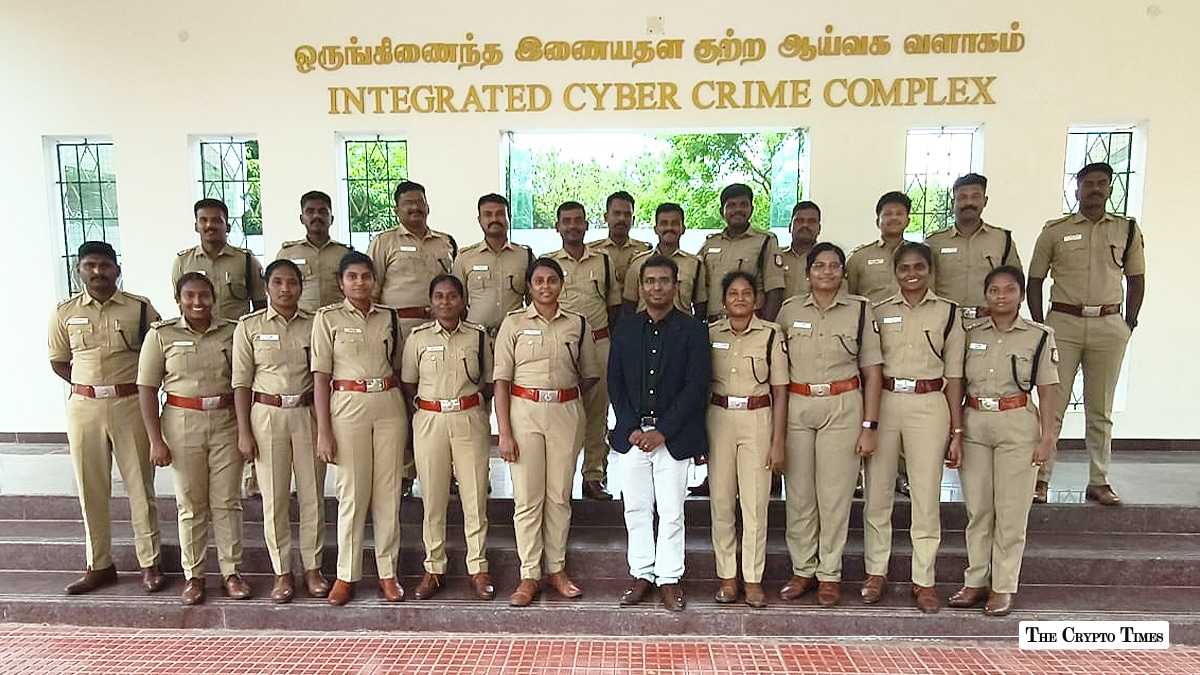
India’s law enforcement apparatus is steadily building the in-house capability it needs to investigate cryptocurrency-related crimes. The latest signal of that shift came out of Chennai last week, where 26 Deputy Superintendents of Police (DSP) trainees at the Tamil Nadu Police Academy completed an intensive five-day training program focused entirely on crypto-related crimes and blockchain investigations.
The program, conducted by Vellore-based non-profit Digital South Trust between May 11 and May 15, covered the full spectrum of crypto crime methodologies that Indian investigators are now encountering on the ground, according to the press release.
That includes investment frauds, fake exchange links, pump-and-dump schemes, MLM-based crypto frauds, social media influencer-driven scams, phishing attacks, wallet-drainer links, fake trading platforms, impersonation scams, and the laundering of proceeds through multiple wallets and exchanges.
In an exclusive conversation with The Crypto Times, Sudhakar Lakshmanaraja, Founder of Digital South Trust, said the programme was designed around a scenario-based teaching approach. “The idea was not to give officers a theoretical overview,” he said.
What the program entailed
The program was designed to help participants work through real-world patterns, understand how funds move across blockchain networks, and learn how to build an investigation from the first suspicious transaction through to asset recovery.
The curriculum also included sessions on how crypto exchanges operate, the different products exchanges offer, Indian laws applicable to crypto-related scams, confiscation procedures under existing statutes, digital evidence handling protocols, and the use of free blockchain explorers to track suspicious transactions on-chain.
One of the more notable aspects of the training was the hands-on exposure officers received to Ritam Intelligence, Digital South Trust’s in-house blockchain forensic tool. The tool supports investigations across multiple blockchains, including Ethereum, Polygon, BNB Chain, Arbitrum, Base, Optimism, Avalanche, Bitcoin, Tron, and Solana. Officers used the tool to trace transaction flows, identify wallet clusters, and understand how laundering patterns play out across different networks.
According to Lakshmanaraja, the participating officers showed strong engagement throughout the program. “These are officers who will go on to lead investigations in their respective jurisdictions,” he told The Crypto Times exclusively.
“When they understand how blockchain works, when they can read a transaction hash and follow the money themselves, the quality of investigation improves significantly.”
Why this matters for India
The training comes at a time when crypto-linked offences across India have been escalating in both volume and sophistication. From multi-crore investment scams and digital arrest frauds to darknet drug operations funded through privacy coins and stablecoins, Indian law enforcement agencies are dealing with a rapidly evolving threat landscape that did not exist at this scale even two years ago.
Multiple state police units, central agencies like the Enforcement Directorate and the Narcotics Control Bureau, and regulatory bodies like FIU-IND have all stepped up their engagement with the crypto space over the past year.
Private exchanges like CoinDCX and WazirX have also announced law enforcement training collaborations. But much of the heavy lifting on the ground, particularly at the state and district level, is being done by organisations that operate outside the exchange ecosystem.
Digital South Trust falls in that category. The Vellore-based non-profit, which operates in the areas of policy, education, research, and capacity building in emerging technologies, says it has now trained more than 3,340 law enforcement officers through its various programmes. These span blockchain investigations, crypto-related crimes, cybercrime awareness, and digital evidence handling.
The organization has stated its long-term goal as helping make India “crypto-crime free by 2035.” Whether that is achievable or not, the direction is clear. India is no longer ignoring the problem. From Parliament calling exchanges for hearings to police academies running week-long blockchain forensic courses, the institutional response is catching up with the scale of the threat.
For a country with over 100 million crypto users and no standalone regulatory framework, that kind of ground-level capacity building may be the most practical step forward right now.
Also Read: Why Crypto Exchange BitDelta’s India Launch is Different from the Rest