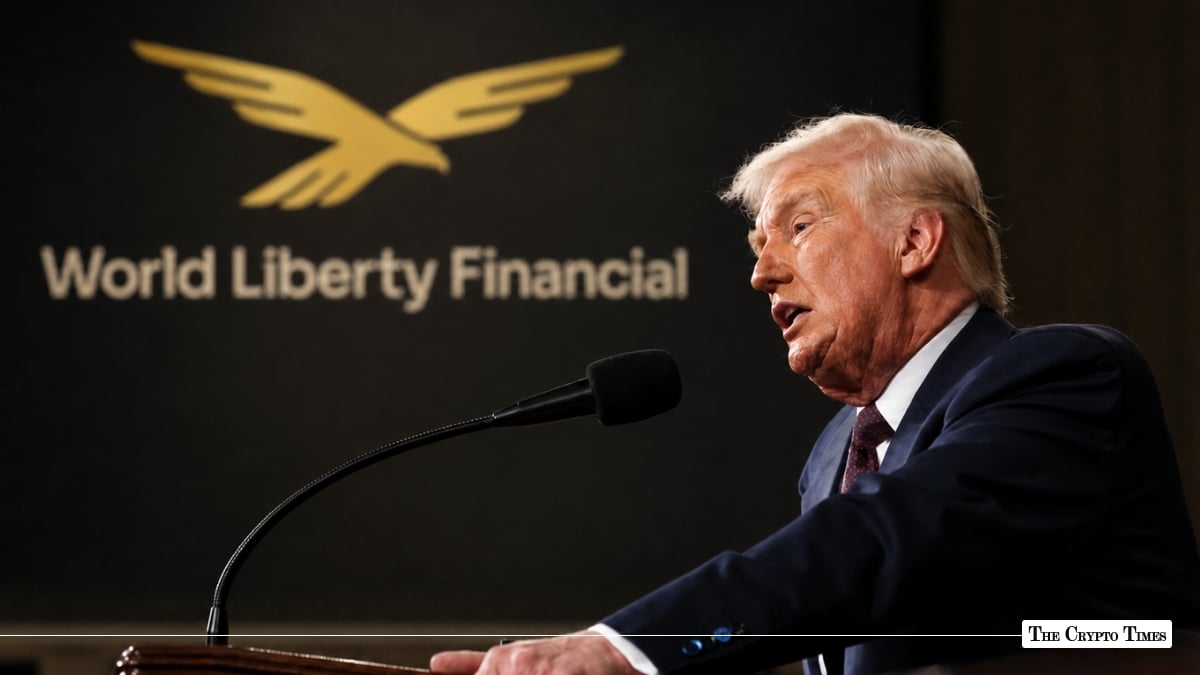
The mystery buyer behind one of the largest known investments in President Donald Trump’s cryptocurrency venture has been identified, and his background has renewed scrutiny of how the venture is funded. According to a New York Times investigation published August 9, the person behind Aqua 1’s $100 million purchase of World Liberty Financial’s WLFI governance tokens is Guren “Bobby” Zhou, a businessman who was arrested in Britain in 2021 on suspicion of money laundering.
Crucially, Zhou has not been charged with any crime. British officials told the NYT the investigation remained active as of late July 2026, and a court record cited in the report alleges his involvement in a laundering operation, but those remain unproven allegations. The report is significant for the crypto industry because, under World Liberty’s structure, as much as $75 million of the $100 million reportedly flowed to a company controlled by the president and his three sons, placing the transaction squarely within the conflict-of-interest debate that has stalled U.S. crypto legislation.
What the Report Found
According to the NYT and corroborating coverage across outlets including IBTimes, Zhou surfaced publicly only briefly before the purchase, identifying himself as “Mr. Bobby” from Aqua 1 during a short audio stream on X, where he described the firm as “a major player in the World Liberty, which is Trump’s family’s crypto venture.” His identity as the fund’s principal was not widely known until the investigation.
The report states that British authorities arrested Zhou in 2021, and that a court record filed in November accused him, along with five other people, of participating in a money-laundering operation dating to 2019. He has not been charged, and the allegations have not been tested in court. The NYT said it could not determine the source of the $100 million used to buy the tokens. These points are central to the story precisely because the money did not stay with an ordinary token sale: under World Liberty’s arrangements, a large share of proceeds flows to entities tied to the Trump family.
The On-Chain and Corporate Trail
Part of what makes the case notable for crypto observers is that much of it was traceable through public records and on-chain data. According to the report, before Aqua 1 emerged, Zhou led a crypto venture fund called Web3Port, which announced a separate $10 million World Liberty investment shortly after Trump’s January 2025 inauguration. Corporate records showed that a Web3Port entity registered in the British Virgin Islands was later renamed Aqua 1 GP Limited, with Aqua 1 announcing the $100 million WLFI purchase about two weeks later. Aqua 1 had previously denied any connection to Web3Port.
Blockchain-analytics firm Arkham Intelligence, cited in the report, traced a wallet controlled by Web3Port buying about $20 million of WLFI in January 2025, and a second wallet believed to be controlled by Aqua 1 buying a further $80 million in June, the on-chain footprint of the combined $100 million position.
A Background Marked by Red Flags
The report described Zhou as having a history of troubled ventures before his emergence as a major crypto investor, including failed businesses and a small crypto start-up whose token collapsed. It also documented instances of claims that did not hold up. In one illustrative episode, Zhou’s companies announced in February that retired U.S. general and former NATO commander Wesley K. Clark would appear at an Abu Dhabi event alongside Aqua Labs; Clark told the NYT he did not attend, and that his team had declined to become involved after learning of the money-laundering investigation.
The Responses
World Liberty Financial defended its conduct through a spokesman, David Wachsman, who said the company had followed all applicable laws and regulations and maintains “a compliance program that meets or exceeds industry standards.” According to the reporting, the company did not confirm what it knew about the source of Zhou’s funds. The White House said the president has no conflicts of interest. Zhou did not respond to any request for comment. None of the parties has been found to have violated any law in connection with the transaction.
Why It Matters for Crypto: The CLARITY Ethics Overhang
The report lands directly on the fault line running through U.S. crypto policy. World Liberty Financial is the Trump family’s flagship digital-asset venture, the family and its affiliates hold a majority economic interest, and its products, including the USD1 stablecoin and WLFI governance token, have drawn hundreds of millions of dollars in investment alongside persistent questions about vetting and compliance. That an investment of this size came from someone under an active money-laundering investigation, with as much as $75 million reportedly reaching Trump-controlled entities, sharpens exactly the concern that has held up the CLARITY Act.
That crypto market-structure bill has stalled in the Senate over an ethics dispute tied to the president’s digital-asset businesses, with Democrats arguing the legislation must include stronger conflict-of-interest safeguards. The Crypto Times has reported on those objections, including Senator Elizabeth Warren’s demand for ethics rules citing the president’s crypto earnings, and on the Senate’s move to set up a September vote. World Liberty has separately faced congressional scrutiny over other large, foreign-linked investments. This report adds a concrete, high-profile case to that debate.
Market Reaction
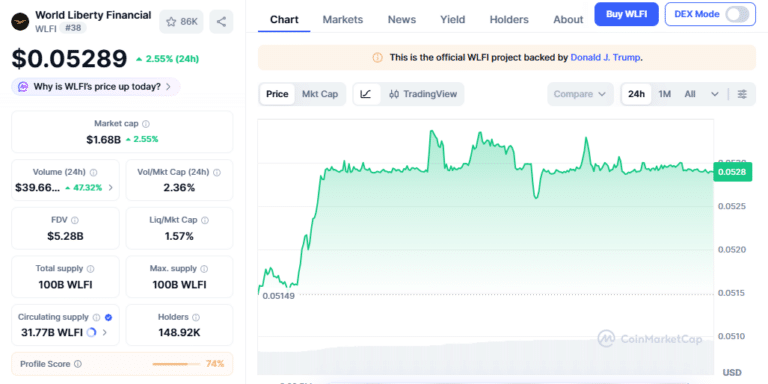
Notably, the news did not dent the token. Following the report, WLFI traded around $0.0528, up about 2.55% over 24 hours, according to data by CoinMarketCap — a reminder that governance-token markets can move on attention and speculation as much as on the substance of a headline. Figures are as of that reporting and move continuously.
The Bottom Line
The identification of Zhou intensifies a question that has followed World Liberty Financial since its launch: who is putting money into the president’s crypto venture, and how carefully is that money vetted. The core facts are that a $100 million investment came from a man under an active British money-laundering investigation, that he has not been charged, that its source is unclear, and that a large share reportedly benefited the Trump family, while World Liberty and the White House say nothing improper occurred. Those competing facts are unlikely to be resolved soon, but they feed directly into the ethics fight that will shape whether the CLARITY Act advances in September. This report makes no determination of wrongdoing by any party.
Also Read: Musk Backs Cloudflare AI Boom Forecast as Crypto Rails Monetize Bot Surge