Bitget, the Seychelles-based cryptocurrency exchange, says some wallet addresses used in its $351.6 million hack have been frozen by blockchain foundations. Customer withdrawals remain suspended, and no date has been set for their return. The update came from Chief Executive Officer (CEO) Gracy Chen on Friday, September 25, 2026, about 11 hours after the exchange detected the breach at 18:31 UTC on September 24.
Chen posted an English summary on X at 05:43:03 UTC on September 25, 2026, and a matching Chinese summary at 05:43:43 UTC. Both recapped a livestream of more than three hours that Bitget hosted on X after 22:26 UTC on September 24, 2026. Chen framed the post as a 12-hour progress note and said she was listing facts rather than general assurances.
Two New Networks on the Affected List
According to Chen’s update, the affected assets include Ether (ETH), XRP, BNB, Avalanche (AVAX), Tether (USDT), USD Coin (USDC) and other altcoins. She named seven affected networks: Ethereum, the XRP Ledger (XRPL), Arbitrum, Avalanche, Optimism, BNB Smart Chain (BSC) and Base.
Read: Bitget Hacked for $351.6M: Withdrawals Frozen as CEO Points to North Korea
Optimism and Base are layer-2 networks, which process transactions away from Ethereum’s main chain and settle them back on it. Neither was among the five chains Chen named during the first livestream. She did not say how much was taken on either network.
Chen again described the XRP Ledger as the largest single-chain loss. She said Bitget’s cold wallets, which are kept offline, remain secure on every affected chain.
Freezes Claimed, Not Itemized
Bitget has contacted the foundations behind every affected chain, Chen wrote. “A few have already frozen the hacker’s wallet addresses.”
She did not name the foundations, the addresses or the amounts frozen. The claim had not been independently confirmed on-chain at the time of writing.
The detail matters because of how the stolen funds have already moved. The attacker converted most stablecoins on Ethereum-compatible chains into ETH, which has no central issuer that can block transfers, as The Crypto Times reported earlier. Which assets sit in the frozen addresses will decide how much the freezes can recover.
Bitget said in its first security notice published at about 21:30 UTC on September 24 that it had flagged the receiving addresses and notified law enforcement and on-chain security firms.
No Withdrawal Window Yet
Withdrawals remain paused. Chen said the goal is a full restart as soon as possible and that Bitget will announce a window only after it is confirmed. “We will not commit to a timeline we cannot deliver,” she wrote. Deposits and trading remain open, as Bitget stated in its official notice.
In a technical update posted on X at 00:43:40 UTC on September 25, 2026, Chen said the attacker compromised a backend system in Bitget’s wallet infrastructure, used it to spoof transaction data, and triggered the exchange’s own authorization process to move funds out. She said private key compromise had been ruled out and that no further unauthorized transfers were possible.
Bitget has said a full incident report, including root-cause analysis, will be published within 24 hours of its first notice. That puts the deadline at about 21:30 UTC on September 25.
Chen also restated that Bitget Wallet, the company’s self-custody wallet app, runs on separate infrastructure from the exchange and was not affected.
BGB Down 3.3%
Bitget Token (BGB), the exchange’s native token used for trading fee discounts and platform benefits, was not on any stolen-asset list published overnight. The token still traded lower on Friday.
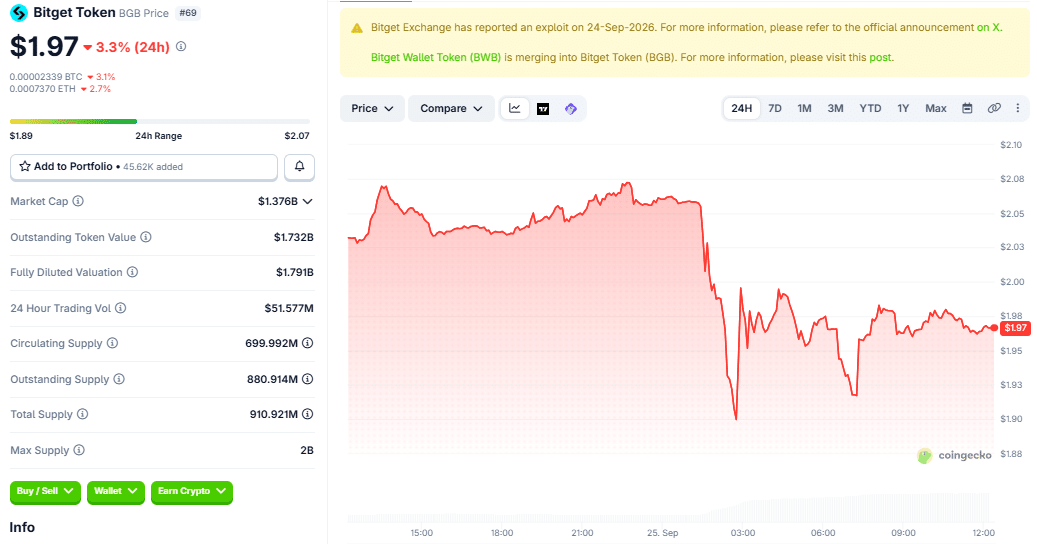
On CoinGecko, on Friday at 7:22 AM UTC, BGB traded at $1.97, down 3.3% over 24 hours, within a 24-hour range of $1.89 to $2.07. Its market capitalization stood at $1.376 billion, with $51.58 million in 24-hour trading volume. Circulating supply was 699.99 million BGB against a maximum supply of 2 billion.
CoinGecko has placed an alert on the token page noting that Bitget reported an exploit on September 24, 2026. The same banner notes that Bitget Wallet Token (BWB) is merging into BGB.
The 3.3% drop is small next to a $351.6 million breach. Most BGB trading still happens on Bitget, and with withdrawals closed, holders on the exchange cannot move the token elsewhere. BGB has not yet faced a full off-platform test.
Bybit CEO Offers to Help Trace Funds
Ben Zhou, co-founder and CEO of rival exchange Bybit, posted on X at 03:38:18 UTC, quoting Chen’s 00:43 UTC technical update. “Bybit team is standby to help in any ways that we can. Bitget helped us when we had the hack,” Zhou wrote.
Bybit lost about $1.5 billion in February 2025 in an attack the United States Federal Bureau of Investigation (FBI) attributed to North Korea. Zhou said Bybit is updating LazarusBounty, the bounty platform it launched after that hack to reward people who help trace and freeze stolen funds, to track the money taken from Bitget.
Where the Incident Stands
- Detection: 18:31 UTC, September 24, 2026
- First official notice: about 21:30 UTC, September 24
- Chen technical update: 00:43 UTC, September 25
- Zhou offers to help: 03:38 UTC, September 25
- Chen progress recap: 05:43 UTC, September 25
- Withdrawals: still paused
- Deposits and trading: still open
- Foundation freezes: claimed, not itemized
- Incident report: due by about 21:30 UTC, September 25
The figures and status in this report are as of 7:30 AM UTC on September 25, 2026. The next confirmed updates that would change the story are a named foundation freeze, a withdrawal restart time, and Bitget’s written incident report.
Also Read: Duelbits Hit by Suspected $4.3M Crypto Hack as Funds Shift to ETH