Key Highlights
- Standard Chartered initiated coverage of Chainlink with a $200 LINK price target for the end of 2030.
- The bank expects tokenized assets to reach $4 trillion by the end of 2028.
- Tokenized and crypto-native assets active in DeFi could reach $2.7 trillion by 2030, according to the report.
Standard Chartered, a British multinational bank, has initiated coverage of Chainlink (LINK), setting a $200 price target for the end of 2030 as the bank expects tokenization and decentralized finance (DeFi) to expand over the coming years.
In an X post on Monday, Chainlink contributor Zach Rynes highlighted the forecast, sharing the bank’s view that tokenized assets could become a $4 trillion market by the end of 2028.
The forecast represents Standard Chartered’s long-term assessment rather than a new Chainlink announcement. The bank’s report also identifies several risks, including slower institutional tokenization, competition from other providers, and technical setbacks.
The Crypto Times has reached out to Chainlink for comment on Standard Chartered’s $200 LINK price projection and has not received a response as of now.
Standard Chartered’s LINK forecast
The bank’s forecast puts LINK at 2026: $13, 2027: $41, 2028: $82, 2029: $133 and in 2030: $200.
Standard Chartered said its valuation is based partly on an expected increase in demand for infrastructure supporting tokenized assets and DeFi. The bank expects Chainlink’s fee generation to rise as financial assets and related activity move onchain.
However, the report does not suggest that growth in tokenized assets would automatically translate into a corresponding increase in LINK’s value. The connection depends on how Chainlink’s services are monetized and how its token economics develop alongside network usage.
LINK trades around $8.29
At the time of this writing, LINK was trading at around $8.29, with a market capitalization of approximately $6.2 billion, and 24-hour trading volume of about $224.38 million, according to CoinMarketCap data (as of 16:19 UTC).
The token had a circulating supply of roughly 748.09 million LINK out of a maximum supply of 1 billion, while its seven-day performance stood at approximately 0.63%.
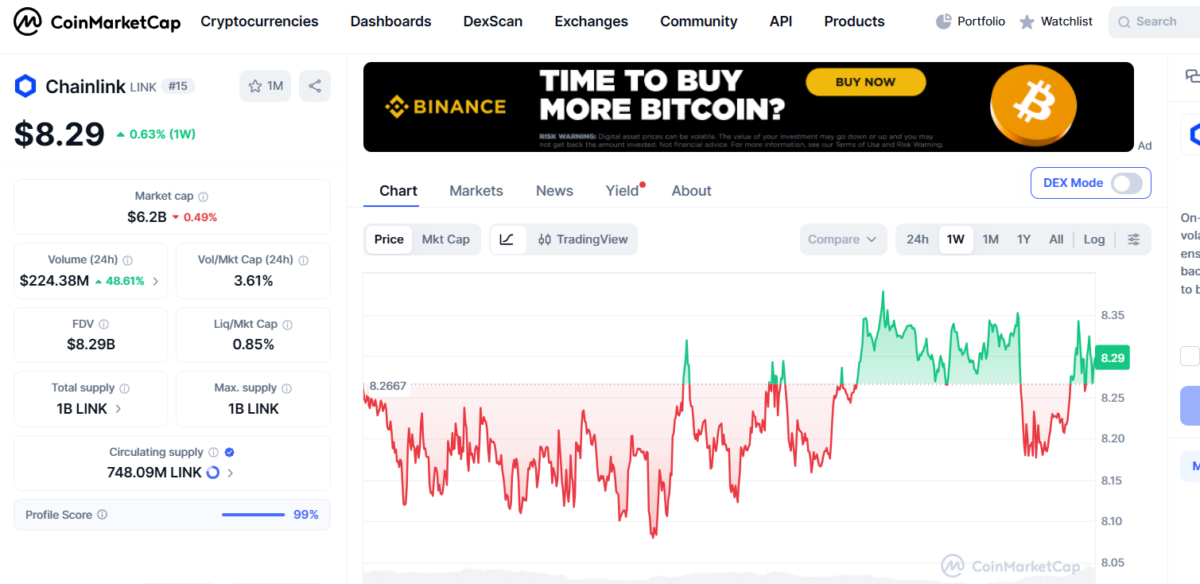
At the current price, Standard Chartered’s $200 LINK target for 2030 would require a substantial increase in value.
The target is therefore a long-term scenario based on the bank’s assumptions about tokenization, DeFi growth, and LINK’s ability to capture value from increased network activity.
Tokenized assets could reach $4 trillion
The broader thesis behind the forecast is Standard Chartered’s expectation that tokenization will expand rapidly. The bank estimates the value of tokenized assets at roughly $340 billion today and expects that figure to reach $4 trillion by the end of 2028.
The projection covers financial assets being represented and transferred through blockchain infrastructure, including tokenized securities and other real-world assets. Standard Chartered expects this market to require infrastructure for data feeds, interoperability between blockchains, compliance, and connections with traditional financial systems.
DeFi assets could grow 37 times
Standard Chartered also expects more tokenized and crypto-native assets to become active within DeFi. The bank projects that the value of those assets could reach $2.7 trillion by 2030, representing roughly a 37-fold increase from current levels.
The report links that expansion to increased demand for blockchain infrastructure, including market data and cross-chain connectivity. Whether those projections materialize will depend on how quickly financial institutions move beyond tokenization pilots and into larger-scale deployment.
Chainlink developments provide recent context
The Standard Chartered forecast comes after several recent Chainlink-related developments involving institutional and tokenized-asset infrastructure.
On August 5, Chainlink was involved in the launch of a Hong Kong Tokenized Securities Framework with participants including Cyberport, Apex Group, FORMS HK, and CSpro. The framework focuses on areas including interoperability, compliance, and infrastructure for tokenized securities.
A day earlier, BitGo selected Chainlink CCIP as part of a planned migration involving approximately $7.7 billion in WBTC.
These developments show the types of blockchain infrastructure activity that Standard Chartered’s report considers relevant to the longer-term growth of tokenization. They do not, however, establish that the bank’s $200 LINK forecast will be achieved.
Earlier Standard Chartered forecasts drew Uniswap debate
Standard Chartered’s broader tokenization and DeFi projections had already attracted attention in June.
On June 15, crypto commentator Niko wrote on X that Standard Chartered expected the value of tokenized assets active in DeFi to grow 37 times by 2030, while arguing that Uniswap could become a major liquidity venue.
The post sparked discussion over which protocols could capture activity from a larger tokenized market.
The earlier discussion is relevant to the latest Chainlink forecast because it highlights a broader question facing the sector: whether growth in tokenized markets will translate into value for the infrastructure and protocols serving them.
Chainlink’s market position
Standard Chartered estimates that Chainlink currently provides data infrastructure for around 70% of DeFi markets globally and more than 80% on Ethereum. The bank also cited more than $32 trillion in transaction value enabled through Chainlink infrastructure.
Its report argues that Chainlink has expanded beyond traditional oracle services into interoperability, compliance, and privacy-related infrastructure. Those areas could become more relevant if tokenized assets begin operating across multiple blockchain networks and connect more closely with traditional financial systems.
LINK forecast raises questions over value capture
Standard Chartered’s $200 LINK target also depends on how growth in Chainlink’s network activity translates into economic value for the token.
Greater use of Chainlink’s infrastructure does not automatically mean higher LINK demand or price appreciation. The forecast depends on the growth of tokenization and DeFi, Chainlink maintaining its position in the market, and increased network activity translating into economic value for LINK.
Standard Chartered also identified slower institutional adoption, competition, and technical setbacks as risks to its outlook.
For now, the $200 target remains a long-term bank forecast, with its outcome dependent on how tokenization develops and how much value Chainlink and LINK capture from that growth.
Also Read: SharpLink Posts $394M Q2 Loss, But ETH Treasury Remains Intact